Results by title
970 books match the query 'Movements' and 6 start with a non-letter
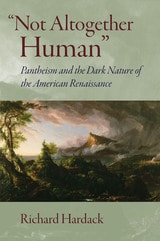
"Not Altogether Human"
Pantheism and the Dark Nature of the American RenaissanceRichard Hardack
University of Massachusetts Press, 2012
Many leading American thinkers in the nineteenth century, who accepted the premises of Emersonian transcendentalism, valued the basic concept of pantheism: that God inheres in nature and in all things, and that a person could achieve a sense of belonging she or he lacked in society by seeking a oneness with all of nature. As Richard Hardack shows, however, writers such as Ralph Waldo Emerson, Nathaniel Hawthorne, and Herman Melville conceived of nature as everything “Other”—other than the white male Protestant culture of which they were a part. This conception of nature, then, became racialized, and the divine became associated with African American and Native American identities, as well as with femininity.
In "Not Altogether Human," Hardack reevaluates transcendentalism in the context of nineteenth-century concerns about individual and national racial identity. Elucidating the influence of pantheism, Hardack draws on an array of canonical and unfamiliar materials to remap the boundaries of what has long been viewed as white male transcendental discourse.
This book significantly revises notions of what transcendentalism and pantheism mean and how they relate to each other. Hardack's close analysis of pantheism and its influence on major works and lesser known writing of the nineteenth century opens up a new perspective on American culture during this key moment in the country's history.

"The Useless Mouths" and Other Literary Writings
Simone de Beauvoir; Edited by Margaret A. Simons and Marybeth Timmermann; Foreword by Sylvie Le Bon de Beauvoir
University of Illinois Press, 2021
The volume begins with a new translation of the 1945 play The Useless Mouths, written in Paris during the Nazi occupation. Other pieces were discovered after Beauvoir's death in 1986, such as the 1965 short novel "Misunderstanding in Moscow," involving an elderly French couple who confront their fears of aging. Two additional previously unknown texts include the fragmentary "Notes for a Novel," which contains the seed of what she later would call "the problem of the Other," and a lecture on postwar French theater titled Existentialist Theater. The collection notably includes the eagerly awaited translation of Beauvoir's contribution to a 1965 debate among Jean-Paul Sartre and other French writers and intellectuals, "What Can Literature Do?"
Prefaces to well-known works such as Bluebeard and Other Fairy Tales,La Bâtarde, and James Joyce in Paris: His Final Years are also available in English for the first time, alongside essays and other short articles. A landmark contribution to Beauvoir studies and French literary studies, the volume includes informative and engaging introductory essays by prominent and rising scholars.
Contributors are Meryl Altman, Elizabeth Fallaize, Alison S. Fell, Sarah Gendron, Dennis A. Gilbert, Laura Hengehold, Eleanore Holveck, Terry Keefe, J. Debbie Mann, Frederick M. Morrison, Catherine Naji, Justine Sarrot, Liz Stanley, Ursula Tidd, and Veronique Zaytzeff.
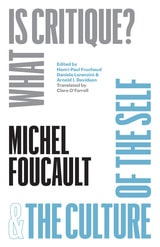
"What Is Critique?" and "The Culture of the Self"
Michel Foucault
University of Chicago Press, 2024
Newly published lectures by Foucault on critique, Enlightenment, and the care of the self—now in paperback.
On May 27, 1978, Michel Foucault gave a lecture to the French Society of Philosophy where he redefined his entire philosophical project in light of Immanuel Kant’s 1784 text “What Is Enlightenment?” Foucault strikingly characterizes critique as the political and moral attitude consisting in the “art of not being governed like this,” one that performs the function of destabilizing power relations and creating the space for a new formation of the self within the “politics of truth.”
This volume presents the first critical edition of this crucial lecture alongside a previously unpublished lecture about the culture of the self and three public debates with Foucault at the University of California, Berkeley, in April 1983. There, for the first time, Foucault establishes a direct connection between his reflections on the Enlightenment and his analyses of Greco-Roman antiquity. However, far from suggesting a return to the ancient culture of the self, Foucault invites his audience to build a “new ethics” that bypasses the traditional references to religion, law, and science.

#Triggered
Social Media, Subjectivity, and the Struggle for Safe SpaceSean Johnson Andrews
University of Michigan Press, 2027
In this time of social crisis and revolutionary change, words have become one of the key sites of social struggle. Using a framework informed by trans studies, critical race theory, and digital media studies, #Triggered looks at the peak period of progressive social media activism in the U.S. and argues that it is primarily a struggle over whether it is safe for each of us to be ourselves, openly, publicly, proudly, and without permission from the dominant culture.
The term “triggered” and the concept of the trigger warning are just two of many emergent sites of struggle. This book provides a contextual, theoretical history to consider them alongside movements like #BlackLivesMatter, #MeToo, and #TimesUp and concepts like cultural appropriation, “cancel culture,” and safe spaces. These on- and offline struggles have transformed the way we talk, the words we use, and the dominant cultural conversation of race, gender, sexuality, police violence, trauma, and equity. And yet the status quo is still one where marginalized individuals are made to fear for their lives if they do not exhibit the appropriate care and deference. #Triggered invites readers to consider the legitimate complaints about oppressive systems underlying this social crisis, the hierarchy of traumas and subjectivity these movements are opposing, and the opportunity to develop a more open and less repressive society and culture.
1650-1850
Ideas, Aesthetics, and Inquiries in the Early Modern Era (Volume 27)Kevin L. Cope
Bucknell University Press, 2022
ISSN 1065-3112
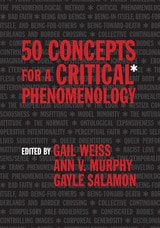
50 Concepts for a Critical Phenomenology
Edited by Gail Weiss, Ann V. Murphy, and Gayle Salamon
Northwestern University Press, 2020
Phenomenology, the philosophical method that seeks to uncover the taken-for-granted presuppositions, habits, and norms that structure everyday experience, is increasingly framed by ethical and political concerns. Critical phenomenology foregrounds experiences of marginalization, oppression, and power in order to identify and transform common experiences of injustice that render “the familiar” a site of oppression for many. In Fifty Concepts for a Critical Phenomenology, leading scholars present fresh readings of classic phenomenological topics and introduce newer concepts developed by feminist theorists, critical race theorists, disability theorists, and queer and trans theorists that capture aspects of lived experience that have traditionally been neglected. By centering historically marginalized perspectives, the chapters in this book breathe new life into the phenomenological tradition and reveal its ethical, social, and political promise. This volume will be an invaluable resource for teaching and research in continental philosophy; feminist, gender, and sexuality studies; critical race theory; disability studies; cultural studies; and critical theory more generally.