Results by title
227 books match the query 'New England (CT, MA, ME, NH, RI, VT)' and 3 start with a non-letter
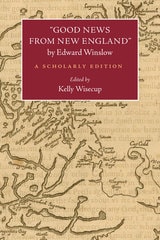
"Good News from New England" by Edward Winslow
A Scholarly EditionKelly Wisecup
University of Massachusetts Press, 2014
First published in 1624, Edward Winslow's Good News from New England chronicles the early experience of the Plimoth colonists, or Pilgrims, in the New World. For several years Winslow acted as the Pilgrims' primary negotiator with New England Algonquians, including the Wampanoag, Massachusett, and Narragansett Indians. During this period he was credited with having cured the Wampanoag sachem Massasoit, one of the colonists' most valuable allies, of an apparently life-threatening illness, and he also served as the Pilgrims' chief agent in England.
It was in the context of all of these roles that Winslow wrote Good News in an attempt to convince supporters in England that the colonists had established friendly relations with Native groups and, as a result, gained access to trade goods. Although clearly a work of diplomacy, masking as it did incidents of brutal violence against Indians as well as evidence of mutual mistrust, the work nevertheless offers, according to Kelly Wisecup, a more complicated and nuanced representation of the Pilgrims' first years in New England and of their relationship with Native Americans than other primary documents of the period.
In this scholarly edition, Wisecup supplements Good News with an introduction, additional primary texts, and annotations to bring to light multiple perspectives, including those of the first European travelers to the area, Native captives who traveled to London and shaped Algonquian responses to colonists, the survivors of epidemics that struck New England between 1616 and 1619, and the witnesses of the colonists' attack on the Massachusetts.
[more]
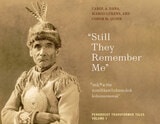
"Still They Remember Me"
Penobscot Transformer Tales, Volume 1Carol A. Dana, Margo Lukens, and Conor M. Quinn
University of Massachusetts Press, 2021
Newell Lyon learned the oral tradition from his elders in Maine's Penobscot Nation and was widely considered to be a "raconteur among the Indians." The thirteen stories in this new volume were among those that Lyon recounted to anthropologist Frank Speck, who published them in 1918 as Penobscot Transformer Tales. Transcribed for the first time into current Penobscot orthography and with a new English translation, this instructive and entertaining story cycle focuses on the childhood and coming-of-age of Gluskabe, the tribe's culture hero. Learning from his grandmother Woodchuck, Gluskabe applies lessons that help shape the Wabanaki landscape and bring into balance all the forces affecting human life. These tales offer a window into the language and culture of the Penobscot people in the early twentieth century.
In "Still They Remember Me," stories are presented in the Penobscot language and English side-by-side, coupled with illustrations from members of the tribal community. For the first time, these stories are accessible to a young generation of Penobscot language learners and scholars of Native American literatures at all levels, from grade school to graduate school.
In "Still They Remember Me," stories are presented in the Penobscot language and English side-by-side, coupled with illustrations from members of the tribal community. For the first time, these stories are accessible to a young generation of Penobscot language learners and scholars of Native American literatures at all levels, from grade school to graduate school.
[more]
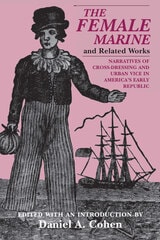
"The Female Marine" and Related Works
Narratives of Cross-Dressing and Urban Vice in America's Early RepublicDaniel A. Cohen
University of Massachusetts Press, 1997
This is the first complete modern edition of The Female Marine, a fictional cross-dressing trilogy originally published between 1815 and 1818. Enormously popular among New England readers, the tale in various versions appeared in no fewer than nineteen editions over that brief four-year span. This new edition appends three other contemporary accounts of cross-dressing and urban vice which, together with The Female Marine, provide a unique portrayal of prostitution and interracial city life in early-nineteenth-century America.
The alternately racy and moralistic narrative recounts the adventures of a young woman from rural Massachusetts who is seduced by a false-hearted lover, flees to Boston, and is entrapped in a brothel. She eventually escapes by disguising herself as a man and serves with distinction on board the U.S. frigate Constitution during the War of 1812. After subsequent onshore adventures in and out of male dress, she is happily married to a wealthy New York gentleman.
In his introduction, Daniel A. Cohen situates the story in both its literary and historical contexts. He explains how the tale draws upon a number of popular Anglo-American literary genres, including the female warrior narrative, the sentimental novel, and the urban exposé. He then explores how The Female Marine reflects early-nineteenth-century anxieties concerning changing gender norms, the expansion of urban prostitution, the growth of Boston's African American community, and feelings of guilt aroused by New England's notoriously unpatriotic activities during the War of 1812.
[more]