Results by title
114 books match the query 'Other Stories' and 4 start with a non-letter
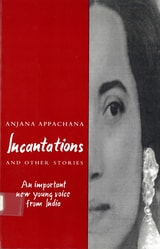
"Incantations" and Other Stories
An Important New Young Voice From IndiaAppachana, Anjana
Rutgers University Press, 1992
This first collection of fiction by Anjana Appachana provides stories that are beautifully written, the characters in them carefully and respectfully drawn. All the stories are set in India, but the people in them seem somehow displaced within their own society—a society in transition but a transition that does not come fast enough to help them. Appachana manages to capture the pervasive humor, poignancy, and self-delusion of the lives of the people she observes, but she does so without seeming to pass judgments on them. She focuses on unexpected moments, as if catching her characters off guard, lovingly exposing the fragile surfaces of respectability and convention that are so much a part of every society, but particularly strong in India, with its caste system, gender privileges, and omnipresent bureaucracies.
All life seems to be prescribed; these characters bravely or cautiously confront the rules and regulations or finally give in to them resignedly—any small triumphs they achieve are never clear-cut. One of the most unusual aspects of many of the stories is the way in which they are informed by but never ruled by the author's feminism. She never lectures her readers but lets us see for ourselves: a bride caught in a hopeless marriage where she has given up all rights to any life of her own, a hapless college student who is confined to campus for minor infractions just at the time when she had an appointment for an abortion, a young girl who keeps the dark secret of her sister's rape, a woman executive and a digruntled male clerk both trapped in the intricate bureaucracy of their business firm and the roles they must play to survive there. By turns warm, gullible, arrogant and bigoted, all of these characters live their lives amid contradictions and double standards, superstitions and impossible dreams. Appachana's vision is unique, her writing superb. Readers will thank her for allowing them to enter territory that is at once distant and exotic but also familiar and recognizable.
All life seems to be prescribed; these characters bravely or cautiously confront the rules and regulations or finally give in to them resignedly—any small triumphs they achieve are never clear-cut. One of the most unusual aspects of many of the stories is the way in which they are informed by but never ruled by the author's feminism. She never lectures her readers but lets us see for ourselves: a bride caught in a hopeless marriage where she has given up all rights to any life of her own, a hapless college student who is confined to campus for minor infractions just at the time when she had an appointment for an abortion, a young girl who keeps the dark secret of her sister's rape, a woman executive and a digruntled male clerk both trapped in the intricate bureaucracy of their business firm and the roles they must play to survive there. By turns warm, gullible, arrogant and bigoted, all of these characters live their lives amid contradictions and double standards, superstitions and impossible dreams. Appachana's vision is unique, her writing superb. Readers will thank her for allowing them to enter territory that is at once distant and exotic but also familiar and recognizable.
[more]

"Tecumseh" and Other Stories of the Ohio River Valley by Julia L. Dumont
Of The Ohio River ValleySandra Parker
University of Wisconsin Press, 2000
Julia Louisa Corry Dumont (1794–1857) was born in Marietta, Ohio. Heralded in her own day as the “first lady” of the Ohio River Valley, she wrote about the lives of ordinary pioneers and settlers when the area was still known as the West. Her early romantic style was typical of the era, depicting river boatmen and Native Americans like Tecumseh. Her stories represent village life and women’s plight as victims, as in her masterpiece Aunt Hetty.
[more]
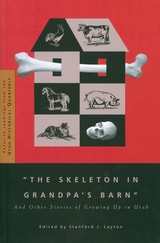
"The Skeleton in Grandpa's Barn"
And Other Stories of Growing Up in UtahStanford J. Layton
Signature Books, 2008
The loft of Grandpa’s barn in Salt Lake City was “off limits,” the trap door padlocked. For boys like Zack Lund, Grandpa might as well have hung out a large “welcome” sign inviting them to break in and see what was hidden there. In Parowan, young Nevada Driggs decided to discover for himself whether Captain Fremont had really slept in his grandma’s bed. Fae Decker Dix tells of how her father refused to accept the church’s newly censored version of a nineteenth-century hymn. To her embarrassment, he sang the original hellfire lyrics to O Ye Mountains High as loudly as he could above the rest of the congregation. All told, this new anthology features sixteen priceless stories: quirky and fun, informative and serious, but all engaging—nostalgic for when Utah was little more than a wide spot in the road, or as Robert Mikkelsen remembers, when both sides of the tracks were the “wrong side.”
[more]
“The Sting of Death” and Other Stories
Shimao Toshio; Translated with an Introduction and Interpretive Comments by Kathryn Sparling
University of Michigan Press, 1985
Until a recent “boom,” Shimao Toshio, writer of short fiction, critic, and essayist, was not widely known, even in Japan. He has never won the Akutagawa or the Naoki Prize, and none of his works had previously appeared in English translation. He is less well known than other writers (Yasuoka Shotaro, Kojima Nobuo, and Shono Junzo) with whom he has associated and whose works have been liberally translated into English. Yet, there are those who consider him to be one of the best contemporary writers in Japan.
This volume by no means exhausts the scope of Shimao's fiction. There are no stories here, for instance, about childhood or student life, and none of his many travel stories. Some of his most famous stories-- "When we Never Left Port," for example--have not been included. But the stories presented here do offer a considerable variety of style, from the pristine storybook language of "The Farthest Edge of the Islands," to the young intellectual's jargon of "Everyday Life in a Dream," to the visionary, hysterical, occasionally ritualistic prose of the "sick wife" stories, to the sober, difficult, almost ponderous narration of "This Time That Summer." Shimao's approach to his material varies as well. "Everyday Life in a Dream" is the only representative here of a large number of stories usually called surrealistic by the critics, stories whose plots progress by the logic of dreams. The individual experience of real life are lived through a combination of conscious and unconscious perception. These stories are the least approachable and the least charming to the casual reader, but they serve, among other things, to highlight patterns in the more realistic fiction. "The Farthest Edge of the Islands" is a symbolic heightening of reality in another way, a romantic fairy tale beginning at the extremity of experience, at the farthest edge of the world. The other stories are presented as precise, close chronicles of reality by a participant in that reality whose attention never waivers and who never allows himself to avert his eyes from a world that he sees as his responsibility and in a sense his fault. All but the first story, "The Farthest Edge of the Islands," which is in third-person narration, are told in the first person by the character who plays Shimao's role in the life that inspired the fiction.
[more]