Results by title
1148 books match the query 'Political Ideologies' and 11 start with a non-letter

"A Road to Peace and Freedom"
The International Workers Order and the Struggle for Economic Justice and Civil Rights, 1930-1954Robert M. Zecker
Temple University Press, 2017
Mining extensive primary sources, Robert Zecker gives voice to the workers in “A Road to Peace and Freedom.” He describes the group's economic goals, commitment to racial justice, and activism, from lobbying to end segregation and lynching in America to defeating fascism abroad. Zecker also illustrates the panoply of entertainment, sports, and educational activities designed to cultivate the minds and bodies of members.
However, the IWO was led by Communists, and the Order was targeted for red-baiting during the Cold War, subject to government surveillance, and ultimately "liquidated." Zecker explains how the dismantling of the IWO and the general suppression of left-wing dissenting views on economic egalitarianism and racial equality had deleterious effects for the entire country. Moreover, Zecker shows why the sobering lesson of the IWO remains prescient today.
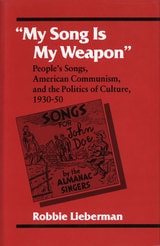
"My Song Is My Weapon"
People's Songs, American Communism, and the Politics of Culture, 1930-50Robbie Lieberman
University of Illinois Press, 1989
"To Serve a Larger Purpose"
Engagement for Democracy and the Transformation of Higher EducationEdited by John Saltmarsh and Matthew Hartley
Temple University Press, 2012
"To Serve a Larger Purpose" calls for the reclamation of the original democratic purposes of civic engagement and examines the requisite transformation of higher education required to achieve it. The contributors to this timely and relevant volume effectively highlight the current practice of civic engagement and point to the institutional change needed to realize its democratic ideals.
Using multiple perspectives, "To Serve a Larger Purpose" explores the democratic processes and purposes that reorient civic engagement to what the editors call "democratic engagement." The norms of democratic engagement are determined by values such as inclusiveness, collaboration, participation, task sharing, and reciprocity in public problem solving and an equality of respect for the knowledge and experience that everyone contributes to education, knowledge generation, and community building. This book shrewdly rethinks the culture of higher education.

(Mis)Understanding the Other Side
How Americans Explain Opposing Political ViewsMatthew V. Hibbing, Matthew Mettler, Jeffery J. Mondak, and Isaiah R. Raynal
Temple University Press, 2027
A genuine understanding of politics requires us to accept that even those with whom we disagree may have a reasoned basis for their preferences. Acknowledgment of the existence and legitimacy of opposing perspectives may help people with ingrained political differences communicate better and develop more thoughtful and informed rationales for their own opinions. (Mis)Understanding the Other Side analyzes Americans’ ability to recognize and understand dissenting views, a necessary step if we are to reduce partisan polarization and be more effective citizens.
The authors conducted a national survey of 2500 Americans to gauge people’s political motivations and their views on major political issues. The respondents were also asked to explain the rationale for “the other side.” Exploration of respondents’ own words and subsequent statistical analyses combine to show how well people articulate their own issue rationales and the extent to which they understand, and are receptive to, opposing positions.
(Mis)Understanding the Other Side identifies severe limitations in how and how well Americans explain both their own positions and those of people who disagree with them. The authors highlight the challenges these limitations pose for effective citizenship and point to strategies that may foster better understanding across lines of political difference.
(New) Fascism
Contagion, Community, MythNidesh Lawtoo
Michigan State University Press, 2019

100 Years of Permanent Revolution
Results and ProspectsEdited by Bill Dunn and Hugo Radice
Pluto Press, 2006
One hundred years after their first appearance in Leon Trotsky's Results and Prospects, this book critically reevaluates two key Marxist theories: uneven and combined development, and permanent revolution. It brings together a formidable array of Marxist intellectuals from across the world including Daniel Bensaid, Michael Löwy, Hillel Ticktin and Patrick Bond.
Marx saw societies progressing through distinct historical stages feudal, bourgeois and communist. Trotsky advanced this model by considering how countries at different stages of development influence each other. Developed countries colonise less developed countries and exploit their people and resources. Elsewhere, even as many were kept in poverty, the influence of foreign capital and state-led industrialisation produced novel economic forms and prospects for political alliances and change. The contributors show how, 100 years on from its original publication, Trotsky's theories are hugely useful for understanding today's globalised economy, dominated by US imperialism. The book makes an ideal introduction to Trosky's thinking, and is ideal for students of political theory and development economics.
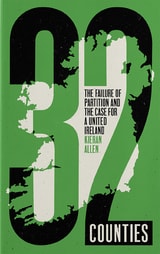
32 Counties
The Failure of Partition and the Case for a United IrelandKieran Allen
Pluto Press, 2021
'This is Irish history seen anew, from below, bristling with practical lessons for working-class struggle today' - Eamonn McCann
The 32 counties of Ireland were divided through imperial terror and gerrymandering. Partition was borne from a Tory strategy to defend the British Empire and has spawned a 'carnival of reaction' in Irish politics ever since. Over the last 100 years, conservative forces have dominated both states offering religious identity as a diversion from economic failures and inequality.
Through a sharp analysis of the history of partition, Kieran Allen rejects the view that the 'two cultures' of Catholic and Protestant communities lock people into permanent antagonism. Instead, the sectarian states have kept its citizens divided through political and economic measures like austerity, competition for reduced services and low wages.
Overturning conventional narratives, 32 Counties evokes the tradition of James Connolly and calls for an Irish unity movement from below to forge the North and the Republic into a secular, socialist and united Ireland.
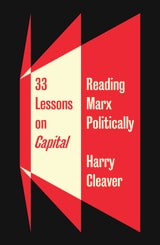
33 Lessons on Capital
Reading Marx PoliticallyHarry Cleaver
Pluto Press, 2019
Harry Cleaver's treatise outlines and critiques Marx's analysis chapter by chapter. His unique interpretation of Marx's labour theory of value reveals how every theoretical category of Capital designates aspects of class struggle in ways that help us resist and escape them. At the same time, while rooted within the tradition of workerism, he understands the working class to include not only the industrial proletariat but also unwaged peasants, housewives, children and students.
A challenge to scholars and an invaluable resource for students and activists today.

“Good Mothers”, Nations and Nationalisms
Cases from Lithuania, Russia and SwedenYulia Gradskova
Central European University Press, 2026

“Sing for the Pro-Palestinian Student Activists.” A Commencement Speech and the Fight to Protect the Freedom of Expression
Rebekah Modrak
Disobedience Press, 2026
Sing for the pro-Palestinian student activists who have, over these past two years, opened our hearts to the injustice and inhumanity of Israel’s war in Gaza.
This single sentence, concluding a brief commencement address by the University of Michigan’s Faculty Senate Chair, ignited a controversy that simmered for weeks. Professor Derek Peterson had praised the work of female, Jewish, and Black activists who had fought for inclusion, ending with a shoutout to students who protested the university’s financial ties to Israel’s war on Gaza.
Hours later, U-M President Domenico Grasso publicly apologized, calling the remarks “hurtful and insensitive.” Peterson faced a barrage of threatening hate mail, alongside demands that he be fired and the university defunded. Conversely, a chorus of passionate dissent argued that a college education should equip students for, not shield them from, sharp controversies.
This volume collects commentary from students, alumni, labor organizers, and faculty. Most, but not all, defend Peterson’s right to say what he said, reflecting on questions of academic freedom, repressive notions of what is “appropriate,” the institution’s traditions of moral courage, the danger of assuming a monolithic “Jewish community,” and the Palestine exception to free speech.
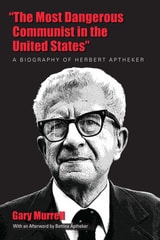
“The Most Dangerous Communist in the United States”
A Biography of Herbert ApthekerGary Murrell
University of Massachusetts Press, 2015
When J. Edgar Hoover declared Herbert Aptheker “the most dangerous Communist in the United States,” the notorious FBI director misconstrued his true significance. In this first book-length biography of Aptheker (1915–2003), Gary Murrell provides a balanced yet unflinching assessment of the controversial figure who was at once a leading historian of African America, radical political activist, literary executor of W. E. B. Du Bois, and lifelong member of the American Communist Party. Although blacklisted at U.S. universities, Aptheker published dozens of books, including the groundbreaking American Negro Slave Revolts (1943) and the monumental seven-volume Documentary History of the Negro People (1951–1994). He also edited four volumes of the correspondence and unpublished writings of Du Bois, an achievement that Eric Foner, writing in the New York Times Book Review, called “a milestone in the coming of age of Afro-American history.”
As Murrell shows, Aptheker the historian was inseparable from Aptheker the leading Communist Party intellectual, polemicist, and agitator. During the 1960s, his ability to rouse and inspire both black and white student radicals made him one of the few Old Leftists accepted by the New Left. Aptheker had joined the CPUSA during its heyday in the 1930s, convinced that only through the party's leadership could fascism be defeated and true liberation be achieved: he ended his affiliation five decades later in 1991 after the collapse of socialism in the Soviet Union and Eastern Europe.
In an afterword, Bettina Aptheker adds to Murrell's narrative by illuminating her mother Fay's vital contributions to her father's work and by affirming the particularly devastating challenges of life in a family dedicated to radical political and social change.