Results by title
1668 books match the query 'Popular culture' and 10 start with a non-letter
"It Was Play or Starve"
Acting in the Nineteenth-Century American Popular TheatreJohn Hanners
University of Wisconsin Press, 1993
"Tecumseh" and Other Stories of the Ohio River Valley by Julia L. Dumont
Of The Ohio River ValleySandra Parker
University of Wisconsin Press, 2000
"Theatricals of Day"
Emily Dickinson and Nineteenth-Century American Popular CultureSandra Runzo
University of Massachusetts Press, 2019
In her own private ways, Emily Dickinson participated in the popular entertainments of her time. On her piano, she performed popular musical numbers, many from the tradition of minstrelsy, and at theaters, she listened to famous musicians, including Jenny Lind and, likely, the Hutchinson Family Singers. In reading the Atlantic Monthly, the Springfield Republican, and Harper's, she kept up with the roiling conflicts over slavery and took in current fiction and verse. And, she enjoyed the occasional excursion to the traveling circus and appreciated the attractions of the dime museum. Whatever her aspirations were regarding participation in a public arena, the rich world of popular culture offered Dickinson a view of both the political and social struggles of her time and the amusements of her contemporaries.
“Theatricals of Day” explores how popular culture and entertainments are seen, heard, and felt in Dickinson's writing. In accessible prose, Sandra Runzo proposes that the presence of popular entertainment in Dickinson's life and work opens our eyes to new dimensions of the poems, illuminating the ways in which the poet was attentive to strife and conflict, to amusement, and to play.
"There Is a North"
Fugitive Slaves, Political Crisis, and Cultural Transformation in the Coming of the Civil WarJohn L. Brooke
University of Massachusetts Press, 2019
How does political change take hold? In the 1850s, politicians and abolitionists despaired, complaining that the "North, the poor timid, mercenary, driveling North" offered no forceful opposition to the power of the slaveholding South. And yet, as John L. Brooke proves, the North did change. Inspired by brave fugitives who escaped slavery and the cultural craze that was Uncle Tom's Cabin, the North rose up to battle slavery, ultimately waging the bloody Civil War.
While Lincoln's alleged quip about the little woman who started the big war has been oft-repeated, scholars have not fully explained the dynamics between politics and culture in the decades leading up to 1861. Rather than simply viewing the events of the 1850s through the lens of party politics, “There Is a North” is the first book to explore how cultural action—including minstrelsy, theater, and popular literature—transformed public opinion and political structures. Taking the North's rallying cry as his title, Brooke shows how the course of history was forever changed.
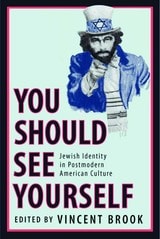
'You Should See Yourself'
Jewish Identity in Postmodern American CultureBrook, Vincent
Rutgers University Press, 2006
The past few decades have seen a remarkable surge in Jewish influences on American culture. Entertainers and artists such as Jerry Seinfeld, Adam Sandler, Allegra Goodman, and Tony Kushner have heralded new waves of television, film, literature, and theater; a major klezmer revival is under way; bagels are now as commonplace as pizza; and kabbalah has become as cool as crystals. Does this broad range of cultural expression accurately reflect what it means to be Jewish in America today?
Bringing together fourteen new essays by leading scholars, You Should See Yourself examines the fluctuating representations of Jewishness in a variety of areas of popular culture and high art, including literature, the media, film, theater, music, dance, painting, photography, and comedy. Contributors explore the evolution that has taken place within these cultural forms and how we can best explain these changes. Are variations in our understanding of Jewishness the result of general phenomena such as multiculturalism, politics, and postmodernism, or are they the product of more specifically Jewish concerns such as the intermarriage/continuity crisis, religious renewal, and relations between the United States and Israel?
Accessible to students and general readers alike, this volume takes an important step toward advancing the discussion of Jewish cultural influences in this country.
1980
America's Pivotal YearJim Cullen
Rutgers University Press, 2023
1980 was a turning point in American history. When the year began, it was still very much the 1970s, with Jimmy Carter in the White House, a sluggish economy marked by high inflation, and the disco still riding the airwaves. When it ended, Ronald Reagan won the presidency in a landslide, inaugurating a rightward turn in American politics and culture. We still feel the effects of this tectonic shift today, as even subsequent Democratic administrations have offered neoliberal economic and social policies that owe more to Reagan than to FDR or LBJ. To understand what the American public was thinking during this pivotal year, we need to examine what they were reading, listening to, and watching.
1980: America's Pivotal Year puts the news events of the era—everything from the Iran hostage crisis to the rise of televangelism—into conversation with the year’s popular culture. Separate chapters focus on the movies, television shows, songs, and books that Americans were talking about that year, including both the biggest hits and some notable flops that failed to capture the shifting zeitgeist. As he looks at the events that had Americans glued to their screens, from the Miracle on Ice to the mystery of Who Shot J.R., cultural historian Jim Cullen garners surprising insights about how Americans’ attitudes were changing as they entered the 1980s.
Praise for Jim Cullen's previous Rutgers University Press books:
"Informed and perceptive" —Norman Lear on Those Were the Days: Why All in the Family Still Matters
"Jim Cullen is one of the most acute cultural historians writing today." —Louis P. Masur, author of The Sum of Our Dreams on Martin Scorsese and the American Dream
"This is a terrific book, fun and learned and provocative....Cullen provides an entertaining and thoughtful account of the ways that we remember and how this is influenced and directed by what we watch." —Jerome de Groot, author of Consuming History on From Memory to History

50+ Fandom Programs
Planning Festivals and Events for Tweens, Teens, and AdultsAmy Alessio
American Library Association, 2017

5000 Years of Popular Culture
Popular Culture before PrintingFred E.H. Schroeder
University of Wisconsin Press, 1980
Its first purpose is to broaden the study of popular culture which is too often regarded in the academic world as the entertainment and leisure time activities of the 20th century. Second, the collection gives recognition to the fact that a number of disciplines have been investigating popular phenomena on different fronts, and it is designed to bring examples of these disciplines together under the common rubric of “popular culture.” Related to this is a third purpose of providing instances of original and innovative interdisciplinary approaches. Last, the collection should be a worthwhile contribution to the component disciplines as well as to the study of popular culture.
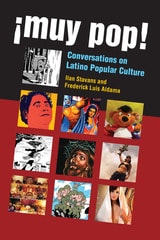
¡Muy Pop!
Conversations on Latino Popular CultureIlan Stavans and Frederick Luis Aldama
University of Michigan Press, 2013
Although investigations of Hispanic popular culture were approached for decades as part of folklore studies, in recent years scholarly explorations—of lucha libre, telenovelas, comic strips, comedy, baseball, the novela rosa and the detective novel, sci-fi, even advertising—have multiplied. What has been lacking is an overarching canvas that offers context for these studies, focusing on the crucial, framing questions: What is Hispanic pop culture? How does it change over time and from region to region? What is the relationship between highbrow and popular culture in the Hispanic world? Does it make sense to approach the whole Hispanic world as homogenized when understanding Hispanic popular culture? What are the differences between nations, classes, ethnic groups, religious communities, and so on? And what distinguishes Hispanic popular culture in the United States?
In ¡Muy Pop!, Ilan Stavans and Frederick Luis Aldama carry on a sustained, free-flowing, book-length conversation about these questions and more, concentrating on a wide range of pop manifestations and analyzing them at length. In addition to making Hispanic popular culture visible to the first-time reader, ¡Muy Pop! sheds new light on the making and consuming of Hispanic pop culture for academics, specialists, and mainstream critics.
“Here, There and Everywhere”
The Foreign Politics of American Popular CultureEdited by Reinhold Wagnleitner and Elaine Tyler May
University Press of New England, 2000