Results by title
1095 books match the query 'Rhetoric' and 5 start with a non-letter
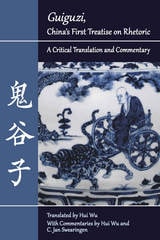
"Guiguzi," China's First Treatise on Rhetoric
A Critical Translation and CommentaryTranslated by Hui Wu / With Commentaries by Hui Wu and C. Jan Swearingen
Southern Illinois University Press, 2016
Wu’s translation includes footnotes that incorporate both past and present scholarly commentary, and is accompanied by a prefatory introduction that situates Guiguzi in the sociopolitical and cultural realities of ancient China, and a glossary of rhetorical terms used in the treatise. Swearingen presents a comparative study suggesting the similarities and differences between emerging Greek and Chinese rhetorics during the same period, including the cultural contexts of warring states and emergent empires that surrounded each.
“Guiguzi,” China’s First Treatise on Rhetoric combines a new translation of a historically significant text with scholarly analysis and critical apparatus that will contribute to the emerging global understanding of Chinese rhetoric and communication.
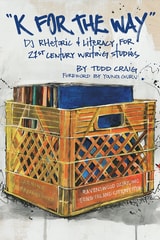
"K for the Way"
DJ Rhetoric and Literacy for 21st Century Writing StudiesTodd Craig
Utah State University Press, 2023
Using material from a larger qualitative research study that illustrates the Hip Hop DJ as a twenty-first-century new media reader, writer, and literary critic, Craig blends interviews from prominent and influential DJs in the Hip Hop community with narrative and interdisciplinary scholarship from writing studies, Hip Hop studies, African American studies, urban education, and ethnomusicology. The voices of DJs sit front and center, presenting a revolutionary conversation about writing and communication in the twenty-first century.
Weaving Craig’s life experiences with important discussions of racial literacies, “K for the Way” is a layered and utterly singular exploration of culture, identity, and literacy in America.
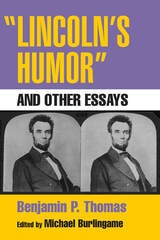
"Lincoln's Humor" and Other Essays
Benjamin P. Thomas. Edited by Michael Burlingame
University of Illinois Press, 2006
A skilled historian and a masterful storyteller himself, Thomas was widely regarded as the greatest Lincoln historian of his generation. With these essays, he combines historical depth with narrative grace in delineating Lincoln's qualities as a humorist, lawyer, and politician. From colorful tall tales to clever barbs aimed at political opponents, Lincoln clothed a shrewd wit in a homespun, backwoods vernacular. He used humor to defuse tension, illuminate a point, put others at ease--and sometimes for sheer fun. From an early reliance on broad humor and ridicule in speeches and on the stump, Lincoln's style shifted in 1854 to a more serious vein in which humor came primarily to elucidate an argument. "If I did not laugh occasionally I should die," he is said to have told his cabinet, "and you need this medicine as much as I do." Thomas brings his deep knowledge of Lincoln to essays on the great man's tumultuous career in Congress, his work as a lawyer, his experiences in the Courts, and his opinions of the South. A gracious survey of Lincoln's early biographers, particularly Ida Tarbell, stands alongside an appreciation of Harry Edward Pratt, a key figure in the early days of the Abraham Lincoln Association. Thomas also assesses Lincoln's use of language and the ongoing significance of the Gettysburg Address.
This diverse collection is enhanced by an introduction by Michael Burlingame, himself a leading biographer of Lincoln. Burlingame provides a balanced portrait of Thomas and his circuitous path toward writing history.
(Inter)views
Cross-Disciplinary Perspectives on Rhetoric and LiteracyGary A. Olson
Southern Illinois University Press, 1991
This book contains interviews with psychologist Mary Field Belenky, linguist and philosopher of language Noam Chomsky, French deconstructionist Jacques Derrida, international literacy scholar Paulo Freire, distinguished anthropologist Clifford Geertz, philosopher Richard Rorty, and cultural critic Gayatri Chakravorty Spivak (all of whose work has influenced the discipline of rhetoric and composition) followed by essay responses from notable scholars in rhetoric and composition.

99 Poets/1999
An International Poetics Symposium, Volume 26Charles Bernstein
Duke University Press, 0
Each poet was asked to ponder a series of questions: Is identity an important issue for your work, and, if so, in what sense? What do you see as the most urgent, yet insufficiently addressed or considered, issue or issues for poetry and poetics at this moment? Do you see your work in the context of a national state, or in the context of international capital, or in some other context?
After years of exchange between the artists—through translations, readings, and visits—the result is a collection of unique and significant literary works, one that is richly suggestive for the future not only of poetry but of literary and cultural studies as well.