Results by title
150 books match the query 'Rural' and 2 start with a non-letter
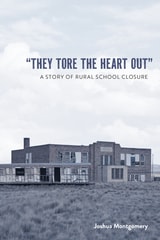
"They Tore the Heart Out"
A Story of Rural School ClosureJoshua Montgomery
University of Wyoming Press, 2027
What does a school mean in rural space? What happens when, despite the protests of a community, a school is closed? How does school closure uncover the cracks in the stories we tell about ourselves and our world? In “They Tore the Heart Out” Joshua Montgomery describes the impact of multiple rounds of school closure and school consolidation in the rural Wyoming community of Medicine Bow, reconstructing the story of the closure and the forces behind it through meeting minutes and other primary sources as well as interviews with past and present residents.
High schools in many small communities act as a surrogate identity and signifier of community success. The school building and the complex community it engenders play roles both prosaic, through school lunches, curriculum, and nurses, and productive, as an economic, political, social, and cultural engine. Montgomery illustrates the long-term impacts of school closure on Medicine Bow and tracks the existential tensions that persist to this day. The story that emerges exists in a rapidly changing cultural context that complicates not only the telling but also the interpreting. School closure, and its aftermath, forced community members to confront issues related to their ability to preserve and control their own destinies.
Told with a strong narrative flair that brings the story to life through dramatic events driven by colorful local characters, “They Tore the Heart Out” allows for a better understanding of the rural educational experience, leads to fundamental questions about who and what we are as a culture, and underscores the importance of maintaining rural space.
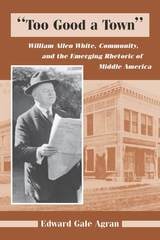
"Too Good a Town"
William Allen White, Community, and the Emerging Rhetoric of Middle AmericaEdward G. Agran
University of Arkansas Press, 1999
For fifty years, William Allen White, first as a reporter and later as the long-time editor of the Emporia Gazette, wrote of his small town and its Mid-American values. By tailoring his writing to the emerging urban middle class of the early twentieth century, he won his “gospel of Emporia” a nationwide audience and left a lasting impact on he way America defines itself.
Investigating White’s life and his extensive writings, Edward Gale Agran explores the dynamic thought of one of America’s best-read and most-respected social commentators. Agran shows clearly how White honed his style and transformed the myth of conquering the western frontier into what became the twentieth-century ideal of community building.
Once a confidante of and advisor to Theodore Roosevelt, White addressed, and reflected in his work, all the great social and political oscillations of his time—urbanization and industrialism, populism, and progressivism, isolationism internationalism, Prohibition, and New Deal reform. Again and again, he asked the question “What’s the matter?” about his times and townspeople, then found the middle ground. With great care and discernment, Agran gathers the man strains of White’s messages, demonstrating one writer’s pivotal contribution to our idea of what it means to be an American.