Results by title
584 books match the query 'Short Stories (single author)' and 7 start with a non-letter
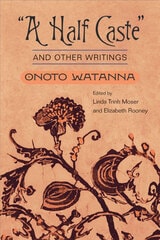
"A Half Caste" and Other Writings
Onoto Watanna
University of Illinois Press, 2003
Born Winnifred Eaton to a British father and Chinese mother, Onoto Watanna was the first novelist of Chinese descent published in the United States. Eaton "became" Watanna to escape Americans' scorn of the Chinese and to capitalize on their fascination with all things Japanese.
This volume includes nineteen of Watanna's shorter works, including thirteen short stories and six essays. "A Half Caste," the earliest essay, appeared in 1898, a year before Miss Numé: A Japanese-American Romance, the first of her bestselling novels. The last short story, “Elspeth,” appeared in 1923. Some of Watanna’s fictional characters will remind readers of the delicate but tragic Madame Butterfly, while others foreshadow types like the trickster in Maxine Hong Kingston’s Tripmaster Monkey (where Watanna makes a cameo appearance). Throughout, Watanna tells stories of people very much like herself—capable, clever, and endlessly inventive.
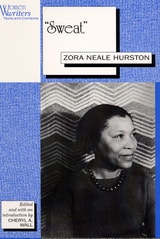
"Sweat"
Written by Zora Neale HurstonWall, Cheryl A
Rutgers University Press, 1997
Now frequently anthologized, Zora Neale Hurston's short story "Sweat" was first published in Firell, a legendary literary magazine of the Harlem Renaissance, whose sole issue appeared in November 1926. Among contributions by Gwendolyn Bennett, Countee Cullen, Langston Hughes, and Wallace Thurman, "Sweat" stood out both for its artistic accomplishment and its exploration of rural Southern black life. In "Sweat" Hurston claimed the voice that animates her mature fiction, notably the 1937 novel Their Eyes Were Watching God; the themes of marital conflict and the development of spiritual consciousness were introduced as well. "Sweat" exemplifies Hurston's lifelong concern with women's relation to language and the literary possibilities of black vernacular.
This casebook for the story includes an introduction by the editor, a chronology of the author's life, the authoritative text of "Sweat," and a second story, "The Gilded Six-Bits." Published in 1932, this second story was written after Hurston had spent years conducting fieldwork in the Southern United States. The volume also includes Hurston's groundbreaking 1934 essay, "Characteristics of Negro Expression," and excerpts from her autobiography, Dust Tracks on a Road. An article by folklorist Roger Abrahams provides additional cultural contexts for the story, as do selected blues and spirituals. Critical commentary comes from Alice Walker, who led the recovery of Hurston's work in the 1970s, Robert Hemenway, Henry Louis Gates, Gayl Jones, John Lowe, Kathryn Seidel, and Mary Helen Washington.
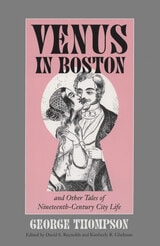
"Venus in Boston" and Other Tales of Nineteenth-Century City Life
George Thompson
University of Massachusetts Press, 2002
The three works in this volume offer a rich representative sample of Thompson's writing. The two novels—Venus in Boston and City Crimes—depict the American city as a place of dark mystery, bawdy humor, and near-universal corruption peopled with con artists and criminals of all kinds. In each novel, a complex narrative structure interweaves multiple stories of exploited labor, abuse of power, seduction, intrigue, and crime. Thompson's autobiography, My Life, presents the author's life in terms nearly as lively as his fiction.
Thompson's zestful, unconventional writings fly in the face of the stereotypical view of Victorian America as straitlaced and sentimental. Ideal for use as a classroom text, this new edition includes a scholarly introduction and an extensive bibliography.
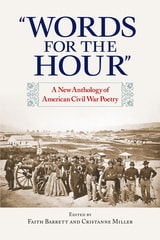
"Words for the Hour"
A New Anthology of American Civil War PoetryFaith Barrett
University of Massachusetts Press, 2005
“Words for the Hour” presents a readable and illuminating account of the Civil War, told through the words of poets North and South. From bathos to profound philosophical meditation and sorrow, the range of these poems illuminates the complexity of their era while also revealing the continuing power of this turning point in American history to speak to readers in the present day.
The volume is divided into three parts, each offering a different perspective on the poetry generated by the war. Part I samples the extraordinary range of poems written immediately preceding and during the war and published in popular periodicals, providing a kind of poetic newspaper account as one might have read it then—from the early days of optimistically heralded victory on both sides, through the mounting casualties and brutal deaths of the long middle years, to the war's conclusion and President Lincoln's assassination. Viewing the struggle from many different vantage points gives the reader access to the ways that people from various backgrounds experienced the trajectory of the war. Civilians and soldiers, free blacks and proponents of slavery, women and men from Massachusetts and Virginia and from recently admitted states and barely developed territories, writers with their eyes on the national political stage and those focused on personal domestic issues: these are the multiple voices of America responding to the war.
Part II includes substantial selections of poems by writers who published extensively in response to the conflict, providing more complex and comprehensive perceptions of the war. These poets include not just well-known figures such as Walt Whitman, Herman Melville, and John Greenleaf Whittier, but also African American poets George Moses Horton and Frances Ellen Watkins Harper and Southern poets Henry Timrod and Sarah Piatt.
Part III offers poems by two poets who did not publish during their lifetimes, but had strong imaginative responses to the conflict, thus giving a sense of the long reach of the war as a defining national experience. One of these two poets (Emily Dickinson) is now renowned while the other (Obadiah Ethelbert Baker) is first published in this volume.
“Words for the Hour” is indeed “new” among anthologies of Civil War poetry not only in its wide range of poems by popular, anonymous, and now canonical poets but also in its informational apparatus. A historical timeline listing major battles and events of the war begins the volume, and historical photographs or lithographs introduce each section of poems. The book also includes a substantial introduction, a glossary of important names and terminology relevant to understanding the poems, and biographical sketches for all the poets whose work is included.
57 Octaves Below Middle C
Kevin McIlvoy
Four Way Books, 2017
99 Fables
William March
University of Alabama Press, 2011
At the time of his death, the longest manuscript still in William March's possession was a collection of fables, which he had completed for the first time in 1938. While Company K, The Tallons, The Bad Seed, and all the rest were in progress, March culled and rewrote, polished and revised these fables, always finding them “too good to destroy,” yet never finding them a good venture for a commercial publisher. Now, posthumously, the collection appears in this book, and readers can enjoy the fabulous world of William March.
This is not to imply that it is a “pretty world.” The fables themselves are an immediate delight, and everyone will find many favorites among the 99. But in the end, March's view of the world is a hard one, and the morals, however charmingly expressed are bitter enough to rival the themes of his novels.
“Obeah” and Other Martinican Stories
Marie-Magdeleine Carbet
Michigan State University Press, 2017