Results by title
4038 books match the query 'Social aspects' and 8 start with a non-letter
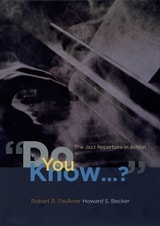
"Do You Know...?"
The Jazz Repertoire in ActionRobert R. Faulkner and Howard S. Becker
University of Chicago Press, 2009
Every night, somewhere in the world, three or four musicians will climb on stage together. Whether the gig is at a jazz club, a bar, or a bar mitzvah, the performance never begins with a note, but with a question. The trumpet player might turn to the bassist and ask, “Do you know ‘Body and Soul’?”—and from there the subtle craft of playing the jazz repertoire is tested in front of a live audience. These ordinary musicians may never have played together—they may never have met—so how do they smoothly put on a show without getting booed offstage.
In “Do You Know . . . ?” Robert R. Faulkner and Howard S. Becker—both jazz musicians with decades of experience performing—present the view from the bandstand, revealing the array of skills necessary for working musicians to do their jobs. While learning songs from sheet music or by ear helps, the jobbing musician’s lexicon is dauntingly massive: hundreds of thousands of tunes from jazz classics and pop standards to more exotic fare. Since it is impossible for anyone to memorize all of these songs, Faulkner and Becker show that musicians collectively negotiate and improvise their way to a successful performance. Players must explore each others’ areas of expertise, develop an ability to fake their way through unfamiliar territory, and respond to the unpredictable demands of their audience—whether an unexpected gang of polka fanatics or a tipsy father of the bride with an obscure favorite song.
“Do You Know . . . ?” dishes out entertaining stories and sharp insights drawn from the authors’ own experiences and observations as well as interviews with a range of musicians. Faulkner and Becker’s vivid, detailed portrait of the musician at work holds valuable lessons for anyone who has to think on the spot or under a spotlight.
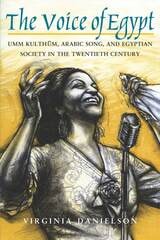
"The Voice of Egypt"
Umm Kulthum, Arabic Song, and Egyptian Society in the Twentieth CenturyVirginia Danielson
University of Chicago Press, 1997
Danielson examines the careful construction of Umm Kulthum's phenomenal popularity and success in a society that discouraged women from public performance. From childhood, her mentors honed her exceptional abilities to accord with Arab and Muslim practice, and as her stature grew, she remained attentive to her audience and the public reception of her work. Ultimately, she created from local precendents and traditions her own unique idiom and developed original song styles from both populist and neo-classical inspirations. These were enthusiastically received, heralded as crowning examples of a new, yet authentically Arab-Egyptian, culture. Danielson shows how Umm Kulthum's music and public personality helped form popular culture and contributed to the broader artistic, societal, and political forces that surrounded her.
This richly descriptive account joins biography with social theory to explore the impact of the individual virtuoso on both music and society at large while telling the compelling story of one of the most famous musicians of all time.
"She is born again every morning in the heart of 120 million beings. In the East a day without Umm Kulthum would have no color."—Omar Sharif
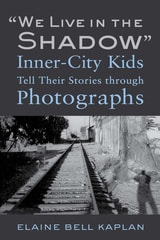
"We Live in the Shadow"
Inner-City Kids Tell Their Stories through PhotographsElaine Bell Kaplan
Temple University Press, 2013
Looking at their photo of railroad tracks, a group of preteen students in South Central Los Angeles see either "a way out of the ghetto," or a "dirty, bad environment." Such are the impressions expressed in the poignant "We Live in the Shadow": Inner-City Kids Tell Their Stories through Photographs.
In Elaine Bell Kaplan's perceptive book, at-risk youth were given five-dollar cameras to tell stories about their world. Their photos and stories show us their response to negative inner-city teen images. We follow them into their schools, and we hear about their creative coping strategies. While these kids see South Central as dangerous, they also see themselves as confident enough to not let the inner city take them down. They refuse to be labeled as "ghetto thugs," as outsiders sometimes do. These outsiders include police, teachers, and other groups representing the institutional voices governing their daily lives.
The kids in "We Live in the Shadow": Inner-City Kids Tell Their Stories through Photographs have developed a multilayered view of society. This impressive book gives voice to their resilience.

12 Rounds in Lo's Gym
Boxing and Manhood in AppalachiaTodd D. Snyder
West Virginia University Press, 2018
Part love letter to Appalachia, part rigorous social critique, readers may find 12 Rounds in Lo’s Gym—and its narrative of individual and community strength in the face of globalism’s headwinds—a welcome corrective to popular narratives that blame those in the region for their troubles.
12 x 12
Conversations in 21st-Century Poetry and PoeticsChristina Mengert
University of Iowa Press, 2009
Christina Mengert and Joshua Marie Wilkinson have assembled an expansive and searching view of the world through the eyes of twenty-four of our most vital and engaging poets. Punctuated by poems from each contributor, 12 × 12 brings together an unparalleled range of poets and poetries, men and women from around the world, working poets for whom the form vitally matters.
Contributors
Jennifer K. Dick–Laura Mullen
Jon Woodward–Rae Armantrout
Sabrina Orah Mark–Claudia Rankine
Christina Hawkey–Tomaž Šalamun
Christine Hume–Rosemarie Waldrop
Srinkath Reddy–Mark Levine
Karen Volkman–Allen Grossman
Paul Fattaruso–Dara Wier
Mark Yakich–Mary Leader
Michelle Robinson–Paul Auster
Sawako Nakayasu–Carla Harryman
Ben Lerner–Aaron Kunin
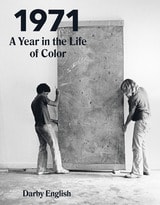
1971
A Year in the Life of ColorDarby English
University of Chicago Press, 2016
1971: A Year in the Life of Color looks at many black artists’ desire to gain freedom from overt racial representation, as well as their efforts—and those of their advocates—to further that aim through public exhibition. Amid calls to define a “black aesthetic,” these experiments with modernist art prioritized cultural interaction and instability. Contemporary Black Artists in America highlighted abstraction as a stance against normative approaches, while The DeLuxe Show positioned abstraction in a center of urban blight. The importance of these experiments, English argues, came partly from color’s special status as a cultural symbol and partly from investigations of color already under way in late modern art and criticism. With their supporters, black modernists—among them Peter Bradley, Frederick Eversley, Alvin Loving, Raymond Saunders, and Alma Thomas—rose above the demand to represent or be represented, compromising nothing in their appeals for interracial collaboration and, above all, responding with optimism rather than cynicism to the surrounding culture’s preoccupation with color.

2001 and Counting
Kubrick, Nietzsche, and AnthropologyBruce Kapferer
Prickly Paradigm Press, 2014
In 2001 and Counting, renowned anthropologist Bruce Kapferer revisits 2001: A Space Odyssey, making a compelling case for its continued cultural relevance. While the film’s earliest audiences considered it to be a critical examination of European and American realities at the height of the Cold War, Kapferer shows that Kubrick’s masterwork speaks equally well to concerns of the contemporary world, including the Iraq War, the 2008 financial crisis, and the material and political effects of neoliberalism. Kapferer explores Kubrick’s central theme—the ever-changing relationship between humanity and technology—both with regard to current events and through the lens of Nietzsche’s Thus Spoke Zarathustra and the mythical concept of the eternal return.
A thought-provoking exploration of the cultural power of cinema, this volume by one of anthropology’s most insightful and imaginative thinkers will appeal to anthropologists and cineastes alike.
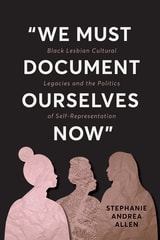
“We Must Document Ourselves Now”
Black Lesbian Cultural Legacies and the Politics of Self-RepresentationStephanie Andrea Allen
The Ohio State University Press, 2026
A long-overdue analysis of how Black lesbians have asserted their lived experience through creative practice, pushing back against heteropatriarchal systems that deny them visibility.
“We Must Document Ourselves Now” examines the essential but oft-ignored importance of Black lesbian literature and film in queer literary and film histories, arguing that Black lesbian cultural texts reflect creators’ lived experiences and resist the heteropatriarchal systems that deny Black lesbians visibility in popular culture. Stephanie Andrea Allen contends that these texts have three goals: to lay bare the experiences of Black lesbians in a raced, gendered, classed, and homophobic society; to challenge the notion that claiming Black lesbian identity is marginal or forbidden; and to take care of Black lesbians by bearing witness to their experiences through creative practice.
Insisting that Black feminist creative practice is an integral form of self and community care, Allen weaves analysis of cultural output spanning key sociocultural moments from 1974 to 2020 with interviews with Black lesbian cultural workers. “We Must Document Ourselves Now” examines the Black Arts / Black Power movement, the “boom” in lesbian and gay publishing, the so-called golden era of Black film, and twenty-first-century visual media to demonstrate how representations of Black lesbians, or lack thereof, were vital to constructing a cultural canon that focused on illuminating Black lesbian experiences in the United States.