Results by title
828 books match the query 'Study and teaching' and 4 start with a non-letter
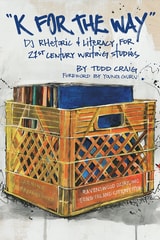
"K for the Way"
DJ Rhetoric and Literacy for 21st Century Writing StudiesTodd Craig
Utah State University Press, 2023
“K for the Way” explores writing, rhetoric, and literacy from the perspective of the Hip Hop DJ. Todd Craig, a DJ himself, establishes and investigates the function of DJ rhetoric and literacy, illuminating the DJ as a fruitful example for (re)envisioning approaches to writing, research, and analysis in contemporary educational settings. Because it is widely recognized that the DJ was the catalyst for the creation of Hip Hop culture, this book begins a new conversation in which Hip Hop DJs introduce ideas about poetics and language formation through the modes, practices, and techniques they engage in on a daily basis.
Using material from a larger qualitative research study that illustrates the Hip Hop DJ as a twenty-first-century new media reader, writer, and literary critic, Craig blends interviews from prominent and influential DJs in the Hip Hop community with narrative and interdisciplinary scholarship from writing studies, Hip Hop studies, African American studies, urban education, and ethnomusicology. The voices of DJs sit front and center, presenting a revolutionary conversation about writing and communication in the twenty-first century.
Weaving Craig’s life experiences with important discussions of racial literacies, “K for the Way” is a layered and utterly singular exploration of culture, identity, and literacy in America.
[more]
(Re)Considering What We Know
Learning Thresholds in Writing, Composition, Rhetoric, and LiteracyLinda Adler-Kassner
Utah State University Press, 2019
Naming What We Know: Threshold Concepts of Writing Studies, published in 2015, contributed to a discussion about the relevance of identifying key concepts and ideas of writing studies. (Re)Considering What We Know continues this conversation while simultaneously raising questions about the ideas around threshold concepts. New contributions introduce additional concepts, investigate threshold concepts as a framework, and explore their use within and beyond writing.
Part 1 raises questions about the ideologies of consensus that are associated with naming threshold concepts of a discipline. Contributions challenge the idea of consensus and seek to expand both the threshold concepts framework and the concepts themselves. Part 2 focuses on threshold concepts in action and practice, demonstrating the innovative ways threshold concepts and a threshold concepts framework have been used in writing courses and programs. Part 3 shows how a threshold concepts framework can help us engage in conversations beyond writing studies.
(Re)Considering What We Know raises new questions and offers new ideas that can help to advance the discussion and use of threshold concepts in the field of writing studies. It will be of great interest to scholars and graduate students in writing studies, especially those who have previously engaged with Naming What We Know.
Contributors:
Marianne Ahokas, Jonathan Alexander, Chris M. Anson, Ian G. Anson, Sarah Ben-Zvi, Jami Blaauw-Hara, Mark Blaauw-Hara, Maggie Black, Dominic Borowiak, Chris Castillo, Chen Chen, Sandra Descourtis, Norbert Elliot, Heidi Estrem, Alison Farrell, Matthew Fogarty, Joanne Baird Giordano, James Hammond, Holly Hassel, Lauren Heap, Jennifer Heinert, Doug Hesse, Jonathan Isaac, Katie Kalish, Páraic Kerrigan, Ann Meejung Kim, Kassia Krzus-Shaw, Saul Lopez, Jennifer Helane Maher, Aishah Mahmood, Aimee Mapes, Kerry Marsden, Susan Miller-Cochran, Deborah Mutnick, Rebecca Nowacek, Sarah O’Brien, Ọlá Ọládipọ̀, Peggy O’Neill, Cassandra Phillips, Mya Poe, Patricia Ratanapraphart, Jacqueline Rhodes, Samitha Senanayake, Susan E. Shadle, Dawn Shepherd, Katherine Stein, Patrick Sullivan, Brenna Swift, Carrie Strand Tebeau, Matt Thul, Nikhil Tiwari, Lisa Tremain, Lisa Velarde, Kate Vieira, Gordon Blaine West, Anne-Marie Womack, Kathleen Blake Yancey, Xiaopei Yang, Madylan Yarc
[more]
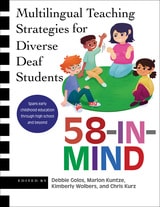
58-IN-MIND
Multilingual Teaching Strategies for Diverse Deaf StudentsDebbie Golos
Gallaudet University Press, 2024
A highly practical and engaging resource for current and future teachers, 58-IN-MIND describes and demonstrates theoretically-driven, research-based, and classroom-tested best practices for using American Sign Language and English in instruction across the curriculum. The multilingual and multimodal instructional strategies presented here are embedded in approaches that aid learning and foster well-being. This book will support teachers in creating meaningful educational experiences for Deaf students in all grades, from early childhood education through high school.
Each chapter is written by a team of researchers and P–12 teachers with at least one Deaf coauthor. With seventy-five percent of the authors being Deaf, this is the first teaching methods book to harness the expertise of Deaf professionals at this level, highlighting their vital role in Deaf education and in shaping inclusive and effective learning environments. This book meets the need for a resource that recognizes the diversity of Deaf students by creating space in the classroom to honor their home/heritage languages, cultures, races, genders, abilities, hearing levels, and other multiple and intersecting identities. Written in a conversational tone, the book includes core recommendations for instruction of the targeted subject area, examples of key strategies, lessons and real stories from those working in the field, suggestions for practice, and recommended resources.
“58-IN-MIND” in the title refers to the version of the ASL sign "stick" that is made on the forehead, which is equivalent to the English idiom “to stick in one's mind.” As in, when students learn in a culturally responsive manner, the learning is likely to stick. The title also alludes indirectly to the collective aspirations of the chapter authors that the practices discussed in the book will also stick in the readers’ minds, and thus have a transformative impact on the way Deaf students are taught.
[more]

60 Ready-to-Use Coding Projects
Ellyssa Kroski
American Library Association, 2020
[more]