Results by title
1214 books match the query 'Subjects & Themes' and 9 start with a non-letter
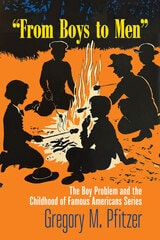
"From Boys to Men"
The Boy Problem and the Childhood of Famous Americans SeriesGregory M. Pfitzer
University of Massachusetts Press, 2024
While adult concern about gender in children’s books has made recent headlines, this discussion is far from new. As Gregory M. Pfitzer reveals, the writers and editors at Bobbs-Merrill, the publisher of the Childhood of Famous Americans book series published between 1932 and 1958, thought carefully about how their books would influence the development of their male readers. These books emphasized inspiring tales over historical accuracy and were written in simple language, with characters, dialogue, and stories that were intended to teach boys how to be successful men.
But this was a specific image of American manhood. Published in an era when sociologists, psychologists, and other experts worried about male delinquency, the men envisioned in these books were steeped in Cold War racial and gender stereotypes, and questions about citizenship and responsibility. Based on deep archival research into the publication history of the series, “From Boys to Men” sheds light on current controversies on children’s books and presentations of gender diversity.
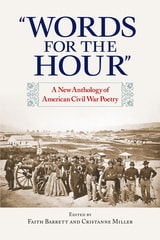
"Words for the Hour"
A New Anthology of American Civil War PoetryFaith Barrett
University of Massachusetts Press, 2005
“Words for the Hour” presents a readable and illuminating account of the Civil War, told through the words of poets North and South. From bathos to profound philosophical meditation and sorrow, the range of these poems illuminates the complexity of their era while also revealing the continuing power of this turning point in American history to speak to readers in the present day.
The volume is divided into three parts, each offering a different perspective on the poetry generated by the war. Part I samples the extraordinary range of poems written immediately preceding and during the war and published in popular periodicals, providing a kind of poetic newspaper account as one might have read it then—from the early days of optimistically heralded victory on both sides, through the mounting casualties and brutal deaths of the long middle years, to the war's conclusion and President Lincoln's assassination. Viewing the struggle from many different vantage points gives the reader access to the ways that people from various backgrounds experienced the trajectory of the war. Civilians and soldiers, free blacks and proponents of slavery, women and men from Massachusetts and Virginia and from recently admitted states and barely developed territories, writers with their eyes on the national political stage and those focused on personal domestic issues: these are the multiple voices of America responding to the war.
Part II includes substantial selections of poems by writers who published extensively in response to the conflict, providing more complex and comprehensive perceptions of the war. These poets include not just well-known figures such as Walt Whitman, Herman Melville, and John Greenleaf Whittier, but also African American poets George Moses Horton and Frances Ellen Watkins Harper and Southern poets Henry Timrod and Sarah Piatt.
Part III offers poems by two poets who did not publish during their lifetimes, but had strong imaginative responses to the conflict, thus giving a sense of the long reach of the war as a defining national experience. One of these two poets (Emily Dickinson) is now renowned while the other (Obadiah Ethelbert Baker) is first published in this volume.
“Words for the Hour” is indeed “new” among anthologies of Civil War poetry not only in its wide range of poems by popular, anonymous, and now canonical poets but also in its informational apparatus. A historical timeline listing major battles and events of the war begins the volume, and historical photographs or lithographs introduce each section of poems. The book also includes a substantial introduction, a glossary of important names and terminology relevant to understanding the poems, and biographical sketches for all the poets whose work is included.
100 Words
PoemsDamon Potter and Truong Tran
Omnidawn, 2021
Tran explains this project, saying “it is occurring to me even as I am writing this now that this is not an experiment, or case study or collaboration or partnership. Damon is not the subject nor am I. This is a shared endeavor, a lived experience between two very different lives trying to understand what it means to be, to see the other.”
1650-1850
Ideas, Aesthetics, and Inquiries in the Early Modern Era (Volume 25)Kevin L. Cope
Bucknell University Press, 2020
About the annual journal 1650-1850
1650-1850 publishes essays and reviews from and about a wide range of academic disciplines—literature (both in English and other languages), philosophy, art history, history, religion, and science. Interdisciplinary in scope and approach, 1650-1850 emphasizes aesthetic manifestations and applications of ideas, and encourages studies that move between the arts and the sciences—between the “hard” and the “humane” disciplines. The editors encourage proposals for “special features” that bring together five to seven essays on focused themes within its historical range, from the Interregnum to the end of the first generation of Romantic writers. While also being open to more specialized or particular studies that match up with the general themes and goals of the journal, 1650-1850 is in the first instance a journal about the artful presentation of ideas that welcomes good writing from its contributors.
First published in 1994, 1650-1850 is currently in its 25th volume.
ISSN 1065-3112.
Published by Bucknell University Press. Distributed worldwide by Rutgers University Press.
1650-1850
Ideas, Aesthetics, and Inquiries in the Early Modern Era (Volume 27)Kevin L. Cope
Bucknell University Press, 2022
ISSN 1065-3112
1650–1850
Ideas, Aesthetics, and Inquiries in the Early Modern Era (Volume 24)Kevin L. Cope
Bucknell University Press, 2019
About the annual journal 1650-1850
1650-1850 publishes essays and reviews from and about a wide range of academic disciplines—literature (both in English and other languages), philosophy, art history, history, religion, and science. Interdisciplinary in scope and approach, 1650-1850 emphasizes aesthetic manifestations and applications of ideas, and encourages studies that move between the arts and the sciences—between the “hard” and the “humane” disciplines. The editors encourage proposals for “special features” that bring together five to seven essays on focused themes within its historical range, from the Interregnum to the end of the first generation of Romantic writers. While also being open to more specialized or particular studies that match up with the general themes and goals of the journal, 1650-1850 is in the first instance a journal about the artful presentation of ideas that welcomes good writing from its contributors.
First published in 1994, 1650-1850 is currently in its 24th volume.
ISSN 1065-3112.
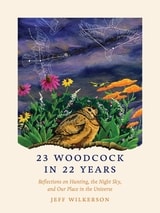
23 Woodcock in 22 Years
Reflections on Hunting, the Night Sky, and Our Place in the UniverseJeff Wilkerson
University of Iowa Press, 2024
As Wilkerson’s thoughts soar to the stars that produced the chemical elements that form us and all the land and its creatures, simple reflections on going afield to harvest a woodcock for a special holiday meal ground him. What emerges is a love story about a bird, the land, and all of creation from atomic nuclei to the farthest reaches of the universe, and a reminder to acknowledge the gentle flow of time while cherishing the everyday existence around us.
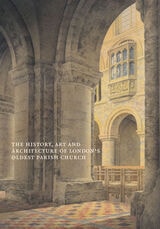
900 Years of St Bartholomew the Great
The History, Art and Architecture of London's Oldest Parish ChurchEdited by Charlotte Gauthier
Paul Holberton Publishing, 2022
The most comprehensive, updated history of St. Bartholomew the Great, the oldest parish church in London, as it celebrates its nine-hundred-year anniversary.
At the heart of the Smithfield area, with its pubs, restaurants, and market, is a church built when Henry I was King of England. Overlooking the fields where kings confronted rebellions, knights jousted, and heretics were burnt, St. Bartholomew’s Priory and Hospital played a central role in the history of medieval London.
The tale of St. Bartholomew’s is one of survival and renewal. Not only has the priory hosted many of London’s most famous (such as a young Benjamin Franklin), but it has also miraculously survived the tumults of the Reformation, the Civil War, the Great Fire of 1666, and the bomb raids of World Wars I and II.
Richly illustrated, 900 Years of St Bartholomew’s surveys the art, architecture, and deep historical significance of this enduring landmark.
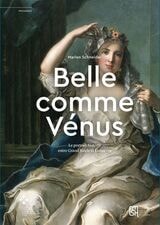
« Belle comme Vénus »
Le portrait historié entre Grand Siècle et LumièresMarlen Schneider
Diaphanes, 2020
Ces portraits dits « historiés », dans lesquels l’effigie d’une personne vivante s’enrichit d’attributs mythologiques comme dans un tableau d’histoire, sont un genre pictural à part entière. D’abord prérogative masculine adoptée par les grands pour célébrer leurs vertus, il devient vers 1680 l’apanage des modèles féminins : le langage allégorique les pare de qualités à connotation spécifiquement féminine et galante, comme la beauté, la jeunesse, la grâce, qui, bien comprises, pouvaient aussi être un moyen de manier le pouvoir. Dès les années 1740, ces peintures font cependant l’objet de critiques répétées et le genre perd peu à peu sa légitimité à la fin de l’Ancien Régime, avant que ce procédé de distinction aristocratique suscite la méfiance des historiens de l’art, qui n’y verront que l’expression d’un amusement futile de milieux oisifs.
Le présent ouvrage remet à leur juste place ces travestissements : à la fois œuvre d’art, objet culturel et pratique sociale, le portrait historié est un phénomène de goût révélateur d’une culture de cour en pleine transformation. Marlen Schneider met ici en lumière les fonctions, les propriétés formelles, la réception et la portée historique d’un type de représentation trop longtemps déconsidéré.