Results by title
527 books match the query 'Translations into English' and 3 start with a non-letter
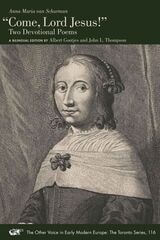
"Come, Lord Jesus!"
Two Devotional Poems. A Bilingual EditionAnna Maria van Schurman
Iter Press, 2026
A bilingual edition of the devotional poems of Dutch scholar and poet Anna Maria van Schurman, illuminating the period of her withdrawal from public life.
The life and reputation of Anna Maria van Schurman (1607–78) swung dramatically from her early fame as a prodigy and femme savante to the infamy she bore in the wake of her late affiliation with Jean de Labadie. From her late adolescence on, van Schurman was widely known for her intellectual gifts, her mastery of languages, and her skillful portraiture and embroidery. Described by some as a femme savante and “the Star of Utrecht,” she gained an international reputation with the publication of her defense of women’s education. Her later years, however, were marked by a growing disillusionment with her own fame and intellectual achievements, and her reputation was dramatically marred in the eyes of her contemporaries when, in her final decade, she repudiated the Dutch Reformed Church to affiliate with Jean de Labadie. With him and his spiritual community, she lived out her last years in peace while also composing a two-volume defense of her actions and convictions, entitled Eukleria or The Better Choice.
The years between her withdrawal from public life and her supposedly scandalous return are not easily mapped. Drawing on two long devotional poems that she wrote during this period (and that remained unpublished during her lifetime), this bilingual edition introduces readers to van Schurman’s private piety, as well as to her theological acumen, her artistry as a vernacular poet, and her participation in the leadership of a conventicle of like-minded friends and acquaintances. The English translation closely approximates the rhyme, meter, and cadence of the Dutch original and thus facilitates an appreciation not only of the poet’s meaning but also of the auditory aesthetics of each text.
[more]
“Obeah” and Other Martinican Stories
Marie-Magdeleine Carbet
Michigan State University Press, 2017
This volume comprises French versions and English translations of seven short stories written by Marie-Magdeleine Carbet, Martinique’s most prolific woman writer. Four of these stories are previously unpublished, culled from documents obtained from Carbet’s niece. While analyses of the literature of the French Caribbean have tended to portray these people typically as suffering from pathologies of colonial oppression, the situations and reflections presented in these stories offer different perspectives on the lives and concerns of ordinary Martinicans and thus provide insight into some of the missing links of the sociocultural scene. This unique, multifaceted text fills an important pedagogical and scholarly need, and allows the reader to access the daily lives of French Caribbeans in a significantly authentic way.
[more]
“The Sting of Death” and Other Stories
Shimao Toshio; Translated with an Introduction and Interpretive Comments by Kathryn Sparling
University of Michigan Press, 1985
Until a recent “boom,” Shimao Toshio, writer of short fiction, critic, and essayist, was not widely known, even in Japan. He has never won the Akutagawa or the Naoki Prize, and none of his works had previously appeared in English translation. He is less well known than other writers (Yasuoka Shotaro, Kojima Nobuo, and Shono Junzo) with whom he has associated and whose works have been liberally translated into English. Yet, there are those who consider him to be one of the best contemporary writers in Japan.
This volume by no means exhausts the scope of Shimao's fiction. There are no stories here, for instance, about childhood or student life, and none of his many travel stories. Some of his most famous stories-- "When we Never Left Port," for example--have not been included. But the stories presented here do offer a considerable variety of style, from the pristine storybook language of "The Farthest Edge of the Islands," to the young intellectual's jargon of "Everyday Life in a Dream," to the visionary, hysterical, occasionally ritualistic prose of the "sick wife" stories, to the sober, difficult, almost ponderous narration of "This Time That Summer." Shimao's approach to his material varies as well. "Everyday Life in a Dream" is the only representative here of a large number of stories usually called surrealistic by the critics, stories whose plots progress by the logic of dreams. The individual experience of real life are lived through a combination of conscious and unconscious perception. These stories are the least approachable and the least charming to the casual reader, but they serve, among other things, to highlight patterns in the more realistic fiction. "The Farthest Edge of the Islands" is a symbolic heightening of reality in another way, a romantic fairy tale beginning at the extremity of experience, at the farthest edge of the world. The other stories are presented as precise, close chronicles of reality by a participant in that reality whose attention never waivers and who never allows himself to avert his eyes from a world that he sees as his responsibility and in a sense his fault. All but the first story, "The Farthest Edge of the Islands," which is in third-person narration, are told in the first person by the character who plays Shimao's role in the life that inspired the fiction.
[more]