Results by title
2285 books match the query 'Women' and 11 start with a non-letter
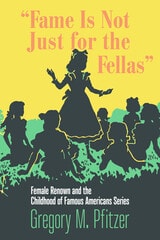
"Fame Is Not Just for the Fellas"
Female Renown and the Childhood of Famous Americans SeriesGregory M. Pfitzer
University of Massachusetts Press, 2022
Finalist of the 2023 SHARP History of the Book Prize
Between 1932 and 1958, thousands of children read volumes in the book series Childhood of Famous Americans. With colorful cover art and compelling—and often highly fictionalized—narrative storylines, these biographies celebrated the national virtues and achievements of famous women like Betsy Ross, Louisa May Alcott, and Amelia Earhart. Employing deep archival research, Gregory M. Pfitzer examines the editorial and production choices of the publisher and considers the influence of the series on readers and American culture more broadly.
In telling the story of how female subjects were chosen and what went into writing these histories for young female readers of the time, Pfitzer illustrates how these books shaped children’s thinking and historical imaginations around girlhood using tales from the past. Utilizing documented conversations and disagreements among authors, editors, readers, reviewers, and sales agents at Bobbs-Merrill, “Fame Is Not Just for the Fellas” places the series in the context of national debates around fame, gender, historical memory, and portrayals of children and childhood for a young reading public—charged debates that continue to this day.

"Rights, Not Roses"
Unions and the Rise of Working-Class Feminism, 1945-80Dennis A. Deslippe
University of Illinois Press, 2000
Educated, white collar professional women carried the most visible banners of feminism. But working class women were a powerful force in the campaign for gender equality. Dennis A. Deslippe explores how unionized wage-earning women led the struggle to place women's employment rights on the national agenda, decisively influencing both the contemporary labor movement and second-wave feminism.
Deslippe's account unravels a complex history of how labor leaders accommodated and resisted working women's demands for change. Through case studies of unions representing packinghouse and electrical workers, Deslippe explains why gender equality emerged as an issue in the 1960s and how the activities of wage-earning women in and outside of their unions shaped the content of the debate. He also traces the fault lines separating working-class women--who sought gender equality within the parameters of unionist principles such as seniority--from middle-class women--who sought an equal rights amendment that would guarantee an abstract equality for all women.
Thoughtful and detailed, "Rights, Not Roses" offers a new look at the complexities of working-class feminism.
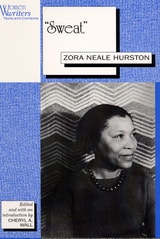
"Sweat"
Written by Zora Neale HurstonWall, Cheryl A
Rutgers University Press, 1997
Now frequently anthologized, Zora Neale Hurston's short story "Sweat" was first published in Firell, a legendary literary magazine of the Harlem Renaissance, whose sole issue appeared in November 1926. Among contributions by Gwendolyn Bennett, Countee Cullen, Langston Hughes, and Wallace Thurman, "Sweat" stood out both for its artistic accomplishment and its exploration of rural Southern black life. In "Sweat" Hurston claimed the voice that animates her mature fiction, notably the 1937 novel Their Eyes Were Watching God; the themes of marital conflict and the development of spiritual consciousness were introduced as well. "Sweat" exemplifies Hurston's lifelong concern with women's relation to language and the literary possibilities of black vernacular.
This casebook for the story includes an introduction by the editor, a chronology of the author's life, the authoritative text of "Sweat," and a second story, "The Gilded Six-Bits." Published in 1932, this second story was written after Hurston had spent years conducting fieldwork in the Southern United States. The volume also includes Hurston's groundbreaking 1934 essay, "Characteristics of Negro Expression," and excerpts from her autobiography, Dust Tracks on a Road. An article by folklorist Roger Abrahams provides additional cultural contexts for the story, as do selected blues and spirituals. Critical commentary comes from Alice Walker, who led the recovery of Hurston's work in the 1970s, Robert Hemenway, Henry Louis Gates, Gayl Jones, John Lowe, Kathryn Seidel, and Mary Helen Washington.
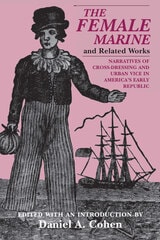
"The Female Marine" and Related Works
Narratives of Cross-Dressing and Urban Vice in America's Early RepublicDaniel A. Cohen
University of Massachusetts Press, 1997
The alternately racy and moralistic narrative recounts the adventures of a young woman from rural Massachusetts who is seduced by a false-hearted lover, flees to Boston, and is entrapped in a brothel. She eventually escapes by disguising herself as a man and serves with distinction on board the U.S. frigate Constitution during the War of 1812. After subsequent onshore adventures in and out of male dress, she is happily married to a wealthy New York gentleman.
In his introduction, Daniel A. Cohen situates the story in both its literary and historical contexts. He explains how the tale draws upon a number of popular Anglo-American literary genres, including the female warrior narrative, the sentimental novel, and the urban exposé. He then explores how The Female Marine reflects early-nineteenth-century anxieties concerning changing gender norms, the expansion of urban prostitution, the growth of Boston's African American community, and feelings of guilt aroused by New England's notoriously unpatriotic activities during the War of 1812.
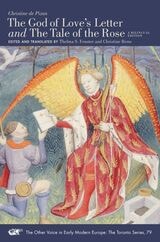
"The God of Love’s Letter" and "The Tale of the Rose"
A Bilingual Edition. With Jean Gerson, “A Poem on Man and Woman,” Translated from the Latin by Thomas O’DonnellChristine de Pizan
Iter Press, 2020
The God of Love’s Letter (1399), Christine de Pizan’s first defense of women, is arguably her most succinct statement about gender. It also rebukes the thirteenth-century Romance of the Rose and anticipates Christine’s City of Ladies. The Tale of the Rose (1402) responds to the growth in chivalric orders for the defense of women by arguing that women, not men, should choose members of the “Order of the Rose.” Both poems are freshly edited here from their earliest manuscripts and each is newly translated into English.
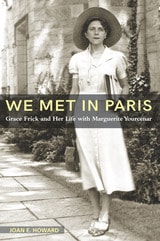
"We Met in Paris"
Grace Frick and Her Life with Marguerite YourcenarJoan E. Howard
University of Missouri Press, 2020
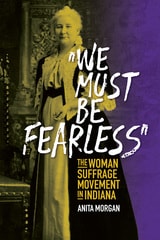
"We Must Be Fearless"
The Woman Suffrage Movement in IndianaAnita Morgan
Indiana Historical Society Press, 2020
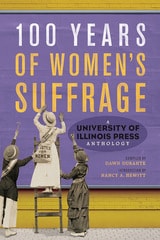
100 Years of Women's Suffrage
A University of Illinois Press AnthologyCompiled by Dawn Durante. Introduction by Nancy A. Hewitt
University of Illinois Press, 2019
A curation of important scholarship on a pivotal historical moment, 100 Years of Women’s Suffrage captures the complex and enduring struggle for fair and equal voting rights.
Contributors: Laura L. Behling, Erin Cassese, Mary Chapman, M. Margaret Conway, Carolyn Daniels, Bonnie Thornton Dill, Ellen Carol DuBois, Julie A. Gallagher, Barbara Green, Nancy A. Hewitt, Leonie Huddy, Kimberly Jensen, Mary-Kate Lizotte, Lady Constance Lytton, and Andrea G. Radke-Moss
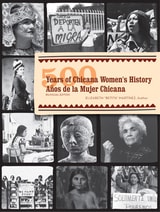
500 Years of Chicana Women's History / 500 Años de la Mujer Chicana
Bilingual EditionMartínez, Elizabeth "
Rutgers University Press, 2008
The history of Mexican Americans spans more than five centuries and varies from region to region across the United States. Yet most of our history books devote at most a chapter to Chicano history, with even less attention to the story of Chicanas.
500 Years of Chicana Women’s History offers a powerful antidote to this omission with a vivid, pictorial account of struggle and survival, resilience and achievement, discrimination and identity. The bilingual text, along with hundreds of photos and other images, ranges from female-centered stories of pre-Columbian Mexico to profiles of contemporary social justice activists, labor leaders, youth organizers, artists, and environmentalists, among others. With a distinguished, seventeen-member advisory board, the book presents a remarkable combination of scholarship and youthful appeal.
In the section on jobs held by Mexicanas under U.S. rule in the 1800s, for example, readers learn about flamboyant Doña Tules, who owned a popular gambling saloon in Santa Fe, and Eulalia Arrilla de Pérez, a respected curandera (healer) in the San Diego area. Also covered are the “repatriation” campaigns” of the Midwest during the Depression that deported both adults and children, 75 percent of whom were U.S.–born and knew nothing of Mexico. Other stories include those of the garment, laundry, and cannery worker strikes, told from the perspective of Chicanas on the ground.
From the women who fought and died in the Mexican Revolution to those marching with their young children today for immigrant rights, every story draws inspiration. Like the editor’s previous book, 500 Years of Chicano History (still in print after 30 years), this thoroughly enriching view of Chicana women’s history promises to become a classic.
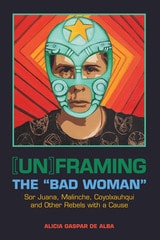
[Un]framing the "Bad Woman"
Sor Juana, Malinche, Coyolxauhqui, and Other Rebels with a CauseBy Alicia Gaspar de Alba
University of Texas Press, 2014
“What the women I write about have in common is that they are all rebels with a cause, and I see myself represented in their mirror,” asserts Alicia Gaspar de Alba. Looking back across a career in which she has written novels, poems, and scholarly works about Sor Juana Inés de la Cruz, la Malinche, Coyolxauhqui, the murdered women of Juárez, the Salem witches, and Chicana lesbian feminists, Gaspar de Alba realized that what links these historically and socially diverse figures is that they all fall into the category of “bad women,” as defined by their place, culture, and time, and all have been punished as well as remembered for rebelling against the “frames” imposed on them by capitalist patriarchal discourses.
In [Un]Framing the “Bad Woman,” Gaspar de Alba revisits and expands several of her published articles and presents three new essays to analyze how specific brown/female bodies have been framed by racial, social, cultural, sexual, national/regional, historical, and religious discourses of identity—as well as how Chicanas can be liberated from these frames. Employing interdisciplinary methodologies of activist scholarship that draw from art, literature, history, politics, popular culture, and feminist theory, she shows how the “bad women” who interest her are transgressive bodies that refuse to cooperate with patriarchal dictates about what constitutes a “good woman” and that queer/alter the male-centric and heteronormative history, politics, and consciousness of Chicano/Mexicano culture. By “unframing” these bad women and rewriting their stories within a revolutionary frame, Gaspar de Alba offers her compañeras and fellow luchadoras empowering models of struggle, resistance, and rebirth.
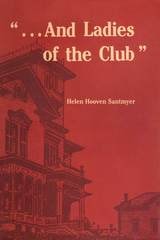
“. . . And the Ladies of the Club”
Helen Hooven Santmyer
The Ohio State University Press, 1980
In this longest and most ambitious of Santmyer’s books, there is—as with all of her previous work—a poignant sense of a past made present again through an acute sensibility, of human life and experience as somehow cumulative, and of lives and events, largely fugitive and forgotten, as captured and transformed as the stuff of her poetry.