Results by title
1441 books match the query 'World' and 3 start with a non-letter
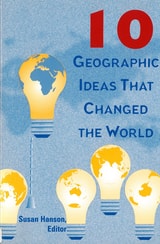
10 Geographic Ideas That Changed the World
Hanson, Susan
Rutgers University Press, 1997
The contributors, who include several past presidents of the Association of American Geographers, members of the National Academy of Sciences, and authors of major works in the discipline, are: Elizabeth K. Burns, Patricia Gober, Anne Godlewska, Michael F. Goodchild, Susan Hanson, Robert W. Kates, John R. Mather, William B. Meyer, Mark Monmonier, Edward Relph, Edward J. Taaffe, and B. L. Turner, II.

50 Maps That Can't Explain the World
A Cartographic Tour from Ptolemy to TrumpNicholas Danforth
University of Chicago Press, 0
An eye-opening journey through fifty maps that ask what, exactly, the people who made our world were thinking, and what that says about our past and future.
Everyone loves a good map. As writer Nicholas Danforth is keen to remind us, maps tell stories about the world and its history—but not always the ones their makers intend. In 50 Maps That Can't Explain the World, Danforth gives us a whirlwind tour of a wide variety of maps, illustrating what they can—and can't—teach us about the world.
Witty and irreverent, the pieces take on many cartographic topics of current political interest, including Russian imperialism, the misunderstood appeal of Greenland, and where Canada came from. Others concern mapmaking itself, exploring why north is “up” and how to map time. In doing so, these pieces show that places as varied as Khiva, Atlantis, and even Arkansas matter for addressing big questions, including the best way to draw borders or the future of America’s foreign policy. Featuring a wide array of unique and forgotten maps, all these pieces regale readers with their interesting tales, such as how the Near East became the Middle East or what the US would look like if it lost World War I.
Throughout, Danforth’s entertaining, thoughtful commentary reveals that while maps may not solve all the world’s woes, they can show us where we’ve been and point us to where we’re trying to go.
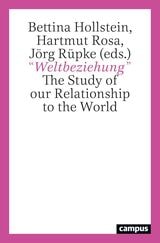
“Weltbeziehung”
The Study of our Relationship to the WorldEdited by Bettina Hollstein, Hartmut Rosa, and Jörg Rüpke
Campus Verlag, 2023
Human beings are always and essentially placed and situated in a world to which they relate, and it is this relationship that defines them. This book describes the historical and cultural variety of self-world-relations of this kind and revolves around aspects and dimensions of what Hartmut Rosa has gathered under the term “Weltbeziehung” (relationship to the world), expanding on his theory on resonance.
This book starts from this innovative approach to discuss socially relevant questions and conceptions of the present, like property, progress, or markets and then contrasts them with non-Western or non-modern forms of “Weltbeziehungen” like specific conceptions of virtue or fatalistic practices. In an effort to overcome Eurocentric biases, the book also includes studies about the decolonization of research in India and the role of markets in China. In addition, comparisons across time help to further refine our understanding of “Weltbeziehungen.” Finally, the volume’s contributions discuss a number of challenges and practical problems of the contemporary world such as the migration crises, sharing practices, or knowledge production in light of this conception.