Results by title
18284 books match the query 'United States' and 117 start with a non-letter

50+ Programs for Tweens, Teens, Adults, and Families
12 Months of IdeasAmy Alessio
American Library Association, 2019
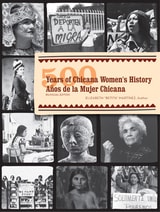
500 Years of Chicana Women's History / 500 Años de la Mujer Chicana
Bilingual EditionMartínez, Elizabeth "
Rutgers University Press, 2008
The history of Mexican Americans spans more than five centuries and varies from region to region across the United States. Yet most of our history books devote at most a chapter to Chicano history, with even less attention to the story of Chicanas.
500 Years of Chicana Women’s History offers a powerful antidote to this omission with a vivid, pictorial account of struggle and survival, resilience and achievement, discrimination and identity. The bilingual text, along with hundreds of photos and other images, ranges from female-centered stories of pre-Columbian Mexico to profiles of contemporary social justice activists, labor leaders, youth organizers, artists, and environmentalists, among others. With a distinguished, seventeen-member advisory board, the book presents a remarkable combination of scholarship and youthful appeal.
In the section on jobs held by Mexicanas under U.S. rule in the 1800s, for example, readers learn about flamboyant Doña Tules, who owned a popular gambling saloon in Santa Fe, and Eulalia Arrilla de Pérez, a respected curandera (healer) in the San Diego area. Also covered are the “repatriation” campaigns” of the Midwest during the Depression that deported both adults and children, 75 percent of whom were U.S.–born and knew nothing of Mexico. Other stories include those of the garment, laundry, and cannery worker strikes, told from the perspective of Chicanas on the ground.
From the women who fought and died in the Mexican Revolution to those marching with their young children today for immigrant rights, every story draws inspiration. Like the editor’s previous book, 500 Years of Chicano History (still in print after 30 years), this thoroughly enriching view of Chicana women’s history promises to become a classic.
53 Ready-to-Use Kawaii Craft Projects
Ellyssa Kroski
American Library Association, 2020
In her new book Kroski, bestselling enthusiast of makerspaces, cosplay, and geek culture in libraries, has gathered creative and crafty librarians to share their most popular Kawaii programs. Running the gamut in terms of cost and difficulty, this book’s 53 programs are sure to include many that will fit your budget, space, and skills. Just scan the estimated budget, age range, materials, equipment needs, and learning outcomes in each listing. Projects include
- keychains with felt or 3D printing;
- slime squishies;
- 3D printed animal earrings;
- hosting a stuffed animal fashion show;
- monster emoji paper bookmarks;
- origami fortune cookies;
- buttons with anime or comic book art;
- crocheted coffee cozy or puppy nose warmer;
- tiny top hats with laser-cut felt cameos; and
- how to Kawaii-ify a planner.
What’s more, the plentiful suggestions for “next projects” scattered throughout the book will help you keep the super-cute fun going!
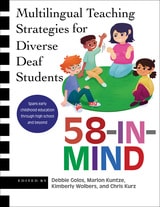
58-IN-MIND
Multilingual Teaching Strategies for Diverse Deaf StudentsDebbie Golos
Gallaudet University Press, 2024
Each chapter is written by a team of researchers and P–12 teachers with at least one Deaf coauthor. With seventy-five percent of the authors being Deaf, this is the first teaching methods book to harness the expertise of Deaf professionals at this level, highlighting their vital role in Deaf education and in shaping inclusive and effective learning environments. This book meets the need for a resource that recognizes the diversity of Deaf students by creating space in the classroom to honor their home/heritage languages, cultures, races, genders, abilities, hearing levels, and other multiple and intersecting identities. Written in a conversational tone, the book includes core recommendations for instruction of the targeted subject area, examples of key strategies, lessons and real stories from those working in the field, suggestions for practice, and recommended resources.
“58-IN-MIND” in the title refers to the version of the ASL sign "stick" that is made on the forehead, which is equivalent to the English idiom “to stick in one's mind.” As in, when students learn in a culturally responsive manner, the learning is likely to stick. The title also alludes indirectly to the collective aspirations of the chapter authors that the practices discussed in the book will also stick in the readers’ minds, and thus have a transformative impact on the way Deaf students are taught.
60 Ready-to-Use Coding Projects
Ellyssa Kroski
American Library Association, 2020

6000 Miles of Fence
By Cordia Sloan Duke
University of Texas Press, 1961
The fabulous XIT Ranch has been celebrated in song, story, and serious history. This book of reminiscences of old XIT cowmen puts on record the everyday life of the individuals who made the ranch run. Their forthright, yet picturesque, discussion of ranching hardships and dangers dissipates Hollywood and TV glamorizing. They relate in honest cowboy language what actually happened inside the XIT's 6,000 miles of fence.
Cordia Sloan Duke, wife of an XIT division manager, Robert L. Duke, many years ago realized that only those who had experienced ranch life could depict it with deep understanding. As the young wife of a rising young ranch hand, she kept in her apron pocket a notebook and pencil, recording all manner of interesting details as they caught her attention. This diary was the nucleus for the present book. Conceiving of an account of life on the XIT as presented by XIT cowboys, Mrs. Duke set about drawing from reticent, sometimes reluctant, ranch hands the impressions of the XIT (occasionally written down by their more literate wives or daughters) which they had retained through the years. Cordia Sloan Duke and Joe B. Frantz have organized the reminiscences around key aspects of ranch life, retaining the language of the cow hands.
9/11
The Culture of CommemorationDavid Simpson
University of Chicago Press, 2006
In 9/11, Simpson argues that elements of the conventional culture of mourning and remembrance—grieving the dead, summarizing their lives in obituaries, and erecting monuments in their memory—have been co-opted for political advantage. He also confronts those who labeled the event an “apocalypse,” condemning their exploitation of 9/11 for the defense of torture and war.
In four elegant chapters—two of which expand on essays originally published in the London Review of Books to great acclaim—Simpson analyzes the response to 9/11: the nationally syndicated “Portraits of Grief” obituaries in the New York Times; the debates over the rebuilding of the World Trade Center towers and the memorial design; the representation of American and Iraqi dead after the invasion of March 2003, along with the worldwide circulation of the Abu Ghraib torture photographs; and the urgent and largely ignored critique of homeland rhetoric from the domain of critical theory.
Calling for a sustained cultural and theoretical analysis, 9/11 is the first book of its kind to consider the events of that tragic day with a perspective so firmly grounded in the humanities and so persuasive about the contribution they can make to our understanding of its consequences.

911 A Public Emergency?, Volume 20
Ella Shohat, Brent Edwards, Stefano Harney, Randy Martin, Timothy Mitchell, and Fred Moten, eds.
Duke University Press, 0
Examining the strengths and shortcomings of area, race, and gender studies in the search for understanding, this issue considers cross-cultural feminism as a means of combating terrorism; racial profiling of Muslims in the context of other racist logics; and the homogenization of dissent. The issue includes poetry, photographic work, and an article by Judith Butler on the discursive space surrounding the attacks of September 11. This impressive range of contributions questions the meaning and implications of the events of September 11 and their aftermath.
Contributors. Muneer Ahmad, Meena Alexander, Lopamudra Basu, Judith Butler, Zillah Eisenstein, Stefano Harney, Randy Martin, Rosalind C. Morris, Fred Moten, Sandrine Nicoletta, Yigal Nizri, Jasbir K. Puar, Amit S. Rai, Ella Shohat, Ban Wang

9XM Talking
WHA Radio and the Wisconsin IdeaRandall Davidson
University of Wisconsin Press, 2017
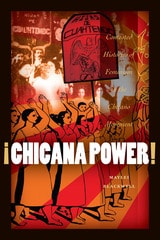
¡Chicana Power!
Contested Histories of Feminism in the Chicano MovementBy Maylei Blackwell
University of Texas Press, 2011
The first book-length study of women's involvement in the Chicano Movement of the late 1960s and 1970s, ¡Chicana Power! tells the powerful story of the emergence of Chicana feminism within student and community-based organizations throughout southern California and the Southwest. As Chicanos engaged in widespread protest in their struggle for social justice, civil rights, and self-determination, women in el movimiento became increasingly militant about the gap between the rhetoric of equality and the organizational culture that suppressed women's leadership and subjected women to chauvinism, discrimination, and sexual harassment. Based on rich oral histories and extensive archival research, Maylei Blackwell analyzes the struggles over gender and sexuality within the Chicano Movement and illustrates how those struggles produced new forms of racial consciousness, gender awareness, and political identities.
¡Chicana Power! provides a critical genealogy of pioneering Chicana activist and theorist Anna NietoGomez and the Hijas de Cuauhtémoc, one of the first Latina feminist organizations, who together with other Chicana activists forged an autonomous space for women's political participation and challenged the gendered confines of Chicano nationalism in the movement and in the formation of the field of Chicana studies. She uncovers the multifaceted vision of liberation that continues to reverberate today as contemporary activists, artists, and intellectuals, both grassroots and academic, struggle for, revise, and rework the political legacy of Chicana feminism.
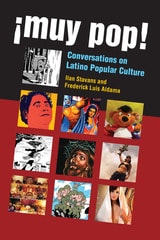
¡Muy Pop!
Conversations on Latino Popular CultureIlan Stavans and Frederick Luis Aldama
University of Michigan Press, 2013
Although investigations of Hispanic popular culture were approached for decades as part of folklore studies, in recent years scholarly explorations—of lucha libre, telenovelas, comic strips, comedy, baseball, the novela rosa and the detective novel, sci-fi, even advertising—have multiplied. What has been lacking is an overarching canvas that offers context for these studies, focusing on the crucial, framing questions: What is Hispanic pop culture? How does it change over time and from region to region? What is the relationship between highbrow and popular culture in the Hispanic world? Does it make sense to approach the whole Hispanic world as homogenized when understanding Hispanic popular culture? What are the differences between nations, classes, ethnic groups, religious communities, and so on? And what distinguishes Hispanic popular culture in the United States?
In ¡Muy Pop!, Ilan Stavans and Frederick Luis Aldama carry on a sustained, free-flowing, book-length conversation about these questions and more, concentrating on a wide range of pop manifestations and analyzing them at length. In addition to making Hispanic popular culture visible to the first-time reader, ¡Muy Pop! sheds new light on the making and consuming of Hispanic pop culture for academics, specialists, and mainstream critics.
¡Presente!
The Politics of PresenceDiana Taylor
Duke University Press, 2020
Águila
The Vision, Life, Death, and Rebirth of a Two-Spirit Shaman in the Ozark MountainsMaría Cristina Moroles
University of Arkansas Press, 2024
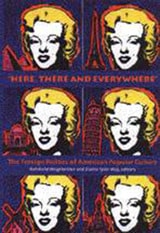
“Here, There and Everywhere”
The Foreign Politics of American Popular CultureEdited by Reinhold Wagnleitner and Elaine Tyler May
University Press of New England, 2000
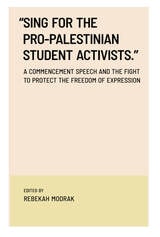
“Sing for the Pro-Palestinian Student Activists.” A Commencement Speech and the Fight to Protect the Freedom of Expression
Rebekah Modrak
Disobedience Press, 2026
Sing for the pro-Palestinian student activists who have, over these past two years, opened our hearts to the injustice and inhumanity of Israel’s war in Gaza.
This single sentence, concluding a brief commencement address by the University of Michigan’s Faculty Senate Chair, ignited a controversy that simmered for weeks. Professor Derek Peterson had praised the work of female, Jewish, and Black activists who had fought for inclusion, ending with a shoutout to students who protested the university’s financial ties to Israel’s war on Gaza.
Hours later, U-M President Domenico Grasso publicly apologized, calling the remarks “hurtful and insensitive.” Peterson faced a barrage of threatening hate mail, alongside demands that he be fired and the university defunded. Conversely, a chorus of passionate dissent argued that a college education should equip students for, not shield them from, sharp controversies.
This volume collects commentary from students, alumni, labor organizers, and faculty. Most, but not all, defend Peterson’s right to say what he said, reflecting on questions of academic freedom, repressive notions of what is “appropriate,” the institution’s traditions of moral courage, the danger of assuming a monolithic “Jewish community,” and the Palestine exception to free speech.
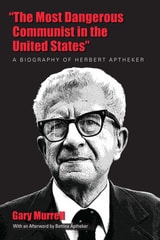
“The Most Dangerous Communist in the United States”
A Biography of Herbert ApthekerGary Murrell
University of Massachusetts Press, 2015
When J. Edgar Hoover declared Herbert Aptheker “the most dangerous Communist in the United States,” the notorious FBI director misconstrued his true significance. In this first book-length biography of Aptheker (1915–2003), Gary Murrell provides a balanced yet unflinching assessment of the controversial figure who was at once a leading historian of African America, radical political activist, literary executor of W. E. B. Du Bois, and lifelong member of the American Communist Party. Although blacklisted at U.S. universities, Aptheker published dozens of books, including the groundbreaking American Negro Slave Revolts (1943) and the monumental seven-volume Documentary History of the Negro People (1951–1994). He also edited four volumes of the correspondence and unpublished writings of Du Bois, an achievement that Eric Foner, writing in the New York Times Book Review, called “a milestone in the coming of age of Afro-American history.”
As Murrell shows, Aptheker the historian was inseparable from Aptheker the leading Communist Party intellectual, polemicist, and agitator. During the 1960s, his ability to rouse and inspire both black and white student radicals made him one of the few Old Leftists accepted by the New Left. Aptheker had joined the CPUSA during its heyday in the 1930s, convinced that only through the party's leadership could fascism be defeated and true liberation be achieved: he ended his affiliation five decades later in 1991 after the collapse of socialism in the Soviet Union and Eastern Europe.
In an afterword, Bettina Aptheker adds to Murrell's narrative by illuminating her mother Fay's vital contributions to her father's work and by affirming the particularly devastating challenges of life in a family dedicated to radical political and social change.
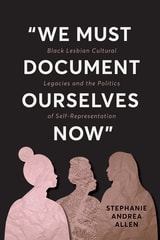
“We Must Document Ourselves Now”
Black Lesbian Cultural Legacies and the Politics of Self-RepresentationStephanie Andrea Allen
The Ohio State University Press, 2026
A long-overdue analysis of how Black lesbians have asserted their lived experience through creative practice, pushing back against heteropatriarchal systems that deny them visibility.
“We Must Document Ourselves Now” examines the essential but oft-ignored importance of Black lesbian literature and film in queer literary and film histories, arguing that Black lesbian cultural texts reflect creators’ lived experiences and resist the heteropatriarchal systems that deny Black lesbians visibility in popular culture. Stephanie Andrea Allen contends that these texts have three goals: to lay bare the experiences of Black lesbians in a raced, gendered, classed, and homophobic society; to challenge the notion that claiming Black lesbian identity is marginal or forbidden; and to take care of Black lesbians by bearing witness to their experiences through creative practice.
Insisting that Black feminist creative practice is an integral form of self and community care, Allen weaves analysis of cultural output spanning key sociocultural moments from 1974 to 2020 with interviews with Black lesbian cultural workers. “We Must Document Ourselves Now” examines the Black Arts / Black Power movement, the “boom” in lesbian and gay publishing, the so-called golden era of Black film, and twenty-first-century visual media to demonstrate how representations of Black lesbians, or lack thereof, were vital to constructing a cultural canon that focused on illuminating Black lesbian experiences in the United States.