Results by title
60 books match the query '1918-1945' and 7 start with a
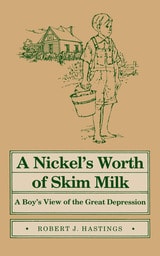
A Nickel's Worth of Skim Milk
A Boy's View of the Great DepressionRobert J. Hastings
Southern Illinois University Press, 1986
Told from the point of view of a young boy, this account shows how a family “faced the 1930s head on and lived to tell the story.” It is the story of growing up in southern Illinois, specifically the Marion, area during the Great Depression. But when it was first published in 1972 the book proved to be more than one writer’s memories of depression-era southern Illinois.
“People started writing me from all over the country,” Hastings notes. “And all said much the same: ‘You were writing about my family, as much as your own. That’s how I remember the 1930s, too.’”
As he proves time and again in this book, Hastings is a natural storyteller who can touch upon the detail that makes the tale both poignant and universal. He brings to life a period that marked every man, woman, and child who lived through it even as that national experience fades into the past.
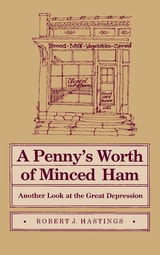
A Penny's Worth of Minced Ham
Another Look at the Great DepressionRobert J. Hastings
Southern Illinois University Press, 1986
Hastings experienced the rural and small town side of an event that touched all who weathered it—the economic crash of 1929 and its 10-year aftermath.
The author grew up in Marion, Illinois, entering the first grade in 1930, the start of the Great Depression. This book, which recalls memorable episodes in the life of that boy, is a sequel to the popular ANickel’s Worth of Skim Milk.
What Hastings experienced as a child was typical of depression-era life. Those who were young then can relive lost youth in Hastings’ books. And there were moments worth reliving: Hastings tells of “laughter and love and tears in the midst of hunger and cold and deprivation.” Those too young to have experienced the economic devastation can see those hard days through the eyes of a trained storyteller reporting from the point of view of a child.
A Pragmatic Alliance
Jewish-Lithuanian political cooperation at the beginning of the 20th centuryVladas Sirutavicius
Central European University Press, 2011
A Violent Peace
Media, Truth, and Power at the League of NationsCarolyn N. Biltoft
University of Chicago Press, 2021
An exploration of instability in information systems, the allure of fascism, and the contradictions at the heart of a global modernity, A Violent Peace paints a rich portrait of the emergence of the age of information—and all its attendant problems.
American Guides
The Federal Writers’ Project and the Casting of American CultureWendy Griswold
University of Chicago Press, 2016
Griswold’s subject here is the Project’s American Guides, an impressively produced series that set out not only to direct travelers on which routes to take and what to see throughout the country, but also to celebrate the distinctive characteristics of each individual state. Griswold finds that the series unintentionally diversified American literary culture’s cast of characters—promoting women, minority, and rural writers—while it also institutionalized the innovative idea that American culture comes in state-shaped boxes. Griswold’s story alters our customary ideas about cultural change as a gradual process, revealing how diversity is often the result of politically strategic decisions and bureaucratic logic, as well as of the conflicts between snobbish metropolitan intellectuals and stubborn locals. American Guides reveals the significance of cultural federalism and the indelible impact that the Federal Writers’ Project continues to have on the American literary landscape.
An American in Hitler's Berlin
Abraham Plotkin's Diary, 1932-33Abraham Plotkin; Edited & with an introduction by Catherine Collomp & Bruno Grop
University of Illinois Press, 2007
Compared to the writings of other American observers of the Third Reich, Plotkin's diary is unique in style, scope, themes, and time span. Most accounts of Hitler's rise to power emphasize political institutions by focusing on the Nazi party's clashes with other political forces. In contrast, Plotkin is especially attentive to socioeconomic factors, providing an alternative view from the left that stems from his access to key German labor and socialist leaders. Chronologically, the diary reports on the moment when Hitler's seizure of power was not yet inevitable and when leaders on the left still believed in a different outcome of the crisis, but it also includes Plotkin's account of the complete destruction of German labor in May 1933.
Australia, New Zealand, and the Pacific Islands since the First World War
Edited by William S. Livingston and Wm. Roger Louis
University of Texas Press, 1979
Three forces—dwindling British power, rising American influence, and nationalism in a variety of forms—have transformed Australia, New Zealand, and the adjacent islands since 1919. In this volume, some of the most distinguished scholars of the Pacific region assess these significant historical changes.
These essays deal with international relations, politics, changing social structures, and literature since World War I. The themes of the volume as a whole are social and humanistic; they concern the evolution of both a regional identity and separate national identities in the Southwest Pacific. The unique areal and thematic concentration of this book makes it essential reading for all those interested in the history, politics, and culture of the Pacific.