Results by title
187 books match the query 'African American women' and 11 start with a
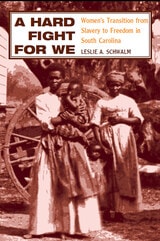
A Hard Fight for We
Women's Transition from Slavery to Freedom in South CarolinaLeslie A. Schwalm
University of Illinois Press, 1997
African-American women fought for their freedom with courage and vigor during and after the Civil War. Leslie Schwalm explores the vital roles of enslaved and formerly enslaved women on the rice plantations of lowcountry South Carolina, both in antebellum plantation life and in the wartime collapse of slavery. From there, she chronicles their efforts as freedwomen to recover from the impact of the war while redefining their lives and labor.
Freedwomen asserted their own ideas of what freedom meant and insisted on important changes in the work they performed both for white employers and in their own homes. As Schwalm shows, these women rejected the most unpleasant or demeaning tasks, guarded the prerogatives they gained under the South's slave economy, and defended their hard-won freedoms against unwanted intervention by Northern whites and the efforts of former owners to restore slavery's social and economic relations during Reconstruction. A bold challenge to entrenched notions, A Hard Fight for We places African American women at the center of the South's transition from a slave society.
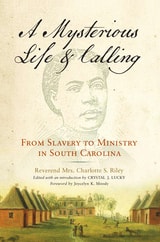
A Mysterious Life and Calling
From Slavery to Ministry in South CarolinaReverend Mrs. Charlotte S. Riley, Edited with an introduction by Crystal J. Lucky, Foreword by Joycelyn K. Moody
University of Wisconsin Press, 2016
Born in 1839 in Charleston, South Carolina, Riley was taught to read, write, and sew despite laws forbidding black literacy. Raised a Presbyterian, she writes of her conversion at age fourteen to the African Methodist Episcopal (AME) church, embracing its ecstatic worship and led by her own spiritual visions. Her memoir is revelatory on many counts, including life in urban Charleston before and after emancipation, her work as a preacher at multiracial revivals, the rise of African American civil servants in the Reconstruction era, and her education and development as a licensed female minister in a patriarchal church.
Crystal J. Lucky, who discovered Riley’s forgotten book in the library archives at Wilberforce University in Ohio, provides an introduction and notes on events, society, and religious practice in the antebellum era and during the Civil War and Reconstruction, and places A Mysterious Life and Calling in the context of other spiritual autobiographies and slave narratives.
A Nickel and a Prayer
Jane Edna Hunter, Edited by Rhondda Robinson Thomas, with a foreword by Joycelyn Moody
West Virginia University Press, 2010
This new and annotated edition of A Nickel and a Prayer includes the final chapter, “Fireside Musings,” that Hunter added to the second, limited printing of her autobiography and an introduction that lauds her as a multifaceted social activist who not only engaged in racial uplift work, but impacted African American cultural production, increased higher education opportunities for women, and invigorated African American philanthropy. This important text restores Jane Edna Harris Hunter to her rightful place among prominent African American race leaders of the twentieth century.
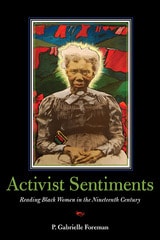
Activist Sentiments
Reading Black Women in the Nineteenth CenturyP. Gabrielle Foreman
University of Illinois Press, 2009
Activist Sentiments takes as its subject women who in fewer than fifty years moved from near literary invisibility to prolific productivity. Grounded in primary research and paying close attention to the historical archive, this book offers against-the-grain readings of the literary and activist work of Harriet Jacobs, Harriet Wilson, Frances E. W. Harper, Victoria Earle Matthews and Amelia E. Johnson.
Part literary criticism and part cultural history, Activist Sentiments examines nineteenth-century social, political, and representational literacies and reading practices. P. Gabrielle Foreman reveals how Black women's complex and confrontational commentary–often expressed directly in their journalistic prose and organizational involvement--emerges in their sentimental, and simultaneously political, literary production.
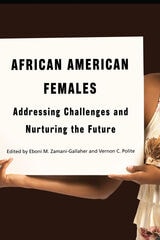
African American Females
Addressing Challenges and Nurturing the FutureEdited by Eboni M. Zamani-Gallaher and Vernon C. Polite
Michigan State University Press, 2013
African American Females: Addressing Challenges and Nurturing the Future illustrates that across education, health, and other areas of social life, opportunities are stratified along gender as well as race lines. The unequal distribution of wealth, power, and privilege between men and women intersects with race and class to create multiple levels of disadvantage. This book is one result of a unique forum intended to bring into focus the K–12 and postsecondary schooling issues and challenges affecting African American girls and women. Focusing on the historical antecedents of African American female participation and the contemporary context of access and opportunity for black girls and women, the contributors to this collection pay particular attention to the interaction of gender with race/ethnicity, class, age, and health, with the central aim of encouraging thoughtful reading, critical thinking, and informed conversations about the necessity of exploring the lives of African American females. Additionally, the book frames important implications for recommended changes in policy and practice regarding a number of critical matters presently affecting African American females in schools and communities across the state of Michigan and nationwide.
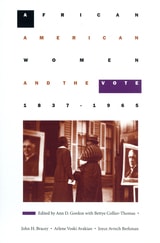
African American Women and the Vote, 1837–1965
Ann D. Gordon
University of Massachusetts Press, 1997
Written by leading scholars of African American and women's history, the essays in this volume seek to reconceptualize the political history of black women in the United States by placing them “at the center of our thinking.” The book explores how slavery, racial discrimination, and gender shaped the goals that African American women set for themselves, their families, and their race and looks at the political tools at their disposal. By identifying key turning points for black women, the essays create a new chronology and a new paradigm for historical analysis. The chronology begins in 1837 with the interracial meeting of antislavery women in New York City and concludes with the civil rights movement of the 1960s.
The contributors focus on specific examples of women pursuing a dual ambition: to gain full civil and political rights and to improve the social conditions of African Americans. Together, the essays challenge us to rethink common generalizations that govern much of our historical thinking about the experience of African American women.
Contributors include Bettina Aptheker, Elsa Barkley Brown, Willi Coleman, Gerald R. Gill, Ann D. Gordon, Evelyn Brooks Higginbotham, Cynthia Neverdon-Morton, Martha Prescod Norman, Janice Sumler-Edmond, Rosalyn Terborg-Penn, and Bettye Collier-Thomas.
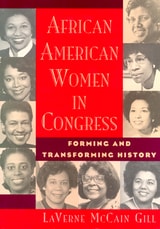
African American Women in Congress
Gill, LaVerne McCain
Rutgers University Press, 1997
African American Women in Congress details the life and career histories of Shirley Chisholm, Barbara Jordan, Yvonne Burke, Cardiss Collins, Katie Hall, Eleanor Holmes Norton, Maxine Waters, Barbara-Rose Collins, Carol Moseley-Braun, Corinne Brown, Carrie Meek, Cynthia McKinney, Eva Clayton, Eddie Bernice Johnson, and Sheila Jackson-Lee. Each profile contains a picture of its subject, interview material, and resumés. Arranged chronologically, the book introduces the reader to issues of vital importance to the Black community—Reconstruction, enfranchisement, lynchings and harassment, civil rights struggles, the founding of advocacy groups, the power of the Congressional Black Caucus, the creation of majority minority districts that allowed greater representation in Congress, the struggle of largely Black Washington, D.C., for representation, and the recent dismantling of past gains by a Republican majority. Gill also describes the uphill battles for social justice and the rights of women that the fifteen women had to wage even within their own political parties, political organizations, and districts.
For general readers, high school and college students, and anyone interested in the political process, this book is illuminating and inspiring reading.

American Anatomies
Theorizing Race and GenderRobyn Wiegman
Duke University Press, 1995
American Anatomies takes the long view: What epistemological frameworks allowed the West, from the Renaissance forward, to schematize racial and gender differences and to create social hierarchies based on these differences? How have those epistemological regimes changed—and not changed—over time? Where are we now? With painstaking care, political passion, and intellectual daring, Wiegman analyzes the biological and cultural bases of racial and gender bias in order to reinvigorate the discussion of identity politics. She concludes that, for very different reasons, identity proves to be dangerous to minority and majority alike.
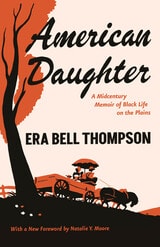
American Daughter
A Midcentury Memoir of Black Life on the PlainsEra Bell Thompson
University of Chicago Press, 2026
A portrait of Black life in the Great Plains, written by a key figure in the Chicago Renaissance and decades-long editor of Ebony.
Era Bell Thompson grew up on the plains of North Dakota, where she and her family were some of the only Black people amid an overwhelmingly white population. American Daughter, originally published in 1946, recounts her childhood in the rural West, her college years in Iowa, and the social and racial revelations she experienced upon arriving in Chicago, where she first encountered a large Black community.
Her memories defy contemporary assumptions. She was a popular high school student, even if she was forced to disarm ignorant questions from her peers. She describes her father’s work for the governor, her family’s interactions with diverse Midwestern immigrant communities, the natural beauty of the landscape, and the collaborative spirit necessary to survive the harsh weather conditions in North Dakota. As an adult in Chicago, she discovered lifestyles and attitudes that were entirely unfamiliar after her childhood in predominantly white spaces. While Thompson endured discrimination in rural and urban settings alike, she relied on her trademark humor to defuse tensions and bridge differences. Her memoir similarly radiates optimism, curiosity, and wit.
Long out of print, this new edition includes a foreword by the Chicago-based journalist Natalie Y. Moore, who not only contextualizes the memoir for contemporary readers but also explores Thompson’s life after American Daughter, including her trailblazing career as an editor for Ebony magazine.
Aphrodite's Daughters
Three Modernist Poets of the Harlem RenaissanceHoney, Maureen
Rutgers University Press, 2016
Archive of Style
New and Selected PoemsCheryl Clarke
Northwestern University Press, 2024
Award-winning poet and essayist Cheryl Clarke’s illustrious career has spanned more than four decades and culminates in Archive of Style: New and Selected Poems, a long-awaited retrospective of the indelible work of a Black feminist, community and LGBTQ activist, and educator. This collection features carefully curated poems from Narratives: Poems in the Tradition of Black Women (1982), Living as a Lesbian (1986), The Days of Good Looks: Prose and Poetry 1980-2005 (2006), By My Precise Haircut (2016), and Targets (2019). Together these works show a brilliant thinker who has profoundly impacted generations of writers and activists.
Clarke’s poetry and essays, centered around the Black, lesbian, feminist experience, have attracted an audience around the world. Her essays, “Lesbianism: an Act of Resistance” and “The Failure to Transform: Homophobia in the Black Community” revolutionized the thinking about lesbians of color and the struggle against homophobia. Her poetry and non-fiction have been reprinted in numerous anthologies and assigned in women and sexuality courses globally. Having published since 1977, Clarke and her work have become a foundational part of LGBTQ literature and activism. Archive of Style is a celebration and homage to one of American literature’s Black Women literary warriors.