Results by title
69 books match the query 'Art, American' and 11 start with a
A Decade of Negative Thinking
Essays on Art, Politics, and Daily LifeMira Schor
Duke University Press, 2009
In essays such as “The ism that dare not speak its name,” “Generation 2.5,” “Like a Veneer,” “Modest Painting,” “Blurring Richter,” and “Trite Tropes, Clichés, or the Persistence of Styles,” Schor considers how artists relate to and represent the past and how the art market influences their choices: whether or not to disavow a social movement, to explicitly compare their work to that of a canonical artist, or to take up an exhausted style. She places her writings in the rich transitory space between the near past and the “nextmodern.” Witty, brave, rigorous, and heartfelt, Schor’s essays are impassioned reflections on art, politics, and criticism.
A Keener Perception
Ecocritical Studies in American Art HistoryEdited by Alan C. Braddock and Christoph Irmsher
University of Alabama Press, 2009
Issues of ecology--both as they appear in the works of nature writers and in the works of literary writers for whom place and the land are central issues--have long been of interest to literary critics, and have given rise over the last two decades to the now firmly established field of ecocriticism. The essays in this volume, written by art historians and literary critics, seek to bring the study of American art into the expanding discourse of ecocriticism.
A Keener Perception offers a series of case studies on topics ranging from John White's watercolors of the Carolina landscape executed during Sir Walter Raleigh's 1585 Roanoke expedition to photographs by environmental activist Eliot Porter. Rather than merely resurrect past instances of ecologically attuned art, this volume features essays that resituate many canonical figures, such as Thomas Eakins, Aaron Douglas, and Thomas Cole, in an ecocritical light by which they have yet to be viewed. Studying such artists and artworks through an ecocritical lens not only provides a better understanding of these works and the American landscape, but also brings a new interpretive paradigm to the field of art history--a field that many of these critics believe would do well to embrace environmental concerns as a vital area of research.
In highlighting the work of scholars who bring ecological agendas to their study of American art, as well as providing models for literary scholars who might like to better incorporate the visual arts into their own scholarship and teaching, A Keener Perception is truly a landmark collection--timely, consequential, and controversial.

A Visitable Past
Views of Venice by American Artists, 1860-1915Margaretta M. Lovell
University of Chicago Press, 1988

Abstract Expressionism
The International ContextMarter, Joan
Rutgers University Press, 2007
Bringing together fifteen original and path-breaking essays by world-class authorities on Abstract Expressionism as well as by younger scholars, this anthology looks beyond the canonical painters to explore the broader connections among abstract artists of the post–World War II era. Moving from the margins to the center, the essays recognize the contributions of artists working far beyond New York City. Topics include Jackson Pollock’s contact with Mexican muralists and the legacy of Abstract Expressionism for leftist artists in Latin America, the relevance of Jean-Paul Sartre and Samuel Beckett as sources of philosophical thought, the significance of northern European CoBrA painters such as Asger Jorn, the impact of Japanese Gutai artists, and connections with the revolutionary art of Italy, Belgium, and France. Abstract Expressionism is also described as a model for contemporaneous developments in the former Soviet Union.
As the first book to consider the movement in relation to post–World War II abstraction on four continents, this book brings a fresh perspective to this widely studied school of painting. Scholars and students alike will find this anthology essential reading in creating a more complete and nuanced understanding of Abstract Expressionism.
Alabama Creates
200 Years of Art and ArtistsEdited by Elliot A. Knight
University of Alabama Press, 2019
A visually rich survey of two hundred years of Alabama fine arts and artists
Alabama artists have been an integral part of the story of the state, reflecting a wide-ranging and multihued sense of place through images of the land and its people. Quilts, pottery, visionary paintings, sculpture, photography, folk art, and abstract art have all contributed to diverse visions of Alabama’s culture and environment. The works of art included in this volume have all emerged from a distinctive milieu that has nourished the creation of powerful visual expressions, statements that are both universal and indigenous.
Published to coincide with the state’s bicentennial, Alabama Creates: 200 Years of Art and Artists features ninety-four of Alabama’s most accomplished, noteworthy, and influential practitioners of the fine arts from 1819 to the present. The book highlights a broad spectrum of artists who worked in the state, from its early days to its current and contemporary scene, exhibiting the full scope and breadth of Alabama art.
This retrospective volume features biographical sketches and representative examples of each artist’s most masterful works. Alabamians like Gay Burke, William Christenberry, Roger Brown, Thornton Dial, Frank Fleming, the Gee’s Bend Quilters, Lonnie Holley, Dale Kennington, Charlie Lucas, Kerry James Marshall, David Parrish, and Bill Traylor are compared and considered with other nationally significant artists.
Alabama Creates is divided into four historical periods, each spanning roughly fifty years and introduced by editor Elliot A. Knight. Knight contextualizes each era with information about the development of Alabama art museums and institutions and the evolution of college and university art departments. The book also contains an overview of the state’s artistic heritage by Gail C. Andrews, director emerita of the Birmingham Museum of Art. Alabama Creates conveys in a sweeping and captivating way the depth of talent, the range of creativity, and the lasting contributions these artists have made to Alabama’s extraordinarily rich visual and artistic heritage.
An Audience of Artists
Dada, Neo-Dada, and the Emergence of Abstract ExpressionismCatherine Craft
University of Chicago Press, 2012
The term Neo-Dada surfaced in New York in the late 1950s and was used to characterize young artists like Robert Rauschenberg and Jasper Johns whose art appeared at odds with the serious emotional and painterly interests of the then-dominant movement, Abstract Expressionism. Neo-Dada quickly became the word of choice in the early 1960s to designate experimental art, including assemblage, performance, Pop art, and nascent forms of minimal and conceptual art.
Art as Information Ecology
Artworks, Artworlds, and Complex Systems AestheticsJason Hoelscher
Duke University Press, 2021
Art for a New Understanding
Native Voices, 1950s to NowMindy N. Besaw
University of Arkansas Press, 2018
This fully illustrated volume includes essays by art historians and historians and reflections by the artists included in the collection. Also included are key contemporary writings—from the 1950s onward—by artists, scholars, and critics, investigating the themes of transculturalism and pan-Indian identity, traditional practices conducted in radically new ways, displacement, forced migration, shadow histories, the role of personal mythologies as a means to reimagine the future, and much more.
As both a survey of the development of Indigenous art from the 1950s to the present and a consideration of Native artists within contemporary art more broadly, Art for a New Understanding expands the definition of American art and sets the tone for future considerations of the subject. It is an essential publication for any institution or individual with an interest in contemporary Native American art, and an invaluable resource in ongoing scholarly considerations of the American contemporary art landscape at large.
Art in an Age of Counterrevolution, 1815-1848
Albert Boime
University of Chicago Press, 2004
This volume focuses on the astonishing range of art forms currently understood to fall within the broad category of Romanticism. Drawing on visual media and popular imagery of the time, this generously illustrated work examines the art of Romanticism as a reaction to the social and political events surrounding it. Boime reinterprets canonical works by such politicized artists as Goya, Delacroix, Géricault, Friedrich, and Turner, framing their work not by personality but by its sociohistorical context. Boime's capacious approach and scope allows him to incorporate a wide range of perspectives into his analysis of Romantic art, including Marxism, social history, gender identity, ecology, structuralism, and psychoanalytic theory, a reach that parallels the work of contemporary cultural historians and theorists such as Edward Said, Pierre Bourdieu, Eric Hobsbawm, Frederic Jameson, and T. J. Clark.
Boime ultimately establishes that art serves the interests and aspirations of the cultural bourgeoisie. In grounding his arguments on their work and its scope and influence, he elucidates how all artists are inextricably linked to history. This book will be used widely in art history courses and exert enormous influence on cultural studies as well.
Art of the United States, 1750–2000
John Davis and Michael Leja
Terra Foundation for American Art, 2020
A sourcebook of unprecedented breadth and depth, Art of the United States brings together multiple voices throughout the ages to provide a framework for learning and critical thinking on US art.
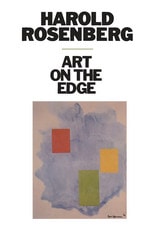
Art on the Edge
Creators and SituationsHarold Rosenberg
University of Chicago Press, 1983