Results by title
109 books match the query 'Astronomy' and 11 start with a
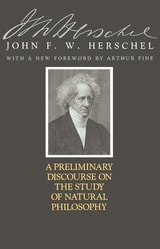
A Preliminary Discourse on the Study of Natural Philosophy
John F. W. Herschel
University of Chicago Press, 1987
"Herschel's book . . . brilliantly analyzes both the history and nature of science."—Keith Stewart Thomson, American Scientist
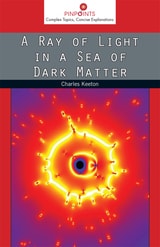
A Ray of Light in a Sea of Dark Matter
Keeton, Charles
Rutgers University Press, 2015
The answer turns out to be surprising and rich. The space between stars is filled with an exotic substance called “dark matter” that exerts gravity but does not emit, absorb, or reflect light. The space between galaxies is rife with “dark energy” that creates a sort of cosmic antigravity causing the expansion of the universe to accelerate. Together, dark matter and dark energy account for 95 percent of the content of the universe. News reporters and science journalists routinely talk about these findings using terms that they assume we have a working knowledge of, but do you really understand how astronomers arrive at their findings or what it all means?
Cosmologists face a conundrum: how can we study substances we cannot see, let alone manipulate? A powerful approach is to observe objects whose motion is influenced by gravity. Einstein predicted that gravity can act like a lens to bend light. Today we see hundreds of cases of this—instances where the gravity of a distant galaxy distorts our view of a more distant object, creating multiple images or spectacular arcs on the sky. Gravitational lensing is now a key part of the international quest to understand the invisible substance that surrounds us, penetrates us, and binds the universe together.
A Ray of Light in a Sea of Dark Matter offers readers a concise, accessible explanation of how astronomers probe dark matter. Readers quickly gain an understanding of what might be out there, how scientists arrive at their findings, and why this research is important to us. Engaging and insightful, Charles Keeton gives everyone an opportunity to be an active learner and listener in our ever-expanding universe.
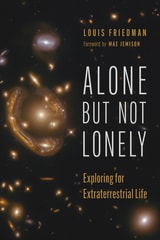
Alone but Not Lonely
Exploring for Extraterrestrial LifeLouis Friedman
University of Arizona Press, 2023
Friedman argues that intelligent life is probably rare in the universe (maybe even uniquely on Earth) but that simple life is likely abundant on millions or billions of planets waiting now to be discovered. He asserts that studying and searching for extraterrestrial life cannot be done by interstellar probes—due to the vastness of space and the comparative brevity of human lifespans—but it can be done remotely by a new technique involving the solar gravity lens that can magnify exoplanets by tens of billions. This technique will allow humankind to explore exoplanets and open up an exciting new field of comparative astrobiology.
Wide-ranging in scope, this book discusses the history of searching for extraterrestrial life, the scientific evidence thereof, and finally his own conclusions on what’s next. Included in the book are three appendices: an explanation of interstellar messaging, a reprint of a debate between Carl Sagan and Ernst Mayr on extraterrestrial intelligence, and an opinion essay on the search for extraterrestrial intelligence.

American Astronomical Society Centennial Issue of the Astrophysical Journal
Edited by Helmut A. Abt
University of Chicago Press, 2000
American Astronomy
Community, Careers, and Power, 1859-1940John Lankford
University of Chicago Press, 1997
research, teaching, or practice in the United States between 1859 and 1940, John Lankford
paints a meticulously documented portrait of this community. He tallies the number with and
without doctorates, the number that taught in colleges or universities versus those involved in
industrial or government work, the number of women versus men, and so on. He also
addresses the crucial question of power within the community—what it meant, which
astronomers had it, and what they did with it.
Drawing on more than a decade of archival research, Lankford attends to the numbers in
concise tables and figures, and takes care to focus through biographical sketches on the
human beings his data represent. This dual approach convincingly illustrates how the changing
structure of a scientific community can alter both the career trajectories of its members and the
nature of the scientific research they choose to pursue.
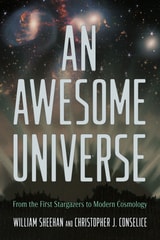
An Awesome Universe
From the First Stargazers to Modern CosmologyWilliam Sheehan and Christopher J. Conselice
University of Arizona Press, 2027
This groundbreaking exploration of humanity’s quest to understand the cosmos spans the earliest observations of the night sky to the latest revelations from advanced space telescopes. It is about humans as much as stars, galaxies, black holes, dark matter, and dark energy. It is a book about the awe we experience in the presence of the awesome universe.
Written by an award-winning historian of astronomy and a professional astronomer specializing in galaxy formation in the early universe, this book provides a comprehensive narrative of cosmic discovery. It examines the evolution of our understanding of the universe—from the first glimpses of the stars to the recognition of the Milky Way as a spiral galaxy and the realization that our universe is filled with countless other galaxies. The book also explores the revolutionary advancements in astrophysics that have shaped our knowledge, including quantum mechanics, nuclear physics, and the study of the still mysterious dark matter and dark energy.
Richly illustrated with remarkable images that show the scale of the universe—from the ancient sky to the ten trillion galaxies now known to exist—An Awesome Universe also addresses some of the most profound questions in science: the nature of life beyond Earth, the fate of the universe, and whether we will ever fully understand the mysteries of space-time, the Big Bang, and the possibility of a multiverse.
This authoritative and visually captivating work offers readers a glimpse into the “Big Picture” of the cosmos, framed by the contributions of pioneering astronomers and driven by our ongoing quest for knowledge about our place in the universe.
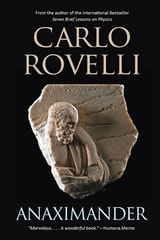
Anaximander
Carlo Rovelli
Westholme Publishing, 2011
THIS EBOOK IS NO LONGER AVAILABLE.
Asteroids
Tom Gehrels
University of Arizona Press, 1979
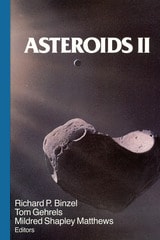
Asteroids II
Richard P. Binzel
University of Arizona Press, 1989
Asteroids II is not a sequel, per se, to the 1979 book Asteroids. It offered a fresh treatment intended to stand on its own as a complete description of the current understanding of the field. It was published in December 1989. The work showcased a large international collaboration, a sign of an active and growing discipline.
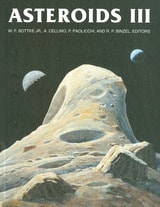
Asteroids III
Edited by W. F. Bottke Jr., A. Cellino, P. Paolicchi, and R. P. Binzel
University of Arizona Press, 2002
This collective knowledge, prepared by a team of more than one hundred international authorities on asteroids, includes new insights into asteroid-meteorite connections, possible relationships with comets, and the hazards posed by asteroids colliding with Earth. The book's contents include reports on surveys based on remote observation and summaries of physical properties; results of in situ exploration; studies of dynamical, collisional, cosmochemical, and weathering evolutionary processes; and discussions of asteroid families and the relationships between asteroids and other solar system bodies. Two previous Space Science Series volumes have established standards for research into asteroids. Asteroids III carries that tradition forward in a book that will stand as the definitive source on its subject for the next decade.
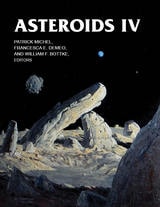
Asteroids IV
Edited by Patrick Michel, Francesca E. DeMeo, and William F. Bottke
University of Arizona Press, 2015
Asteroids IV sets the latest scientific foundation upon which all these topics and more will be built upon for the future. Nearly 150 international authorities through more than 40 chapters convey the definitive state of the field by detailing our current astronomical, compositional, geological, and geophysical knowledge of asteroids, as well as their unique physical processes and interrelationships with comets and meteorites. Most importantly, this volume outlines the outstanding questions that will focus and drive researchers and students of all ages toward new advances in the coming decade and beyond.