112 books match the query 'Body' and 9 start with a
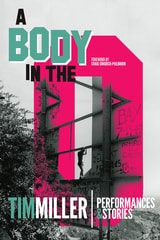
cover of A Body in the O: Performances and Stories

A Body in the O

Performances and Stories

Tim Miller

University of Wisconsin Press, 2019
From London to DC to Australia to Los Angeles, Tim Miller has sold out shows in which he addresses issues of gender, immigration, homophobia, and censorship. As one of the “NEA Four,” who successfully sued the federal government for violating their First Amendment rights when their funding was rescinded in the early 1990s, Miller has always played an important role in defending queer artistic expression on stage. His autobiographical explorations into identity, politics, and art through the lens of his own experiences lead to visceral, humorous, and poignant performances. His activism and experiences inform his newest collection of performance scripts and writings, which represent the culmination of the many struggles for rights and equality that Miller has documented, and performed, over the course of his career. A Body in the O is an important addition to Miller’s existing body of work, picking up from his show Lay of the Land and moving into his more recent piece, Rooted.
[more]
cover of A Body of Individuals: The Paradox of Community in Contemporary Fiction

A Body of Individuals

The Paradox of Community in Contemporary Fiction

Sue-Im Lee

The Ohio State University Press, 2009
Why are some versions of the collective “we” admired and desired while other versions are scorned and feared? A Body of Individuals: The Paradox of Community in Contemporary Fiction examines the conflict over the collective “we” through discourses of community. In the discourse of benevolent community, community is a tool towards achieving healing, productiveness, and connection. In the discourse of dissenting community, community that serves a function is simply another name for totalitarianism; instead, community must merely be a fact of coexistence. What are the sources and the appeal of these irreconcilable views of community, and how do they interact in contemporary fiction’s attempt at imagining “we”?
 
By engaging contemporary U.S. writers such as Toni Morrison, Richard Powers, Karen Tei Yamashita, Lydia Davis, Lynne Tillman, and David Markson with theorists such as Jean-Luc Nancy, Giorgio Agamben, François Lyotard, Ernesto Laclau, Louis Althusser, Roland Barthes, and Ludwig Wittgenstein, this book reveals how the two conflicting discourses of community—benevolent and dissenting—are inextricably intertwined in various literary visions of “we”—“we” of the family, of the world, of the human, and of coexistence.
 
These literary visions demonstrate, in a way that popular visions of community and postmodern theories of community cannot, the dialectical relationship between the discourses of benevolent community and dissenting community. Sue-Im Lee argues that contemporary fiction’s inability to resolve the paradox results in a model of ambivalent community, one that offers unique insights into community and into the very notion of unity.
 
 
[more]
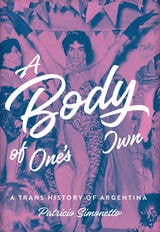
cover of A Body of One's Own: A Trans History of Argentina

A Body of One's Own

A Trans History of Argentina

Patricio Simonetto

University of Texas Press, 2024

2026 Silver Medal for the Best LGBTQ+ Themed Book, Conference on Latin American History (CLAH)
2026 Honorable Mention, Book Award, Social History Society
2025 Best Book in Social Sciences Award, Southern Cone Section, Latin American Studies Association
2024 Sylvia Rivera Award in Transgender Studies, The Center for LGBTQ Studies at the Graduate Center, CUNY

A history of Argentina that examines how trans bodies were understood, policed, and shaped in a country that banned medically assisted gender affirmation practices and punished trans lives.

As a trans history of Argentina, a country that banned medically assisted gender affirmation practices and punished trans lives, A Body of One’s Own places the histories of trans bodies at the core of modern Argentinian history. Patricio Simonetto documents the lives of people who crossed the boundaries of gender from the early twentieth century to the present. Based on extensive archival research in public and community-based archives, this book explores the mainstream medical and media portrayals of trans or travesti people, the state policing of gender embodiment, the experiences of those transgressing the boundaries of gender, and the development of homemade technologies from prosthetics to the self-injection of silicone. A Body of One's Own explores how trans activists' challenges to the exclusionary effects of Argentina’s legal, cultural, social, and political cisgender order led to the passage of the Gender Identity Law in 2012. Analyzing the decisive yet overlooked impact of gender transformation in the formation of the nation-state, gender-belonging, and citizenship, this book ultimately shows that supposedly abstract struggles to define the shifting notions of "sex," citizenship, and nationhood are embodied material experiences.
[more]
cover of An Utterly Dark Spot: Gaze and Body in Early Modern Philosophy

An Utterly Dark Spot

Gaze and Body in Early Modern Philosophy

Miran Bozovic

University of Michigan Press, 2000

Slovenian philosopher Miran Bozovic's An Utterly Dark Spot examines the elusive status of the body in early modern European philosophy by examining its various encounters with the gaze. Its range is impressive, moving from the Greek philosophers and theorists of the body (Aristotle, Plato, Hippocratic medical writers) to early modern thinkers (Spinoza, Leibniz, Malebranche, Descartes, Bentham) to modern figures including Jon Elster, Lacan, Althusser, Alfred Hitchcock, Stephen J. Gould, and others. Bozovic provides startling glimpses into various foreign mentalities haunted by problems of divinity, immortality, creation, nature, and desire, provoking insights that invert familiar assumptions about the relationship between mind and body.
The perspective is Lacanian, but Bozovic explores the idiosyncrasies of his material (e.g., the bodies of the Scythians, the transvestites transformed and disguised for the gaze of God; or Adam's body, which remained unseen as long as it was the only one in existence) with an attention to detail that is exceptional among Lacanian theorists. The approach makes for engaging reading, as Bozovic stages imagined encounters between leading thinkers, allowing them to converse about subjects that each explored, but in a different time and place. While its focus is on a particular problem in the history of philosophy, An Utterly Dark Spot will appeal to those interested in cultural studies, semiotics, theology, the history of religion, and political philosophy as well.
Miran Bozovic is Associate Professor of Philosophy at the University of Ljubljana, Slovenia. He is the author of Der grosse Andere: Gotteskonzepte in der Philosophie der Neuzeit (Vienna: Verlag Turia & Kant, 1993) and editor of The Panopticon Writings by Jeremy Bentham (London: Verso, 1995).
[more]
cover of András Visky's Barrack Dramaturgy: Memories of the Body

András Visky's Barrack Dramaturgy

Memories of the Body

Edited by Jozefina Komporaly

Intellect Books, 2017

Widely considered one of the most innovative voices in Hungarian theater, András Visky has enjoyed growing audiences and increased critical acclaim over the last fifteen years. Nonetheless, his plays have yet to reach an English-language audience. This volume, edited by Jozefina Komporaly, begins to correct this by bringing together a translated collection of Visky’s work.

The book includes the first English-language anthology of Visky’s best known plays—Juliet, I Killed My Mother, and Porn—as well as critical analysis and an exploration of Visky’s “Barrack Dramaturgy,” a dramaturgical theory in which he considers the theater as a space for exploring feelings of cultural and personal captivity. Inspired by personal experience of the oppressive communist regime in Romania, Visky’s work explores the themes of gender, justice, and trauma, encouraging shared moments of remembrance and collective memory. This collection makes use of scripts and director’s notes, as well as interviews with creative teams behind the productions, to reveal a holistic, insider’s view of Visky’s artistic vision. Scholars and practitioners alike will benefit from this rare, English-language collection of Visky’s work and dramaturgy.
[more]
cover of Annali d'italianistica: Urban Space and the Body

Annali d'italianistica

Urban Space and the Body

Edited by Silvia Ross and Giulio Giovannoni

Arizona Center for Medieval and Renaissance Studies, 2019
Founded in 1983, Annali d’Italianistica has become synonymous with timely and fundamental scholarship on Italy’s literary culture, employing broad historical, cultural, and literary perspectives that are of interest to a wide variety of scholars. Published annually and monographic in nature, the journal uses as its point of departure the study of Italian literature and the Humanities more generally to foster scholarly excellence at all levels. Annali d’Italianistica is receptive to a variety of topics, critical approaches, and theoretical perspectives that cross disciplinary boundaries and span several centuries, from the beginning of Italy’s cultural history to the present.
[more]
cover of Anonymous Connections: The Body and Narratives of the Social in Victorian Britain

Anonymous Connections

The Body and Narratives of the Social in Victorian Britain

Tina Young Choi

University of Michigan Press, 2016
Anonymous Connections asks how the Victorians understood the ethical, epistemological, and biological implications of social belonging and participation. Specifically, Tina Choi considers the ways nineteenth-century journalists, novelists, medical writers, and social reformers took advantage of spatial frames-of-reference in a social landscape transforming due to intense urbanization and expansion. New modes of transportation, shifting urban demographics, and the threat of epidemics emerged during this period as anonymous and involuntary forms of contact between unseen multitudes. While previous work on the early Victorian social body have tended to describe the nineteenth-century social sphere in static political and class terms, Choi’s work charts new critical terrain, redirecting attention to the productive—and unpredictable—spaces between individual bodies as well as to the new narrative forms that emerged to represent them. Anonymous Connections makes a significant contribution to scholarship on nineteenth-century literature and British cultural and medical history while offering a timely examination of the historical forebears to modern concerns about the cultural and political impact of globalization.

[more]
cover of Aquinas and the Theology of the Body

Aquinas and the Theology of the Body

Thomas Petri

Catholic University of America Press, 2016
Pope John Paul's Theology of the Body catecheses has garnered tremendous popularity in theological and catechetical circles. Students of the Theology of the Body have generally interpreted it as innovative not only in its presentation of the Church's teaching on marriage and sexuality, but also as radically advancing that teaching. Aquinas and the Theology of the Body offers a somewhat different interpretation. Fr. Thomas Petri argues that the philosophy and theology of Thomas Aquinas substantially contributed to John Paul's intellectual formation, which he never abandoned. A correct interpretation of the Theology of the Body requires, therefore, a thorough understanding of Thomistic anthropology and theology, which has been mostly lacking in commentaries on the pope's important contributions on the subject of marriage and sexuality.
[more]
cover of Articulations: The Body and Illness in Poetry

Articulations

The Body and Illness in Poetry

Jon Mukand

University of Iowa Press, 1994

In 1987 poet and physician Jon Mukand published Sutured Words, a volume of contemporary poems to help patients, their families and friends, and all health care professionals embrace the complexity of healing, illness, and death. Robert Coles called the collection “a wonderful source of inspiration and instruction for any of us who are trying to figure out what our work means”; Norman Cousins was impressed by the “discernment and high quality of the selections.” Now, in Articulations, Mukand adds more than a hundred new poems to the strongest poems from Sutured Words to give us a lyrical, enlightened understanding of the human dimensions of suffering and illness

[more]