Results by title
62 books match the query 'British' and 3 start with a
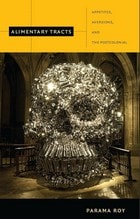
Alimentary Tracts
Appetites, Aversions, and the PostcolonialParama Roy
Duke University Press, 2010
Interpreting texts that have addressed cooking, dining, taste, hungers, excesses, and aversions in South Asia and its diaspora since the mid-nineteenth century, Roy relates historical events and literary figures to tropes of disgust, abstention, dearth, and appetite. She analyzes the fears of pollution and deprivation conveyed in British accounts of the so-called Mutiny of 1857, complicates understandings of Mohandas K. Gandhi’s vegetarianism, examines the “famine fictions” of the novelist-actor Mahasweta Devi, and reflects on the diasporic cookbooks and screen performances of Madhur Jaffrey. This account of richly visceral global modernity furnishes readers with a new idiom for understanding historical action and cultural transformation.

America Lost and Found
An English Boy's Wartime Adventure in the New WorldAnthony Bailey
University of Chicago Press, 2000
"An original, sensitively told story in which the perspectives of the child are carefully remembered. . . . Bailey's book speaks, with gentle eloquence, not only to those who remember being boys, but to everyone who would seek to protect children from the hurts and ravagings that ordinary life can inflict, to say nothing of war." —Richard Montague, Newsday
"No doubt Tony Bailey owed America something for its hospitality during those anxious years, and with this book he has amply repaid the debt." —Joseph McLellan, Washington Post
"An exquisitely controlled, quietly amusing and moving story." —Publishers Weekly
"As tender as it is truthful, and as amusing as it is unpretentious." —John Russell, New York Times Book Review
American and British Writers in Mexico, 1556-1973
By Drewey Wayne Gunn
University of Texas Press, 1974
American and British Writers in Mexico is the study that laid the foundation upon which subsequent examinations of Mexico’s impact upon American and British letters have built. Chosen by the Mexican government to be placed, in translation, in its public libraries, the book was also referenced by Nobel Laureate Octavio Paz in an article in the New Yorker, “Reflections—Mexico and the United States.” Drewey Wayne Gunn demonstrates how Mexican experiences had a singular impact upon the development of English writers, beginning with early British explorers who recorded their impressions for Hakluyt’s Voyages, through the American Beats, who sought to escape the strictures of American culture.
Among the 140 or so writers considered are Stephen Crane, Ambrose Bierce, Langston Hughes, D. H. Lawrence, Somerset Maugham, Katherine Anne Porter, Hart Crane, Malcolm Lowry, John Steinbeck, Graham Greene, Tennessee Williams, Saul Bellow, William Carlos Williams, Robert Lowell, Ray Bradbury, Allen Ginsberg, William Burroughs, and Jack Kerouac.
Gunn finds that, while certain elements reflecting the Mexican experience—colors, landscape, manners, political atmosphere, a sense of the alien—are common in their writings, the authors reveal less about Mexico than they do about themselves. A Mexican sojourn often marked the beginning, the end, or the turning point in a literary career. The insights that this pioneering study provide into our complex cultural relationship with Mexico, so different from American and British authors’ encounters with Continental cultures, remain vital. The book is essential for anyone interested in understanding the full range of the impact of the expatriate experience on writers.