Results by title
134 books match the query 'Business' and 8 start with a

A Catechism For Business
Andrew V. Abela
Catholic University of America Press, 2014

A Catechism for Business
Andrew V. Abela
Catholic University of America Press, 2016

A Catholic Spirituality for Business
Martin Schlag
Catholic University of America Press, 2019
<
The expression “logic of gift” was introduced into official Catholic social teaching by Pope Benedict XVI, who presented it in association with the principle of gratuitousness, which in turn is an expression of fraternity. However, before Caritas in Veritate and ever since Marcel Mauss’s groundbreaking work The Gift, the importance of gift for human relationships and for the cohesion of society had been increasingly recognized. Alain Caillé and Jacques T. Godbout further fleshed out the implication of gift for contemporary society in the context of secular social sciences, striving to overcome utilitarianism. It was the “civil economy” movement, however, that exercised greatest influence on Benedict XVI’s encyclical Caritas in Veritate
This present volume reflects on the general scope of these notions for business and society. This is done by structuring the book in two parts, each dedicated to one of the two concepts. Each part has two general chapters and two that apply the notions to business and to business education. The authors are a mix of well-known emeritus professors and younger talented emerging scholars. We have also been careful to combine European with American authors.
A Catholic Spirituality for Business: The Logic of Gift does not seek to provide a definitive answer to all social challenges, but to make a contribution to a better understanding of Christian spirituality and gift in connection with business organizations. The authors in this book are convinced that markets can be ethical and social, that moral change towards ethical capitalism is possible.
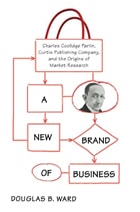
A New Brand of Business
Charles Coolidge Parlin, Curtis Publishing Company, and the Origins of Market ResearchDouglas B. Ward
Temple University Press, 2009
Charles Coolidge Parlin was considered by many to be the founder of market research. Working for the dominant Curtis Publishing Company, he revolutionized the industry by providing added value to advertisers through information about the racial, ethnic, and regional biases of readers and consumers. By maintaining contact with both businesses and customers, Parlin and Curtis publications were able to turn consumer wants into corporate profits.
In A New Brand of Business, Douglas Ward provides an intriguing business history that explains how and why Curtis developed its market research division. He reveals the evolution and impact of Parlin’s work, which understood how readers and advertisers in the emerging consumer economy looked at magazines and advertisements. Ward also examines the cultural and social reasons for the development and use of market research—particularly in regard to Curtis' readership of upper-income elites. The result weaves the stories of Parlin and Curtis into the changes taking place in American business and advertising in the early twentieth century.

ALA Guide to Economics and Business Reference
American Library Association, 2011

Achieving Access to Justice in a Business and Human Rights Context
An Assessment of Litigation and Regulatory Responses in European Civil-Law CountriesVirginie Rouas
University of London Press, 2022
Multinational enterprises, or MNEs, can contribute to economic prosperity and social development in the countries where they operate. At the same time, their activities may directly or indirectly cause harm to humans and to the environment. Historically, MNEs have rarely been held accountable for their involvement in human rights abuses and environmental damage. In recent years, however, activists have sought to hold parent companies directly liable for the harm caused by their group’s activities. They have also strategically used litigation to trigger corporate accountability reforms at international, regional, and national levels.
Focusing on Europe, this book evaluates the extent to which litigation against MNEs has been effective in achieving access to justice and corporate accountability, particularly in civil-law countries. It also considers whether ongoing regulatory developments, such as the adoption of mandatory human rights due diligence norms and the negotiations for a business and human rights treaty, can contribute to the realization of access to justice and corporate accountability in the future.
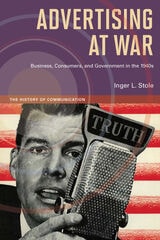
Advertising at War
Business, Consumers, and Government in the 1940sInger L. Stole
University of Illinois Press, 2012
Using archival sources, newspapers accounts, and trade publications, Stole demonstrates that the war elevated and magnified the seeming contradictions of advertising and allowed critics of these practices one final opportunity to corral and regulate the institution of advertising. Exploring how New Dealers and consumer advocates such as the Consumers Union battled the advertising industry, Advertising at War traces the debate over two basic policy questions: whether advertising should continue to be a tax-deductible business expense during the war, and whether the government should require effective standards and labeling for consumer products, which would render most advertising irrelevant. Ultimately the postwar climate of political intolerance and reverence for free enterprise quashed critical investigations into the advertising industry. While advertising could be criticized or lampooned, the institution itself became inviolable.
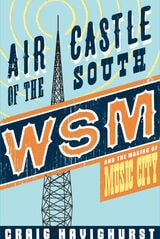
Air Castle of the South
WSM and the Making of Music CityCraig Havighurst
University of Illinois Press, 2013
Started by the National Life and Accident Insurance Company in 1925, WSM became one of the most influential and exceptional radio stations in the history of broadcasting and country music. WSM gave Nashville the moniker “Music City USA” as well as a rich tradition of music, news, and broad-based entertainment. With the rise of country music broadcasting and recording between the 1920s and ‘50s, WSM, Nashville, and country music became inseparable, stemming from WSM’s launch of the Grand Ole Opry, popular daily shows like Noontime Neighbors, and early morning artist-driven shows such as Hank Williams on Mother’s Best Flour.
Sparked by public outcry following a proposal to pull country music and the Opry from WSM-AM in 2002, Craig Havighurst scoured new and existing sources to document the station’s profound effect on the character and self-image of Nashville. Introducing the reader to colorful artists and businessmen from the station’s history, including Owen Bradley, Minnie Pearl, Jim Denny, Edwin Craig, and Dinah Shore, the volume invites the reader to reflect on the status of Nashville, radio, and country music in American culture.