Results by title
59 books match the query 'Caribbean' and 4 start with a
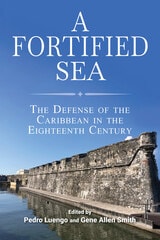
A Fortified Sea
The Defense of the Caribbean in the Eighteenth CenturyEdited by Pedro Luengo and Gene Allen Smith
University of Alabama Press, 2024
WINNER OF THE SOCIETY FOR MILITARY HISTORY'S 2025 DISTINGUISHED BOOK AWARD
A multinational, interdisciplinary study illuminating how fortifications reshaped the Caribbean as a contested imperial borderland in the eighteenth century.
A Fortified Sea illuminates the key role of military forts in the greater Caribbean during the long eighteenth century. The historical Caribbean, with its multiple contested boundaries at the periphery of European western expansion, typically has been analyzed as part of an empire. European powers, including Spain, the Netherlands, England, and Denmark, carved up the Caribbean Sea into a cultural patchwork. These varied cultural contexts were especially evident during regional and national conflicts throughout the eighteenth century and prompted the construction of more fortifications to protect imperial interests. The emergence of Anglo-American colonies during the eighteenth century and later the United States gradually altered previous geopolitical balances, redefining the cultural and geopolitical boundaries of the region.
This collection of essays incorporates several historiographical traditions—from Spanish to American—all portraying the borderland as a breakthrough contested cultural, social, economic, and military boundary. A multinational roster of contributors approaches topics through a war studies lens as well as architecturally and historically, enriching a usually monothematic view. As well, discussion of cultural management of the historical remains of forts shows local communities trying to preserve and interpret the role of forts in society.
Part I defines the training of military engineers in Spain. Part II engages with British defensive military plans and settlements in the Caribbean and shows how the British dealt with the rhetorical image of the empire. Part III clarifies the building processes of fortifications in Santiago de Cuba, Cartagena de Indias, Havana, and Veracruz, among other places. Copious period maps complement the prodigious research. The book will appeal to readers interested in the history of the Caribbean, military history, and European imperial expansion.
CONTRIBUTORS
Mónica Cejudo Collera / Pedro Cruz Freire / María Mercedes Fernández Martín / Aaron Graham / Manuel Gámez Casado / Francisco Javier Herrera García / Nuria Hinarejos Martín / Pedro Luengo / Ignacio J. López-Hernández / José Miguel Morales Folguera / Alfredo J. Morales / Juan Miguel Muñoz Corbalán / Jesús Maria Ruiz Carrasco / Germán Segura García / Gene Allen Smith / Christopher K. Waters
A Region among States
Law and Non-sovereignty in the CaribbeanLee Cabatingan
University of Chicago Press, 2023
How is it that a great swath of the independent, English-speaking Caribbean continues to accept the judicial oversight of their former colonizer via the British institution of the Privy Council? And what possibilities might the Caribbean Court of Justice—a judicial institution responsive to the region, not to any single nation—offer for untangling sovereignty and regionhood, law and modernity, and postcolonial Caribbean identity?
Joining the Court as an intern, Lee Cabatingan studied its work up close: she attended each court hearing and numerous staff meetings, served on committees, assisted with the organization of conferences, and helped prepare speeches and presentations for the judges. She now offers insight into not only how the Court positions itself vis-à-vis the Caribbean region and the world but also whether the Court—and, perhaps, the region itself as an overarching construct—might ever achieve a real measure of popular success. In their quest for an accepting, eager constituency, the Court is undertaking a project of extrajudicial region building that borrows from the toolbox of the nation-state. In each chapter, Cabatingan takes us into an analytical dimension familiar from studies of nation and state building—myth, territory, people, language, and brand—to help us understand not only the Court and its ambitions but also the regionalist project, beset as it is with false starts and disappointments, as a potential alternative to the sovereign state.
An Unformed Map
Geographies of Belonging between Africa and the CaribbeanPhilip Janzen
Duke University Press, 2025
Archaeology and Geoinformatics
Case Studies from the CaribbeanEdited by Basil A. Reid
University of Alabama Press, 2008
Addressing the use of geoinformatics in Caribbean archaeology, this volume is based on case studies drawn from specific island territories, namely, Barbados, St. John, Puerto Rico, Jamaica, Nevis, St. Eustatius, and Trinidad and Tobago, as well as inter-island interaction and landscape conceptualization in the Caribbean region. Geoinformatics is especially critical within the Caribbean where site destruction is intense due to storm surges, hurricanes, ocean and riverine erosion, urbanization, industrialization, and agriculture, as well as commercial development along the very waterfronts that were home to many prehistoric peoples. By demonstrating that the region is fertile ground for the application of geoinformatics in archaeology, this volume places a well-needed scholarly spotlight on the Caribbean.