Results by title
282 books match the query 'Caribbean & West Indies' and 17 start with a
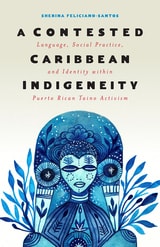
A Contested Caribbean Indigeneity
Language, Social Practice, and Identity within Puerto Rican Taíno ActivismSherina Feliciano-Santos
Rutgers University Press, 2021
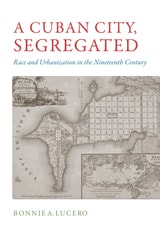
A Cuban City, Segregated
Race and Urbanization in the Nineteenth CenturyBonnie A. Lucero
University of Alabama Press, 2019
Founded as a white colony in 1819, Cienfuegos, Cuba, quickly became home to people of African descent, both free and enslaved, and later a small community of Chinese and other immigrants. Despite the racial, ethnic, and cultural diversity that defined the city’s population, the urban landscape was characterized by distinctive racial boundaries, separating the white city center from the heterogeneous peripheries. A Cuban City, Segregated: Race and Urbanization in the Nineteenth Century explores how the de facto racial segregation was constructed and perpetuated in a society devoid of explicitly racial laws.
Drawing on the insights of intersectional feminism, Bonnie A. Lucero shows that the key to understanding racial segregation in Cuba is recognizing the often unspoken ways specifically classed notions and practices of gender shaped the historical production of race and racial inequality. In the context of nineteenth-century Cienfuegos, gender, race, and class converged in the concept of urban order, a complex and historically contingent nexus of ideas about the appropriate and desired social hierarchy among urban residents, often embodied spatially in particular relationships to the urban landscape.
As Cienfuegos evolved subtly over time, the internal logic of urban order was driven by the construction and defense of a legible, developed, aesthetically pleasing, and, most importantly, white city center. Local authorities produced policies that reduced access to the city center along class and gendered lines, for example, by imposing expensive building codes on centric lands, criminalizing poor peoples’ leisure activities, regulating prostitution, and quashing organized labor. Although none of these policies mentioned race outright, this new scholarship demonstrates that the policies were instrumental in producing and perpetuating the geographic marginality and discursive erasure of people of color from the historic center of Cienfuegos during its first century of existence.
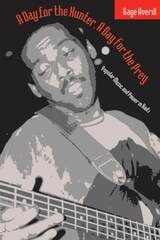
A Day for the Hunter, a Day for the Prey
Popular Music and Power in HaitiGage Averill
University of Chicago Press, 1997
Averill explores such diverse genres as Haitian jazz, troubadour traditions, Vodou-jazz, konpa, mini-djaz, new generation, and roots music. He examines the complex interaction of music with power in contexts such as honorific rituals, sponsored street celebrations, Carnival, and social movements that span the political spectrum.
With firsthand accounts by musicians, photos, song texts, and ethnographic descriptions, this book explores the profound manifestations of power and song in the day-to-day efforts of ordinary Haitians to rise above political repression.
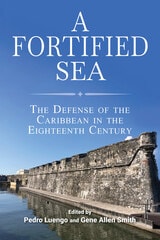
A Fortified Sea
The Defense of the Caribbean in the Eighteenth CenturyEdited by Pedro Luengo and Gene Allen Smith
University of Alabama Press, 2024
WINNER OF THE SOCIETY FOR MILITARY HISTORY'S 2025 DISTINGUISHED BOOK AWARD
A multinational, interdisciplinary study illuminating how fortifications reshaped the Caribbean as a contested imperial borderland in the eighteenth century.
A Fortified Sea illuminates the key role of military forts in the greater Caribbean during the long eighteenth century. The historical Caribbean, with its multiple contested boundaries at the periphery of European western expansion, typically has been analyzed as part of an empire. European powers, including Spain, the Netherlands, England, and Denmark, carved up the Caribbean Sea into a cultural patchwork. These varied cultural contexts were especially evident during regional and national conflicts throughout the eighteenth century and prompted the construction of more fortifications to protect imperial interests. The emergence of Anglo-American colonies during the eighteenth century and later the United States gradually altered previous geopolitical balances, redefining the cultural and geopolitical boundaries of the region.
This collection of essays incorporates several historiographical traditions—from Spanish to American—all portraying the borderland as a breakthrough contested cultural, social, economic, and military boundary. A multinational roster of contributors approaches topics through a war studies lens as well as architecturally and historically, enriching a usually monothematic view. As well, discussion of cultural management of the historical remains of forts shows local communities trying to preserve and interpret the role of forts in society.
Part I defines the training of military engineers in Spain. Part II engages with British defensive military plans and settlements in the Caribbean and shows how the British dealt with the rhetorical image of the empire. Part III clarifies the building processes of fortifications in Santiago de Cuba, Cartagena de Indias, Havana, and Veracruz, among other places. Copious period maps complement the prodigious research. The book will appeal to readers interested in the history of the Caribbean, military history, and European imperial expansion.
CONTRIBUTORS
Mónica Cejudo Collera / Pedro Cruz Freire / María Mercedes Fernández Martín / Aaron Graham / Manuel Gámez Casado / Francisco Javier Herrera García / Nuria Hinarejos Martín / Pedro Luengo / Ignacio J. López-Hernández / José Miguel Morales Folguera / Alfredo J. Morales / Juan Miguel Muñoz Corbalán / Jesús Maria Ruiz Carrasco / Germán Segura García / Gene Allen Smith / Christopher K. Waters
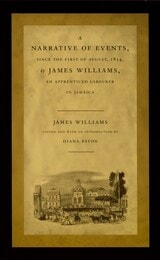
A Narrative of Events, since the First of August, 1834, by James Williams, an Apprenticed Labourer in Jamaica
James Williams
Duke University Press, 2001
Describing the hard working conditions on plantations and the harsh treatment of apprentices unjustly incarcerated, Williams argues that apprenticeship actually worsened the conditions of Jamaican ex-slaves: former owners, no longer legally permitted to directly punish their workers, used the Jamaican legal system as a punitive lever against them. Williams’s story documents the collaboration of local magistrates in this practice, wherein apprentices were routinely jailed and beaten for both real and imaginary infractions of the apprenticeship regulations.
In addition to the complete text of Williams’s original Narrative, this fully annotated edition includes nineteenth-century responses to the controversy from the British and Jamaican press, as well as extensive testimony from the Commission of Enquiry that heard evidence regarding the Narrative’s claims. These fascinating and revealing documents constitute the largest extant body of direct testimony by Caribbean slaves or apprentices.
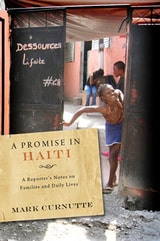
A Promise in Haiti
A Reporter's Notes on Families and Daily LivesMark Curnutte
Vanderbilt University Press, 2011
A Promise in Haiti is Curnutte's story of his time, spanning the last decade, living among several families in Gonaives, a city of 200,000 people a hundred kilometers north of Port-au-Prince. He began traveling to Haiti as a volunteer with the aid organization Hands Together, eventually building trust and credibility with many Haitians. Curnutte introduces the reader to the Cenecharles family, strained by entrenched unemployment and the need to continually travel for work. He is invited into the home of the Henrisma family, and is forced to reconcile journalistic detachment with basic compassion as he contributes financially to help them. The reader is confronted with a complicated, conflicted written and photographic record of a worldview that evolves right on the page. As a reporter, Curnutte found parallels between the lives he encountered in Gonaives and the world of the Great Depression recounted in James Agee and Walker Evans's Let Us Now Praise Famous Men. Agee and Evans loom large as a challenge and inspiration to Curnutte.
The result is equal parts homage to that historic chronicle, on-the-ground reporting, and introspective narrative on the lessons Gonaives taught Curnutte about his own life and family. In late February 2010, Curnutte went back to Haiti on assignment, but conditions made it impossible for him to return to Gonaives. The resulting frustration provoked a meditation on the monumental challenges that face Haiti -- and on the destructive cycle of international attention that constantly moves on to "The Next Big Story."
A Region among States
Law and Non-sovereignty in the CaribbeanLee Cabatingan
University of Chicago Press, 2023
How is it that a great swath of the independent, English-speaking Caribbean continues to accept the judicial oversight of their former colonizer via the British institution of the Privy Council? And what possibilities might the Caribbean Court of Justice—a judicial institution responsive to the region, not to any single nation—offer for untangling sovereignty and regionhood, law and modernity, and postcolonial Caribbean identity?
Joining the Court as an intern, Lee Cabatingan studied its work up close: she attended each court hearing and numerous staff meetings, served on committees, assisted with the organization of conferences, and helped prepare speeches and presentations for the judges. She now offers insight into not only how the Court positions itself vis-à-vis the Caribbean region and the world but also whether the Court—and, perhaps, the region itself as an overarching construct—might ever achieve a real measure of popular success. In their quest for an accepting, eager constituency, the Court is undertaking a project of extrajudicial region building that borrows from the toolbox of the nation-state. In each chapter, Cabatingan takes us into an analytical dimension familiar from studies of nation and state building—myth, territory, people, language, and brand—to help us understand not only the Court and its ambitions but also the regionalist project, beset as it is with false starts and disappointments, as a potential alternative to the sovereign state.
Africa in America
Slave Acculturation and Resistance in the American South and the British Caribbean, 1736-1831Michael Mullin
University of Illinois Press, 1992
Afro-Caribbean Religions
An Introduction to Their Historical, Cultural, and Sacred TraditionsNathaniel Samuel Murrell
Temple University Press, 2009
This accessibly written introduction to Afro-Caribbean religions examines the cultural traditions and transformations of all of the African-derived religions of the Caribbean along with their cosmology, beliefs, cultic structures, and ritual practices. Ideal for classroom use, Afro-Caribbean Religions also includes a glossary defining unfamiliar terms and identifying key figures.
After Love
Queer Intimacy and Erotic Economies in Post-Soviet CubaNoelle Stout
Duke University Press, 2014
After Yorktown
The Final Struggle for American IndependenceDon Glickstein
Westholme Publishing, 2016
Although most people think the American Revolution ended with the British surrender at Yorktown, Virginia, on October 19, 1781, it did not. The war spread around the world, and exhausted men kept fighting—from the Arctic to Arkansas, from India and Ceylon to Schenectady and South America—while others labored to achieve a final diplomatic resolution.
After Cornwallis’s unexpected loss, George III vowed revenge, while Washington planned his next campaign. Spain, which France had lured into the war, insisted there would be no peace without seizing British-held Gibraltar. Yet the war had spun out of control long before Yorktown. Native Americans and Loyalists continued joint operations against land-hungry rebel settlers from New York to the Mississippi Valley. African American slaves sought freedom with the British. Soon, Britain seized the initiative again with a decisive naval victory in the Caribbean against the Comte de Grasse, the French hero of Yorktown.
In After Yorktown: The Final Struggle for American Independence, Don Glickstein tells the engrossing story of this uncertain and violent time, from the remarkable American and French success in Virginia to the conclusion of the fighting—in India—and then to the last British soldiers leaving America more than two years after Yorktown. Readers will learn about the people—their humor, frustration, fatigue, incredulity, worries; their shock at the savage terrorism each side inflicted; and their surprise at unexpected grace and generosity. Based on an extraordinary range of primary sources, the story encompasses a fascinating cast of characters: a French captain who destroyed a British trading post, but left supplies for Indians to help them through a harsh winter, an American Loyalist releasing a captured Spanish woman in hopes that his act of kindness will result in a prisoner exchange, a Native American leader caught “between two hells” of a fickle ally and a greedy enemy, and the only general to surrender to both George Washington and Napoleon Bonaparte. Finally, the author asks the question we face today: How do you end a war that doesn’t want to end?
An Historical Account of the Black Empire of Hayti
Marcus Rainsford
Duke University Press, 2013
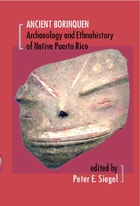
Ancient Borinquen
Archaeology and Ethnohistory of Native Puerto RicoEdited by Peter E. Siegel
University of Alabama Press, 2008
Ancient Borinquen is a re-examination of the archaeology of Puerto Rico, drawing data from beyond the boundaries of the island itself because in prehistoric times the waters between islands would not have been viewed as a boundary in the contemporary sense of the term. The last few decades have witnessed a growth of intense archaeological research on the island, from material culture in the form of lithics, ceramics, and rock art; to nutritional, architecture, and environmental studies; to rituals and social patterns; to the aftermath of Conquest.
It is unlikely that prehistoric occupants recognized the same boundaries and responded to the same political forces that operated in the formation of current nations, states, or cities. Yet, archaeologists traditionally have produced such volumes and they generally represent anchors for ongoing research in a specific region, in this case the island of Puerto Rico, its immediate neighbors, and the wider Caribbean basin.
Ancient Borinquen provides a comprehensive overview of recent thinking, new data, syntheses, and insights into current Puerto Rican archaeology, and it reflects and illuminates similar concerns elsewhere in the West Indies, lowland South America, and Central America.

Apocalypse 1692
Empire, Slavery, and the Great Port Royal EarthquakeBen Hughes
Westholme Publishing, 2017
A haven for pirates and the center of the New World’s frenzied trade in slaves and sugar, Port Royal, Jamaica, was a notorious cutthroat settlement where enormous fortunes were gained for the fledgling English empire. But on June 7, 1692, it all came to a catastrophic end. Drawing on research carried out in Europe, the Caribbean, and the United States, Apocalypse 1692: Empire, Slavery, and the Great Port Royal Earthquake by Ben Hughes opens in a post–Glorious Revolution London where two Jamaica-bound voyages are due to depart. A seventy-strong fleet will escort the Earl of Inchiquin, the newly appointed governor, to his residence at Port Royal, while the Hannah, a slaver belonging to the Royal African Company, will sail south to pick up human cargo in West Africa before setting out across the Atlantic on the infamous Middle Passage. Utilizing little-known first-hand accounts and other primary sources, Apocalypse 1692 intertwines several related themes: the slave rebellion that led to the establishment of the first permanent free black communities in the New World; the raids launched between English Jamaica and Spanish Santo Domingo; and the bloody repulse of a full-blown French invasion of the island in an attempt to drive the English from the Caribbean. The book also features the most comprehensive account yet written of the massive earthquake and tsunami which struck Jamaica in 1692, resulting in the deaths of thousands, and sank a third of the city beneath the sea. From the misery of everyday life in the sugar plantations, to the ostentation and double-dealings of the plantocracy; from the adventures of former-pirates-turned-treasure-hunters to the debauchery of Port Royal, Apocalypse 1692 exposes the lives of the individuals who made late seventeenth-century Jamaica the most financially successful, brutal, and scandalously corrupt of all of England’s nascent American colonies.
Archaeology below the Cliff
Race, Class, and Redlegs in Barbadian Sugar SocietyMatthew C. Reilly
University of Alabama Press, 2019
Archaeology below the Cliff: Race, Class, and Redlegs in Barbadian Sugar Society is the first archaeological study of the poor whites of Barbados, the descendants of seventeenth-century European indentured servants and small farmers. “Redlegs” is a pejorative to describe the marginalized group who remained after the island transitioned to a sugar monoculture economy dependent on the labor of enslaved Africans. A sizable portion of the “white” minority, the Redlegs largely existed on the peripheries of the plantation landscape in an area called “Below Cliff,” which was deemed unsuitable for profitable agricultural production. Just as the land on which they resided was cast as marginal, so too have the poor whites historically and contemporarily been derided as peripheral and isolated as well as idle, alcoholic, degenerate, inbred, and irrelevant to a functional island society and economy.
Using archaeological, historical, and oral sources, Matthew C. Reilly shows how the precarious existence of the Barbadian Redlegs challenged elite hypercapitalistic notions of economics, race, and class as they were developing in colonial society. Experiencing pronounced economic hardship, similar to that of the enslaved, albeit under very different circumstances, Barbadian Redlegs developed strategies to live in a harsh environment. Reilly’s investigations reveal that what developed in Below Cliff was a moral economy, based on community needs rather than free-market prices.
Reilly extensively excavated households from the tenantry area on the boundaries of the Clifton Hall Plantation, which was abandoned in the 1960s, to explore the daily lives of poor white tenants and investigate their relationships with island economic processes and networks. Despite misconceptions of strict racial isolation, evidence also highlights the importance of poor white encounters and relationships with Afro-Barbadians. Historical data are also incorporated to address how an underrepresented demographic experienced the plantation landscape. Ultimately, Reilly’s narrative situates the Redlegs within island history, privileging inclusion and embeddedness over exclusion and isolation.
Architecture by Moonlight
Rebuilding Haiti, Redrafting a LifePaul E. Fallon
University of Missouri Press, 2015
At the Point of a Cutlass
The Pirate Capture, Bold Escape, and Lonely Exile of Philip AshtonGregory N. Flemming
University Press of New England, 2015