475 books match the query 'Catholic' and 55 start with a
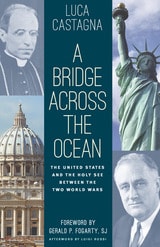
cover of A Bridge Across the Ocean

A Bridge Across the Ocean

Luca Castagna

Catholic University of America Press, 2014
A Bridge across the Ocean focuses on the relations between the United States and the Holy See from the First World War to the eve of the Second, through the combination of American, Italian, and Vatican sources. More than an overall picture of the American and Vatican foreign policy during the first half of the twentieth century, the book analyzes the U.S.-Vatican rapprochement in a multifaceted way, considering both the international and the internal sphere. A Bridge across the Ocean discusses the spread of anti-Catholicism in the United States during the first two decades of the twentieth century, and its repercussions on the American administrations' behavior during and after the Versailles Conference, together with the changes that occurred in the Holy See's attitude toward the American church and the White House after the election of Pope Pius XI. Luca Castagna explores the convergence of the New Deal legislation with the church's social thought, and demonstrates how the partial U.S.-Vatican rapprochement in 1939 resulted from Roosevelt and Pacelli's common aim to cooperate, as two of the most important and global moral powers in the struggle against Nazi-fascism.
[more]
cover of A Brief Apology for a Catholic Moment

A Brief Apology for a Catholic Moment

Jean-Luc Marion

University of Chicago Press, 2021
A timely new work by one of France’s premier philosophers, A Brief Apology for a Catholic Moment offers insight into what “catholic” truly means. In this short, accessible book, Jean-Luc Marion braids the sense of catholic as all-embracing and universal into conversation about what it is to be Catholic in the present moment. A Brief Apology for a Catholic Moment tackles complex issues surrounding church-state separation and addresses a larger Catholic audience that transcends national boundaries, social identities, and linguistic differences. Marion insists that Catholic universalism, with its core of communion and community, is not an outmoded worldview, but rather an outlook that has the potential to counter the positivist rationality and nihilism at the core of our current political moment, and can help us address questions surrounding liberalism and religion and what is often presented as tension between “Islam and the West.” As an inviting and sophisticated Catholic take on current political and social realities—realities that are not confined to France alone—A Brief Apology for a Catholic Moment is a valuable contribution to a larger conversation.
[more]
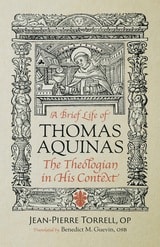
cover of A Brief Life of Aquinas: The Theologian in His Context

A Brief Life of Aquinas

The Theologian in His Context

Jean-Pierre Torrell

Catholic University of America Press, 2024
Jean-Pierre Torrell, OP, who has already written the most highly-regarded contemporary two-volume introduction to the life and works of Saint Thomas, has composed a shorter book that captures the essence of the career of the Angelic Doctor for a more general audience. Torrell follows a biographical outline of the saint, although he also includes brief accounts of what the author takes to be the most important features of Aquinas's teachings. Part biography, part travelogue, part theology, Jean-Pierre Torrell, OP’s A Brief Life of Thomas Aquinas is a multi-faceted look at the life and the writings of Saint Thomas Aquinas. Torrell’s hope is that his biography of the doctor communis intertwined with his theological examination of Aquinas’s writings will enable the reader to understand the person behind the writer and the writer behind the person. Aquinas’s life, Torrell claims, can shed light on his work with respect not only to their number, or to the varied topics he writes about, but to their content as well. It would be inaccurate to view Aquinas hiding behind a mountain of books in the cells he occupied in the various houses he inhabited around the Dominican world. He taught, he preached, he debated, he faced a number of conflicts of ideas that were not of his own making, but out of which would come some of his best-known writings. Torrell’s unique approach makes accessible one of the greatest minds of our tradition and the richness of the legacy he left the Church.
[more]
cover of A Case for All-Girls' Catholic Schools: A Feminist Theological Perspective

A Case for All-Girls' Catholic Schools

A Feminist Theological Perspective

Cynthia L. Cameron

Catholic University of America Press, 2026
Many arguments have been made for the continued good work of all-girls’ schools: they prepare girls well for success in college and career, helping them be better students, better leaders, and more assertive citizens. All-girls’ Catholic schools offer something more: a rationale that is rooted in the theological commitments of the Roman Catholic Church. Indeed, in a contemporary culture that routinely marginalizes adolescent girls and holds them to unattainable expectations, the Church and its theologians and religious educators – because of their commitment to human dignity and flourishing – must advance a theological anthropology that centers adolescent girls. This theological anthropology of female adolescent flourishing then provides both a rationale for the Church’s continued support of all-girls’ Catholic schools and a vision for the mission of these schools as they advocate for the girls they serve. All-girls’ schools, therefore, can be places where the commitment to the flourishing of girls is prioritized and where the toxic milieu of contemporary culture can be resisted. In this book, Cynthia Cameron draws theological attention to female adolescence and uses the resulting robust theological anthropology to provide a theological argument for all-girls’ Catholic schools. It draws from the work of developmental and clinical psychologists who work with adolescent girls, from systematic, contextual, feminist, and intersectional theologians who explore what it means for humans to be created by God in the image of God, and from educational researchers focusing on the history and mission of Catholic schools in the United States. Ultimately, it argues that, in addition to the psychosocial and educational reasons for supporting all-girls’ Catholic schools, there must also be a theological reason. All-girls’ Catholic schools must be committed to the dignity and goodness of girls, to the basic truth that girls are already good as they are and not just for the adults that they may become.
[more]
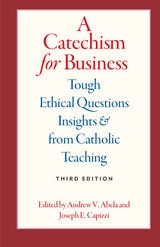
cover of A Catechism for Business: Tough Ethical Questions & Insights from Catholic Teaching, Third Edition

A Catechism for Business

Tough Ethical Questions & Insights from Catholic Teaching, Third Edition

Andrew V. Abela

Catholic University of America Press, 2021
In the four years since the publication of the second edition of A Catechism for Business, Pope Francis' enormous contributions to spreading the good news of the gospel has led to his promulgation of two apostolic exhortations and now a new encyclical, Fratelli tutti, focusing on human fraternity and solidarity. The vibrant tradition of Catholic thinking on social issues is unparalleled in its capacity to help guide human beings towards individual and communal flourishing. The context of a world emerging from a pandemic and new challenges to Christian faith and practice beckon for a refreshed look at pressing questions. Editors Andrew Abela and Joseph Capizzi offer the updated third edition which will incorporate material from both of these apostolic exhortations and the new encyclical.
[more]
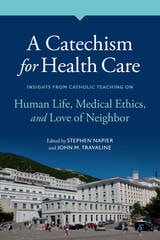
cover of A Catechism for Health Care: Insights from Catholic Teaching on Human Life, Medical Ethics, and Love of Neighbor

A Catechism for Health Care

Insights from Catholic Teaching on Human Life, Medical Ethics, and Love of Neighbor

Stephen Napier

Catholic University of America Press, 2024
The Catholic Church’s teachings on ethical issues arising in healthcare delivery and biomedical science are distributed across a plethora of different places ranging from papal allocutions, encyclicals, instructions by the Congregation for the Doctrine of the Faith, and guidance documents authored by various congregations of bishops. Furthermore, they are distributed throughout time ranging from, for example, the Didache (or teaching of the 12 apostles, circa 1st Century), to Pope Pius XII’s address in 1954 addressing ethical issues in transplantation, and onto the 2009 instruction entitled Dignitas personae. It is difficult for a wider audience to make sense of these sources on the various issues arising in healthcare delivery and scientific research, but the editors of A Catechism for Health Care have collated them in a way that makes them easier to understand The purpose of this book is to present the teachings of the Catholic Church as they pertain to ethical issues arising in the healthcare and biomedical sciences. The premise of the project is that the Catholic Church’s teaching speaks in an accessible way to a wide range of people concerned about healthcare ethics. It is important to present these teachings concisely. The book is ordered around numerous questions concerning the most common practices in health care that have ethical dimensions. It then provides concise answers to these questions as are found in various magisterial Church documents. These answers are refreshingly clear and to the point.
[more]
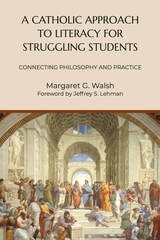
cover of A Catholic Approach to Literacy for Struggling Students: Connecting Philosophy and Practice

A Catholic Approach to Literacy for Struggling Students

Connecting Philosophy and Practice

Margaret G. Walsh

Catholic University of America Press, 2025
Discover effective literacy methods that align with a Christian anthropological view of the human person, as described by Aquinas and Aristotle and joined to research-based strategies. Through this work you will learn the most important pieces to building the skills needed for literacy acquisition. The aim of this book is to provide parents and educators with the foundational understanding of how a person learns to read in order to equip them with the tools needed to effectively implement a full reading curriculum. Included are intervention methods that can be used in conjunction with reading curriculum to improve reading outcomes for students who struggle. The principles used in this book are research-based intervention methods that are blended with models of human development set out by Aristotle and St Thomas Aquinas. In the Summa Theologiae, St Thomas Aquinas writes about the faculties of the soul, relying on the foundational work of Aristotle in the De Anima. In Aquinas’ description of the powers of the soul, he outlines the way in which man comes to know, through the systematic use of his senses, imagination, memory, cogitative powers and finally his intellect and will. Effective intervention methods, as outlined in this work, align with the process Aquinas outlines. Understanding effective intervention strategies in light of the bigger picture of who man is and what he is made for, elevates learning and puts the development of literacy in a holistic perspective.
[more]
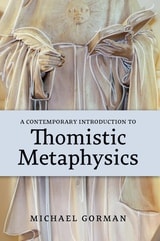
cover of A Contemporary Introduction to Thomistic Metaphysics

A Contemporary Introduction to Thomistic Metaphysics

Michael Gorman

Catholic University of America Press, 2023
A Contemporary Introduction to Thomistic Metaphysics provides the reader with an introductory presentation of key themes in Thomistic metaphysics. There are many such books, but this one is, to use a phrase Michael Gorman has adopted, “analytic-facing,” i.e., it presents things in dialogue with analytic philosophy. Sometimes that means disagreeing with analytic proposals (for example, possible worlds), and sometimes it means agreeing with them (for instance, making ample use of Ryle’s notion of “systematically misleading expressions”). What’s more, it (gently) takes a somewhat deflationary attitude towards many things metaphysicians like to talk about, such as accidents, universals, and the like. By “deflationary” Gorman means that such items are taken seriously, but their ontological status is taken down a notch: features, universals, possible worlds, and other such things are understood in terms of what substances are and what substances are. Substances are ”basic beings,” and other things are what they are only in relation to substances. Of course this is Aristotle 101, but metaphysicians, Aristotelians included, often slip into treating non-substances as mini-substances, and Gorman pushes back against this throughout. A Contemporary Introduction to Thomistic Metaphysics begins by explaining what philosophy is, what metaphysics is, and how these relate to other kinds of thinking. It then moves through a series of topics, ending with a brief look at applications of metaphysical thinking in theology.
[more]
cover of A Cry for Justice: Daniel Rudd and His Life in Black Catholicism, Journalism, and Activism, 1854-1933

A Cry for Justice

Daniel Rudd and His Life in Black Catholicism, Journalism, and Activism, 1854-1933

Gary B. Agee

University of Arkansas Press, 2017
Daniel A. Rudd, born a slave in Bardstown, Kentucky, grew up to achieve much in the years following the Civil War. His Catholic faith, passion for activism, and talent for writing led him to increasingly influential positions in many places. One of his important early accomplishments was the publication of the American Catholic Tribune, which Rudd referred to as "the only Catholic journal owned and published by colored men." At its zenith, the Tribune, run out of Detroit and Cincinnati, where Rudd lived, had ten thousand subscribers, making it one of the most successful black newspapers in the country. Rudd was also active in the leadership of the Afro-American Press Association, and he was a founding member of the Catholic Press Association. By 1889, Rudd was one of the nation's best-known black Catholics. His work was endorsed by a number of high-ranking church officials in Europe as well as in the United States, and he was one of the founders of the Lay Catholic Congress movement. Later, his travels took him to Bolivar County, Mississippi, and eventually on to Forrest City, Arkansas, where he worked for the well-known black farmer and businessperson, Scott Bond, and eventually co-wrote Bond's biography.
[more]
cover of A Defense of Free Will Against Luther: Assertionis Lutheranae Confutatio, Article 36

A Defense of Free Will Against Luther

Assertionis Lutheranae Confutatio, Article 36

Thomas P. St. John Fisher

Catholic University of America Press, 2024
Lord Acton said that of all the works written against Martin Luther in the beginning of the Reformation, Bishop John Fisher of Rochester's Assertionis Lutheranae Confutatio of 1523 was the most important. Oddly enough this massive work of Catholic apologetics, compsed in Latin, has never been rendered into the English language. It contains Fisher's detailed responses to all forty-one articles defended by Martin Luther against the censures of Pope Leo X found in the bull Exsurge Domine (1520). In this volume Thomas Scheck presents for the first time in English translation, introduced, and annotated, Fisher's Preface to the Reader, Ten Truths, and the most important single article found in Fisher's Confutation, namely his Confutation of Luther's Assertion of Article 36, in which Fisher defends the existence of free will against Luther's claim that free will is a fiction with no reality. Fisher's reply is thoroughly grounded in Scripture and in the interpretation of Scripture found in the ancient Fathers of the Church. Interestingly to defend free will be makes abundant use of Augustine, Origen, Jerome, Tertullian and John Chrysostom. Luther's controversy with the Catholic Church over free will is well known today from his debate with Erasmus of Rotterdam, which is easily accessible in English. Less well known is the fact that Bishop John Fisher's reply to Luther preceded Erasmus's by one year and was used extensively by Erasmus himself in arguing against Luther's positions. Also noteworthy is that Bishop John Fisher's particular response to Luther was well known to the bishops and theologians at the Council of Trent (1545-1563) and appears to have influenced the formulation of Catholic dogma in the Decree on Justification, where free will is affirmed and the power of human resistance recognized. Bishop John Fisher was canonized along with St. Thomas More in 1935, 400 years after their bloody martyrdoms under King Henry VIII. Their mutual feast day is on June 22.
[more]
cover of A Defense of the Catholic Religion: The Necessity, Existence, and Limits of an Infallible Church

A Defense of the Catholic Religion

The Necessity, Existence, and Limits of an Infallible Church

Beda Mayr, OSB

Catholic University of America Press, 2023
The Benedictine Beda Mayr,OSB, (1742–1794) was one of the main figures of the German Catholic Enlightenment. He was not only the first Catholic to wrestle with the challenges of Reimarus and Lessing, but also the first to develop an ecumenical methodology for a reunion of the churches. The text, translated from the German original for the first time, presents a theologian who intentionally went to the margins of orthodoxy in order to allow for more interconfessional dialogue. Mayr argued that Catholic theology should follow minority opinions for unsettled dogmatic questions, which would allow for easier union agreements with Protestant churches. Moreover, he suggested limiting ecclesial infallibility to directly revealed truths, thereby reducing the authoritative truth claims of conciliar or papal decisions. Although the study of Catholic Enlightenment is booming among historians and theologians, too few texts are available in reliable translations. A major strength of this edition is not only that its introduction introduces the reader to the colorful landscape of eighteenth-century theological discussions, but also presents the entire text of Mayr's book (with the exception of its appendix) thereby allowing the reader to see the strengths and weaknesses of Enlightenment ecumenism. Mayr's Limited Infallibility was put on the Index of Forbidden Books, on which it remained until the 20th Century. It invites readers to a modern, non-scholastic way of theologizing for the sake of Christian unity.
[more]
cover of A Guide to Formation Advising for Seminarians

A Guide to Formation Advising for Seminarians

Edward J. McCormack

Catholic University of America Press, 2020
The future of the Church depends, in part, on forming future priests and ministers who are ready to accompany, lead, and love the People of God. Formation advising is one important part of that work. A Guide to Formation Advising for Seminarians/Seminary Faculty offers a practical guide to formation advising as a ministry of accompaniment, participation, and evaluation. Deacon Edward McCormack offers a comprehensive introduction to the ministry of formation advising for seminarians studying for priestly ministry. These volumes are for men and women who are new to the ministry of formation advising. The recent Vatican guidelines for seminary formation call for professional accompaniment of seminarians throughout their formation. This book explains in concrete detail how to do this through the entire formation process. Beginning with an overview of the formation process, A Guide to Formation Advising for Seminarians/Seminary Faculty explains the role of the formation advisor and the skills required for that ministry. It describes the various ways the formation advisor accompanies a person through the formation process. McCormack also provides concrete suggestions for how to promote in seminarians’ active participation in the process. Formators will also find explanation of the evaluation process with a style sheet and examples of written evaluations. The handbook contains an annotated bibliography on all the major topics a formation advisor comes across.
[more]
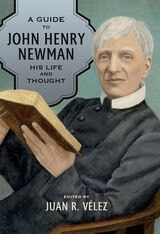
cover of A Guide to John Henry Newman: His Life and Thought

A Guide to John Henry Newman

His Life and Thought

Juan R. Velez

Catholic University of America Press, 2022

John Henry Newman (1801-1890), renowned thinker and writer, Anglican clergyman and later Roman Catholic priest and cardinal, has had a lasting influence on both Anglicans and Catholics, in the fields of literature, education, and theology. On October 13, 2019, Pope Francis declared him a saint in Rome. Appealing to both the student and the scholar, A Guide to John Henry Newman provides a wide range of subjects on Newman’s life and thought relevant for our times and complementary to biographies of Newman. The contributors include authors from many different disciplines such as theology, education, literature, history, and philosophy, highlighting the wide range of Newman’s work. These authors offer a positive assessment of Newman’s thought and contribute to the discussion of the recent scholarship of others. A Guide to John Henry Newman will interest educated readers and professors alike, and serve as a text for college seminars for the purpose of studying Newman.
[more]
cover of A Historian and His World: A Life of Christopher Dawson, 1889-1970

A Historian and His World

A Life of Christopher Dawson, 1889-1970

Christina Scott

Catholic University of America Press, 2023

The English historian of culture Christopher Dawson (1889-1970) was an independent scholar and the author of more than twenty books. He served as assistant lecturer in the History of Culture, University College, Exeter (1925), Forwood Lecturer in the Philosophy of Religion, University of Liverpool (1934), Gifford Lecturer at the University of Edinburgh (1947-1949), and as Professor of Catholic Studies at Harvard University (1958-1962). He was elected Fellow of the British Academy in 1943 and edited the Dublin Review during the Second World War. This biography by Christina Scott, Dawson’s daughter, is a sensitive portrait of a complex and fascinating scholar. Unlike other English Christian converts of the twentieth century who excelled in literature, like G. K. Chesterton or C. S. Lewis, Dawson turned to the social sciences. He drew from the new idea of culture as a common way of life emerging from anthropology at the time of the Great War to shape a new approach to history. His study of the intimate relationship between religion and culture throughout world history shaped his trenchant criticisms of his own times. He wrote in 1955 that, “the first step in the transformation of culture is a change in the pattern of culture within the mind, for this is the seed out of which there spring new forms of life which ultimately change the social way of life and thus create a new culture.” Dawson’s engagement with anthropology and the idea of culture marked an important moment of development in the Catholic intellectual tradition. Christina Scott shows that Dawson is best understood as he himself interpreted his historical subjects—in the context of “the spiritual world in which he lived, the ideas that moved him, and the faith that inspired his action.” Dawson was not a historian of ideas for their own sake; he had a passionate belief in their liberating power. A Historian and His World will be of interest to intellectual historians, historians of religion and culture, and students of modern Catholic thought. The Introduction is written by Dawson scholar Joseph T. Stuart and the book is graced by a postscript by Christopher Dawson reflecting upon the meaning of his work.
[more]
cover of A Learned Faith: Principles, Problems, and Ends of Catholic Theology: Essays in Honor of Reinhard Huetter

A Learned Faith

Principles, Problems, and Ends of Catholic Theology: Essays in Honor of Reinhard Huetter

Thomas Pfau

Catholic University of America Press, 2026
One of the preeminent theologians of our time, Reinhard Hütter, has taught at the Catholic University of America, Duke University Divinity School, and Lutheran School of Theology at Chicago, has held prestigious visiting professorships at Providence College and Mundelein Seminary, and has published groundbreaking books engaging with Aquinas and Newman (among others). He has served as co-editor of Nova et Vetera and as editor of Pro Ecclesia, has been the president of the Academy of Catholic Theology, and has been a member of the International Theological Commission, the most important theological body in the Roman Catholic Church. This festschrift in honor of Reinhard Hütter contains twelve essays, with attention especially to theological method, the doctrine of the Triune God, faith and reason, the virtues, and ecclesiology, in light of Hütter’s own emphases. The Introduction explores Hütter’s distinctive contributions to Catholic theology, focusing on his constructive engagements with the theologies of Augustine, Aquinas, Newman, and Ratzinger. Contributors include Michael Root, Matthew Levering, Thomas Joseph White OP, Bruce D. Marshall, Peter Casarella, John R. Betz, Mats Wahlberg, Miguel J. Romero, Holly Taylor Coolman, Guy Mansini OSB, Edgardo A. Colón-Emeric, and Thomas Pfau.
[more]
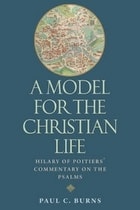
cover of A Model for the Christian Life: Hilary of Poitier's Commentary on the Psalms

A Model for the Christian Life

Hilary of Poitier's Commentary on the Psalms

Paul C. Burns

Catholic University of America Press, 2012
In this examination of Hilary's treatise, Paul C. Burns discusses the intended audience of Hilary's text and the use of the Psalms by Christians in the fourth century. He identifies Hilary's distinctive perspectives; his dependence on Origen; his Latin theological and exegetical tradition; and the creative directions of Hilary's thought.
[more]
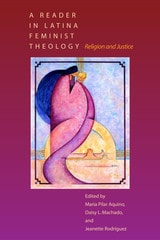
cover of A Reader in Latina Feminist Theology: Religion and Justice

A Reader in Latina Feminist Theology

Religion and Justice

Edited by María Pilar Aquino, Daisy L. Machado, and Jeanette Rodríguez

University of Texas Press, 2002

Speaking for the growing community of Latina feminist theologians, the editors of this volume write, "With the emergence and growth of the feminist theologies of liberation, we no longer wait for others to define or validate our experience of life and faith.... We want to express in our own words our plural ways of experiencing God and our plural ways of living our faith. And these ways have a liberative tone."

With twelve original essays by emerging and established Latina feminist theologians, this first-of-its-kind volume adds the perspectives, realities, struggles, and spiritualities of U.S. Latinas to the larger feminist theological discourse. The editors have gathered writings from both Roman Catholics and Protestants and from various Latino/a communities. The writers address a wide array of theological concerns: popular religion, denominational presence and attraction, methodology, lived experience, analysis of nationhood, and interpretations of life lived on a border that is not only geographic but also racial, gendered, linguistic, and religious.
[more]
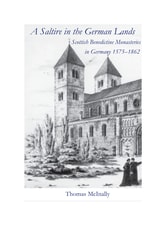
cover of A Saltire in the German Lands: Scottish Benedictine Monasteries in Germany 1575-1862

A Saltire in the German Lands

Scottish Benedictine Monasteries in Germany 1575-1862

Thomas McInally

Aberdeen University Press, 2017
For almost three hundred years, when Catholicism was illegal in Scotland, southern Germany was host to communities of Scottish Benedictine monks. From the Reformation onwards Scots went to monasteries run by their own countrymen in Bavaria, Franconia and Thuringia in order to take up life in a religious order. Throughout their stay in the lands of the Holy Roman Emperor the concern of these Scots Benedictines was to support and engage in the missionary activities of the Catholic Church in Scotland. Almost inevitably, however, they became involved in German political life in part through being active participants in their hosts’ counter-Reformation. They became witnesses to and minor participants in a number of major cataclysmic events including the Thirty Years’ War, the War of Austrian Succession, the French Revolutionary and Napoleonic Wars all of which threatened their continued existence. However, their survival and prosperity came to depend on the strong networks of support developed by Scots at home and in continental Europe. From the late seventeenth through to the nineteenth century the monasteries were able to engage energetically in the provision of education not only for their fellow Scots but for their German hosts. Efforts in this regard led to their making significant contributions to the wider European Enlightenment movement – a fact that has long been known in Germany although almost unrecognised elsewhere. A Saltire in the German Lands is an attempt to bring their achievements to the wider audience they deserve.
[more]
cover of A Service of Love

A Service of Love

Paul McPartlan

Catholic University of America Press, 2013
In this short and penetrating study, Paul McPartlan, a member of the international Roman Catholic-Orthodox theological dialogue, presents a proposal, carefully argued both historically and theologically, for a primacy exercising a service of love in a reconciled church, West and East.
[more]
cover of A Short Treatise on the Virgin Mary

A Short Treatise on the Virgin Mary

Rene Laurentin

Catholic University of America Press, 2022
As a peritus at Vatican II and by the end of his life arguably the world’s leading Mariologist, René Laurentin has earned the privilege of republication of a work of considerable value for any theologian who aims for comprehensiveness of Catholic theological perspective, historically and systematically. Laurentin’s orthodox, yet highly original treatment displays his command of all of the relevant biblical, patristic, medieval and modern texts up to and including the entire proceedings of the Second Vatican Council, as well as the whole range of related historical and theological scholarship. His proposal to pursue Mariological speculation along two tracks – first, “from above,” following the course of doctrinal development from biblical revelation to the VCII era, and second, “from below,” considering Mary’s own life (walking in her footsteps, as it were), from before the Annunciation to the Parousia – provides a clear, accessible structure for the work, yielding rich theological and spiritual fruit. Not only are all the major Marian doctrines and their developments handled with the greatest sensitivity, from the Virgin birth to the modern promulgations of Immaculate Conception and Assumption, but Laurentin’s approach in his second part opens the way to a human-psychological treatment of motherhood, still solidly bolstered by traditional Christian anthropology. Regarding Mary’s status as Mother of God, Laurentin’s discussion of the Theotokos exhibits his deep ecumenical commitments, as much as his specific attention to Mary’s soteriological role as a sticking point for Protestantism. One of the most striking qualities of the work is Laurentin’s deft integration of his evident scholastic formation into an overarching vision thoroughly at ease with the phenomenological (“personalist”) and existential currents in which he also inevitably swam throughout his education and professional scholarly occupation. As a result, the work can be read and appreciated instinctively, as it were, as much by the eclectic contemporary theologian, influenced by the likes of Heidegger, et al, as by the Thomist.
[more]
cover of A Symphony of Distances: Patristic, Modern, and Gendered Dimensions of Balthasar's Trinitarian Theology

A Symphony of Distances

Patristic, Modern, and Gendered Dimensions of Balthasar's Trinitarian Theology

Christopher M. Hadley, SJ

Catholic University of America Press, 2022
The two-fold task of A Symphony of Distances is to provide an overview of Hans Urs von Balthasar’s use of distance imagery with regard to personal distinctions in the Holy Trinity and to offer a critical analysis of him as a modern Catholic theologian. A metaphor of “distance” integrates all of Balthasar’s theological thought as a primary cipher for the many symbols through which he reads the Christian theological tradition in a trinitarian and eschatological mode. The book follows a chronological, four-stage development of Balthasar’s trinitarianism through the lens of this distance metaphor as it occurs across representative texts. The critical analysis employs the conceit of a symphony of four musical movements that correspond to four varieties of theological distance. These distances show certain correspondences of God’s creation and redemption of the world—marked by the first two “distances”—with the relations of the divine persons to each other in the economy of salvation and in the eternal Trinity itself—marked by the third and fourth distances. “Listening” to the four movements of Balthasar’s theological distances enables his readers to “hear” the themes of all four movements in the ascending order of richness, complexity, and inclusivity over the long development of his thought. This fundamentally positive approach of A Symphony of Distances allows for a thorough critique of the internal consistency of Balthasar’s applied method, of the controversial use of gendered trinitarian notions in his speculations on divine pathos, and of his adequacy to the tasks of modern theology. The final judgment is that Balthasar’s theology of distance can be accepted, with reservations, as a positive element of his contribution to contemporary trinitarian theology. The book can thus serve as a critical reference for readers who find Balthasar’s notion of trinitarian distance, and indeed his trinitarianism as a whole, to be compelling, confusing, or frustrating.
[more]
cover of A Treasure to be Shared: Understanding <i>Anglicanorum coetibus</i>

A Treasure to be Shared

Understanding <i>Anglicanorum coetibus</i>

Walter Oxley

Catholic University of America Press, 2022
A Treasure to Be Shared is intended to promote a more widespread knowledge of the Apostolic Constitution Anglicanorum coetibus, promulgated by Pope Benedict XVI in 2009. The Apostolic Constitution provided for Personal Ordinariates for Anglicans entering into full communion with the Catholic Church. On the occasion of the 10th anniversary of the Apostolic Constitution, an academic symposium in the year 2019 sponsored by the Pontifical Gregorian University and the Congregation for the Doctrine of the Faith, provided historical, liturgical, canonical and ecumenical perspectives on the fruits of the Apostolic Constitution for the wider Church. The hope is that the reader will see the Personal Ordinariates of The Chair of Saint Peter in the United States and Canada, Our Lady of Walsingham in Great Britain and Our Lady of the Southern Cross in Australia as a gift to the Church, and a treasure to be shared by all.
[more]
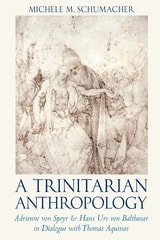
cover of A Trinitarian Anthropology: Adrienne von Speyr & Hans Urs von Balthasar in Dialogue with Thomas Aquinas

A Trinitarian Anthropology

Adrienne von Speyr & Hans Urs von Balthasar in Dialogue with Thomas Aquinas

Michele M. Schumacher

Catholic University of America Press, 2014

In this magisterial work, Michele M. Schumacher seeks to promote dialogue between disciples of the Swiss theologian Hans Urs von Balthasar (d. 1988) and those of the church's common doctor, St. Thomas Aquinas (d. 1274) on a critical theological question. How are analogies and metaphors from the philosophy and theology of the person (anthropology) rightly used to address the mystery of the Trinity? She does so by considering the specific setting of Balthasar's theology: the inseparability of his work from that of the Swiss physician and mystic Adrienne von Speyr (d. 1967).
[more]
cover of A Witness to the Silent Church: Memoirs of Ukrainian Cardinal Josyf Slipyj

A Witness to the Silent Church

Memoirs of Ukrainian Cardinal Josyf Slipyj

Josef Slipyj

Catholic University of America Press, 2025
A Witness of the Silent Church is a first-hand personal witness to the life of one of the outstanding religious leaders in the Catholic Church and the confessor of faith. It presents the autobiography of Cardinal Josyf Slipyj (1892-1984), who served as a head of the Ukrainian Greek-Catholic Church in the period of the Soviet regime (1944-1984) and led his Church through the difficult period of catacombs and persecutions. This memoir traces the trajectory and main events of Slipyj’s life and sheds light on his personality and inner world of his thoughts and intentions. They cover his childhood and formation period, his pastoral and scholarly ministry in the Church, as well as his suffering in prisons, camps, and exile until his liberation in 1963. Slipyj’s life story appears as a backdrop where the entire epoch unfolds. The reader can observe the religious life of Western Ukraine against the background of the complex religious, political and social developments of the twentieth century, the martyrology and underground activity of the Greek Catholics during the period of Church persecution, the dire fate of the clergy, faithful, and cultural and political leaders in the Soviet time. A Witness of the Silent Church is supplied with extensive commentaries and annotations that provide important insights into the religious life of Ukraine of this period. The introduction to Slipyj’s autobiography presents the complicated textual history of the manuscript, its historical value and prepares a reader for the historically-contextualized reading of these memoirs. Slipyj’s autobiography is supplemented with the two studies, which complete Slipyj’s unfinished narrative, elucidating the circumstances of Slipyj’s release from the Gulag and his activity in Rome during the last twenty years of his life (1963-1984) as well as the events following his death: such as Slipyj’s rehabilitation and the glorious return of his relics to the homeland. The book includes appendices with valuable historical documents related to the activity of Cardinal Josyf Slipyj as a witness of the silent Church of the martyrs. This book is intended for scholars, church historians, and all readers interested in the history of Catholic Church, Christian testimony of faith and the biographies of twentieth-century martyrs and confessors.
[more]
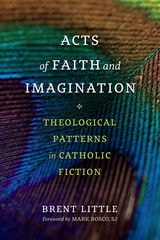
cover of Acts of Faith and Imagination: Theological Patterns in Catholic Fiction

Acts of Faith and Imagination

Theological Patterns in Catholic Fiction

Brent Little

Catholic University of America Press, 2023
Acts of Faith and Imagination wagers that fiction written by Catholic authors assists readers to reflect critically on the question: “what is faith?” To speak of a person’s “faith-life” is to speak of change and development. As a narrative form, literature can illustrate the dynamics of faith, which remains in flux over the course of one’s life. Because human beings must possess faith in something (whether religious or not), it inevitably has a narrative structure—faith ebbs and flows, flourishes and decays, develops and stagnates. Through an exploration of more than a dozen Catholic authors’ novels and short stories, Brent Little argues that Catholic fiction encourages the reader to reflect upon their faith holistically, that is, the way faith informs one’s affections, and how a person conceives and interacts with the world as embodied beings. Amidst the diverse stories of modern and contemporary fiction, a consistent pattern emerges: Catholic fiction portrays faith—at its most fundamental, often unconscious, level—as an act of the imagination. Faith is the way one imagines themselves, others, and creation. A person’s primary faith conditions how they live in the world, regardless of the level of conscious reflection, and regardless of whether this is a “religious” faith. Acts of Faith and Imagination investigates the creative depth and vitality of the Catholic literary imagination by bringing late modern Catholic authors into dialogue with more contemporary ones. Readers will then consider well-known works, such as those by Graham Greene, Flannery O’Connor, and Muriel Spark in the fresh light of contemporary stories by Toni Morrison, Alice McDermott, Uwem Akpan, and several others.
[more]
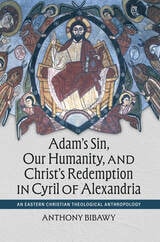
cover of Adam's Sin, Our Humanity, and Christ's Redemption in Cyril of Alexandria: An Eastern Christian Theological Anthropology

Adam's Sin, Our Humanity, and Christ's Redemption in Cyril of Alexandria

An Eastern Christian Theological Anthropology

Anthony Bibawy

Catholic University of America Press, 2026
As a result of the neo-patristic movement of the early twentieth century, the teachings of original sin and atonement as understood in the West were questioned and reformulated based on what was believed to be early Eastern Christian patristic thought. This new paradigm proposed that humanity inherited death and corruption, but not sin, from Adam and that the purpose of the incarnation and salvific work of Christ was to restore humanity from death and corruption, but not an inherent sinfulness. In contrast to this popular and seemingly dogmatic paradigm and false dichotomy between Western and Eastern teaching on sin and redemption, this book proposes that the writings of many Eastern fathers of the early fifth century incorporate many, if not the majority, of the terms and teachings behind what have been labeled as Western departures concerning the relationship between Adam’s sin, humanity, and its redemption in Christ. Through a comprehensive analysis of the writings of Cyril of Alexandria and some of his contemporaries in the early fifth century East during the time of the Pelagian controversy, this book demonstrates that a central and consistent theme of their soteriology revolves around the sinfulness and guilt of all humanity that is rooted in Adam’s sin and is resolved only through recapitulation into the new root, the second Adam, the impeccable Christ. Christ’s impeccability is necessary to correct the state of sinfulness and guilt in humanity through his incarnation and spotless sacrifice on the cross as a ransom and substitute on behalf of and in exchange of all to satisfy the divine justice and to restore humanity to its original state in the divine image.
[more]
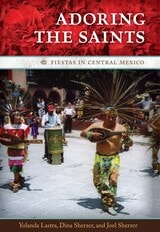
cover of Adoring the Saints: Fiestas in Central Mexico

Adoring the Saints

Fiestas in Central Mexico

By Yolanda Lastra, Dina Sherzer, and Joel Sherzer

University of Texas Press, 2009

Mexico is famous for spectacular fiestas that embody its heart and soul. An expression of the cult of the saint, patron saint fiestas are the centerpiece of Mexican popular religion and of great importance to the lives and cultures of people and communities. These fiestas have their own language, objects, belief systems, and practices. They link Mexico's past and present, its indigenous and European populations, and its local and global relations.

This work provides a comprehensive study of two intimately linked patron saint fiestas in the state of Guanajuato, near San Miguel de Allende—the fiesta of the village of Cruz del Palmar and that of the town of San Luis de la Paz. These two fiestas are related to one another in very special ways involving both religious practices and their respective pre-Hispanic origins.

A mixture of secular and sacred, patron saint fiestas are multi-day affairs that include many events, ritual specialists, and performers, with the participation of the entire community. Fiestas take place in order to honor the saints, and they are the occasion for religious ceremonies, processions, musical performances, dances, and dance dramas. They feature spectacular costumes, enormous puppets, masked and cross-dressed individuals, dazzling fireworks, rodeos, food stands, competitions, and public dances. By encompassing all of these events and performances, this work displays the essence of Mexico, a lens through which this country's complex history, religion, ethnic mix, traditions, and magic can be viewed.
[more]
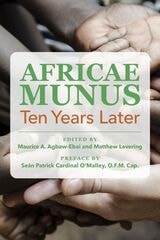
cover of Africae Munus: Ten Years Later

Africae Munus

Ten Years Later

Agbaw-ebai

St. Augustine's Press, 2022

With great foresight and vision for the Church, Pope Emeritus Benedict XVI carefully integrated theological, catechetical and pastoral themes in the Post-Synodal Apostolic Exhortation, Africae Munus. Maurice A. Agbaw-Ebai and Matthew Levering, in the introduction to this collection of reflections and studies focused on the Pope Emeritus’ themes, affirm the African continent’s status as a global center for the growth of the Catholic Church in the twenty-first century and the future of the international Catholic community.
     Building on the vitality and enthusiasm of the Church in Africa, it is important to lift their faith through scholarly research and academic reflections. We cannot fully appreciate the dedication, commitment and perseverance of the Catholic community throughout the African continent if we do not know the truth of their sufferings and persecution and understand their resilience in the light of faith. This collection, drawn from the halls of academia, provides an important contribution to the understanding and advancement of Catholic Africa, following the insights and enlightenment of Pope Emeritus Benedict. It is my hope that these essays will enrich your understanding and experience of the Catholic faith.

— From the Preface by Seán Patrick Cardinal O’Malley
[more]
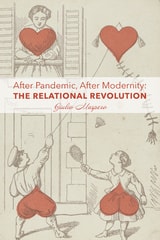
cover of After Pandemic, After Modernity: The Relational Revolution

After Pandemic, After Modernity

The Relational Revolution

Giulio Maspero

St. Augustine's Press, 2022

The global pandemic has levied a heavy toll on humanity, but in its wake appears a great opportunity. Amidst what he calls a crisis of modernity, Giulio Maspero points to a phenomenon that can be seen in plain sight. "The absence of personal relationships highlighted by the health crisis exposes the consequences of the modern matrix, which, having lost its Christian element, now risks transforming itself into a digital matrix, substantially configuring itself as a technognosis."   

Without Trinitarian framework ancient and new idols emerge, as the Covid-19 tragedies have shown. Yet post-pandemic must be a moment of clarity and realism, as we can see how necessary it is that humanity place itself in relation to something beyond. The post-modern journey, however, must be in the spirit of Christian humanism or else any so-called progress will no longer be unable to speak authentically of our humanity. That is to say, the relational dimension of human life will be erased right along with the other ills that plague our earth. 
[more]
cover of Against Eunomius

Against Eunomius

Catholic University of America Press, 2011
Basil of Caesarea is considered one of the architects of the Pro-Nicene Trinitarian doctrine adopted at the Council of Constantinople in 381, which eastern and western Christians to this day profess as ""orthodox."" Nowhere is his Trinitarian theology more clearly expressed than in his first major doctrinal work, Against Eunomius, finished in 364 or 365 CE. Responding to Eunomius, whose Apology gave renewed impetus to a tradition of starkly subordinationist Trinitarian theology that would survive for decades, Basil's Against Eunomius reflects the intense controversy raging at that time among Christians across the Mediterranean world over who God is. In this treatise, Basil attempts to articulate a theology both of God's unitary essence and of the distinctive features that characterize the Father, Son, and Holy Spirit--a distinction that some hail as the cornerstone of ""Cappadocian"" theology. In Against Eunomius, we see the clash not simply of two dogmatic positions on the doctrine of the Trinity, but of two fundamentally opposed theological methods. Basil's treatise is as much about how theology ought to be done and what human beings can and cannot know about God as it is about the exposition of Trinitarian doctrine. Thus Against Eunomius marks a turning point in the Trinitarian debates of the fourth century, for the first time addressing the methodological and epistemological differences that gave rise to theological differences. Amidst the polemical vitriol of Against Eunomius is a call to epistemological humility on the part of the theologian, a call to recognize the limitations of even the best theology. While Basil refined his theology through the course of his career, Against Eunomius remains a testament to his early theological development and a privileged window into the Trinitarian controversies of the mid-fourth century.
[more]
cover of Against Marcellus and On Ecclesiastical History

Against Marcellus and On Ecclesiastical History

Kelly Eusebius of Caesarea

Catholic University of America Press, 2018

This is the first English translation of the last two theological works of Eusebius of Caesarea, Against Marcellus and On Ecclesiastical Theology. The first text was composed after the deposition of Marcellus of Ancyra in 336 to justify the action of the council fathers in ordering the deposition on the grounds of heresy, contending that Marcellus was “Sabellian” (or modalist) on the Trinity and a follower of Paul of Samosata (hence adoptionist) in Christology. Relying heavily upon extensive quotations from a treatise Marcellus wrote against Asterius the Sophist, this text provides important information about ecclesiastical politics in the period before and just after the Council of Nicea, and endeavors to demonstrate Marcellus’s erroneous interpretation of several key biblical passages that had been under discussion since before the council. In doing so, Eusebius criticizes Marcellus’s inadequate account of the distinction between the persons of the Trinity, eschatology, and the Church’s teaching about the divine and human identities of Christ.

On Ecclesiastical Theology, composed circa 338/339 just before Eusebius’s death, and perhaps in response to the amnesty for deposed bishops enacted by Constantius after the death of Constantine in 377 and the possibility of Marcellus’s return to his see, continues to lay out the criticisms initially put forward in Against Marcellus, again utilizing quotations from Marcellus’s book against Asterius. However, we see in this text a much more systematic explanation of Eusebius’s objections to the various elements of Marcellus’s theology and what he sees as the proper orthodox articulation of those elements.

Long overlooked for statements at odds with later orthodoxy, even written off as heretical because allegedly “semi-Arian,” recent scholarship has demonstrated the tremendous influence these texts had on the Greek theological tradition in the fourth century, especially on the orthodox understanding of the Trinity. In addition to their influence, they are some of the few complete texts that we have from Greek theologians in the immediate period following the Council of Nicea in 325, thus filling a gap in the materials available for research and teaching in this critical phase of theological development.
[more]
cover of America's Theologian: Father Richard McBride of Notre Dame

America's Theologian

Father Richard McBride of Notre Dame

Todd Hartch

Catholic University of America Press, 2027
America's Theologian: Father Richard McBrien of Notre Dame is an intellectual biography of the Catholic theologian and commentator Richard McBrien (1936-2015), author of the best-selling Catholicism and 24 other books, arguably the most influential American Catholic voice of the 1980s and 1990s. Like Wilson Miscamble’s American Priest: The Ambitious Life and Conflicted Legacy of Notre Dame's Father Ted Hesburgh, this biography gives a respectful yet critical treatment of one of the lions of American liberal Catholicism. Openly radical in his younger days and critical of Vatican II for being too moderate, McBrien was frustrated with the slow pace of religious change in the 1970s but realized that his bold and straightforward approach was not working. His 1980 magnum opus, Catholicism, which sold 150,000 copies in its first edition and 50,000 more in later editions, marked a change of course. From this point forward, he adopted the rhetoric of moderation, used ambiguity to cloak his more radical ideas, and became an outspoken defender of Vatican II. His theology did not change, but he presented himself as a centrist who was defending the legacy of Vatican II. One of those impressed by Catholicism was University of Notre Dame President Ted Hesburgh, who recruited McBrien in 1980 to transform the university’s theology department. During his decade as chair, McBrien turned the Notre Dame theology department into an influential center of liberal Catholic theology.
[more]
cover of American Catholic Hospitals: A Century of Changing Markets and Missions

American Catholic Hospitals

A Century of Changing Markets and Missions

Wall, Barbra Mann

Rutgers University Press, 2016

In American Catholic Hospitals, Barbra Mann Wall chronicles changes in Catholic hospitals during the twentieth century, many of which are emblematic of trends in the American healthcare system.

Wall explores the Church's struggle to safeguard its religious values. As hospital leaders reacted to increased political, economic, and societal secularization, they extended their religious principles in the areas of universal health care and adherence to the Ethical and Religious Values in Catholic Hospitals, leading to tensions between the Church, government, and society. The book also examines the power of women--as administrators, Catholic sisters wielded significant authority--as well as the gender disparity in these institutions which came to be run, for the most part, by men. Wall also situates these critical transformations within the context of the changing Church policy during the 1960s. She undertakes unprecedented analyses of the gendered politics of post-Second Vatican Council Catholic hospitals, as well as the effect of social movements on the practice of medicine.
[more]
cover of American Catholicism

American Catholicism

John Tracy Ellis

University of Chicago Press, 1969

The Catholic Church remains one of the oldest institutions of Western civilization. It continues to withstand attack from without and defection from within. In his revision of American Catholicism, Monsignor Ellis has added a new chapter on the history of the Church since 1956. Here he deals with developments in Catholic education, with the changing relations of the Church to its own members and to society in general, and especially with arguments for and against the ecumenical movement brought about by Vatican Council II.

The author gives an updated historical account of the part played by Catholics in both the American Revolution and the Civil War, and of the difficulties within the Church that came with the clash of national interests among Irish, French, and Germans in the nineteenth century. He regards immigration as the key to the increasingly important role of American Catholicism in the nation after 1820. For contemporary America, the author counts among the signs of the mature Church an increase in Church membership, the presence of nine Americans in the College of Cardinals in May, 1967, and the expansion of American effort in Catholic missions throughout the world.
[more]
cover of An African Perspective on the Thought of Benedict XVI

An African Perspective on the Thought of Benedict XVI

Agbaw-ebai

St. Augustine's Press, 2023

Catholicism continues to experience an exponential growth in Africa. Going by the figures and the intensity of religious practice, Africa can unarguably be described as the new center of the Christianity in general, and Catholicism in particular. With over 236 million Catholics, Africa considers itself as having come of age and capable of making its voice heard on matters pertaining to global Catholicism/Christianity. And if there is a contemporary theologian greatly loved and admired by African scholars, Joseph Ratzinger/Benedict XVI ranks premium on that list. His convening a second synod on Africa on the theme of justice, peace and reconciliation, further endeared him to the African theologians. This book is a testimony to the affection that the Church in Africa has for Benedict XVI. In effect, as Africa finds its voice on the stage of global Catholicism, the theology of Joseph Ratzinger/Benedict XVI provides a fruitful space for Africa's engagement with the wider Church. Benedict XVI described Africa as the spiritual lung of the world. This volume testifies to the vitality and healthiness of that lung, a must read for all interested in African Catholicism and its definite impact on global Christianity as a whole. 
[more]
cover of An Anthropology of Vocations: Man-and-Woman, The Image of God

An Anthropology of Vocations

Man-and-Woman, The Image of God

Marc Ouellet

Catholic University of America Press, 2026
The revitalization of the Church requires a vocational renewal capable of stimulating participation, communion and mission in Christian communities. However, in order to conceive of such a renewal, we must take stock of the current anthropological challenge, which requires an adequate response in tune with our changing times and the current cultural conditions, marked by migration and the development of digital communication. The proceedings of the Roman Symposium of March 2024 offer a multidisciplinary approach to the anthropological theme, which, in a perspective of openness to universal fraternity, situates the enduring foundations of the Christian vision in relation to the various options circulating on questions of identity, belonging and integration that respects differences. This theological reflection on vocations fills a void and is a valuable resource for the Christian formation of all baptismal vocations, from school to university, in secular or religious settings. It is an indispensable complement to the work of the 2022 Symposium on the priesthood, published in six languages. There is no comparable update on the theme of vocations since the Second Vatican Council.
[more]
cover of An Evangelical Adrift: The Making of John Henry Newman's Theology

An Evangelical Adrift

The Making of John Henry Newman's Theology

Geertjan Zuijdwegt

Catholic University of America Press, 2022
An Evangelical Adrift is a theological biography of John Henry Newman (1801-1890) that reconstructs the most formative period in his development: the years between his teenage conversion to evangelicalism in 1816 and the beginning of the Tractarian Movement in 1833. By the early 1830s, Newman had explicitly rejected much of the theology he espoused in the late 1810s and early 1820s, and developed a highly original, deeply personal, and quite radical alternative, whose fundamental notions continued to shape his thought in later life. To date, there is neither a historically accurate nor a theologically sophisticated account of this change: the period in which it occurred is neglected, its significance is overlooked, its nature and content are misrepresented, and its scope is narrowed. Besides being modelled on Newman’s own brief treatment of the period in his autobiographical Apologia pro vita sua (1864), later scholarly accounts are burdened by a persistent assumption that Newman’s catholic sensibility and anti-liberal convictions were constants throughout his life. This assumption was problematized by Frank Turner’s revisionist biography of the Anglican Newman (2002) and the ensuing debate about its reception. Zuijdwegt argues that Turner rightly identified evangelicalism as a key polemical target of the Anglican Newman, but stretched his argument too far by reducing Newman’s self-proclaimed lifelong battle against liberalism as a much later gloss on this earlier history. The present study offers a compelling alternative to both mainline and revisionist interpretations. Based on detailed historical and theological analysis of the whole range of primary sources (including much neglected published and unpublished material), it meticulously reconstructs Newman’s youthful adoption of, gradual departure from, and theological alternative to evangelicalism. Against most mainline studies, it argues that this was a fundamental transformation, affecting nearly every aspect of Newman’s theology. Against Turner and other revisionists, it argues that this change was the product of careful and consistent theological reasoning and reflection, and that anti-liberalism was just as integral to it as anti-evangelicalism.
[more]
cover of An Exemplar of the True: The Tabernacle and the Architecture of Medieval Theology

An Exemplar of the True

The Tabernacle and the Architecture of Medieval Theology

Allison Zbicz Michael

Catholic University of America Press, 2026
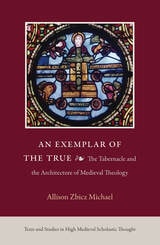
Scholarly academics, cloistered monks, and high-ranking prelates once found abundantly fertile material for theological reflection in the Exodus descriptions of Tabernacle and the Ark of the Covenant. Where traditional scholarly accounts of the rise of scholasticism tend to focus almost entirely on the incorporation of Aristotelian thought and the legacy of Peter Lombard’s sententiae, attention to these works illuminates some of the deeply biblical roots of scholastic patterns of thought. The Tabernacle often appealed to these early interpreters because it provided a valuable source for exploring the structural patterns embedded in creation. The first part of this book examines the works of four major twelfth-century figures on this popular interpretive theme. Richard of St. Victor, Stephen Langton, Peter of Poitiers, and Adam of Dryburgh each share the conviction that the details of the Tabernacle’s material structure reflect the structures of immaterial truths. The second part of the book shows the rich inheritance of this tradition, as received by Saint Bonaventure and Saint Thomas Aquinas. In the twelfth-century, the image of the Tabernacle, composed of diverse parts arranged in a coherent whole, provides a divinely-given source for theological method and a model for attempts to systematize and integrate various forms of knowledge. At times, the Tabernacle structure suggests for these interpreters certain correspondences with Aristotelian insights, while elsewhere, the edifice undergirds attempts to offer a rigorous counterbalance to perceived philosophical excesses. In both cases, the Tabernacle is taken as a biblical locus for working through methodological questions prompted by the increasing availability of Aristotle’s corpus. These biblical interpreters bequeathed to the thirteenth-century magistri a structural framework and a confidence that disparate forms of human knowing all fit together.
[more]
cover of An Image of God: The Catholic Struggle with Eugenics

An Image of God

The Catholic Struggle with Eugenics

Sharon M. Leon

University of Chicago Press, 2013
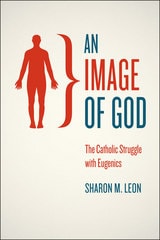
During the first half of the twentieth century, supporters of the eugenics movement offered an image of a racially transformed America by curtailing the reproduction of “unfit” members of society. Through institutionalization, compulsory sterilization, the restriction of immigration and marriages, and other methods, eugenicists promised to improve the population—a policy agenda that was embraced by many leading intellectuals and public figures. But Catholic activists and thinkers across the United States opposed many of these measures, asserting that “every man, even a lunatic, is an image of God, not a mere animal."

In An Image of God, Sharon Leon examines the efforts of American Catholics to thwart eugenic policies, illuminating the ways in which Catholic thought transformed the public conversation about individual rights, the role of the state, and the intersections of race, community, and family. Through an examination of the broader questions raised in this debate, Leon casts new light on major issues that remain central in American political life today: the institution of marriage, the role of government, and the separation of church and state. This is essential reading in the history of religion, science, politics, and human rights.

[more]
cover of An Introduction to Personalism

An Introduction to Personalism

Juan Manuel Burgos

Catholic University of America Press, 2018

Much has been written about the great personalist philosophers of the 20th century – including Jacques Maritain and Emmanuel Mournier, Martin Buber and Emmanuel Levinas, Dietrich von Hildebrand and Edith Stein, Max Scheler and Karol Wojtyla (later Pope John Paul II) – but few books cover the personalist movement as a whole. An Introduction to Personalism fills that gap.

Juan Manuel Burgos shows the reader how personalist philosophy was born in response to the tragedies of two World Wars, the Great Depression, and the totalitarian regimes of the 1930s. Through a revitalization of the concept of the person, an array of thinkers developed a philosophy both rooted in the best of the intellectual tradition and capable of dialoguing with contemporary concerns.

Burgos then delves into the potent ideas of more than twenty thinkers who have contributed to the growth of personalism, including Romano Guardini, Gabriel Marcel, Xavier Zubiri, and Michael Polanyi. Burgos’s encyclopedic knowledge of the movement allows for a concise and well-rounded perspective on each of the personalists studied.

An Introduction to Personalism concludes with a synthesis of personalist thought, bringing together the brightest insights of each personalist philosopher into an organic whole. Burgos argues that personalism is not an eclectic hodge-podge, but a full-fledged school of philosophy, and gives a dynamic and rigorous exposition of the key features of the personalist position.

Our times are marked by numerous and often contradictory ideas about the human person. An Introduction to Personalism presents an engaging anthropological vision capable of taking the lead in the debate about the meaning of human existence and of winning hearts and minds for the cause of the dignity of every person in the 21st century and beyond.
[more]
cover of An Introduction to Vatican II as an Ongoing Theological Event

An Introduction to Vatican II as an Ongoing Theological Event

Matthew Levering

Catholic University of America Press, 2017

Contemporary scholars often refer to “the event of Vatican II,” but what kind of an event was it? In this first book of the new CUA Press series Sacra Doctrina, Matthew Levering leads his readers to see the Council as a “theological event”—a period of confirming and continuing God’s self-revelation in Christ into a new historical era for the Church.

This is an introduction to Vatican II with a detailed summary of each of its four central documents—the dogmatic constitutions—followed by explanations of how to interpret them. In contrast to other introductions, which pay little attention to the theological soil in which the documents of Vatican II germinated, Levering o­ffers a reading of each conciliar Constitution in light of a key theological author from the era: René Latourelle, SJ for Dei Verbum (persons and propositions); Louis Bouyer, CO for Sacrosanctum Concilium (active participation); Yves Congar, OP for Lumen Gentium (true and false reform); and Henri de Lubac, SJ for Gaudium et Spes (nature and grace).

This theological event is “ongoing,” Levering demonstrates, by tracing in each chapter the theological debates that have stretched from the close of the council till the present, and the difficulties the Church continues to encounter in encouraging an ever deeper participation in Jesus Christ on the part of all believers. In this light, the book’s final chapter compares the historicist (Massimo Faggioli) and Christological (Robert Imbelli) interpretations of Vatican II, arguing that historicism can undermine the Council’s fundamental desire for a reform and renewal rooted in Christ. The conclusion addresses the concerns about secularization and loss of faith raised after the Council by Henri de Lubac, Joseph Ratzinger, and Yves Congar, arguing that contemporary Vatican II scholarship needs to take these concerns more seriously.

[more]
cover of Ancestral Voices: Religion and Nationalism in Ireland

Ancestral Voices

Religion and Nationalism in Ireland

Conor Cruise O'Brien

University of Chicago Press, 1995

Scholar and statesman Conor Cruise O'Brien illuminates why peace has been so elusive in Northern Ireland. He explains the conflation of religion and nation through Irish history into our own time. Using his life as a prism through which he interprets Ireland's past and present, O'Brien identifies case after case of the lethal mixing of God with country that has spilled oceans of blood throughout this century of nationalism and that, from Bosnia to Northern Ireland, still curses the world.

"O'Brien's bravura performance [is] seductive in its intellectual sweep and literary assurance."—Toby Barnard, Times Literary Supplement

"Has the magical insistence which Conor Cruise O'Brien can produce at his best. . . . Where he looks back to his own childhood the book shines. He writes of his mother and father with effortless grace and candor, with a marvelous, elegant mix of affection and detachment."—Observer
[more]
cover of Anthony of Padua: Franciscan, Preacher, Teacher, Saint

Anthony of Padua

Franciscan, Preacher, Teacher, Saint

Valentin Strappazzon, Valentin

Catholic University of America Press, 2024
Anthony of Padua: Franciscan, Preacher, Teacher, Saint represents the culmination of a lifetime of scholarly work by Valentin Strappazzon (d. 2023) on Anthony of Padua and especially on his sermons and spirituality. About 20 years prior to this volume, he had penned a short overview of his life in the popular "Petites Vies" series in the French language. A few years before the publication of the book in question, he edited and published three significant volumes on the sermons of the saint. Although the present volume has been written in a less rigorous and erudite manner, it is intended to be a solid historical and analytical treatment for a wider reading public interested in the life and preaching of this fascinating medieval friar. Particular attention is given to explaining how and why Anthony, once he became a Franciscan living in France and Italy, became the focus of intense waves of popular devotion to whom numerous miracles and wonders came to be attributed both in the Middle Ages and even in our own time. Being the penultimate work of this author, written in French and lucidly translated by Michael F. Cusato, Anthony of Padua is a work of intelligence and reflection on a medieval figure who has too often only been the subject of piety rather than an assessment of the towering spiritual person that he was.
[more]
cover of Anti-Catholicism in Arkansas: How Politicians, the Press, the Klan, and Religious Leaders Imagined an Enemy, 1910–1960

Anti-Catholicism in Arkansas

How Politicians, the Press, the Klan, and Religious Leaders Imagined an Enemy, 1910–1960

Kenneth C. Barnes

University of Arkansas Press, 2016

Winner, 2017 Ragsdale Award

A timely study that puts current issues—religious intolerance, immigration, the separation of church and state, race relations, and politics—in historical context.

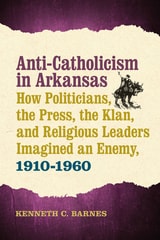
The masthead of the Liberator, an anti-Catholic newspaper published in Magnolia, Arkansas, displayed from 1912 to 1915 an image of the Whore of Babylon. She was an immoral woman sitting on a seven-headed beast, holding a golden cup “full of her abominations,” and intended to represent the Catholic Church.

Propaganda of this type was common during a nationwide surge in antipathy to Catholicism in the early twentieth century. This hostility was especially intense in largely Protestant Arkansas, where for example a 1915 law required the inspection of convents to ensure that priests could not keep nuns as sexual slaves.

Later in the decade, anti-Catholic prejudice attached itself to the campaign against liquor, and when the United States went to war in 1917, suspicion arose against German speakers—most of whom, in Arkansas, were Roman Catholics.

In the 1920s the Ku Klux Klan portrayed Catholics as “inauthentic” Americans and claimed that the Roman church was trying to take over the country’s public schools, institutions, and the government itself. In 1928 a Methodist senator from Arkansas, Joe T. Robinson, was chosen as the running mate to balance the ticket in the presidential campaign of Al Smith, a Catholic, which brought further attention.

Although public expressions of anti-Catholicism eventually lessened, prejudice was once again visible with the 1960 presidential campaign, won by John F. Kennedy.

Anti-Catholicism in Arkansas illustrates how the dominant Protestant majority portrayed Catholics as a feared or despised “other,” a phenomenon that was particularly strong in Arkansas.
[more]
cover of Approaching the Assumption, 1863-1950: Revelation, Scripture, and the Laity in the Development of a Marian Dogma

Approaching the Assumption, 1863-1950

Revelation, Scripture, and the Laity in the Development of a Marian Dogma

Eric Lafferty

Catholic University of America Press, 2026
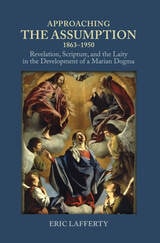
The Assumption of Mary refers to the ancient Christian belief that the Mother of God was taken up into Heaven, body and soul, at the end of her earthly life. For centuries, Catholics and other Christians celebrated the Assumption as a liturgical feast and meditated on the miraculous event in the Rosary. Nevertheless, its relationship to Revelation remained undefined. This changed in 1950 when Pope Pius XII declared the Assumption of Mary a dogma of the Catholic Church. In this rare exercise of papal authority, Pius XII infallibly and irrevocably taught that the Assumption was a truth revealed by God. This book explores how the definition of this Marian dogma came to fruition. After a brief history of the prior three Marian dogmas — Mother of God, Ever-Virgin, and the Immaculate Conception — this book narrates the major moments in the effort to obtain a dogmatic definition of the Assumption. The beginning of this “Assumptionist movement” can be dated to 1863 when Queen Isabel II of Spain petitioned the pope to declare the Assumption a dogma. Subsequently, petitionary efforts and scholarly inquiry increased and spread throughout the world. In addition to the narrative of this movement, this book gives special consideration to three vital aspects: debate over the Assumption’s definability as a dogma, if and how Scripture reveals the Assumption, and the contribution of the laity on a matter of doctrine. Collectively, the Assumptionist movement emerges as a critical event in the nineteenth- and twentieth-century Catholic Church. Culminating in a dogmatic definition shortly before the opening of Vatican II, it also serves as a key point of inquiry for continuity and development of doctrine. A final chapter argues that the operative beliefs pertaining to Revelation, Scripture, and the laity during the Assumptionist movement stand in continuity with the teachings of Vatican II.
[more]
cover of Aquinas and the Early Chinese Masters: Chinese Philosophy and Catholic Theology

Aquinas and the Early Chinese Masters

Chinese Philosophy and Catholic Theology

Joshua Brown

Catholic University of America Press, 2025
Aquinas and the Early Chinese Masters lays intellectual foundations for the integration of Chinese philosophy into Catholic theology. Although Catholic theology in Chinese contexts has drawn upon Chinese philosophical concepts, few have attempted to develop a rigorous, systematic approach to testing what in the Chinese philosophical traditions can be fruitful or unfruitful for Catholic theological expression. This book attempts to model such an approach by engaging classical Chinese philosophy with the mind and spirit of St. Thomas Aquinas, who read Aristotle and other pagan philosophers with both charitable appreciation and a firm, critical eye. It applies this Thomistic lens through concrete comparative engagements with three main representatives of early Chinese philosophy: Mencius (Mengzi孟子), Xunzi荀子, and Mozi墨子. In each chapter, the book presents Aquinas’ thought as an evaluative frame for perceiving how Chinese philosophical commitments and concepts do or do not seem fit for adoption into Catholic theological science. Following the general structure of the Summa theologiae, the book is comprised of six chapters touching on the doctrine of God, morality, and Christology. The first two chapters engage Confucian master Mengzi’s notion of Heaven (Tian天), and then the Mohist doctrine of Heaven’s Will (Tian zhi天志). Chapter three provides a Thomistic assessment of the two main positions in the classical Confucian debate on the goodness of man’s moral nature (renxing人性). Chapter four compares Aquinas’ account of charity and Mozi’s doctrine of “universal love” (jian ai兼愛). Chapter 5 offers a Thomistic assessment of the possibility of understanding Christ in terms of Xunzi’s “sage” (shengren聖人). Finally, Chapter 6 explores Christ as a moral teacher by putting Aquinas’ reading of Matt 8:21-22 into conversation with Confucian ethics of filial virtue.
[more]
cover of Aquinas at 800: Commemorative Studies 1225-2025, Volume 1

Aquinas at 800

Commemorative Studies 1225-2025, Volume 1

David Cory

Catholic University of America Press, 2025

These volumes gather together the latest research from 40 of the world's most eminent Thomistic theologians and philosophers, in commemoration of the 800th anniversary of Thomas Aquinas's birth. To mark this anniversary, these scholars each prepared a chapter that is an original research study shared at a major international conference in September 2024. The volumes cover a wide range of both philosophical and theological topics, reflecting the breadth of Aquinas's own thought, and will be organized by subject matter. Together, these volumes will provide a compendium of outstanding research on the wide spectrum of Aquinas's thought, which we hope will have enduring value for the field, offering an opportunity to revisit the ongoing importance of the work of Thomas Aquinas today.
[more]
cover of Aquinas at 800: Commemorative Studies 1225-2025, Volume 2

Aquinas at 800

Commemorative Studies 1225-2025, Volume 2

David Cory

Catholic University of America Press, 2025

These volumes gather together the latest research from 40 of the world's most eminent Thomistic theologians and philosophers, in commemoration of the 800th anniversary of Thomas Aquinas's birth. To mark this anniversary, these scholars each prepared a chapter that is an original research study shared at a major international conference in September 2024. The volumes cover a wide range of both philosophical and theological topics, reflecting the breadth of Aquinas's own thought, and will be organized by subject matter. Together, these volumes will provide a compendium of outstanding research on the wide spectrum of Aquinas's thought, which we hope will have enduring value for the field, offering an opportunity to revisit the ongoing importance of the work of Thomas Aquinas today.
[more]
cover of Aquinas on Prophecy: Wisdom and Charism in the <i>Summa Theologiae</i>

Aquinas on Prophecy

Wisdom and Charism in the <i>Summa Theologiae</i>

Paul M. Rogers

Catholic University of America Press, 2023

Aquinas on Prophecy argues that a lacuna exists (especially among Anglophone scholars of Aquinas) that neglects to identify his most famous work as a prophetic witness to the transformative effect of Christian theology. Through a detailed examination of Aquinas’s treatment of prophecy in the Summa Theologiae (II-II, QQ.171-174), Paul Rogers reveals how prophetic testimony is central to the understanding of Christian revelation, faith, and theology, since it presents an initial (and historically-rooted) model for a Christian pedagogy that attempts to affect intellectual and moral transformation through communicating knowledge about God. The theologian thus conceived by Aquinas exercises analogously a prophetic, and hence social, function among Christian believers that has a special care for their spiritual and moral guidance. In contrast to readings of Aquinas that portray him as overly reliant on Aristotelian gnoseology (e.g., Jenkins 1997), Rogers lays out a reading more in line with recent ‘ressourcement’ Thomistic interpreters that identifies in his account of prophecy a creative adaptation of Arabic-Aristotelian gnoseology in the service of clarifying difficulties that had arisen in the thirteenth century surrounding the reception of a patristic (and predominantly Augustinian) tradition of prophetic illumination or vision. In the hands of Aquinas, the traditional Augustinian theory of prophetic illumination was re-envisioned and reinvigorated, which in turn allowed him to reassert confidently prophecy’s status as certain knowledge (scientia) that required its own distinct ‘light’, comparable to the light of natural reason and the lights of faith and glory. Highlighting prophecy in Aquinas’s thought helps especially to refocus today’s readers on how knowledge of the final end as revealed was for Aquinas the ultimate moral objective shared by both the prophet and theologian: a point that is best appreciated when his account of prophecy is related back to his understanding of sacred doctrine and faith as a whole—the book’s central task.
[more]
cover of Aquinas' Cruciform Theology of the Natural Law

Aquinas' Cruciform Theology of the Natural Law

Kevin E. O'Reilly

Catholic University of America Press, 2026

The predominant understanding of St. Thomas’s account of the natural law to date has been that it is basically philosophical in character. In Thomas Aquinas’s Cruciform Theology of the Natural Law, Kevin E. O’Reilly, OP, argues that Thomas’s construal of the natural law is, on the contrary, thoroughly theological in its inspiration. In order to establish this point the author first unpacks the significance of the scriptural quotations employed by Thomas in his very first article devoted to the natural law (ST I-II, q. 91, a. 2). Exegesis of one of those quotations, namely Ps. 4:6 – "Offer up the sacrifice of justice" – intimates that the degree to which one grasps the demands of the natural law is intimately bound up with the extent to which one is conformed to the Crucified Christ. Consideration of the notion that the natural law is the participation of the eternal law in the rational creature yields the same conclusion. Thus, while the eternal law pertains to God’s essence, it is nevertheless expressed by and therefore appropriated to the Word uttered by the Father. This Word is the divine Wisdom ultimately disclosed on the Cross. It becomes apparent that the eternal law is thus cruciform in nature. So too is the natural law as a cognitive participation therein. This cognitive participation engages the life of faith and charity as well as the Gifts of the Holy Spirit. Examination of Thomas’s account of the three degrees of charity as well as his treatment of the Gifts of the Holy Spirit and the beatitudes that are correlated with them underscores the important role that the dynamics of cruciformity play in illuminating the demands of the natural law. Cruciformity and moral illumination are intimately connected.
[more]