501 books match the query 'Catholic Church' and 56 start with a
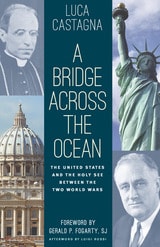
cover of A Bridge Across the Ocean

A Bridge Across the Ocean

Luca Castagna

Catholic University of America Press, 2014
A Bridge across the Ocean focuses on the relations between the United States and the Holy See from the First World War to the eve of the Second, through the combination of American, Italian, and Vatican sources. More than an overall picture of the American and Vatican foreign policy during the first half of the twentieth century, the book analyzes the U.S.-Vatican rapprochement in a multifaceted way, considering both the international and the internal sphere. A Bridge across the Ocean discusses the spread of anti-Catholicism in the United States during the first two decades of the twentieth century, and its repercussions on the American administrations' behavior during and after the Versailles Conference, together with the changes that occurred in the Holy See's attitude toward the American church and the White House after the election of Pope Pius XI. Luca Castagna explores the convergence of the New Deal legislation with the church's social thought, and demonstrates how the partial U.S.-Vatican rapprochement in 1939 resulted from Roosevelt and Pacelli's common aim to cooperate, as two of the most important and global moral powers in the struggle against Nazi-fascism.
[more]
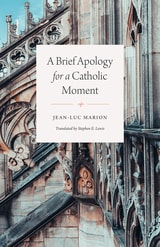
cover of A Brief Apology for a Catholic Moment

A Brief Apology for a Catholic Moment

Jean-Luc Marion

University of Chicago Press, 2021
A timely new work by one of France’s premier philosophers, A Brief Apology for a Catholic Moment offers insight into what “catholic” truly means. In this short, accessible book, Jean-Luc Marion braids the sense of catholic as all-embracing and universal into conversation about what it is to be Catholic in the present moment. A Brief Apology for a Catholic Moment tackles complex issues surrounding church-state separation and addresses a larger Catholic audience that transcends national boundaries, social identities, and linguistic differences. Marion insists that Catholic universalism, with its core of communion and community, is not an outmoded worldview, but rather an outlook that has the potential to counter the positivist rationality and nihilism at the core of our current political moment, and can help us address questions surrounding liberalism and religion and what is often presented as tension between “Islam and the West.” As an inviting and sophisticated Catholic take on current political and social realities—realities that are not confined to France alone—A Brief Apology for a Catholic Moment is a valuable contribution to a larger conversation.
[more]
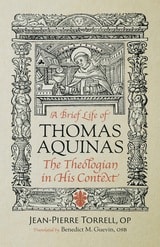
cover of A Brief Life of Aquinas: The Theologian in His Context

A Brief Life of Aquinas

The Theologian in His Context

Jean-Pierre Torrell

Catholic University of America Press, 2024
Jean-Pierre Torrell, OP, who has already written the most highly-regarded contemporary two-volume introduction to the life and works of Saint Thomas, has composed a shorter book that captures the essence of the career of the Angelic Doctor for a more general audience. Torrell follows a biographical outline of the saint, although he also includes brief accounts of what the author takes to be the most important features of Aquinas's teachings. Part biography, part travelogue, part theology, Jean-Pierre Torrell, OP’s A Brief Life of Thomas Aquinas is a multi-faceted look at the life and the writings of Saint Thomas Aquinas. Torrell’s hope is that his biography of the doctor communis intertwined with his theological examination of Aquinas’s writings will enable the reader to understand the person behind the writer and the writer behind the person. Aquinas’s life, Torrell claims, can shed light on his work with respect not only to their number, or to the varied topics he writes about, but to their content as well. It would be inaccurate to view Aquinas hiding behind a mountain of books in the cells he occupied in the various houses he inhabited around the Dominican world. He taught, he preached, he debated, he faced a number of conflicts of ideas that were not of his own making, but out of which would come some of his best-known writings. Torrell’s unique approach makes accessible one of the greatest minds of our tradition and the richness of the legacy he left the Church.
[more]
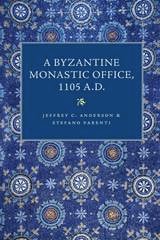
cover of A Byzantine Monastic Office, A.D. 1105

A Byzantine Monastic Office, A.D. 1105

Jeffrey C. Anderson

Catholic University of America Press, 2016
This book centers on a Greek text that was likely compiled in Constantinople, in 1105, for use in one of the monasteries located there. The book is a liturgical psalter, containing the fixed structure (the ordinary) in both the Greek original and in English translation, as well as a description of the hours themselves. The extensive commentary explains the development of the monastic office, and the particular history of the translated manuscript, while brief notes clarify and explain, in a way suitable for non-liturgists, the more-technical aspects of the offices.
[more]
cover of A Catechism For Business

A Catechism For Business

Andrew V. Abela

Catholic University of America Press, 2014
A Catechism for Business presents the teachings of the Catholic Church as they relate to more than one hundred specific and challenging moral questions that have been asked by business leaders. Andrew V. Abela and Joseph E. Capizzi have assembled the relevant quotations from recent Catholic social teaching as responses to these questions. Questions and answers are grouped under major topics such as marketing, finance, and investment. Business ethics questions can be too subtle for definitive yes / no answers, so the book offers no more and no less than church teaching on each particular question. Where the church has offered definitive answers, the book provides them. When the church has not, the book offers guidelines for reflection and insights into what one should consider in given situations.
[more]
cover of A Catechism for Business

A Catechism for Business

Andrew V. Abela

Catholic University of America Press, 2016
This second edition streamlines some of the editing from the first addition, and more importantly, includes material from Pope Francis's encyclical, Laudato Si’, and his apostolic exhortation, Evangelii Gaudium. A Catechism for Business presents the teachings of the Catholic Church as they relate to more than one hundred specific and challenging moral questions as they have been asked by business leaders. Andrew V. Abela and Joseph E. Capizzi have assembled the relevant quotations from recent Catholic social teaching as responses to these questions. Questions and answers are grouped together under major topics such as marketing, finance and investment. The book's easy-to-use question and answer approach invites quick reference for tough questions and serves as a basis for reflection and deeper study in the rich Catholic tradition of social doctrine.
[more]
cover of A Catechism for Family Life

A Catechism for Family Life

Sarah Bartel

Catholic University of America Press, 2018

The purpose of A Catechism for Family Life: Insights from Catholic Teaching on Love, Marriage, Sex, and Parenting is to present the teachings of the Catholic Church as they relate to specific questions in marriage and family life. Many Catholics are under-catechized and have trouble both understanding and articulating Church teaching on sexuality and marriage to an increasingly challenging culture. Pope Francis, along with the fathers of the two recent Synods on the Family, have called for better formation for those who work in the area of marriage and family life (see Amoris Laetitia, 202).

To address this need, we gathered pertinent questions facing men, women, and pastoral workers in marriage and family life. We then found passages relevant to these questions by researching Church documents on marriage and family from the past one hundred years. These include papal encyclicals, apostolic exhortations, and addresses, Vatican II documents, and the Catechism of the Catholic Church.

Mainstream media coverage of Church events and Church teaching leads many to misunderstand Catholic positions on marriage and family life. While the Catholic Church has developed a rich, detailed, and positive teaching on marriage, family, and sexuality, many Catholics do not have access to this teaching, buried as it is in lengthy Church documents which many find intimidating. Finding the relevant teaching to address specific questions is not always a simple task, either. This book’s main contribution is to present Church teaching relevant to marriage and family in one volume clearly organized by topic and question.
[more]
cover of A Catechism for Health Care: Insights from Catholic Teaching on Human Life, Medical Ethics, and Love of Neighbor

A Catechism for Health Care

Insights from Catholic Teaching on Human Life, Medical Ethics, and Love of Neighbor

Stephen Napier

Catholic University of America Press, 2024
The Catholic Church’s teachings on ethical issues arising in healthcare delivery and biomedical science are distributed across a plethora of different places ranging from papal allocutions, encyclicals, instructions by the Congregation for the Doctrine of the Faith, and guidance documents authored by various congregations of bishops. Furthermore, they are distributed throughout time ranging from, for example, the Didache (or teaching of the 12 apostles, circa 1st Century), to Pope Pius XII’s address in 1954 addressing ethical issues in transplantation, and onto the 2009 instruction entitled Dignitas personae. It is difficult for a wider audience to make sense of these sources on the various issues arising in healthcare delivery and scientific research, but the editors of A Catechism for Health Care have collated them in a way that makes them easier to understand The purpose of this book is to present the teachings of the Catholic Church as they pertain to ethical issues arising in the healthcare and biomedical sciences. The premise of the project is that the Catholic Church’s teaching speaks in an accessible way to a wide range of people concerned about healthcare ethics. It is important to present these teachings concisely. The book is ordered around numerous questions concerning the most common practices in health care that have ethical dimensions. It then provides concise answers to these questions as are found in various magisterial Church documents. These answers are refreshingly clear and to the point.
[more]
cover of A Catholic Spirituality for Business

A Catholic Spirituality for Business

Martin Schlag

Catholic University of America Press, 2019

Spirituality and gift are notions that are en vogue. Topics such as spirituality at the workplace, spirituality management, spirituality in leadership, organizational spirituality and other related topics are trending in management literature. The “logic of gift” is also appearing more frequently, especially in attempts to rethink the way our economy works in order to include the marginalized.
<
The expression “logic of gift” was introduced into official Catholic social teaching by Pope Benedict XVI, who presented it in association with the principle of gratuitousness, which in turn is an expression of fraternity. However, before Caritas in Veritate and ever since Marcel Mauss’s groundbreaking work The Gift, the importance of gift for human relationships and for the cohesion of society had been increasingly recognized. Alain Caillé and Jacques T. Godbout further fleshed out the implication of gift for contemporary society in the context of secular social sciences, striving to overcome utilitarianism. It was the “civil economy” movement, however, that exercised greatest influence on Benedict XVI’s encyclical Caritas in Veritate
This present volume reflects on the general scope of these notions for business and society. This is done by structuring the book in two parts, each dedicated to one of the two concepts. Each part has two general chapters and two that apply the notions to business and to business education. The authors are a mix of well-known emeritus professors and younger talented emerging scholars. We have also been careful to combine European with American authors.

A Catholic Spirituality for Business: The Logic of Gift does not seek to provide a definitive answer to all social challenges, but to make a contribution to a better understanding of Christian spirituality and gift in connection with business organizations. The authors in this book are convinced that markets can be ethical and social, that moral change towards ethical capitalism is possible.
[more]
cover of A Christian Samurai

A Christian Samurai

William J. Farge

Catholic University of America Press, 2016
Through a close critical analysis of Baba Bunko's often humorous, but always biting, satirical essays a new picture of the hidden world of Christianity in eighteenth-century Japan emerges - a picture that contradicts the generally-held belief among Western historians that the Catholic mission in Japan ended in failure. A Christian Samurai will surprise many readers when they discover that Christian moral teachings not only survived the long period of persecution but influenced Japanese society throughout the Tokugawa period.
[more]
cover of A Cry for Justice: Daniel Rudd and His Life in Black Catholicism, Journalism, and Activism, 1854-1933

A Cry for Justice

Daniel Rudd and His Life in Black Catholicism, Journalism, and Activism, 1854-1933

Gary B. Agee

University of Arkansas Press, 2017
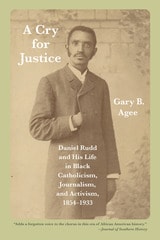
Daniel A. Rudd, born a slave in Bardstown, Kentucky, grew up to achieve much in the years following the Civil War. His Catholic faith, passion for activism, and talent for writing led him to increasingly influential positions in many places. One of his important early accomplishments was the publication of the American Catholic Tribune, which Rudd referred to as "the only Catholic journal owned and published by colored men." At its zenith, the Tribune, run out of Detroit and Cincinnati, where Rudd lived, had ten thousand subscribers, making it one of the most successful black newspapers in the country. Rudd was also active in the leadership of the Afro-American Press Association, and he was a founding member of the Catholic Press Association. By 1889, Rudd was one of the nation's best-known black Catholics. His work was endorsed by a number of high-ranking church officials in Europe as well as in the United States, and he was one of the founders of the Lay Catholic Congress movement. Later, his travels took him to Bolivar County, Mississippi, and eventually on to Forrest City, Arkansas, where he worked for the well-known black farmer and businessperson, Scott Bond, and eventually co-wrote Bond's biography.
[more]
cover of A Defense of Free Will Against Luther: Assertionis Lutheranae Confutatio, Article 36

A Defense of Free Will Against Luther

Assertionis Lutheranae Confutatio, Article 36

Thomas P. St. John Fisher

Catholic University of America Press, 2024
Lord Acton said that of all the works written against Martin Luther in the beginning of the Reformation, Bishop John Fisher of Rochester's Assertionis Lutheranae Confutatio of 1523 was the most important. Oddly enough this massive work of Catholic apologetics, compsed in Latin, has never been rendered into the English language. It contains Fisher's detailed responses to all forty-one articles defended by Martin Luther against the censures of Pope Leo X found in the bull Exsurge Domine (1520). In this volume Thomas Scheck presents for the first time in English translation, introduced, and annotated, Fisher's Preface to the Reader, Ten Truths, and the most important single article found in Fisher's Confutation, namely his Confutation of Luther's Assertion of Article 36, in which Fisher defends the existence of free will against Luther's claim that free will is a fiction with no reality. Fisher's reply is thoroughly grounded in Scripture and in the interpretation of Scripture found in the ancient Fathers of the Church. Interestingly to defend free will be makes abundant use of Augustine, Origen, Jerome, Tertullian and John Chrysostom. Luther's controversy with the Catholic Church over free will is well known today from his debate with Erasmus of Rotterdam, which is easily accessible in English. Less well known is the fact that Bishop John Fisher's reply to Luther preceded Erasmus's by one year and was used extensively by Erasmus himself in arguing against Luther's positions. Also noteworthy is that Bishop John Fisher's particular response to Luther was well known to the bishops and theologians at the Council of Trent (1545-1563) and appears to have influenced the formulation of Catholic dogma in the Decree on Justification, where free will is affirmed and the power of human resistance recognized. Bishop John Fisher was canonized along with St. Thomas More in 1935, 400 years after their bloody martyrdoms under King Henry VIII. Their mutual feast day is on June 22.
[more]
cover of A Defense of the Catholic Religion: The Necessity, Existence, and Limits of an Infallible Church

A Defense of the Catholic Religion

The Necessity, Existence, and Limits of an Infallible Church

Beda Mayr, OSB

Catholic University of America Press, 2023
The Benedictine Beda Mayr,OSB, (1742–1794) was one of the main figures of the German Catholic Enlightenment. He was not only the first Catholic to wrestle with the challenges of Reimarus and Lessing, but also the first to develop an ecumenical methodology for a reunion of the churches. The text, translated from the German original for the first time, presents a theologian who intentionally went to the margins of orthodoxy in order to allow for more interconfessional dialogue. Mayr argued that Catholic theology should follow minority opinions for unsettled dogmatic questions, which would allow for easier union agreements with Protestant churches. Moreover, he suggested limiting ecclesial infallibility to directly revealed truths, thereby reducing the authoritative truth claims of conciliar or papal decisions. Although the study of Catholic Enlightenment is booming among historians and theologians, too few texts are available in reliable translations. A major strength of this edition is not only that its introduction introduces the reader to the colorful landscape of eighteenth-century theological discussions, but also presents the entire text of Mayr's book (with the exception of its appendix) thereby allowing the reader to see the strengths and weaknesses of Enlightenment ecumenism. Mayr's Limited Infallibility was put on the Index of Forbidden Books, on which it remained until the 20th Century. It invites readers to a modern, non-scholastic way of theologizing for the sake of Christian unity.
[more]
cover of A Flock Divided: Race, Religion, and Politics in Mexico, 1749–1857

A Flock Divided

Race, Religion, and Politics in Mexico, 1749–1857

Matthew D. O Hara

Duke University Press, 2010

Catholicism, as it developed in colonial Mexico, helped to create a broad and remarkably inclusive community of Christian subjects, while it also divided that community into countless smaller flocks. Taking this contradiction as a starting point, Matthew D. O’Hara describes how religious thought and practice shaped Mexico’s popular politics. As he shows, religion facilitated the emergence of new social categories and modes of belonging in which individuals—initially subjects of the Spanish crown, but later citizens and other residents of republican Mexico—found both significant opportunities for improving their place in society and major constraints on their ways of thinking and behaving.

O’Hara focuses on interactions between church authorities and parishioners from the late-colonial era into the early-national period, first in Mexico City and later in the surrounding countryside. Paying particular attention to disputes regarding caste status, the category of “Indian,” and the ownership of property, he demonstrates that religious collectivities from neighborhood parishes to informal devotions served as complex but effective means of political organization for plebeians and peasants. At the same time, longstanding religious practices and ideas made colonial social identities linger into the decades following independence, well after republican leaders formally abolished the caste system that classified individuals according to racial and ethnic criteria. These institutional and cultural legacies would be profound, since they raised fundamental questions about political inclusion and exclusion precisely when Mexico was trying to envision and realize new forms of political community. The modes of belonging and organizing created by colonialism provided openings for popular mobilization, but they were always stalked by their origins as tools of hierarchy and marginalization.
[more]
cover of A Godly Humanism: Clarifying the Hope That Lies Within

A Godly Humanism

Clarifying the Hope That Lies Within

Francis E. George

Catholic University of America Press, 2015
For Francis Cardinal George, the Catholic Church is not a movement, built around ideas, but a communion, built around relationships. In A Godly Humanism, he shares his understanding of the Church in lively, compelling prose, presenting a way to understand and appreciate the relationships of God to human beings and of human beings to one another. These loving relationships are continually made present to us in and through the Church, from the time of Jesus' first disciples down to our own day. We are introduced to how the spiritual and intellectual life of Christians, aided in every generation by the Holy Spirit working through the Apostles and their successors, resist the danger of splitting apart from one another. Though they take different outward forms at different times, both wisdom and holiness are made possible for every Christian of every station of life. Sign-posting his conversation by the milestones of his own spiritual and intellectual journey, Cardinal George invites us to view the Church and her history in ways that go beyond the categories of politics - through which we find merely human initiative, contrivance, and adjustment - and rather to see the initiative as God's first and foremost. God is the non-stop giver, we are non-stop recipients of his gifts, and the recent popes, no less than the Father of the Church, have made every effort to make us aware of the graces - that is, of the unearned benefits - that God confers on us as Catholics, as Christians, as believers, and simply as human persons. Pope Francis, he reminds us, contrasts human planning with God's providence, and this book is at once an exposition of that providence and a personal response of gratitude for the way it has operated in one man's life.
[more]
cover of A Guide to Formation Advising for Seminarians

A Guide to Formation Advising for Seminarians

Edward J. McCormack

Catholic University of America Press, 2020
The future of the Church depends, in part, on forming future priests and ministers who are ready to accompany, lead, and love the People of God. Formation advising is one important part of that work. A Guide to Formation Advising for Seminarians/Seminary Faculty offers a practical guide to formation advising as a ministry of accompaniment, participation, and evaluation. Deacon Edward McCormack offers a comprehensive introduction to the ministry of formation advising for seminarians studying for priestly ministry. These volumes are for men and women who are new to the ministry of formation advising. The recent Vatican guidelines for seminary formation call for professional accompaniment of seminarians throughout their formation. This book explains in concrete detail how to do this through the entire formation process. Beginning with an overview of the formation process, A Guide to Formation Advising for Seminarians/Seminary Faculty explains the role of the formation advisor and the skills required for that ministry. It describes the various ways the formation advisor accompanies a person through the formation process. McCormack also provides concrete suggestions for how to promote in seminarians’ active participation in the process. Formators will also find explanation of the evaluation process with a style sheet and examples of written evaluations. The handbook contains an annotated bibliography on all the major topics a formation advisor comes across.
[more]
cover of A Guide to Formation Advising for Seminary Faculty: Accompaniment, Participation, and Evaluation

A Guide to Formation Advising for Seminary Faculty

Accompaniment, Participation, and Evaluation

Edward J. McCormack

Catholic University of America Press, 2020

The future of the Church depends, in part, on forming future priests and ministers who are ready to accompany, lead, and love the People of God. Formation advising is one important part of that work. A Guide to Formation Advising for Seminarians/Seminary Faculty offers a practical guide to formation advising as a ministry of accompaniment, participation, and evaluation. Deacon Edward McCormack offers a comprehensive introduction to the ministry of formation advising for seminarians studying for priestly ministry. These volumes are for men and women who are new to the ministry of formation advising. The recent Vatican guidelines for seminary formation call for professional accompaniment of seminarians throughout their formation. This book explains in concrete detail how to do this through the entire formation process.

Beginning with an overview of the formation process, A Guide to Formation Advising for Seminarians/Seminary Faculty explains the role of the formation advisor and the skills required for that ministry. It describes the various ways the formation advisor accompanies a person through the formation process. McCormack also provides concrete suggestions for how to promote in seminarians’ active participation in the process. Formators will also find explanation of the evaluation process with a style sheet and examples of written evaluations. The handbook contains an annotated bibliography on all the major topics a formation advisor comes across.
[more]
cover of A Partisan Church

A Partisan Church

Todd Scribner

Catholic University of America Press, 2015
In the wake of Vatican II and the political and social upheavals of the 1960s, disruption and disagreement rent the Catholic Church in America. Since then a diversity of opinions on a variety of political and religious questions found expression in the church, leading to a fragmented understanding of Catholic identity. Liberal, conservative, neoconservative and traditionalist Catholics competed to define what constituted an authentic Catholic worldview, thus making it nearly impossible to pinpoint a unique "Catholic position" on any given topic. A Partisan Church examines these controversies during the Reagan era and explores the way in which one group of intellectuals - well-known neoconservative Catholics such as George Weigel, Michael Novak, and Richard John Neuhaus - sought to reestablish a coherent and unified Catholic identity.
[more]
cover of A Quest for the Historical Christ: Scientia Christi and the Modern Study of Jesus

A Quest for the Historical Christ

Scientia Christi and the Modern Study of Jesus

Anthony Giambrone, OP

Catholic University of America Press, 2021
A Catholic Quest for the Historical Christ brings together a collection of interrelated essays on the historical Jesus and primitive Christology. Sensitive to the diverse, but traditionally Protestant assumptions and perspectives of the "Quest" as well as to the widely lamented disconnect between New Testament exegesis and classical dogmatic theology, an alternative approach is proposed in these pages. Ecumenical and conciliar reference points, along with non-confessional historical methods (e.g. archeology) shape the basic project, which nevertheless assumes some distinctive and important Catholic contours. This particular synthesis injects the voice of a missing interlocutor into an established conversation that has not infrequently been both historically confused and dogmatically (and philosophically) numb. The book is divided into three sections: Historical Foundations, Theological Perspectives, and Jesus and the Scriptures. While the individual chapters represent independent probes, the cumulative argument and arc of the study drives in clear and concerted directions. After a first approach to the Gospel data, attentive at once to historiographical and historical questions, a series of interventions reorienting the present scholarly discussion are suggested. These various, foundational essays lead, finally, to a sustained mediation on the mind of Christ, considered as a unique reader of the Scriptures: a meditation having its proper reflex and reflection in the way Christians themselves, as readers of the Gospels, participate in the Lord's own encounter with the living Word.
[more]
cover of A Reason Open to God

A Reason Open to God

Pope Benedict XVI Brown

Catholic University of America Press, 2013
With clarity and wisdom, Pope Benedict XVI sets out his vision for Catholic higher education in this first and only collection of his major addresses on the topic. What is the mission and identity of a Catholic university? What are the responsibilities of administrators, teachers, and students in Catholic institutes of higher learning? Where does the central theme of "love of God and others" fit into academia?
[more]
cover of A Service of Love

A Service of Love

Paul McPartlan

Catholic University of America Press, 2013
In this short and penetrating study, Paul McPartlan, a member of the international Roman Catholic-Orthodox theological dialogue, presents a proposal, carefully argued both historically and theologically, for a primacy exercising a service of love in a reconciled church, West and East.
[more]
cover of A Service of Love

A Service of Love

Paul McPartlan

Catholic University of America Press, 2016
"Msgr Paul McPartlan's book constitutes a significant contribution to the theological dialogue between the Roman Catholic and the Orthodox Churches. It combines valuable historical information with deep theological insights by presenting the development of papal primacy in the two millennia of Church history in close connection with collegiality and the Eucharist. A scholarly work with particular importance for the discussion of one of the most crucial issues in ecclesiology and ecumenism. It is warmly recommended for study by all those interested in the promotion of Christian unity." -Metropolitan John (Zizioulas) of Pergamon
[more]
cover of A Shining Lamp

A Shining Lamp

Mary C. Sullivan

Catholic University of America Press, 2017
Catherine McAuley (1778-1841), the founder of the Sisters of Mercy in 1831, frequently gave oral instructions to the first Mercy community. Though she sometimes spoke explicitly about their religious vows, her words were always focused on the life, example, teachings, and evangelic spirit of Jesus Christ, emphasizing "resemblance" to him, and fidelity to the calls of the Gospel. Her instructions have, therefore, a broad present-day relevance that can be inspiring and encouraging for all Christians. They are the "shining" words of a companion, a soul-friend, who offers guiding light to those who wend their pilgrim way toward the full embrace of God's merciful reign.
[more]
cover of A Sip from the "Well of Grace": Medieval Texts from the Apostolic Penitentiary

A Sip from the "Well of Grace"

Medieval Texts from the Apostolic Penitentiary

Kirsi Salonen

Catholic University of America Press, 2009
The first book to include full texts and photographs from the Apostolic Penitentiary, A Sip from the "Well of Grace" is groundbreaking in its analysis of one of the most important papal offices of the Middle Ages.
[more]
cover of A Symphony of Distances: Patristic, Modern, and Gendered Dimensions of Balthasar's Trinitarian Theology

A Symphony of Distances

Patristic, Modern, and Gendered Dimensions of Balthasar's Trinitarian Theology

Christopher M. Hadley, SJ

Catholic University of America Press, 2022
The two-fold task of A Symphony of Distances is to provide an overview of Hans Urs von Balthasar’s use of distance imagery with regard to personal distinctions in the Holy Trinity and to offer a critical analysis of him as a modern Catholic theologian. A metaphor of “distance” integrates all of Balthasar’s theological thought as a primary cipher for the many symbols through which he reads the Christian theological tradition in a trinitarian and eschatological mode. The book follows a chronological, four-stage development of Balthasar’s trinitarianism through the lens of this distance metaphor as it occurs across representative texts. The critical analysis employs the conceit of a symphony of four musical movements that correspond to four varieties of theological distance. These distances show certain correspondences of God’s creation and redemption of the world—marked by the first two “distances”—with the relations of the divine persons to each other in the economy of salvation and in the eternal Trinity itself—marked by the third and fourth distances. “Listening” to the four movements of Balthasar’s theological distances enables his readers to “hear” the themes of all four movements in the ascending order of richness, complexity, and inclusivity over the long development of his thought. This fundamentally positive approach of A Symphony of Distances allows for a thorough critique of the internal consistency of Balthasar’s applied method, of the controversial use of gendered trinitarian notions in his speculations on divine pathos, and of his adequacy to the tasks of modern theology. The final judgment is that Balthasar’s theology of distance can be accepted, with reservations, as a positive element of his contribution to contemporary trinitarian theology. The book can thus serve as a critical reference for readers who find Balthasar’s notion of trinitarian distance, and indeed his trinitarianism as a whole, to be compelling, confusing, or frustrating.
[more]
cover of A Theology of the Christian Bible: Revelation - Inspiration - Canon

A Theology of the Christian Bible

Revelation - Inspiration - Canon

Denis Farkasfalvy

Catholic University of America Press, 2018
A Theology of the Christian Bible is built upon the thesis that divine revelation, the inspiration and canonization of Scripture should be viewed as “sequentially linked movements” of a single process wherein God reveals his Word in history and ensures permanent accessibility of revelation for his People, both of Israel and of the Church. The starting point is the view expressed in the Second Vatican Council’s document Dei Verbum that revelation consists of the “words and realities” of Salvation History. This marks a shift away from the neo-scholastic concept that approached revelation primarily as a set of propositional truths. Farkasfalvy begins with the notion of revelation as a historical process: God reveals his Word in a “salvation history,” which culminates in the Incarnation. The transmission of revelation always involves human mediation by chosen individuals or, in the language of the biblical and patristic tradition, “Prophets and Apostles.” Farkasfalvy then moves on to review some of the major contributors to the theology of inspiration around the time of Vatican II (Bea, Rahner, Alonso-Schökel), the teaching of Dei Verbum proper, and finally the 2014 document of the Pontifical Biblical Commission and biblical inspiration and the truth of the Bible, treating each of these in its individual context. According to Farkasfalvy, the theology of inspiration was greatly handicapped by the neo-scholastic notion of God as a “literary author” of the scriptural texts. Advocating God as true and genuine “author” of Scripture, but in a non-literary sense, Farkasfalvy also reviews afresh the tradition inspiration-incarnation analogy. Scripture should be thought of in light of God progressively revealing himself in limited and located contexts to chosen human beings, through whom revelation is transmitted in verbal and, eventually, written form. God guides the complex compositional processes of the biblical books so that his word becomes accessibly and permanently preserved in writing for his people, the Church. The final chapters of A Theology of the Christian Bible take up the extension of these dynamics into canonization. These largely exegetical and historical chapters focus on the transmission of the revelation in Christ through both Testaments by means of Jesus’ Apostles, embracing the Hebrew Scriptures and setting in motion the formation and, in early patristics, the canonization of the New Testament.
[more]
cover of A Thomistic Christocentrism: Recovering the Carmelites of Salamanca on the Logic of the Incarnation

A Thomistic Christocentrism

Recovering the Carmelites of Salamanca on the Logic of the Incarnation

Dylan Schrader

Catholic University of America Press, 2021
Saint Thomas Aquinas famously held the opinion that, in God’s actual plan for the world, the Word would not have become flesh except to redeem us from sin. Conversely, Blessed John Duns Scotus argued that God intended Christ first, such that Christ would have come even if there had been no sin. While Aquinas and Scotus were far from the first to consider this question, they became emblematic of two seemingly irreconcilable approaches. In this book, Father Dylan Schrader recovers the thought of the Salmanticenses, the Discalced Carmelites writing at the University of Salamanca in the seventeenth century. The Salmanticenses argue that Christ is primary in God’s intention precisely as redeemer, so that it is true both that God has made everything else for the sake of Christ and that Christ’s coming is essentially redemptive, connected with sin. In this way, the Salmanticenses offer a Thomistic Christocentrism. This book summarizes the historical background to the Salmanticenses, from the time of Anselm up through the early-modern period. Next, it presents and defends the Salmanticenses’ argument for the primacy of Christ the redeemer. A Thomistic Christocentrism then turns to two key post-conciliar figures, Karl Rahner and Hans Urs von Balthasar. Rahner sees Christ as the culmination of the world’s opening up to God. Balthasar sees Christ as the reconciler of divine and human freedom through his cross, descent, and resurrection. Both Christocentric approaches have good aspirations but suffer from serious flaws. In its final chapters, this book applies the Salamanca theory to Rahner and Balthasar, showing its enduring value for post-conciliar Christocentrism.
[more]
cover of A Thomistic Introduction to Modern Psychology

A Thomistic Introduction to Modern Psychology

Leslie Kelley

Catholic University of America Press, 2026
Modern psychology has garnered an abundance of data, but how do the dis­crete studies of psychology fit together into a clear picture of the human person. Chesterton quips, “. . . what is pompously called induction is simply collecting more of the data. And Aristotle or Aquinas, or anybody in his five wits, would of course agree that the conclusion could only be true if the premises were true; and that the more true premises there were the better.” A Thomistic philosophical framework can provide important insights into the meaning and value of modern psychological theories and research. Thomistic anthropology allows us to develop a holistic vision of the human person, avoiding the modern tendencies toward determinism and reductionism. St. Thomas provides clear direction regarding the role and purpose of man’s var­ious powers, and using a Thomistic philosophical framework allows for ob­jectivity in our understanding of human adaptive and dysfunctional behavior, and helps to specify the unique and unified roles of body and mind. The place of psychology, in relation to philosophy and the natural sciences has been unclear throughout psychology’s short history, and Thomistic distinctions can clarify the distinctive position of psychology. In addition to describing Thomistic anthropology as a framework for modern psychology, Leslie Kelly also demonstrates examples of evidence from the social sciences that supports the Thomistic view of the human person. And last of all, a Thomistic frame­work allows investigators of psychology to develop a teleological perspective, so as to see the results of modern research in relation to the final end of the human person. Whether you are academically seasoned or a beginner, you will enjoy this fresh take on modern psychology through the perspective of St. Thomas.
[more]
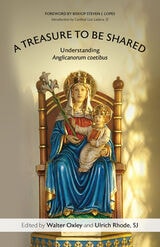
cover of A Treasure to be Shared: Understanding <i>Anglicanorum coetibus</i>

A Treasure to be Shared

Understanding <i>Anglicanorum coetibus</i>

Walter Oxley

Catholic University of America Press, 2022
A Treasure to Be Shared is intended to promote a more widespread knowledge of the Apostolic Constitution Anglicanorum coetibus, promulgated by Pope Benedict XVI in 2009. The Apostolic Constitution provided for Personal Ordinariates for Anglicans entering into full communion with the Catholic Church. On the occasion of the 10th anniversary of the Apostolic Constitution, an academic symposium in the year 2019 sponsored by the Pontifical Gregorian University and the Congregation for the Doctrine of the Faith, provided historical, liturgical, canonical and ecumenical perspectives on the fruits of the Apostolic Constitution for the wider Church. The hope is that the reader will see the Personal Ordinariates of The Chair of Saint Peter in the United States and Canada, Our Lady of Walsingham in Great Britain and Our Lady of the Southern Cross in Australia as a gift to the Church, and a treasure to be shared by all.
[more]
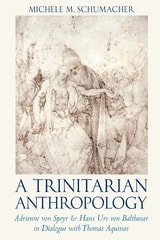
cover of A Trinitarian Anthropology: Adrienne von Speyr & Hans Urs von Balthasar in Dialogue with Thomas Aquinas

A Trinitarian Anthropology

Adrienne von Speyr & Hans Urs von Balthasar in Dialogue with Thomas Aquinas

Michele M. Schumacher

Catholic University of America Press, 2014
In this magisterial work, Michele M. Schumacher seeks to promote dialogue between disciples of the Swiss theologian Hans Urs von Balthasar (d. 1988) and those of the church's common doctor, St. Thomas Aquinas (d. 1274) on a critical theological question. How are analogies and metaphors from the philosophy and theology of the person (anthropology) rightly used to address the mystery of the Trinity? She does so by considering the specific setting of Balthasar's theology: the inseparability of his work from that of the Swiss physician and mystic Adrienne von Speyr (d. 1967).
[more]
cover of Acts of Faith and Imagination: Theological Patterns in Catholic Fiction

Acts of Faith and Imagination

Theological Patterns in Catholic Fiction

Brent Little

Catholic University of America Press, 2023
Acts of Faith and Imagination wagers that fiction written by Catholic authors assists readers to reflect critically on the question: “what is faith?” To speak of a person’s “faith-life” is to speak of change and development. As a narrative form, literature can illustrate the dynamics of faith, which remains in flux over the course of one’s life. Because human beings must possess faith in something (whether religious or not), it inevitably has a narrative structure—faith ebbs and flows, flourishes and decays, develops and stagnates. Through an exploration of more than a dozen Catholic authors’ novels and short stories, Brent Little argues that Catholic fiction encourages the reader to reflect upon their faith holistically, that is, the way faith informs one’s affections, and how a person conceives and interacts with the world as embodied beings. Amidst the diverse stories of modern and contemporary fiction, a consistent pattern emerges: Catholic fiction portrays faith—at its most fundamental, often unconscious, level—as an act of the imagination. Faith is the way one imagines themselves, others, and creation. A person’s primary faith conditions how they live in the world, regardless of the level of conscious reflection, and regardless of whether this is a “religious” faith. Acts of Faith and Imagination investigates the creative depth and vitality of the Catholic literary imagination by bringing late modern Catholic authors into dialogue with more contemporary ones. Readers will then consider well-known works, such as those by Graham Greene, Flannery O’Connor, and Muriel Spark in the fresh light of contemporary stories by Toni Morrison, Alice McDermott, Uwem Akpan, and several others.
[more]
cover of Aesthetic Revelation: Reading Ancient and Medieval Texts after Hans Urs von Balthasar

Aesthetic Revelation

Reading Ancient and Medieval Texts after Hans Urs von Balthasar

Oleg Bychkov

Catholic University of America Press, 2010
Oleg Bychkov's masterly exposition also shows how the texts analyzed have significantly influenced the development of Western theological thought.
[more]
cover of Africae Munus: Ten Years Later

Africae Munus

Ten Years Later

Agbaw-ebai

St. Augustine's Press, 2022

With great foresight and vision for the Church, Pope Emeritus Benedict XVI carefully integrated theological, catechetical and pastoral themes in the Post-Synodal Apostolic Exhortation, Africae Munus. Maurice A. Agbaw-Ebai and Matthew Levering, in the introduction to this collection of reflections and studies focused on the Pope Emeritus’ themes, affirm the African continent’s status as a global center for the growth of the Catholic Church in the twenty-first century and the future of the international Catholic community.
     Building on the vitality and enthusiasm of the Church in Africa, it is important to lift their faith through scholarly research and academic reflections. We cannot fully appreciate the dedication, commitment and perseverance of the Catholic community throughout the African continent if we do not know the truth of their sufferings and persecution and understand their resilience in the light of faith. This collection, drawn from the halls of academia, provides an important contribution to the understanding and advancement of Catholic Africa, following the insights and enlightenment of Pope Emeritus Benedict. It is my hope that these essays will enrich your understanding and experience of the Catholic faith.

— From the Preface by Seán Patrick Cardinal O’Malley
[more]
cover of Africans to Spanish America: Expanding the Diaspora

Africans to Spanish America

Expanding the Diaspora

Edited by Sherwin K. Bryant, Rachel Sarah O’Toole, & Ben Vinson III

University of Illinois Press, 2014

Africans to Spanish America expands the Diaspora framework that has shaped much of the recent scholarship on Africans in the Americas to include Mexico, Peru, Ecuador, and Cuba, exploring the connections and disjunctures between colonial Latin America and the African Diaspora in the Spanish empires. While a majority of the research on the colonial Diaspora focuses on the Caribbean and Brazil, analysis of the regions of Mexico and the Andes opens up new questions of community formation that incorporated Spanish legal strategies in secular and ecclesiastical institutions as well as articulations of multiple African identities. Editors Sherwin K. Bryant, Rachel Sarah O'Toole, and Ben Vinson III arrange the volume around three themes: identity construction in the Americas; the struggle by enslaved and free people to present themselves as civilized, Christian, and resistant to slavery; and issues of cultural exclusion and inclusion. Across these broad themes, contributors offer probing and detailed studies of the place and roles of people of African descent in the complex realities of colonial Spanish America.

Contributors are Joan C. Bristol, Nancy E. van Deusen, Leo J. Garofalo, Herbert S. Klein, Charles Beatty-Medina, Karen Y. Morrison, Rachel Sarah O'Toole, Frank "Trey" Proctor III, and Michele Reid-Vazquez.
[more]
cover of Alfred Loisy and Modern Biblical Studies

Alfred Loisy and Modern Biblical Studies

Jeffrey L. Morrow

Catholic University of America Press, 2019
The French Catholic priest and biblical scholar Alfred Loisy (1857-1940) was at the heart of the Roman Catholic Modernist crisis in the early part of the twentieth century. He saw much of his work as an attempt to bring John Henry Newman’s notion of development of doctrine into the realm of Catholic biblical studies, and thereby transform Catholic theology. This volume situates Loisy’s better known works on the New Testament and theology in the context of his lesser known work in Assyriology and Old Testament studies. His early training in Assyriology taught Loisy a comparative historical approach to studying ancient texts, in addition to providing him the requisite training in ancient Near Eastern languages and literature. Loisy built upon this Assyriological foundation with his historical critical work in biblical studies, first in the Old Testament. In his biblical scholarship, Loisy combined the then current trends of historical biblical criticism with his more comparative approach. Prior to his excommunication in 1908, Loisy attempted in his more popular writings to defend the inclusion of historical biblical criticism in the repertoire of Catholic biblical interpretation. He saw this as an important step in reforming Catholic theology. The Modernist crisis set the stage for the major debates that would occur in the Catholic theological world for more than a century. The controversy over Modernism became one important conflict that helped pave the way for the Second Vatican Council. The issues raised during Loisy’s time, remain contested today. Examining how Loisy approached biblical studies helps readers better understand his overall work, and the place it played in the pivotal intellectual turmoil of his day.
[more]
cover of All Religions Are Good in Tzintzuntzan: Evangelicals in Catholic Mexico

All Religions Are Good in Tzintzuntzan

Evangelicals in Catholic Mexico

By Peter S. Cahn

University of Texas Press, 2003

Since the 1960s, evangelical Christian denominations have made converts throughout much of Roman Catholic Latin America, causing clashes of faith that sometimes escalate to violence. Yet in one Mexican town, Tzintzuntzan, the appearance of new churches has provoked only harmony. Catholics and evangelicals alike profess that "all religions are good," a sentiment not far removed from "here we are all equal," which was commonly spoken in the community before evangelicals arrived.

In this paradigm-challenging study, Peter Cahn investigates why the coming of evangelical churches to Tzintzuntzan has produced neither the interfaith clashes nor the economic prosperity that evangelical conversion has brought to other communities in Mexico and Latin America. Drawing on extensive ethnographic fieldwork, he demonstrates that the evangelicals' energetic brand of faith has not erupted into violence because converts continue to participate in communal life, while Catholics, in turn, participate in evangelical practices. He also underscores how Tzintzuntzan's integration into global economic networks strongly motivates the preservation of community identity and encourages this mutual borrowing. At the same time, however, Cahn concludes that the suppression of religious difference undermines the revolutionary potential of religion.
[more]
cover of Alone Before God: The Religious Origins of Modernity in Mexico

Alone Before God

The Religious Origins of Modernity in Mexico

Pamela Voekel

Duke University Press, 2002

Focusing on cemetery burials in late-eighteenth-century Mexico, Alone Before God provides a window onto the contested origins of modernity in Mexico. By investigating the religious and political debates surrounding the initiative to transfer the burials of prominent citizens from urban to suburban cemeteries, Pamela Voekel challenges the characterization of Catholicism in Mexico as an intractable and monolithic institution that had to be forcibly dragged into the modern world.
Drawing on the archival research of wills, public documents, and other texts from late-colonial and early-republican Mexico, Voekel describes the marked scaling-down of the pomp and display that had characterized baroque Catholic burials and the various devices through which citizens sought to safeguard their souls in the afterlife. In lieu of these baroque practices, the new enlightened Catholics, claims Voekel, expressed a spiritually and hygienically motivated preference for extremely simple burial ceremonies, for burial outside the confines of the church building, and for leaving their earthly goods to charity. Claiming that these changes mirrored a larger shift from an external, corporate Catholicism to a more interior piety, she demonstrates how this new form of Catholicism helped to initiate a cultural and epistemic shift that placed the individual at the center of knowledge.
Breaking with the traditional historiography to argue that Mexican liberalism had deeply religious roots, Alone Before God will be of interest to specialists in Latin American history, modernity, and religion.
[more]
cover of Amazons, Wives, Nuns, and Witches: Women and the Catholic Church in Colonial Brazil, 1500-1822

Amazons, Wives, Nuns, and Witches

Women and the Catholic Church in Colonial Brazil, 1500-1822

By Carole A. Myscofski

University of Texas Press, 2013

The Roman Catholic church played a dominant role in colonial Brazil, so that women’s lives in the colony were shaped and constrained by the Church’s ideals for pure women, as well as by parallel concepts in the Iberian honor code for women. Records left by Jesuit missionaries, Roman Catholic church officials, and Portuguese Inquisitors make clear that women’s daily lives and their opportunities for marriage, education, and religious practice were sharply circumscribed throughout the colonial period. Yet these same documents also provide evocative glimpses of the religious beliefs and practices that were especially cherished or independently developed by women for their own use, constituting a separate world for wives, mothers, concubines, nuns, and witches.

Drawing on extensive original research in primary manuscript and printed sources from Brazilian libraries and archives, as well as secondary Brazilian historical works, Carole Myscofski proposes to write Brazilian women back into history, to understand how they lived their lives within the society created by the Portuguese imperial government and Luso-Catholic ecclesiastical institutions. Myscofski offers detailed explorations of the Catholic colonial views of the ideal woman, the patterns in women’s education, the religious views on marriage and sexuality, the history of women’s convents and retreat houses, and the development of magical practices among women in that era. One of the few wide-ranging histories of women in colonial Latin America, this book makes a crucial contribution to our knowledge of the early modern Atlantic World.
[more]
cover of America's Teilhard

America's Teilhard

Susan Kassman Sack

Catholic University of America Press, 2019
America’s Teilhard: Christ and Hope in the 1960s is a study of the reception of Teilhard in the United States during this period and contributes to an awareness of the thought of this important figure and the impact of his work. Additionally, it further develops an understanding of U.S. Catholicism in all its dimensions during these years, and provides clues as to how it has unfolded over the past several decades. Susan Sack argues that the manner and intensity of the reception of Teilhard’s thought happened as it did at this point in history because of the confluence of the then developing social milieu, the disintegration of the immigrant Catholic subculture, and the opening of the church to the world through Vatican II. Additionally, as these social and historical events unfolded within U.S. culture during these years, the way Teilhard was read, and the contributions which his thought provided changed. This book considers his work as a carrier at times for an almost Americanist emphasis upon progress, energy and hope; in other years his teleological understanding of the value of suffering moves to center. Additionally, the stories of numerous persons – scientists, theologians, politicians, and scholars – who became involved in the American Teilhardian effort are detailed.
[more]
cover of American Catholic Hospitals: A Century of Changing Markets and Missions

American Catholic Hospitals

A Century of Changing Markets and Missions

Wall, Barbra Mann

Rutgers University Press, 2016

In American Catholic Hospitals, Barbra Mann Wall chronicles changes in Catholic hospitals during the twentieth century, many of which are emblematic of trends in the American healthcare system.

Wall explores the Church's struggle to safeguard its religious values. As hospital leaders reacted to increased political, economic, and societal secularization, they extended their religious principles in the areas of universal health care and adherence to the Ethical and Religious Values in Catholic Hospitals, leading to tensions between the Church, government, and society. The book also examines the power of women--as administrators, Catholic sisters wielded significant authority--as well as the gender disparity in these institutions which came to be run, for the most part, by men. Wall also situates these critical transformations within the context of the changing Church policy during the 1960s. She undertakes unprecedented analyses of the gendered politics of post-Second Vatican Council Catholic hospitals, as well as the effect of social movements on the practice of medicine.
[more]
cover of American Catholics and the Church of Tomorrow: Building Churches for the Future, 1925–1975

American Catholics and the Church of Tomorrow

Building Churches for the Future, 1925–1975

Catherine R. Osborne

University of Chicago Press, 2018

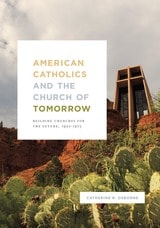
In the mid-twentieth century, American Catholic churches began to shed the ubiquitous spires, stained glass, and gargoyles of their European forebears, turning instead toward startling and more angular structures of steel, plate glass, and concrete.  But how did an institution like the Catholic Church, so often seen as steeped in inflexible traditions, come to welcome this modernist trend?  
 
Catherine R. Osborne’s innovative new book finds the answer: the alignment between postwar advancements in technology and design and evolutionary thought within the burgeoning American Catholic community.  A new, visibly contemporary approach to design, church leaders thought, could lead to the rebirth of the church community of the future. As Osborne explains, the engineering breakthroughs that made modernist churches feasible themselves raised questions that were, for many Catholics, fundamentally theological. Couldn’t technological improvements engender worship spaces that better reflected God's presence in the contemporary world? Detailing the social, architectural, and theological movements that made modern churches possible, American Catholics and the Churches of Tomorrow breaks important new ground in the history of American Catholicism, and also presents new lines of thought for scholars attracted to modern architectural and urban history.
[more]
cover of An African Perspective on the Thought of Benedict XVI

An African Perspective on the Thought of Benedict XVI

Agbaw-ebai

St. Augustine's Press, 2023
Catholicism continues to experience an exponential growth in Africa. Going by the figures and the intensity of religious practice, Africa can unarguably be described as the new center of the Christianity in general, and Catholicism in particular. With over 236 million Catholics, Africa considers itself as having come of age and capable of making its voice heard on matters pertaining to global Catholicism/Christianity. And if there is a contemporary theologian greatly loved and admired by African scholars, Joseph Ratzinger/Benedict XVI ranks premium on that list. His convening a second synod on Africa on the theme of justice, peace and reconciliation, further endeared him to the African theologians. This book is a testimony to the affection that the Church in Africa has for Benedict XVI. In effect, as Africa finds its voice on the stage of global Catholicism, the theology of Joseph Ratzinger/Benedict XVI provides a fruitful space for Africa's engagement with the wider Church. Benedict XVI described Africa as the spiritual lung of the world. This volume testifies to the vitality and healthiness of that lung, a must read for all interested in African Catholicism and its definite impact on global Christianity as a whole. 
[more]
cover of An Answer Key to 'A Primer of Ecclesiastical Latin'

An Answer Key to 'A Primer of Ecclesiastical Latin'

John R. Dunlap

Catholic University of America Press, 2006
[more]
cover of An Image of God: The Catholic Struggle with Eugenics

An Image of God

The Catholic Struggle with Eugenics

Sharon M. Leon

University of Chicago Press, 2013
During the first half of the twentieth century, supporters of the eugenics movement offered an image of a racially transformed America by curtailing the reproduction of “unfit” members of society. Through institutionalization, compulsory sterilization, the restriction of immigration and marriages, and other methods, eugenicists promised to improve the population—a policy agenda that was embraced by many leading intellectuals and public figures. But Catholic activists and thinkers across the United States opposed many of these measures, asserting that “every man, even a lunatic, is an image of God, not a mere animal."

In An Image of God, Sharon Leon examines the efforts of American Catholics to thwart eugenic policies, illuminating the ways in which Catholic thought transformed the public conversation about individual rights, the role of the state, and the intersections of race, community, and family. Through an examination of the broader questions raised in this debate, Leon casts new light on major issues that remain central in American political life today: the institution of marriage, the role of government, and the separation of church and state. This is essential reading in the history of religion, science, politics, and human rights.

[more]
cover of An Immigrant Bishop: John England's Adaptation of Irish Catholicism to American Republicanism, Second Edition

An Immigrant Bishop

John England's Adaptation of Irish Catholicism to American Republicanism, Second Edition

Patrick W. Carey

Catholic University of America Press, 2022
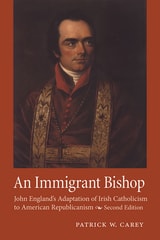
An Immigrant Bishop is a revised examination of the Irish intellectual roots of Bishop John England’s American pastoral works in the diocese of Charleston, South Carolina (1820-1842). The text focuses on his political philosophy and his theology of the Church, both of which were influenced by the Enlightenment and a theological, not a political, Gallicanism. As the study demonstrates, we now know more about England’s intellectual life prior to his immigration than we do about any other Catholic immigrant from Ireland. Neither Peter Guilday’s monumental two-volume biography (1927) of England nor any subsequent scholarly study of England has uncovered and analyzed, as this book does, England’s many unpublished and published writings in Ireland—his explicitly authored texts, his published speeches before the Cork Aggregate meetings, and his pseudonymous articles in the Cork Mercantile Chronicle between 1808, when he was ordained, and 1820, when he emigrated to the United States. John England (1786-1842), the first Catholic bishop of Charleston, was the foremost national spokesman for Catholicism in the United States during the years of his episcopacy and the primary apologist for the compatibility of Catholicism and American republicanism. He was also the first Catholic bishop to speak before the United States Congress and the first American to receive a papal appointment as an Apostolic Delegate to a foreign country (in this case to negotiate a concordat with President Jean Pierre Boyer of Haiti). He is considered the father of the Baltimore Provincial Councils and the nineteenth-century American Catholic conciliar tradition. He was also the only bishop in American history to develop a constitutional form of diocesan government and administration. Among other things he was the first cleric to establish a diocesan newspaper that had something of a national distribution. England’s contribution to the early formation of an American Catholicism has been told many times before, but he has the kind of creative mind and episcopal leadership that demands repeated re-considerations.
[more]
cover of An Introduction to Vatican II as an Ongoing Theological Event

An Introduction to Vatican II as an Ongoing Theological Event

Matthew Levering

Catholic University of America Press, 2017

Contemporary scholars often refer to “the event of Vatican II,” but what kind of an event was it? In this first book of the new CUA Press series Sacra Doctrina, Matthew Levering leads his readers to see the Council as a “theological event”—a period of confirming and continuing God’s self-revelation in Christ into a new historical era for the Church.

This is an introduction to Vatican II with a detailed summary of each of its four central documents—the dogmatic constitutions—followed by explanations of how to interpret them. In contrast to other introductions, which pay little attention to the theological soil in which the documents of Vatican II germinated, Levering o­ffers a reading of each conciliar Constitution in light of a key theological author from the era: René Latourelle, SJ for Dei Verbum (persons and propositions); Louis Bouyer, CO for Sacrosanctum Concilium (active participation); Yves Congar, OP for Lumen Gentium (true and false reform); and Henri de Lubac, SJ for Gaudium et Spes (nature and grace).

This theological event is “ongoing,” Levering demonstrates, by tracing in each chapter the theological debates that have stretched from the close of the council till the present, and the difficulties the Church continues to encounter in encouraging an ever deeper participation in Jesus Christ on the part of all believers. In this light, the book’s final chapter compares the historicist (Massimo Faggioli) and Christological (Robert Imbelli) interpretations of Vatican II, arguing that historicism can undermine the Council’s fundamental desire for a reform and renewal rooted in Christ. The conclusion addresses the concerns about secularization and loss of faith raised after the Council by Henri de Lubac, Joseph Ratzinger, and Yves Congar, arguing that contemporary Vatican II scholarship needs to take these concerns more seriously.
[more]
cover of Analogies of Transcendence

Analogies of Transcendence

Stephen M. Fields

Catholic University of America Press, 2016
The problem of nature and grace lies at the heart of Christian theology. No dimension of divine revelation can be addressed without implicitly drawing reference to this issue.Analogies of Transcendence focuses on the central role that the analogies of being and faith play in developing a solution to the problem. These link God, as self-manifesting transcendence, to the human person as both fallen and justified, and to the material cosmos. Although the proposed solution draws on the work of Maréchal, de Lubac, Balthasar, and Rahner, it criticizes their approach for its underdeveloped analogies that diminish nature in grace's engagement with it. In redressing this weakness, Fr. Fields adapts its solution to the intellectual struggle of our time. This volume examines the origins and structure of modernity, which, it asserts, has not been superseded and is therefore critical of'‘postmodernism,' as well as of some ambiguous legacies of Thomism.
[more]
cover of Angels and Demons

Angels and Demons

Serge-Thomas Bonino

Catholic University of America Press, 2016
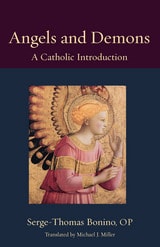
Angels occupy a significant space in contemporary popular spirituality. Yet, today more than ever, the belief in the existence of intermediary spirits between the human and divine realms needs to be evangelized and Christianized. Angels and Demons offers a detailed synthesis of the givens of the Christian tradition concerning the angels and demons, as systematized in its essential principles by St. Thomas Aquinas. Certainly, the doctrine of angels and demons is not at the heart of Christian faith, but its place is far from negligible. On the one hand, as part of faith seeking understanding, angelology has been and can continue to be a source of enrichment for philosophy. Thus, reflection on the ontological constitution of the angel, on the modes of angelic knowledge, and on the nature of the sin of Satan can engage and shed light on the most fundamental areas of metaphysics, epistemology, and ethics. On the other hand, angelology, insofar as it is inseparable from the ensemble of the Christian mystery (from the doctrine of creation to the Christian understanding of the spiritual life), can be envisioned from an original and fruitful perspective.
[more]
cover of Apostolic Religious Life in America Today: A Response to the Crisis

Apostolic Religious Life in America Today

A Response to the Crisis

Richard Gribble

Catholic University of America Press, 2011
Divided into two parts, this volume first presents an analysis of the problem and secondly a solution to place apostolic religious life on a positive trajectory in the 21st century.
[more]
cover of Aquinas and the Early Chinese Masters: Chinese Philosophy and Catholic Theology

Aquinas and the Early Chinese Masters

Chinese Philosophy and Catholic Theology

Joshua Brown

Catholic University of America Press, 2025

Aquinas and the Early Chinese Masters lays intellectual foundations for the integration of Chinese philosophy into Catholic theology. Although Catholic theology in Chinese contexts has drawn upon Chinese philosophical concepts, few have attempted to develop a rigorous, systematic approach to testing what in the Chinese philosophical traditions can be fruitful or unfruitful for Catholic theological expression. This book attempts to model such an approach by engaging classical Chinese philosophy with the mind and spirit of St. Thomas Aquinas, who read Aristotle and other pagan philosophers with both charitable appreciation and a firm, critical eye. It applies this Thomistic lens through concrete comparative engagements with three main representatives of early Chinese philosophy: Mencius (Mengzi孟子), Xunzi荀子, and Mozi墨子. In each chapter, the book presents Aquinas’ thought as an evaluative frame for perceiving how Chinese philosophical commitments and concepts do or do not seem fit for adoption into Catholic theological science. Following the general structure of the Summa theologiae, the book is comprised of six chapters touching on the doctrine of God, morality, and Christology. The first two chapters engage Confucian master Mengzi’s notion of Heaven (Tian天), and then the Mohist doctrine of Heaven’s Will (Tian zhi天志). Chapter three provides a Thomistic assessment of the two main positions in the classical Confucian debate on the goodness of man’s moral nature (renxing人性). Chapter four compares Aquinas’ account of charity and Mozi’s doctrine of “universal love” (jian ai兼愛). Chapter 5 offers a Thomistic assessment of the possibility of understanding Christ in terms of Xunzi’s “sage” (shengren聖人). Finally, Chapter 6 explores Christ as a moral teacher by putting Aquinas’ reading of Matt 8:21-22 into conversation with Confucian ethics of filial virtue.
[more]