Results by title
159 books match the query 'Change' and 18 start with a
A Change in the Weather
Modernist Imagination, African American ImaginaryGeoffrey Jacques
University of Massachusetts Press, 2009
A Generation of Change
A Profile of America's Older PopulationJacob S. Siegel
Russell Sage Foundation, 1993
A Legacy of Change
Historic Human Impact on Vegetation in the Arizona BorderlandsConrad Joseph Bahre
University of Arizona Press, 1991
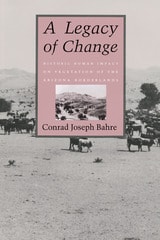
Geographer Conrad Bahre now challenges the view that these vegetation changes are due to climatic change. Correlating his own field research with archival records and photographs, Bahre demonstrates that most of the changes follow some type of human disturbance, such as cattle grazing, fuelwood cutting, wildfire suppression, agriculture, and road construction. Indeed, all available evidence suggests that Anglo settlement brought unprecedented changes to the land.
Vegetation change in the American West has long been an issue of concern. This careful scrutiny of one corner of that region—one of the most ecologically diverse areas of the United States—shows how poorly understood is the relationship between human activities and vegetation. More important, it introduces new techniques for differentiating between natural and anthropogenic factors effecting vegetation change that can be used to help ecologists understand vegetation dynamics worldwide.
Across a Great Divide
Continuity and Change in Native North American Societies, 1400–1900Edited by Laura L. Scheiber and Mark D. Mitchell
University of Arizona Press, 2010
The contributors address a series of interlocking themes. Several consider the role of indigenous agency in the processes of colonial interaction, paying particular attention to gender and status. Others examine the ways long-standing native political economies affected, and were in turn affected by, colonial interaction. A third group explores colonial-period ethnogenesis, emphasizing the emergence of new native social identities and relations after 1500. The book also highlights tensions between the detailed study of local cases and the search for global processes, a recurrent theme in postcolonial research.
If archaeologists are to bridge the artificial divide separating history from prehistory, they must overturn a whole range of colonial ideas about American Indians and their history. This book shows that empirical archaeological research can help replace long-standing models of indigenous culture change rooted in colonialist narratives with more nuanced, multilinear models of change—and play a major role in decolonizing knowledge about native peoples.

Administrative Justice
Advocacy and Change in a Government AgencyPhilippe Nonet
Russell Sage Foundation, 1969
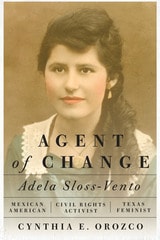
Agent of Change
Adela Sloss-Vento, Mexican American Civil Rights Activist and Texas FeministBy Cynthia E. Orozco
University of Texas Press, 2020
Liz Carpenter Award for Research in the History of Women, Texas State Historical Association
The essayist Adela Sloss-Vento (1901–1998) was a powerhouse of activism in South Texas’s Lower Rio Grande Valley throughout the Mexican American civil rights movement beginning in 1920 and the subsequent Chicano movement of the 1960s and 1970s. At last presenting the full story of Sloss-Vento’s achievements, Agent of Change revives a forgotten history of a major female Latina leader.
Bringing to light the economic and political transformations that swept through South Texas in the 1920s as ranching declined and agribusiness proliferated, Cynthia E. Orozco situates Sloss-Vento’s early years within the context of the Jim Crow/Juan Crow era. Recounting Sloss-Vento’s rise to prominence as a public intellectual, Orozco highlights a partnership with Alonso S. Perales, the principal founder of the League of United Latin American Citizens. Agent of Change explores such contradictions as Sloss-Vento’s tolerance of LULAC’s gender-segregated chapters, even though the activist was an outspoken critic of male privilege in the home and a decidedly progressive wife and mother. Inspiring and illuminating, this is a complete portrait of a savvy, brazen critic who demanded reform on both sides of the US-Mexico border.
Agent of Change
Print Culture Studies after Elizabeth L. EisensteinSabrina Alcorn Baron
University of Massachusetts Press, 2007
Inspiring debate since the early days of its publication, Elizabeth L. Eisenstein's The Printing Press as an Agent of Change: Communications and Cultural Transformations in Early-Modern Europe (1979) has exercised its own force as an agent of change in the world of scholarship. Its path-breaking agenda has played a central role in shaping the study of print culture and “book history”—fields of inquiry that rank among the most exciting and vital areas of scholarly endeavor in recent years.
Joining together leading voices in the field of print scholarship, this collection of twenty essays affirms the catalytic properties of Eisenstein's study as a stimulus to further inquiry across geographic, temporal, and disciplinary boundaries. From early modern marginalia to the use of architectural title pages in Renaissance books, from the press in Spanish colonial America to print in the Islamic world, from the role of the printed word in nation-building to changing histories of reading in the electronic age, this book addresses the legacy of Eisenstein's work in print culture studies today as it suggests future directions for the field.
In addition to a conversation with Elizabeth L. Eisenstein, the book includes contributions by Peng Hwa Ang, Margaret Aston, Tony Ballantyne, Vivek Bhandari, Ann Blair, Barbara A. Brannon, Roger Chartier, Kai-wing Chow, James A. Dewar, Robert A. Gross, David Scott Kastan, Harold Love, Paula McDowell, Jane McRae, Jean-Dominique Mellot, Antonio Rodriguez-Buckingham, Geoffrey Roper, William H. Sherman, Peter Stallybrass, H. Arthur Williamson, and Calhoun Winton.

All Faithful People
Change and Continuity in Middletown’s ReligionTheodore Caplow, Howard M. Bahr, Bruce A. Chadwick, Dwight W. Hoover, Laurence A. Martin, Joseph B. Tamney, and Margaret Holmes Williamson
University of Minnesota Press, 1983
All Faithful People was first published in 1983. Minnesota Archive Editions uses digital technology to make long-unavailable books once again accessible, and are published unaltered from the original University of Minnesota Press editions.
In 1924 Robert and Helen Lynd went to Middletown (Muncie, Indiana) to study American institutions and values. The results of their work are the classic studies Middletown (1929) and Middletown in Transition (1937). In the late 1970s a team of social scientists returned to Middletown to gauge the changes that have taken place in the fifty years since the Lynds' first visit. The Middletown III Project, by replicating the earlier work, in some cases by using the same questions, provides an unprecedented portrait of a small American town as it adapts to changing times. Its first report, Middletown Families, was published by Minnesota in 1982.
This book explores the role of religion in the life of Middletown. Using the Lynds' magnificent cache of empirical data as a base, social scientists on the Middletown III Project attempted to gauge how religious beliefs and practices have changed. For the most part, their findings show that the current perception of a trend toward a more secular society is not true. In Middletown, religion seems to be more important than ever.
All Faithful People also covers the history of Middletown's churches, the differences between the town's Protestants and Catholics, religious participation among young people, and the role in Middletown life of private devotions and public rituals. In conclusion, the authors of All Faithful People evaluate Middletown as a representative community. They attempt to explain the myth of the death of organized religion, and briefly compare religion in America to religion in other Western countries.
Fifty years after the Lynds first made Middletown famous, a team of social scientists returned to find out how American values have changed. This, their second report, focuses on religion. What does religion mean to Middletown today? Has America become a secular society? Those are some of the questions discussed in All Faithful People.

American Educational Governance on Trial
Change and ChallengesEdited by William L. Boyd and Debra Miretzky
University of Chicago Press, 2003
Ancient Communities in the Mimbres Valley
Continuity and Change from AD 750 to 1350Roger Anyon and Steven A. LeBlanc
University of Arizona Press, 2024
Expanding beyond studies that focus on a single pueblo, this volume represents the final report on the excavations of the Mimbres Foundation. It brings together data from a range of pithouse and pueblo sites of different sizes and histories in diverse locations—to refine the current understandings of Mimbres region archaeology in the context of the Greater Southwest.
From the end of the Late Pithouse period through the Black Mountain phase, the book provides excellent documentation of the artifacts and data recovered from the sites, addresses models of Mimbres community, and tracks change and continuity in the valley over centuries. In addition, the authors consider the nature of the relationship between the Classic Mimbres period population of the valley and the people of the succeeding Black Mountain phase, as well as relationships among the Black Mountain phase people and those of neighboring parts of the region, including the Casas Grandes world and the Jornada Mogollon area.
In Ancient Communities in the Mimbres Valley two leading archaeologists bring together a trove of unpublished investigations, expanding understandings and setting a course for the future.
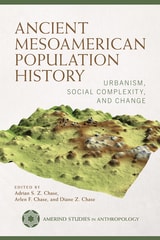
Ancient Mesoamerican Population History
Urbanism, Social Complexity, and ChangeAdrian S. Z. Chase, Arlen F. Chase, and Diane Z. Chase
University of Arizona Press, 2024
Establishing ancient population numbers and determining how they were distributed across a landscape over time constitute two of the most pressing problems in archaeology. Accurate population data is crucial for modeling, interpreting, and understanding the past. Now, advances in both archaeology and technology have changed the way that such approximations can be achieved.
Including research from both highland central Mexico and the tropical lowlands of the Maya and Olmec areas, this book reexamines the demography in ancient Mesoamerica. Contributors present methods for determining population estimates, field methods for settlement pattern studies to obtain demographic data, and new technologies such as LiDAR (light detecting and ranging) that have expanded views of the ground in forested areas. Contributions to this book provide a view of ancient landscape use and modification that was not possible in the twentieth century. This important new work provides new understandings of Mesoamerican urbanism, development, and changes over time.
Contributors
Traci Ardren
M. Charlotte Arnauld
Bárbara Arroyo
Luke Auld-Thomas
Marcello A. Canuto
Adrian S. Z. Chase
Arlen F. Chase
Diane Z. Chase
Elyse D. Z. Chase
Javier Estrada
Gary M. Feinman
L. J. Gorenflo
Julien Hiquet
Scott R. Hutson
Gerardo Jiménez Delgado
Eva Lemonnier
Rodrigo Liendo Stuardo
José Lobo
Javier López Mejía
Michael L. Loughlin
Deborah L. Nichols
Christopher A. Pool
Ian G. Robertson
Jeremy A. Sabloff
Travis W. Stanton
Apostles of Change
Latino Radical Politics, Church Occupations, and the Fight to Save the BarrioBy Felipe Hinojosa
University of Texas Press, 2021
2021 Finalist Raul Yzaguirre Best Political/Current Affairs Book, International Latino Book Awards
Winner of the Texas Association of Chicanos in Higher Education Inaugural Book Award
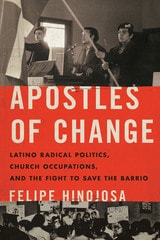
Unraveling the intertwined histories of Latino radicalism and religion in urban America, this book examines how Latino activists transformed churches into staging grounds for protest against urban renewal and displacement.
In the late 1960s, the American city found itself in steep decline. An urban crisis fueled by federal policy wreaked destruction and displacement on poor and working-class families. The urban drama included religious institutions, themselves undergoing fundamental change, that debated whether to stay in the city or move to the suburbs. Against the backdrop of the Black and Brown Power movements, which challenged economic inequality and white supremacy, young Latino radicals began occupying churches and disrupting services to compel church communities to join their protests against urban renewal, poverty, police brutality, and racism.
Apostles of Change tells the story of these occupations and establishes their context within the urban crisis; relates the tensions they created; and articulates the activists' bold, new vision for the church and the world. Through case studies from Chicago, Los Angeles, New York City, and Houston, Felipe Hinojosa reveals how Latino freedom movements frequently crossed boundaries between faith and politics and argues that understanding the history of these radical politics is essential to understanding the dynamic changes in Latino religious groups from the late 1960s to the early 1980s.
Archaeology without Borders
Contact, Commerce, and Change in the U.S. Southwest and Northwestern MexicoMaxine E. McBrinn
University Press of Colorado, 2008
Contributors examining early agriculture offer models for understanding the transition to agriculture, explore relationships between the spread of agriculture and Uto-Aztecan migrations, and present data from Arizona, New Mexico, and Chihuahua. Contributors focusing on social identity discuss migration, enculturation, social boundaries, and ethnic identities. They draw on case studies that include diverse artifact classes - rock art, lithics, architecture, murals, ceramics, cordage, sandals, baskets, faunal remains, and oral histories. Mexican scholars present data from Chihuahua, Durango, Zacatecas, Michoacan, Coahuila, and Nuevo Leon. They address topics including Spanish-indigenous conflicts, archaeological history, cultural landscapes, and interactions among Mesoamerica, northern Mexico, and the U.S. Southwest.
Laurie D. Webster is a visiting scholar in the Department of Anthropology at the University of Arizona. Maxine E. McBrinn is a postdoctoral research scientist at the Field Museum in Chicago. Proceedings of the 2004 Southwest Symposium. Contributors include Karen R. Adams, M. Nicolás Caretta, Patricia Carot, John Carpenter, Jeffery Clark, Linda S. Cordell, William E. Doolittle, Suzanne L. Eckert, Gayle J. Fritz, Eduardo Gamboa Carrera, Leticia González Arratia, Arturo Guevara Sánchez, Robert J. Hard, Kelly Hays-Gilpin, Marie-Areti Hers, Amber L. Johnson, Steven A. LeBlanc, Patrick Lyons, Jonathan B. Mabry, A. C. MacWilliams, Federico Mancera, Maxine E. McBrinn, Francisco Mendiola Galván, William L. Merrill, Martha Monzón Flores, Scott G. Ortman, John R. Roney, Guadalupe Sanchez de Carpenter, Moisés Valadez Moreno, Bradley J. Vierra, Laurie D. Webster, and Phil C. Weigand.
Aristotle's Ontology of Change
Mark Sentesy
Northwestern University Press, 2020
Aristotle may be the only thinker to propose a noncircular definition of change. With his landmark argument that change did, in fact, exist, Aristotle challenged established assumptions about what it is and developed a set of conceptual frameworks that continue to provide insight into the nature of reality. This groundbreaking work on change, however, has long been interpreted through a Platonist view of change as unreal. By offering a comprehensive reexamination of Aristotle’s pivotal arguments, and establishing his positive ontological conception of change, Sentesy makes a significant contribution to scholarship on Aristotle, ancient philosophy, the history and philosophy of science, and metaphysics.
Arranged Marriage
The Politics of Tradition, Resistance, and ChangePéter Berta
Rutgers University Press, 2023
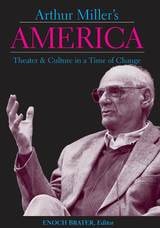
Arthur Miller's America
Theater and Culture in a Time of ChangeEnoch Brater, Editor
University of Michigan Press, 2005
Arthur Miller's America collects new writing by leading international critics and scholars that considers the dramatic world of icon, activist, and playwright Arthur Miller's theater as it reflects the changing moral equations of his time. Written on the occasion of Miller's 85th year, the original essays and interviews in Arthur Miller's America treat the breadth of Miller's work, including his early political writings for the campus newspaper at the University of Michigan, his famous work with John Huston, Clark Gable and Marilyn Monroe on The Misfits, and his signature plays like Death of a Salesman and All My Sons.

Arts Integration in Education
Teachers and Teaching Artists as Agents of ChangeEdited by Gail Humphries Mardirosian and Yvonne Pelletier Lewis
Intellect Books, 2018
Awareness to Action
The Enneagram, Emotional Intelligence, and ChangeRobert Tallon and Mario Sikora
University of Scranton Press, 2006