121 books match the query 'Cinema' and 10 start with a
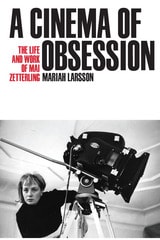
cover of A Cinema of Obsession: The Life and Work of Mai Zetterling

A Cinema of Obsession

The Life and Work of Mai Zetterling

Mariah Larsson

University of Wisconsin Press, 2020

Mai Elizabeth Zetterling (1925–94) is among the most exceptional postwar female filmmakers. Born in Sweden, she lived in England and France for most of her life, making her directorial debut in 1964 with the Swedish art film Loving Couples after a fraught transition from working in front of the camera as a successful actress.
Critics have compared her work to that of Ingmar Bergman, Luis Buñuel, and Federico Fellini, but Zetterling had a distinct style—alternately radical and reactionary—that straddled the gendered divide between high art and mass culture. Tackling themes of sexuality, isolation, and creativity, her documentaries, short and feature films, and television works are visually striking. Her oeuvre provoked controversy and scandal through her sensational representations of reproduction and motherhood.
Mariah Larsson provides a lively and authoritative take on Zetterling's legacy and complicated position within film and women's history. A Cinema of Obsession provides necessary perspective on how the breadth of an artist's collected works keeps gatekeepers from recognizing their achievements, and questions why we still distinguish between national and global visual cultures and the big and small screens in the #MeToo era.
[more]
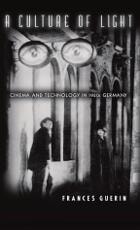
cover of A Culture of Light: Cinema and Technology in 1920s Germany

A Culture of Light

Cinema and Technology in 1920s Germany

Frances Guerin

University of Minnesota Press, 2005

Cinema is a medium of light. And during Weimar Germany's advance to technological modernity, light - particularly the representational possibilities of electrical light - became the link between the cinema screen and the rapid changes that were transforming German life.In Frances Guerin's compelling history of German silent cinema of the 1920s, the innovative use of light is the pivot around which a new conception of a national cinema, and a national culture emerges. Guerin depicts a nocturnal Germany suffused with light - electric billboards, storefronts, police searchlights - and shows how this element of the mise-en-scene came to reflect both the opportunities and the anxieties surrounding modernity and democracy. Guerin's interpretations center on use of light in films such as Schatten (1923), Variete (1925), Metropolis (1926), and Der Golem (1920). In these films we see how light is the substance of image composition, the structuring device of the narrative, and the central thematic concern. This history relieves German films of the responsibility to explain the political and ideological instability of the period, an instability said to be the uncertain foundation of Nazism. In unlocking this dubious link, A Culture of Light redefines the field of German film scholarship.
[more]
cover of A Dream to Conjure: Emergent Forms in Caribbean Art and Cinema

A Dream to Conjure

Emergent Forms in Caribbean Art and Cinema

Yasmine Espert

Duke University Press, 2027
In A Dream to Conjure, Yasmine Espert considers the hopes and imaginings of Caribbean film from its beginnings. Focusing on narratives of migration from the late 1980s to the late 2010s, Espert attends to the restorative and life-affirming practices that diasporic Caribbean filmmakers conjure to assert their wellbeing, sovereignty, and sense of relation to the Caribbean. She examines how their embodied, aesthetic, and political practices set precedents for organizing efforts and continue a tradition of resistance to colonial extraction. Drawing from her own conversations and collaborations with these artists, she elevates the study with a deeper reflection on what it is like to create in, and about, lands that many said had no place in the film industry. Through an anticolonial, queer-of-color framework, Espert engages the films, dreams, and acts of Caribbean creators as multisensory, time-bending forms of collective engagement that defy colonial logic and prioritize those most vulnerable under regimes of oppression.
[more]
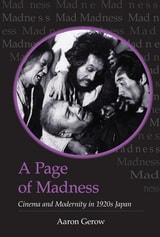
cover of A Page of Madness: Cinema and Modernity in 1920s Japan

A Page of Madness

Cinema and Modernity in 1920s Japan

Aaron Gerow

University of Michigan Press, 2008
Kinugasa Teinosuke’s 1926 film A Page of Madness (Kurutta ichipeiji) is celebrated as one of the masterpieces of silent cinema. It was an independently produced, experimental, avant-garde work from Japan whose brilliant use of cinematic technique was equal to if not superior to that of contemporary European cinema. Those studying Japan, focusing on the central involvement of such writers as Yokomitsu Riichi and the Nobel Prize winner Kawabata Yasunari, have seen it as a pillar of the close relationship in the Taisho era between film and artistic modernism, as well as a marker of the uniqueness of prewar Japanese film culture.
But is this film really what it seems to be? Aaron Gerow brings meticulous research to the film’s production, distribution, exhibition, and reception and closely analyzes the film’s shooting script and shooting notes, which were recently made available. He draws a new picture of this complex work, revealing a film divided between experiment and convention, modernism and melodrama, the image and the word, cinema and literature, conflicts that play out in the story and structure of the film and its context. A Page of Madness, a film fundamentally about differing perceptions and conflicting worlds, was received at the time in different versions and with varying interpretations, and ironically, the film that exists today is not in fact the one originally released. Including a detailed analysis of the film and translations of contemporary reviews and shooting notes for scenes missing from the current print, Gerow’s book offers provocative insight into the fascinating film A Page of Madness was—and still is—and into the struggles over this work that tried to articulate the place of cinema in Japanese society and modernity.
[more]
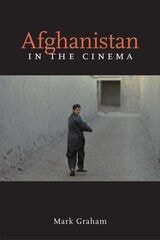
cover of Afghanistan in the Cinema

Afghanistan in the Cinema

Mark Graham

University of Illinois Press, 2010

In this timely critical introduction to the representation of Afghanistan in film, Mark Graham examines the often surprising combination of propaganda and poetry in films made in Hollywood and the East. Through the lenses of postcolonial theory and historical reassessment, Graham analyzes what these films say about Afghanistan, Islam, and the West and argues that they are integral tools for forming discourse on Afghanistan, a means for understanding and avoiding past mistakes, and symbols of the country's shaky but promising future. Thoughtfully addressing many of the misperceptions about Afghanistan perpetuated in the West, Afghanistan in the Cinema incorporates incisive analysis of the market factors, funding sources, and political agendas that have shaped the films.

The book considers a range of films, beginning with the 1970s epics The Man Who Would Become King and The Horsemen and following the shifts in representation of the Muslim world during the Russian War in films such as The Beast and Rambo III. Graham then moves on to Taliban-era films such as Kandahar, Osama, and Ellipsis, the first Afghan film directed by a woman. Lastly, the book discusses imperialist nostalgia in films such as Charlie Wilson's War and destabilizing visions represented in contemporary works such as The Kite Runner.
[more]
cover of American Twilight: The Cinema of Tobe Hooper

American Twilight

The Cinema of Tobe Hooper

By Kristopher Woofter and Will Dodson

University of Texas Press, 2021

A master of gritty horror, Tobe Hooper captured on-screen an America in constant crisis and upended myths of prosperity to reveal the country’s internal decay.

Tobe Hooper's productions, which often trespassed upon the safety of the family unit, cast a critical eye toward an America in crisis. Often dismissed by scholars and critics as a one-hit wonder thanks to his 1974 horror classic The Texas Chain Saw Massacre, Hooper nevertheless was instrumental in the development of a robust and deeply political horror genre from the 1960s until his death in 2017. In American Twilight, the authors assert that the director was an auteur whose works featured complex monsters and disrupted America’s sacrosanct perceptions of prosperity and domestic security.

American Twilight focuses on the skepticism toward American institutions and media and the articulation of uncanny spaces so integral to Hooper’s vast array of feature and documentary films, made-for-television movies, television episodes, and music videos. From Egg Shells (1969) to Poltergeist (1982), Djinn (2013), and even Billy Idol’s music video for “Dancing with Myself” (1985), Tobe Hooper provided a singular directorial vision that investigated masculine anxiety and subverted the idea of American exceptionalism.

[more]
cover of An Archaeology of Sympathy: The Sentimental Mode in Literature and Cinema

An Archaeology of Sympathy

The Sentimental Mode in Literature and Cinema

James Chandler

University of Chicago Press, 2013
In the middle of the eighteenth century, something new made itself felt in European culture—a tone or style that came to be called the sentimental. The sentimental mode went on to shape not just literature, art, music, and cinema, but people’s very structures of feeling, their ways of doing and being.
 
In what is sure to become a critical classic, An Archaeology of Sympathy challenges Sergei Eisenstein’s influential account of Dickens and early American film by tracing the unexpected history and intricate strategies of the sentimental mode and showing how it has been reimagined over the past three centuries. James Chandler begins with a look at Frank Capra and the Capraesque in American public life, then digs back to the eighteenth century to examine the sentimental substratum underlying Dickens and early cinema alike. With this surprising move, he reveals how literary spectatorship in the eighteenth century anticipated classic Hollywood films such as Capra’s It Happened One Night, Mr. Deeds Goes to Town, and It’s a Wonderful Life. Chandler then moves forward to romanticism and modernism—two cultural movements often seen as defined by their rejection of the sentimental—examining how authors like Mary Shelley, Joseph Conrad, James Joyce, and Virginia Woolf actually engaged with sentimental forms and themes in ways that left a mark on their work.
 
Reaching from Laurence Sterne to the Coen brothers, An Archaeology of Sympathy casts new light on the long eighteenth century and the novelistic forebears of cinema and our modern world.
[more]
cover of Anatomy of a Robot: Literature, Cinema, and the Cultural Work of Artificial People

Anatomy of a Robot

Literature, Cinema, and the Cultural Work of Artificial People

Kakoudaki, Despina

Rutgers University Press, 2014

Why do we find artificial people fascinating? Drawing from a rich fictional and cinematic tradition, Anatomy of a Robot explores the political and textual implications of our perennial projections of humanity onto figures such as robots, androids, cyborgs, and automata. In an engaging, sophisticated, and accessible presentation, Despina Kakoudaki argues that, in their narrative and cultural deployment, artificial people demarcate what it means to be human. They perform this function by offering us a non-human version of ourselves as a site of investigation. Artificial people teach us that being human, being a person or a self, is a constant process and often a matter of legal, philosophical, and political struggle.

By analyzing a wide range of literary texts and films (including episodes from Twilight Zone, the fiction of Philip K. Dick, Kazuo Ishiguro’s novel Never Let Me Go, Metropolis, The Golem, Frankenstein, The Terminator, Iron Man, Blade Runner, and I, Robot), and going back to alchemy and to Aristotle’s Physics and De Anima, she tracks four foundational narrative elements in this centuries-old discourse— the fantasy of the artificial birth, the fantasy of the mechanical body, the tendency to represent artificial people as slaves, and the interpretation of artificiality as an existential trope. What unifies these investigations is the return of all four elements to the question of what constitutes the human.

This focused approach to the topic of the artificial, constructed, or mechanical person allows us to reconsider the creation of artificial life.  By focusing on their historical provenance and textual versatility, Kakoudaki elucidates artificial people’s main cultural function, which is the political and existential negotiation of what it means to be a person.
[more]
cover of Andrei Tarkovsky: Elements of Cinema

Andrei Tarkovsky

Elements of Cinema

Robert Bird

Reaktion Books, 2008

The masters of Russian arts and letters are a prestigious fraternity that includes such renowned artists as Tolstoy, Rachmaninoff, and Shostakovich. But alongside these luminaries stands a lesser-known but equally revered figure, filmmaker Andrei Tarkovsky. Robert Bird offers in Andrei Tarkovsky an unprecedented investigation of Tarkovsky’s oeuvre and its far-reaching influence on world cinema.

Bird brings a novel approach to his dissection of Tarkovsky’s wholly original techniques and sensibilities, arranging the films into elemental categories of Water, Fire, Earth, and Air. Solaris, Ivan’s Childhood, Mirror, Nostalgia, Andrei Rublev, and Sacrifice all get their due here; through them, Bird explores how the filmmaker probed the elusive correlation between cinematic representation and a more primeval perception of the world. Though the book also considers Tarkovsky’s work in radio, theatre, and opera—as well as his work as an actor, screenwriter, and film theorist—Bird throughout keeps his focus firmly on Tarkovsky as a consummate filmmaker.
 
Anchored by a wealth of film stills and photographs, Andrei Tarkovsky is a must-read for all film buffs and admirers of European cinema.
[more]
cover of Art in Cinema: Documents Toward a History of the Film Society

Art in Cinema

Documents Toward a History of the Film Society

Scott MacDonald

Temple University Press, 2006

From 1946 until 1954, the San Francisco-based film society Art in Cinema presented programs of independent film to audiences at the San Francisco Museum of Art and the University of California, Berkeley. Led by filmmaker Frank Stauffacher, Art in Cinema's programs pioneered the promotion of avant-garde cinema in America.

Scott MacDonald's Art in Cinema presents complete programs presented by the legendary society; dozens of previously unavailable letters between Stauffacher, his collaborators, and filmmakers including Maya Deren, Hans Richter, Vincent Minelli, and Man Ray; a reprint of the society's original catalog, which features essays by Henry Miller and others; and a wide range of other remarkable historical documents.

A companion to Cinema 16 (Temple), a documentary history of the first west coast film society, Art in Cinema provides cineastes, students, teachers, and scholars with extensive and fascinating documentation of one of the most important film societies in American history. Together or separately, the books provide an indispensable reference source for the beginning of this country's love affair with independent film.
[more]