Results by title
129 books match the query 'City and town life' and 9 start with a
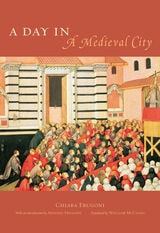
A Day in a Medieval City
Chiara Frugoni
University of Chicago Press, 2005
A Day in a Medieval City breathes life into the activities of the city streets, homes, fields, schools, and places of worship. With entertaining anecdotes and gritty details, it engages the modern reader with its discoveries of the religious, economic, and institutional practices of the day. From urban planning and education to child care, hygiene, and the more leisurely pursuits of games, food, books, and superstitions, Frugoni unearths the daily routines of the private and public lives of citizens. A Day in a Medieval City is a charming portal to the Middle Ages that you'll surely want with you on your travels to Europe—or in your armchair.
“Stunningly beautiful . . . and a good read as well. . . . It’s amazing how much wealth of detail and image Ms. Frugoni has packed into this delightful, relatively small book.”—Steve Goode, Washington Times
“Charming and insightful. . . .Written with exceptional grace and infused with a warm sense of humanity.”—Library Journal
A Little Rock Boyhood
Growing Up in the Great DepressionA. Cleveland Harrison
Butler Center for Arkansas Studies, 2010
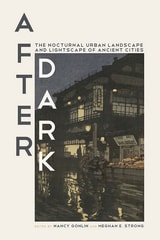
After Dark
The Nocturnal Urban Landscape and Lightscape of Ancient CitiesNancy Gonlin
University Press of Colorado, 2022
Sensory archaeology focuses on the sensual experience of the nocturnal environment—the sights, sounds, smells, tastes, and feel of an ancient city—and the multi-faceted stimuli that diverse urban populations experienced in the dark. Contributors investigate night work—for example, standing guard or pursuing nocturnal trades—and nightlife, such as gambling at Chaco Canyon. They also examine how urban architecture, infrastructure, and the corresponding lighting were inextricably involved in enabling nighttime pursuits and signaling social status.
The subjects of the night, darkness, and illumination taken together form a comprehensive framework for analyzing city life. After Dark embraces night as a conceptual lens through which to view the material and visual cultures of the ancient world and, in doing so, demonstrates a wealth of activities, behaviors, and beliefs that took place between dusk and dawn. This perspective greatly enriches the understanding of urban life and its evolution and has much to offer archaeologists in deepening an examination of complexity and inequality. This volume will be of interest to any scholar or student of the past who is interested in urban activities and the significance of the night in urban settings.
Contributors: Susan M. Alt, J. Antonio Ochatoma Cabrera, Martha Cabrera Romero, Tiffany Earley-Spadoni, Kirby Farrah, Nancy Gonlin, Anna Guengerich, Christopher Hernandez, John Janusek, Kristin V. Landau, Maggie L. Popkin, Monica L. Smith, Meghan E. Strong, Susan Toby Evans, Robert S. Weiner
After the West Was Won
Homesteaders and Town-Builders in Western South Dakota, 1900-1917Paula M. Nelson
University of Iowa Press, 1989

Alliance, Illinois
Dave Etter
Northwestern University Press, 2005
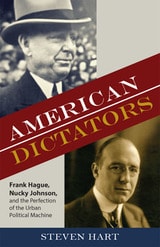
American Dictators
Frank Hague, Nucky Johnson, and the Perfection of the Urban Political MachineHart, Steven
Rutgers University Press, 2013
One man was tongue-tied and awkward around women, in many ways a mama's boy at heart, although his reputation for thuggery was well earned. The other was a playboy, full of easy charm and ready jokes, his appetite for high living a matter of public record. One man tolerated gangsters and bootleggers as long as they paid their dues to his organization. The other was effectively a gangster himself, so crooked that he hosted a national gathering of America's most ruthless killers. One man never drank alcohol. The other, from all evidence, seldom drank anything else.
American Dictators is the dual biography of two of America’s greatest political bosses: Frank Hagueand Enoch “Nucky” Johnson. Packed with compelling information and written in an informal, sometimes humorous style, the book shows Hague and Johnson at the peak of their power and the strength of their political machines during the years of Prohibition and the Great Depression. Steven Hart compares how both men used their influence to benefit and punish the local citizenry, amass huge personal fortunes, and sometimes collaborate to trounce their enemies.
Similar in their ruthlessness, both men were very different in appearance and temperament. Hague, the mayor of Jersey City, intimidated presidents and wielded unchallenged power for three decades. He never drank and was happily married to his wife for decades. He also allowed gangsters to run bootlegging and illegal gambling operations as long as they paid protection money. Johnson, the political boss of Atlantic City, and the inspiration for the hit HBO series Boardwalk Empire, presided over corruption as well, but for a shorter period of time. He was notorious for his decadent lifestyle. Essentially a gangster himself, Johnson hosted the infamous Atlantic City conference that fostered the growth of organized crime.
Both Hague and Johnson shrewdly integrated otherwise disenfranchised groups into their machines and gave them a stake in political power. Yet each failed to adapt to changing demographics and circumstances. In American Dictators, Hart paints a balanced portrait of their accomplishments and their failures.
Anonymous Connections
The Body and Narratives of the Social in Victorian BritainTina Young Choi
University of Michigan Press, 2016
Antebellum Jefferson, Texas
Everyday Life in an East Texas TownJacques D. Bagur
University of North Texas Press, 2012
Archaeology of Southern Urban Landscapes
Amy L Young
University of Alabama Press, 2000
Groundbreaking essays in urban archaeology highlight the impact of towns and cities on the southern landscape.
The rapid growth and development of urban areas in the South have resulted in an increase in the number of urban archaeology projects required by federal and state agencies. These projects provide opportunities not only to investigate marginal areas between the town and countryside but also to recover information long buried beneath the earliest urban structures. Such projects have also created a need for a one-volume update on archaeology as it is practiced in the urban areas of the southeastern United States.
Archaeology of Southern Urban Landscapes will assist practitioners and scholars in the burgeoning fields of urban and landscape archaeology by treating the South as a distinctive social, geographic, and material entity and by focusing on the urban South rather than the stereotypical South of rural plantations. The case studies in this volume span the entire southeastern United States, from Annapolis to New Orleans and from colonial times to the 19th century. The authors address questions involving the function of cities, interregional diversity, the evolution of the urban landscape, and the impact of the urban landscape on southern culture. By identifying the relationship between southern culture and the South's urban landscapes, this book will help us understand the built landscape of the past and predict future growth in the region.