188 books match the query 'City planning' and 8 start with a
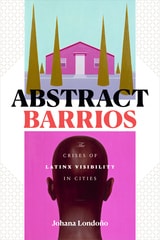
cover of Abstract Barrios: The Crises of Latinx Visibility in Cities

Abstract Barrios

The Crises of Latinx Visibility in Cities

Johana Londoño

Duke University Press, 2020
In Abstract Barrios Johana Londoño examines how Latinized urban landscapes are made palatable for white Americans. Such Latinized urban landscapes, she observes, especially appear when whites feel threatened by concentrations of Latinx populations, commonly known as barrios. Drawing on archival research, interviews, and visual analysis of barrio built environments, Londoño shows how over the past seventy years urban planners, architects, designers, policy makers, business owners, and other brokers took abstracted elements from barrio design—such as spatial layouts or bright colors—to safely “Latinize” cities and manage a long-standing urban crisis of Latinx belonging. The built environments that resulted ranged from idealized notions of authentic Puerto Rican culture in the interior design of New York City’s public housing in the 1950s, which sought to diminish concerns over Puerto Rican settlement, to the Fiesta Marketplace in downtown Santa Ana, California, built to counteract white flight in the 1980s. Ultimately, Londoño demonstrates that abstracted barrio culture and aesthetics sustain the economic and cultural viability of normalized, white, and middle-class urban spaces.
[more]
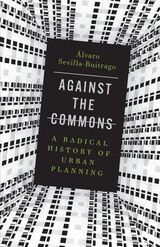
cover of Against the Commons: A Radical History of Urban Planning

Against the Commons

A Radical History of Urban Planning

Álvaro Sevilla-Buitrago

University of Minnesota Press, 2022

An alternative history of capitalist urbanization through the lens of the commons

Characterized by shared, self-managed access to food, housing, and the basic conditions for a creative life, the commons are essential for communities to flourish and protect spaces of collective autonomy from capitalist encroachment. In a narrative spanning more than three centuries, Against the Commons provides a radical counterhistory of urban planning that explores how capitalism and spatial politics have evolved to address this challenge.

Highlighting episodes from preindustrial England, New York City and Chicago between the 1850s and the early 1900s, Weimar-era Berlin, and neoliberal Milan, Álvaro Sevilla-Buitrago shows how capitalist urbanization has eroded the egalitarian, convivial life-worlds around the commons. The book combines detailed archival research with provocative critical theory to illuminate past and ongoing struggles over land, shared resources, public space, neighborhoods, creativity, and spatial imaginaries.

Against the Commons underscores the ways urbanization shapes the social fabric of places and territories, lending particular awareness to the impact of planning and design initiatives on working-class communities and popular strata. Projecting history into the future, it outlines an alternative vision for a postcapitalist urban planning, one in which the structure of collective spaces is ultimately defined by the people who inhabit them.
[more]
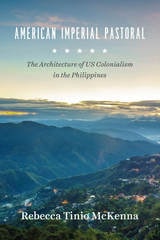
cover of American Imperial Pastoral: The Architecture of US Colonialism in the Philippines

American Imperial Pastoral

The Architecture of US Colonialism in the Philippines

Rebecca Tinio McKenna

University of Chicago Press, 2017

In 1904, renowned architect Daniel Burnham, the Progressive Era urban planner who famously “Made No Little Plans,” set off for the Philippines, the new US colonial acquisition. Charged with designing environments for the occupation government, Burnham set out to convey the ambitions and the dominance of the regime, drawing on neo-classical formalism for the Pacific colony. The spaces he created, most notably in the summer capital of Baguio, gave physical form to American rule and its contradictions.

In American Imperial Pastoral, Rebecca Tinio McKenna examines the design, construction, and use of Baguio, making visible the physical shape, labor, and sustaining practices of the US’s new empire—especially the dispossessions that underwrote market expansion. In the process, she demonstrates how colonialists conducted market-making through state-building and vice-versa. Where much has been made of the racial dynamics of US colonialism in the region, McKenna emphasizes capitalist practices and design ideals—giving us a fresh and nuanced understanding of the American occupation of the Philippines.
[more]
cover of Ancient Mesopotamia at the Dawn of Civilization: The Evolution of an Urban Landscape

Ancient Mesopotamia at the Dawn of Civilization

The Evolution of an Urban Landscape

Guillermo Algaze

University of Chicago Press, 2008

The alluvial lowlands of the Tigris and Euphrates rivers in southern Mesopotamia are widely known as the “cradle of civilization,” owing to the scale of the processes of urbanization that took place in the area by the second half of the fourth millennium BCE.
            In Ancient Mesopotamia at the Dawn of Civilization, Guillermo Algaze draws on the work of modern economic geographers to explore how the unique river-based ecology and geography of the Tigris-Euphrates alluvium affected the development of urban civilization in southern Mesopotamia. He argues that these natural conditions granted southern polities significant competitive advantages over their landlocked rivals elsewhere in Southwest Asia, most importantly the ability to easily transport commodities. In due course, this resulted in increased trade and economic activity and higher population densities in the south than were possible elsewhere. As southern polities grew in scale and complexity throughout the fourth millennium, revolutionary new forms of labor organization and record keeping were created, and it is these socially created innovations, Algaze argues, that ultimately account for why fully developed city-states emerged earlier in southern Mesopotamia than elsewhere in Southwest Asia or the world.
[more]
cover of Architecture in Translation: Germany, Turkey, and the Modern House

Architecture in Translation

Germany, Turkey, and the Modern House

Esra Akcan

Duke University Press, 2012

In Architecture in Translation, Esra Akcan offers a way to understand the global circulation of culture that extends the notion of translation beyond language to visual fields. She shows how members of the ruling Kemalist elite in Turkey further aligned themselves with Europe by choosing German-speaking architects to oversee much of the design of modern cities. Focusing on the period from the 1920s through the 1950s, Akcan traces the geographical circulation of modern residential models, including the garden city—which emphasized green spaces separating low-density neighborhoods of houses surrounded by gardens—and mass housing built first for the working-class residents in industrial cities and, later, more broadly for mixed-income residents. She shows how the concept of translation—the process of change that occurs with transportation of people, ideas, technology, information, and images from one or more countries to another—allows for consideration of the sociopolitical context and agency of all parties in cultural exchanges. Moving beyond the indistinct concepts of hybrid and transculturation and avoiding passive metaphors such as import, influence, or transfer, translation offers a new approach relevant to many disciplines. Akcan advocates a commitment to a new culture of translatability from below for a truly cosmopolitan ethics in a globalizing world.
[more]
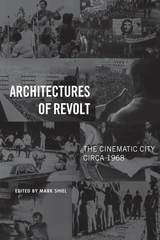
cover of Architectures of Revolt: The Cinematic City circa 1968

Architectures of Revolt

The Cinematic City circa 1968

Mark Shiel

Temple University Press, 2018

Coinciding with the fiftieth anniversary of the worldwide mass protest movements of 1968—against war, imperialism, racism, poverty, misogyny, and homophobia—the exciting anthology Architectures of Revolt explores the degree to which the real events of political revolt in the urban landscape in 1968 drove change in the attitudes and practices of filmmakers and architects alike.

In and around 1968, as activists and filmmakers took to the streets, commandeering public space, buildings, and media attention, they sought to re-make the urban landscape as an expression of utopian longing or as a dystopian critique of the established order. In Architectures of Revolt, the editor and contributors chronicle city-specific case studies from Paris, Berlin, Milan, and Chicago to New York, Los Angeles, Mexico City, and Tokyo. The films discussed range from avant-garde and agitprop shorts to mainstream narrative feature films. All of them share a focus on the city and, often, particular streets and buildings as places of political contestation and sometimes violence, which the medium of cinema was uniquely equipped to capture.

Contributors include: Stephen Barber, Stanley Corkin, Jesse Lerner, Jon Lewis, Gaetana Marrone, Jennifer Stob, Andrew Webber, and the editor.
[more]
cover of Art for People's Sake: Artists and Community in Black Chicago, 1965-1975

Art for People's Sake

Artists and Community in Black Chicago, 1965-1975

Rebecca Zorach

Duke University Press, 2019
In the 1960s and early 1970s, Chicago witnessed a remarkable flourishing of visual arts associated with the Black Arts Movement. From the painting of murals as a way to reclaim public space and the establishment of independent community art centers to the work of the AFRICOBRA collective and Black filmmakers, artists on Chicago's South and West Sides built a vision of art as service to the people. In Art for People's Sake Rebecca Zorach traces the little-told story of the visual arts of the Black Arts Movement in Chicago, showing how artistic innovations responded to decades of racist urban planning that left Black neighborhoods sites of economic depression, infrastructural decay, and violence. Working with community leaders, children, activists, gang members, and everyday people, artists developed a way of using art to help empower and represent themselves. Showcasing the depth and sophistication of the visual arts in Chicago at this time, Zorach demonstrates the crucial role of aesthetics and artistic practice in the mobilization of Black radical politics during the Black Power era.
[more]
cover of Atlanta Unbound: Enabling Sprawl through Policy and Planning

Atlanta Unbound

Enabling Sprawl through Policy and Planning

Carlton Wade Basmajian

Temple University Press, 2015

Looking at Atlanta, Georgia, one might conclude that the city’s notorious sprawl, degraded air quality, and tenuous water supply is a result of a lack of planning—particularly an absence of coordination at the regional level. In Atlanta Unbound, Carlton Wade Basmajian shows that Atlanta’s low-density urban form and its associated problems have been both highly coordinated and regionally planned.
 
Basmajian’s shrewd analysis shows how regional policies spanned political boundaries and   framed local debates over several decades. He examines the role of the Atlanta Regional Commission’s planning deliberations that appear to have contributed to the urban sprawl that they were designed to control. Basmajian explores four cases—regional land development plans, water supply strategies, growth management policies, and transportation infrastructure programs—to provide a detailed account of the interactions between citizens, planners, regional commissions, state government, and federal agencies.
 
In the process, Atlanta Unbound answers the question: Toward what end and for whom is Atlanta’s regional planning process working?
 
In the series Urban Life, Landscape, and Policy, edited by Zane L. Miller, David Stradling, and Larry Bennett
[more]