Results by title
90 books match the query 'Civilization, Modern' and 9 start with a

A User's Guide to the Crisis of Civilization
And How to Save ItNafeez Mosaddeq Ahmed
Pluto Press, 2010
It often seems that different crises are competing to devastate civilisation. This book argues that financial meltdown, dwindling oil reserves, terrorism and food shortages need to be considered as part of the same ailing system.
Most accounts of our contemporary global crises such as climate change, or the threat of terrorism, focus on one area, or another, to the exclusion of others. Nafeez Mosaddeq Ahmed argues that the unwillingness of experts to look outside their own fields explains why there is so much disagreement and misunderstanding about particular crises. This book attempts to investigate all of these crises, not as isolated events, but as trends and processes that belong to a single global system. We are therefore not dealing with a 'clash of civilisations', as Huntington argued. Rather, we are dealing with a fundamental crisis of civilisation itself.
This book provides a stark warning of the consequences of failing to take a broad view of the problems facing the world and shows how catastrophe can be avoided.
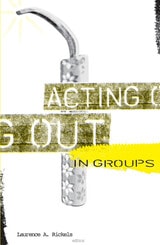
Acting Out In Groups
Laurence A. Rickels
University of Minnesota Press, 1999
Examines outrageous public behavior and what it can tell us about cultural and political change.
The International Psychoanalytic Congress gathered in 1967 to define the clinical concept of “acting out.” Thirty years later, our society, which once labeled those who exhibited excessive aggression as delinquent, celebrates outrageous public behavior. In Acting Out in Groups, writers, literary theorists, and cultural critics explore therapeutic descriptions of acting out in relation to the conduct condoned, even encouraged, on daytime TV talk shows, at political rallies, and in performance.
Through a deconstruction of “acting out,” this collection seeks a new, performative style of critical discourse that incorporates the exuberance and intensity of acting out for analytical ends. Topics include the Jenny Jones murder trial; the response of psychoanalysts to the acclaimed documentary Crumb; the place of the Berlin Wall and other national symbols in German life; and the roles of aggression and discipline in childhood development.Contributors: Kathy Acker; Peter Canning; Julie Carlson, U of California, Santa Barbara; Susan Derwin, U of California, Santa Barbara; Andrew Hewitt, SUNY Buffalo; Gary Indiana; Rhonda Lieberman; Catherine Liu, U of Minnesota; Fred Moten, NYU; John Mowitt, U of Minnesota; Klaus Theweleit; Elisabeth Weber, U of California, Santa Barbara.
After God
Mark C. Taylor
University of Chicago Press, 2007
Religion, Mark C. Taylor argues in After God, is more complicated than either its defenders or critics think and, indeed, is much more influential than any of us realize. Our world, Taylor maintains, is shaped by religion even when it is least obvious. Faith and value, he insists, are unavoidable and inextricably interrelated for believers and nonbelievers alike.
The first comprehensive theology of culture since the pioneering work of Paul Tillich, After God redefines religion for our contemporary age. This volumeis a radical reconceptualization of religion and Taylor’s most pathbreaking work yet, bringing together various strands of theological argument and cultural analysis four decades in the making.
Praise for Mark C. Taylor
“The distinguishing feature of Taylor’s career is a fearless, or perhaps reckless, orientation to the new and to whatever challenges orthodoxy. . . . Taylor’s work is playful, perverse, rarefied, ingenious, and often brilliant.”—New York Times Magazine

After Pandemic, After Modernity
The Relational RevolutionGiulio Maspero
St. Augustine's Press, 2022
Without Trinitarian framework ancient and new idols emerge, as the Covid-19 tragedies have shown. Yet post-pandemic must be a moment of clarity and realism, as we can see how necessary it is that humanity place itself in relation to something beyond. The post-modern journey, however, must be in the spirit of Christian humanism or else any so-called progress will no longer be unable to speak authentically of our humanity. That is to say, the relational dimension of human life will be erased right along with the other ills that plague our earth.

Against Purity
Living Ethically in Compromised TimesAlexis Shotwell
University of Minnesota Press, 2016
The world is in a terrible mess. It is toxic, irradiated, and full of injustice. Aiming to stand aside from the mess can produce a seemingly satisfying self-righteousness in the scant moments we achieve it, but since it is ultimately impossible, individual purity will always disappoint. Might it be better to understand complexity and, indeed, our own complicity in much of what we think of as bad, as fundamental to our lives? Against Purity argues that the only answer—if we are to have any hope of tackling the past, present, and future of colonialism, disease, pollution, and climate change—is a resounding yes. Proposing a powerful new conception of social movements as custodians for the past and incubators for liberated futures, Against Purity undertakes an analysis that draws on theories of race, disability, gender, and animal ethics as a foundation for an innovative approach to the politics and ethics of responding to systemic problems.
Being against purity means that there is no primordial state we can recover, no Eden we have desecrated, no pretoxic body we might uncover through enough chia seeds and kombucha. There is no preracial state we could access, no erasing histories of slavery, forced labor, colonialism, genocide, and their concomitant responsibilities and requirements. There is no food we can eat, clothes we can buy, or energy we can use without deepening our ties to complex webbings of suffering. So, what happens if we start from there?
Alexis Shotwell shows the importance of critical memory practices to addressing the full implications of living on colonized land; how activism led to the official reclassification of AIDS; why we might worry about studying amphibians when we try to fight industrial contamination; and that we are all affected by nuclear reactor meltdowns. The slate has never been clean, she reminds us, and we can’t wipe off the surface to start fresh—there’s no fresh to start. But, Shotwell argues, hope found in a kind of distributed ethics, in collective activist work, and in speculative fiction writing for gender and disability liberation that opens new futures.
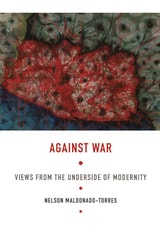
Against War
Views from the Underside of ModernityNelson Maldonado-Torres
Duke University Press, 2008
Considering Levinas’s critique of French liberalism and Nazi racial politics, and the links between them, Maldonado-Torres identifies a “master morality” of dominion and control at the heart of western modernity. This master morality constitutes the center of a warring paradigm that inspires and legitimizes racial policies, imperial projects, and wars of invasion. Maldonado-Torres refines the description of modernity’s war paradigm and the Levinasian critique through Fanon’s phenomenology of the colonized and racial self and the politics of decolonization, which he reinterprets in light of the Levinasian conception of ethics. Drawing on Dussel’s genealogy of the modern imperial and warring self, Maldonado-Torres theorizes race as the naturalization of war’s death ethic. He offers decolonial ethics and politics as an antidote to modernity’s master morality and the paradigm of war. Against War advances the de-colonial turn, showing how theory and ethics cannot be conceived without politics, and how they all need to be oriented by the imperative of decolonization in the modern/colonial and postmodern world.
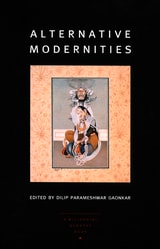
Alternative Modernities, Volume 11
Dilip Parameshwar Gaonkar, ed.
Duke University Press, 2001
The idea of “alternative modernities” holds that modernity always unfolds within specific cultures or civilizations and that different starting points of the transition to modernity lead to different outcomes. Without abandoning the Western discourse on the subject, the contributors to this volume write from the standpoint that modernity is in truth a richly mulitiplicitous concept. Believing that the language and lessons of Western modernity must be submitted to comparative study of its global receptions, they focus on such sites as China, Russia, India, Trinidad, and Mexico. Other essays treat more theoretical aspects of modernity, such as its self-understanding and the potential reconcilability of cosmopolitanism and diversity.
Contributors. Homi Bhabha, William Cunningham Bissell, Dipesh Chakrabarty, Dilip Parameshwar Gaonkar, Michael Hanchard, Beatriz Jaguaribe, Leo Ou-fan Lee, Claudio Lomnitz, Thomas McCarthy, Tejaswini Niranjana, Elizabeth A. Povinelli, Shahzia Sikander, Charles Taylor, Andrew Wachtel
Amythia
Crisis in the Natural History of Western CultureLoyal D. Rue
University of Alabama Press, 1989
Amythia results when cosmology and morality are not effectively integrated by a root metaphor, and the only possibility for the future is to transpose the old Christian God as Person to a root metaphor that is even older in origin, the concept of the Covenant tradition inherited from Israel but now understood in a nonsupernaturalist manner.
Rue asserts that amythia is a critical condition within the natural history of Western culture. The argument of the book begins with a theoretical perspective on the place of human culture within the scope of natural history and proceeds to establish the conceptual foundations for a natural history of culture.
Following an overview of the natural history of Western culture to expose the origins and depth of the contemporary intellectual and moral crisis, Rue moves on to specify and justify the limits of distinctiveness and plausibility appropriate for the task of transposing Covenant tradition. Finally, an appeal is made to the mythmakers of contemporary culture to take up the challenge of amythia.
Antinomies of Modernity
Essays on Race, Orient, NationVasant Kaiwar and Sucheta Mazumdar, eds.
Duke University Press, 2003
Drawing on archival sources and fieldwork, the contributors explore aspects of modernity within societies of South Asia, the Middle East, and Africa. Whether considering how European ideas of Orientalism became foundational myths of Indian nationalism; how racial caste systems between blacks, South Asians, and whites operate in post-apartheid South Africa; or how Indian immigrants to the United States negotiate their identities, these essays demonstrate that the contours of cultural and identity politics did not simply originate in metropolitan centers and get adopted wholesale in the colonies. Colonial and postcolonial modernisms have emerged via the active appropriation of, or resistance to, far-reaching European ideas. Over time, Orientalism and nationalist and racialized knowledges become indigenized and acquire, for all practical purposes, a completely "Third World" patina. Antinomies of Modernity shows that people do make history, constrained in part by political-economic realities and in part by the categories they marshal in doing so.
Contributors. Neville Alexander, Andrew Barnes, Vasant Kaiwar, Sucheta Mazumdar, Minoo Moallem, Mohamad Tavakoli-Targhi, A. R. Venkatachalapathy, Michael O. West