Results by title
319 books match the query 'Communication Studies' and 27 start with a
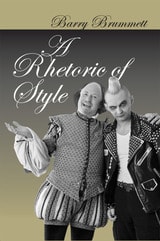
A Rhetoric of Style
Barry Brummett
Southern Illinois University Press, 2008
Exploring style in a global culture
In A Rhetoric of Style, Barry Brummett illustrates how style is increasingly a global system of communication as people around the world understand what it means to dress a certain way, to dance a certain way, to decorate a certain way, to speak a certain way. He locates style at the heart of popular culture and asserts that it is the basis for social life and politics in the twenty-first century.
Brummett sees style as a system of signification grounded largely in image, aesthetics, and extrarational modes of thinking. He discusses three important aspects of this system—its social and commercial structuring, its political consequences, and its role as the chief rhetorical system of the modern world. He argues that aesthetics and style are merging into a major engine of the global economy and that style is becoming a way to construct individual identity, as well as social and political structures of alliance and opposition. It is through style that we stereotype or make assumptions about others’ political identities, their sexuality, their culture, and their economic standing.
To facilitate theoretical and critical analysis, Brummett develops a systematic rhetoric of style and then demonstrates its use through an in-depth exploration of gun culture in the United States. Armed with an understanding of how this rhetoric of style works methodologically, students and scholars alike will have the tools to do their own analyses. Written in clear and engaging prose, A Rhetoric of Style presents a novel discussion of the workings of style and sheds new light on a venerable and sometimes misunderstood rhetorical concept by illustrating how style is the key to constructing a rhetoric for the twenty-first century.
A Voice Of Their Own
The Woman Suffrage Press, 1840-1910Martha Solomon
University of Alabama Press, 1991
Abducting Writing Studies
Edited by Sidney I. Dobrin and Kyle Jensen
Southern Illinois University Press, 2017
Each of the twelve essays that comprise this collection sparks new insights about the phenomenon of writing. A must-read for rhetoric and composition scholars and students, Abducting Writing Studies is sure to foster vibrant discussions about what is possible in writing research and instruction.
Abductive Reasoning
Douglas Walton
University of Alabama Press, 2005
Examines three areas in which abductive reasoning is especially important: medicine, science, and law. The reader is introduced to abduction and shown how it has evolved historically into the framework of conventional wisdom in logic. Discussions draw upon recent techniques used in artificial intelligence, particularly in the areas of multi-agent systems and plan recognition, to develop a dialogue model of explanation. Cases of causal explanations in law are analyzed using abductive reasoning, and all the components are finally brought together to build a new account of abductive reasoning.
By clarifying the notion of abduction as a common and significant type of reasoning in everyday argumentation, Abductive Reasoning will be useful to scholars and students in many fields, including argumentation, computing and artificial intelligence, psychology and cognitive science, law, philosophy, linguistics, and speech communication and rhetoric.
Ad Hominem Arguments
Douglas Walton
University of Alabama Press, 2009
A vital contribution to legal theory and media and civic discourse
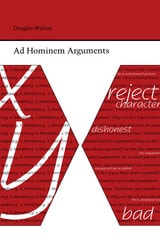
In the 1860s, northern newspapers attacked Abraham Lincoln's policies by attacking his character, using the terms "drunk," "baboon," "too slow," "foolish," and "dishonest." Steadily on the increase in political argumentation since then, the argumentum ad hominem, or personal attack argument, has now been carefully refined as an instrument of "oppo tactics" and "going negative" by the public relations experts who craft political campaigns at the national level. In this definitive treatment of one of the most important concepts in argumentation theory and informal logic, Douglas Walton presents a normative framework for identifying and evaluating ad hominem or personal attack arguments.
Personal attack arguments have often proved to be so effective, in election campaigns, for example, that even while condemning them, politicians have not stopped using them. In the media, in the courtroom, and in everyday confrontation, ad hominem arguments are easy to put forward as accusations, are difficult to refute, and often have an extremely powerful effect on persuading an audience.
Walton gives a clear method for analyzing and evaluating cases of ad hominem arguments found in everyday argumentation. His analysis classifies the ad hominem argument into five clearly defined subtypes—abusive (direct), circumstantial, bias, "poisoning the well," and tu quoque ("you're just as bad") arguments—and gives methods for evaluating each type. Each subtype is given a well-defined form as a recognizable type of argument. The numerous case studies show in concrete terms many practical aspects of how to use textual evidence to identify and analyze fallacies and to evaluate argumentation as fallacious or not in particular cases.
Advertising at War
Business, Consumers, and Government in the 1940sInger L. Stole
University of Illinois Press, 2012
Using archival sources, newspapers accounts, and trade publications, Stole demonstrates that the war elevated and magnified the seeming contradictions of advertising and allowed critics of these practices one final opportunity to corral and regulate the institution of advertising. Exploring how New Dealers and consumer advocates such as the Consumers Union battled the advertising industry, Advertising at War traces the debate over two basic policy questions: whether advertising should continue to be a tax-deductible business expense during the war, and whether the government should require effective standards and labeling for consumer products, which would render most advertising irrelevant. Ultimately the postwar climate of political intolerance and reverence for free enterprise quashed critical investigations into the advertising industry. While advertising could be criticized or lampooned, the institution itself became inviolable.
Against a Sharp White Background
Infrastructures of African American PrintEdited by Brigitte Fielder and Jonathan Senchyne
University of Wisconsin Press, 2019
Ageing with Smartphones in Ireland
When Life Becomes CraftPauline Garvey and Daniel Miller
University College London, 2021
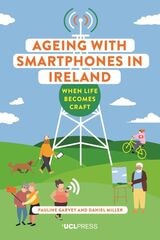
This volume documents a radical change in the experience of aging. Based on two ethnographies in Dublin, Ireland, the book illustrates how smartphones enable old people to focus on crafting a new life in retirement. For some, the smartphone is an intimidating burden linked to being on the wrong side of a new digital divide. But for most, however, it has become integral to a new trajectory towards a more sustainable life, both for themselves and their environment. The smartphone has reunited extended family and old friends, helped resolve intergenerational conflicts though new forms of grandparenting, and has become a health resource. This is a book about acknowledging late middle age in contemporary Ireland and examines how older people in Ireland experience life today.

Ageing with Smartphones in Uganda
Togetherness in the Dotcom AgeCharlotte Hawkins
University College London, 2023
Ageing with Smartphones in Uganda is based on a sixteen-month ethnography about experiences of aging in a neighborhood in central Kampala, Uganda. Taking a convivial approach, which celebrates multiple ways of knowing about social life, Charlotte Hawkins draws from these expressions about cooperative morality and modernity to consider the everyday mitigation of profound social change. “Dotcom” is understood to encompass everything from the influence of information and communications technologies to urban migration and lifestyles in the city to shifts in ways of knowing and relating. At the same time, dotcom tools such as mobile phones and smartphones facilitate elder care through, for example, regular mobile money remittances.
This book explores how dotcom relates to older people’s health, their care norms, their social standing, their values of respect and relatedness, and their intergenerational relationships—both political and personal. It also re-frames the youth-centricity of research on the city and work, new media and technology, and politics and service provision in Uganda. Through ethnographic consideration of everyday life and self-formation in this context, this monograph seeks to contribute to an ever-incomplete understanding of how we relate to each other and to the world around us.
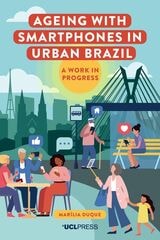
Ageing with Smartphones in Urban Brazil
A Work in ProgessMarília Duque
University College London, 2022
With people living longer all over the world, aging has begun to be framed as a socioeconomic problem. In Brazil, older people are expected to remain healthy and autonomous while actively participating in society. Based on ethnographic research in São Paulo, this book shows how older people in a middle-class neighborhood try to reconcile these expectations with the freedom and pleasures reserved for old age by using smartphones. Smartphones have become of great importance to the residents as they search for and engage in new forms of work and hobbies. Connected by a digital network, they work as content curators, sharing activities that fill their schedules. Managing multiple WhatsApp groups is a job in itself, as well as a source of solidarity and hope. Friendship groups help each to download new apps, search for medical information and guidance, and navigate the city. Together, the author shows, older people are reinventing themselves as volunteers, entrepreneurs, and influencers, or they are finding a new interest that gives their later life a purpose. The smartphone, which enables the residents to share and discuss their busy lives, is also helping them, and us, to rethink aging.

Ageing with Smartphones in Urban Chile
The Experience of Peruvian MigrantsAlfonso Otaegui
University College London, 2023
What does it mean to be aging in Chile as a migrant? Drawing on extensive ethnographic fieldwork, Ageing with Smartphones in Urban Chile analyzes the experience of aging for Peruvian migrants aged around sixty who have lived in Chile for more than twenty years. Their lives, we discover, are informed by a series of experiences of being ‘in between’. They live between two countries, two generations, and two different stages in life, between giving care and not wanting care, and between a continuing legacy and not transmitting legacy. By focusing on the entanglement of aging, migration, and technology, this book is an ethnographic contribution to an unexplored subject in the vast literature on migration studies in Chile.

Ageing with Smartphones in Urban China
From the Cultural to the Digital Revolution in ShanghaiXinyuan Wang
University College London, 2023
The current oldest generation in Shanghai was born at a time when the average household could not afford electric lights, but today they can turn their lights off using smartphone apps. Grounded in extensive ethnographic fieldwork in Shanghai, Ageing with Smartphones in Urban China tackles the intersection between the “two revolutions” experienced by the older generation in Shanghai: the contemporary smartphone-based digital revolution and the earlier communist revolutions and argues that we can only understand the smartphone revolution if we first appreciate the long-term consequences of these people’s experiences during the communist revolutions. Supported by detailed ethnographic material, the observations and analysis here provide a panorama view of the social landscape of contemporary China, addressing such topics the digital and everyday life, aging and healthcare, intergenerational relations and family development, community building and grassroots organizations, collective memories, and political attitudes among ordinary Chinese people.
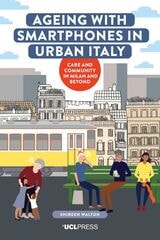
Ageing with Smartphones in Urban Italy
Care and Community in Milan and BeyondShireen Walton
University College London, 2021
This book is an anthropological account of the experience of age and ageing in an inner-city neighborhood in Milan, exploring the relationship between ageing and technology amidst a backdrop of rapid global technological innovation, including the advent of mobile health, smart cities, and a number of wider socioeconomic and technological transformations. Through extensive urban and digital ethnographic research in Milan, Shireen Walton shows how the smartphone has become a “constant companion” in contemporary life, accompanying people throughout the day and through individual and collective experiences. The volume argues that ageing with smartphones in the contemporary urban Italian context is about living with ambiguity, change, and contradiction, as well as developing curiosities about a changing world, our changing selves, and changing relationships with others.
All Edge
Inside the New Workplace NetworksClay Spinuzzi
University of Chicago Press, 2015
Spinuzzi offers for the first time a comprehensive framework for understanding how these new groups function and thrive. His rigorous analysis tackles both the pros and cons of this evolving workflow and is based in case studies of real all-edge adhocracies at work. His provocative results will challenge our long-held assumptions about how we should be doing work.
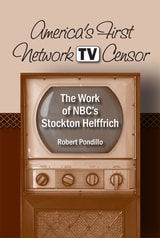
America's First Network TV Censor
The Work of NBC's Stockton HelffrichRobert Pondillo
Southern Illinois University Press, 2010
While other books have cited Helffrich’s reports, none have considered them as a body of work, complemented by the details of Helffrich’s life and the era in which he lived. America’s First Network TV Censor explores the ways in which Helffrich’s personal history and social class influenced his perception of his role as NBC-TV censor and his tendency to ignore certain political and cultural taboos while embracing others.
Author Robert Pondillo considers Helffrich’s life in broadcasting before and after the Second World War, and his censorial work in the context of 1950s American culture and emerging network television. Pondillo discusses the ways that cultural phenomena, including the arrival of the mid-twentieth-century religious boom, McCarthyism, the dawn of the Civil Rights era, and the social upheaval over sex, music, and youth, contributed to a general sense that the country was morally adrift and ripe for communist takeover.
Five often-censored subjects—advertising, language, and depictions of sex, violence, and race—are explored in detail, exposing the surprising complexity and nuance of early media censorship. Questions of whether too many sadistic westerns would coarsen America’s children, how to talk about homosexuality without using the word “homosexuality,” and how best to advertise toilet paper without offending people were on Helffrich’s mind; his answers to these questions helped shape the broadcast media we know today.
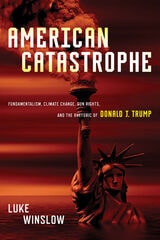
American Catastrophe
Fundamentalism, Climate Change, Gun Rights, and the Rhetoric of Donald J. TrumpLuke Winslow
The Ohio State University Press, 2020
Luke Winslow introduces the rhetorical homology as a critical tool useful for understanding how catastrophic appeals unite Americans across disparate religious, ecological, cultural, and political spheres. More specifically, the four case study chapters examining Christian fundamentalism, anti-environmentalism, gun rights messaging, and the administration of Donald Trump reveal a consistent formal pattern oriented toward catastrophe. In teasing out this orientation toward catastrophe, Winslow offers a fresh, provocative, and insightful contribution to our most pressing social challenges.
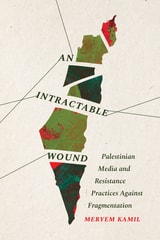
An Intractable Wound
Palestinian Media and Resistance Practices Against FragmentationMeryem Kamil
Rutgers University Press, 2027
An Intractable Wound explores Palestinian resistance to colonial fragmentation that originated as territorial fracture, as proposed through the United Nations partition plan that split the land between the state of Israel and Arab territories. The resulting fragmentation of geography, sovereignty, and populations spurred multiple other schisms that manifest culturally, politically, and developmentally across the West Bank, Gaza, refugee camps, exiled and diasporic Palestinians, and Arab citizens of Israel.
An Intractable Wound considers the various tactics Palestinians deploy to combat these multiple, intersecting iterations of fracture. In particular, this text considers Palestinian media technologies and practices that manage, subvert, and overcome fragmentation. Each chapter centers projects that elaborate on these fractures and combat them, including virtual reality representations, online archives, digital mapping platforms, and video games that imagine and construct an intact Palestinian community. Together, these case studies provide a capacious reading of the Palestinian condition as structured by fragmentation, and Palestinian resistance as struggling in opposition to that geographic, sociopolitical, and cultural disillusion.
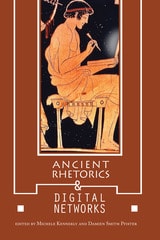
Ancient Rhetorics and Digital Networks
Edited by Michele Kennerly and Damien Smith Pfister
University of Alabama Press, 2018
What can ancient rhetorical theory possibly tell us about the role of new digital media technologies in contemporary public culture? Some central issues we currently deal with—making sense of information abundance, persuading others in our social network, navigating new media ecologies, and shaping broader cultural currents—also pressed upon the ancients.
Ancient Rhetorics and Digital Networks makes this connection explicit, reexamining key figures, texts, concepts, and sensibilities from ancient rhetoric in light of the glow of digital networks, or, ordered conversely, surveying the angles and tangles of digital networks from viewpoints afforded by ancient rhetoric. By providing an orientation grounded in ancient rhetorics, this collection simultaneously historicizes contemporary developments and reenergizes ancient rhetorical vocabularies.
Contributors engage with a variety of digital phenomena including remix, big data, identity and anonymity, memes and virals, visual images, decorum, and networking. Taken together, the essays in Ancient Rhetorics and Digital Networks help us to understand and navigate some of the fundamental communicative issues we deal with today.
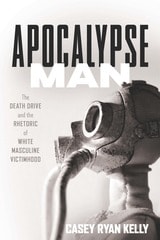
Apocalypse Man
The Death Drive and the Rhetoric of White Masculine VictimhoodCasey Ryan Kelly
The Ohio State University Press, 2020
Exemplified by President Donald J. Trump’s slogan “Make American Great Again,” white masculinity has become increasingly organized around melancholic attachments to an imagined past when white men were still atop the social hierarchy. How and why are white men increasingly identifying as victims of social, economic, and political change? Casey Ryan Kelly’s Apocalypse Man seeks to answer this question by examining textual and performative examples of white male rhetoric—as found among online misogynist and incel communities, survivalists and “doomsday preppers,” gender-motivated mass shooters, gun activists, and political demagogues. Using sources ranging from reality television and Reddit manifestos to gun culture and political rallies, Kelly ultimately argues that death, victimhood, and fatalism have come to underwrite the constitution of contemporary white masculinity.
Appeals in Modern Rhetoric
An Ordinary Language ApproachM. Jimmie Killingsworth
Southern Illinois University Press, 2005
Appeals in Modern Rhetoric: An Ordinary-Language Approach introduces students to current issues in rhetorical theory through an extended treatment of the rhetorical appeal, a frequently used but rarely discussed concept at the core of rhetorical analysis and criticism. Shunning the standard Aristotelian approach that treats ethos, pathos, and logos as modes of appeal, M. Jimmie Killingsworth uses common, accessible language to explain the concept of the rhetorical appeal—meaning the use of language to plead and to please. The result is a practical and innovative guide to understanding how persuasion works that is suitable for graduate and undergraduate courses yet still addresses topics of current interest to specialists.
Supplementing the volume are practical and theoretical approaches to the construction and analysis of rhetorical messages and brief and readable examples from popular culture, academic discourse, politics, and the verbal arts. Killingsworth draws on close readings of primary texts in the field, referencing theorists to clarify concepts, while he decodes many of the basic theoretical constructs common to an understanding of identification. Beginning with examples of the model of appeals in social criticism, popular film, and advertising, he covers in subsequent chapters appeals to time, place, the body, gender, and race. Additional chapters cover the use of common tropes and rhetorical narrative, and each chapter begins with definitions of key concepts.
Are You Sure About That?
Discerning Fact from FictionKaren A. Cerulo
Rutgers University Press, 2027
Phone in hand, TV on, we wake up and fall asleep to endless information. There’s no escape—we are drowning in a sea of breaking news, notifications, and popular beliefs and claims. Every day, we encounter hundreds of posts and podcasts on politics, celebrities, or current events. People share links to “expert” recommendations on Instagram or Reddit. YouTube and TikTok bring us those who want to instruct us on the realities of the world or pass on longstanding conventional wisdom, all in the hopes of influencing our decisions and actions.
The information overload of the constant news and information cycle is exhausting and extremely frustrating. You may ask: Just what or whom should we believe? Are You Sure About That? Discerning Fact from Fiction helps readers navigate the perilous informational terrain of contemporary life. We provide a game plan of strategies and guidance for easily and reliably assessing the accuracy of any claim, helping readers to cut through the noise and adjust what they know.
Arenas of Language Use
Herbert H. Clark
University of Chicago Press, 1993
According to Clark, in order for one person to understand another, there must be a "common ground" of knowledge between them. He shows how people infer this "common ground" from their past conversations, their immediate surroundings, and their shared cultural background. Clark also discusses the means by which speakers design their utterances for particular audiences and coordinate their use of language with other participants in a language arena. He argues that language use in conversation is a collaborative process, where speaker and listener work together to establish that the listener understands the speaker's meaning. Since people often use words to mean something quite different from the dictionary definitions of those words, Clark offers a realistic perspective on how speakers and listeners coordinate on the meanings of words.
This collection presents outstanding examples of Clark's pioneering work on the pragmatics of language use and it will interest psychologists, linguists, computer scientists, and philosophers.
Argumentation Theory and the Rhetoric of Assent
David Williams
University of Alabama Press, 1990
The eleven essays coalesce around the general question of "When, if ever, is assent justified?" And, as Professor Cox astutely notes in his introduction, such a question immediately leads into considerations of argument and power. In these considerations, many differing perspectives are represented in this volume: aesthetic and symbolist approaches, rationalistic and formalistic approaches, field theory perspectives, orientations toward various conceptualizations of a public sphere, etc.
Argumentation Theory and the Rhetoric of Assent is intended not as a primer on argument theory but rather as a look at American approaches to a philosophy of argumentation and argument criticism. As such, the essays probe the implications of both current practices and theoretical approaches: the objective is not to map the terrain argumentation theory has traversed in recent years but rather to plot a route for the direction in which argumentation studies should move. The concluding essays by James Arnt Aune and G. Thomas Goodnight confront these concerns explicitly.
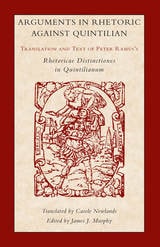
Arguments in Rhetoric Against Quintilian
Translation and Text of Peter Ramus's Rhetoricae Distinctiones in QuintilianumPeter Ramus, Translated by Carole Newlands, Edited by James J. Murphy,
Southern Illinois University Press, 2010
First published in 1986, this book offers the Latin text and English translation of a pivotal work by one of the most influential and controversial writers of early modern times. Pierre de la Ramée, better known as Peter Ramus, was a college instructor in Paris who published a number of books attacking and attempting to refute foundational texts in philosophy and rhetoric. He began in the early 1540s with books on Aristotle—which were later banned and burned—and Cicero, and later, in 1549, he published Rhetoricae Distinctiones in Quintilianum. The purpose of Ramus’s book is announced in the opening paragraph of its dedication to Charles of Lorraine: “I have a single argument, a single subject matter, that the arts of dialectic and rhetoric have been confused by Aristotle, Cicero, and Quintilian. I have previously argued against Aristotle and Cicero. What objection then is there against calling Quintilian to the same account?”
Carole Newlands’s excellent translation—the first in modern English—remains the standard English version. This volume also provides the original Latin text for comparative purposes. In addition, James J. Murphy’s insightful introduction places the text in historical perspective by discussing Ramus’s life and career, the development of his ideas, and the milieu in which his writings were produced. This edition includes an updated bibliography of works concerning Ramus, rhetoric, and related topics.
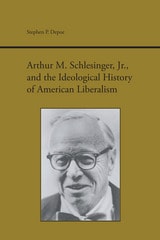
Arthur M. Schlesinger Jr. and the Ideological History of American Liberalism
Stephen P. Depoe
University of Alabama Press, 1994
Arthur M. Schlesinger, Jr., is a historian and political advocate whose ideas and activities have significantly influenced the shape and direction of American liberalism during the past fifty years. A central feature of Schlesinger’s ideological perspective is his belief that American history has been marked by alternating periods of conservative and liberal dominance, which he has termed the “tides of national politics.” Throughout his career, Schlesinger has used the “tides of national politics” to defend the legitimacy and superiority of active liberal government and leadership.
The study investigates how the “tides” concept has functioned in both Schlesinger’s historical scholarship and his partisan political discourse. Depoe also explores the ways in which the “tides” concept has shaped and channeled Schlesinger’s political thought over time, leading him toward certain definitions of situations and away from others. Finally, Depoe offers Schlesinger’s life and work as a case study of the highs and lows of postwar American liberalism. By tracing Schlesinger’s responses to Eisenhower-era conservatism, Kennedy’s New Frontier, and the problems of Vietnam and violence during the 1960s, and the gradual delegitimation of liberalism from the 1970s to the present, this book offers a road map that can guide the reader toward a better understanding of the past, present, and future of liberalism in America.

At Home in the Anthropocene
Amy D. Propen
The Ohio State University Press, 2022
By employing the tenets of posthumanism, compassionate conservation, and entangled empathy—and making them accessible through storytelling and narrative—Propen offers new perspectives about how to more compassionately and productively understand ideas about home, connectivity, and coexistence across a range of places and ecosystems. Uniquely conceptualized to include narrative related to the Anthropause, as well as travel and nature writing amidst COVID-19, At Home in the Anthropocene engages with questions about home and belonging in generative ways that attempt to open up possibilities for sustainable futures in which we may productively coexist with our more-than-human kin.

Awful Archives
Conspiracy Theory, Rhetoric, and Acts of EvidenceJenny Rice
The Ohio State University Press, 2020
After sketching a broader framework for understanding what evidence is, Awful Archives then asks how we can practice more ethical and productive forms of debate, especially when we’re faced with arguments that feel like a dead end. Thorough, engaging, and deeply insightful, Awful Archives:Conspiracy Theory, Rhetoric, and Acts of Evidence introduces an entirely new perspective on evidence—one that will impact the field for years to come.