Results by title
162 books match the query 'Comparative Politics' and 5 start with a

A Social Laboratory for Modern France
The Musée Social and the Rise of the Welfare StateJanet R. Horne
Duke University Press, 2001
As a nineteenth-century think tank that sought answers to France’s pressing “social question,” the Musée Social reached across political lines to forge a reformist alliance founded on an optimistic faith in social science. In A Social Laboratory for Modern France Janet R. Horne presents the story of this institution, offering a nuanced explanation of how, despite centuries of deep ideological division, the French came to agree on the basic premises of their welfare state.
Horne explains how Musée founders believed—and convinced others to believe—that the Third Republic would carry out the social mission of the French Revolution and create a new social contract for modern France, one based on the rights of citizenship and that assumed collective responsibility for the victims of social change. Challenging the persistent notion of the Third Republic as the stagnant backwater of European social reform, Horne instead depicts the intellectually sophisticated and progressive political culture of a generation that laid the groundwork for the rise of a hybrid welfare system, characterized by a partnership between private agencies and government. With a focus on the cultural origins of turn-of-the-century thought—including religion, republicanism, liberalism, solidarism, and early sociology—A Social Laboratory for Modern France demonstrates how French reformers grappled with social problems that are still of the utmost relevance today and how they initiated a process that gave the welfare state the task of achieving social cohesion within an industrializing republic.
Horne explains how Musée founders believed—and convinced others to believe—that the Third Republic would carry out the social mission of the French Revolution and create a new social contract for modern France, one based on the rights of citizenship and that assumed collective responsibility for the victims of social change. Challenging the persistent notion of the Third Republic as the stagnant backwater of European social reform, Horne instead depicts the intellectually sophisticated and progressive political culture of a generation that laid the groundwork for the rise of a hybrid welfare system, characterized by a partnership between private agencies and government. With a focus on the cultural origins of turn-of-the-century thought—including religion, republicanism, liberalism, solidarism, and early sociology—A Social Laboratory for Modern France demonstrates how French reformers grappled with social problems that are still of the utmost relevance today and how they initiated a process that gave the welfare state the task of achieving social cohesion within an industrializing republic.
[more]
Administrative Law in Central and Eastern Europe
Denis J. Galligan
Central European University Press, 1998
Following the constitutional and political reforms in Central and Eastern Europe of the last decade, the time has now come for the whole-scale reform of public administration and the creation of a professional civil service. What is needed is a clear sense of the objectives to be achieved by the administration; and the provision of adequate resources to perform the tasks of public administration. In addition, and perhaps most importantly of all, there must be a sound legal basis for public administration. Recognizing these realities, this book examines administrative law and administrative institutions in Central and Eastern Europe. In a series of case studies, discussing each country in the region in turn, it looks at the ways in which a range of administrative decisions are reached and at how the citizens affected by them are treated. The material for each of the fourteen chapters was collected by a person or persons native to the respective country.
[more]

After Authority
Global Art Cinema and Political TransitionKalling Heck
Rutgers University Press, 2020
After Authority explores the tendency in art cinema to respond to political transition by turning to ambiguity, a system that ideally stems the reemergence of authoritarian logics in art and elsewhere. By comparing films from Italy, Hungary, South Korea, and the United States, this book contends that the aesthetic tradition of ambiguity in art cinema can be traced to post-authoritarian conditions and that it is in the context of a transition away from authoritarianism where art cinema aesthetics become legible. Art cinema, then, can be seen as a mode of cinematic practice that is at its core political, as its constitutive ambiguity finds its roots in the rejection of centralized and hierarchical configurations of authority. Ultimately, After Authority proposes a history of art cinema predicated on the potentials, possibilities, and politics of ambiguity.
[more]
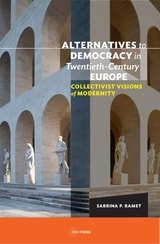
Alternatives to Democracy in Twentieth-Century Europe
Collectivist Visions of ModernitySabrina P. Ramet
Central European University Press, 2019
Alternatives to Democracy in Twentieth-Century Europe examines the historical examples of Soviet Communism, Italian Fascism, German Nazism, and Spanish Anarchism, suggesting that, in spite of their differences, they had some key features in common, in particular their shared hostility to individualism, representative government, laissez faire capitalism, and the decadence they associated with modern culture. But rather than seeking to return to earlier ways of working these movements and regimes sought to design a new future – an alternative future – that would restore the nation to spiritual and political health. The Fascists, for their part, specifically promoted palingenesis, which is to say the spiritual rebirth of the nation.
The book closes with a long epilogue, in which Ramet defends liberal democracy, highlighting its strengths and advantages. In this chapter, the author identifies five key choke points, which would-be authoritarians typically seek to control, subvert, or instrumentalize: electoral rules, the judiciary, the media, hate speech, and surveillance, and looks at the cases of Viktor Orbán’s Hungary, Jarosław Kaczyński’s Poland, and Donald Trump’s United States.
[more]
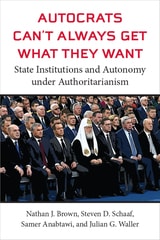
Autocrats Can't Always Get What They Want
State Institutions and Autonomy under AuthoritarianismNathan J. Brown, Steven D. Schaaf, Samer Anabtawi, and Julian G. Waller
University of Michigan Press, 2024
Authoritarianism seems to be everywhere in the political world—even the definition of authoritarianism as any form of non-democratic governance has grown very broad. Attempts to explain authoritarian rule as a function of the interests or needs of the ruler or regime can be misleading. Autocrats Can’t Always Get What They Want argues that to understand how authoritarian systems work we need to look not only at the interests and intentions of those at the top, but also at the inner workings of the various parts of the state. Courts, elections, security force structure, and intelligence gathering are seen as structured and geared toward helping maintain the regime. Yet authoritarian regimes do not all operate the same way in the day-to-day and year-to-year tumble of politics.
In Autocrats Can’t Always Get What They Want, the authors find that when state bodies form strong institutional patterns and forge links with key allies both inside the state and outside of it, they can define interests and missions that are different from those at the top of the regime. By focusing on three such structures (parliaments, constitutional courts, and official religious institutions), the book shows that the degree of autonomy realized by a particular part of the state rests on how thoroughly it is institutionalized and how strong its links are with constituencies. Instead of viewing authoritarian governance as something that reduces politics to rulers’ whims and opposition movements, the authors show how it operates—and how much what we call “authoritarianism” varies.
In Autocrats Can’t Always Get What They Want, the authors find that when state bodies form strong institutional patterns and forge links with key allies both inside the state and outside of it, they can define interests and missions that are different from those at the top of the regime. By focusing on three such structures (parliaments, constitutional courts, and official religious institutions), the book shows that the degree of autonomy realized by a particular part of the state rests on how thoroughly it is institutionalized and how strong its links are with constituencies. Instead of viewing authoritarian governance as something that reduces politics to rulers’ whims and opposition movements, the authors show how it operates—and how much what we call “authoritarianism” varies.
[more]