Results by title
90 books match the query 'Constitutional history' and 5 start with a
A Century of Controversy
Constitutional Reform in AlabamaH. Bailey Thomson
University of Alabama Press, 2002
A timely examination of Alabama’s severely criticized state constitution
Alabama’s present constitution, adopted in 1901, is widely viewed as the source of many, if not most, of the state’s historic difficulties and inequities. Chief among these is a poorly funded school system, an imbalanced tax system that favors special business interests, legislated racism, and unchecked urban sprawl. Many citizens believe that, after 100 years of overburdening amendments and confusing addendums, the constitution urgently needs rewriting.
With this book, Bailey Thomson has assembled the best scholarship on the constitution, its history, and its implications for the future. Historian Harvey H. Jackson III details the degree to which the 1901 document was drafted as a legal tool to ensure white supremacy at the expense of poor whites and blacks, while Joe A. Sumners illustrates how the constitution ties the hands of elected civic leaders by handing authority for local decisions to state government in Montgomery. James W. Williams Jr. explores the impact of the state constitution on the beleaguered tax system and the three principal “revenue crises” it has engendered. Thomson’s own contribution explains how, in contrast to the previous failed attempts for constitutional change by past governors who appealed to their fellow power brokers, the current reform movement arose from the grassroots level.
As citizens and politicians in Alabama review the 1901 constitution for revision, as they navigate the pitfalls and opportunities inherent in change, it is incumbent that they inform themselves adequately on the controversies that have swirled around the constitution since its adoption. The future of Alabama’s government will depend upon it, as will the fortunes of Alabama’s business interests and the well-being of every citizen in the state for years to come.
A Community Built on Words
The Constitution in History and PoliticsH. Jefferson Powell
University of Chicago Press, 2002
Combining history and theory, Powell analyzes a series of constitutional controversies from 1790 to 1944 to demonstrate that constitutional law from its very beginning has involved politically charged and ideologically divisive arguments. Nowhere in our past can one find the golden age of apolitical constitutional thinking that a great deal of contemporary scholarship seeks or presupposes. Viewed over time, American constitutional law is a history of political dispute couched in constitutional terms.
Powell then takes his conclusions one step further, claiming that it is precisely this historical tradition of argument that has given American constitutional law a remarkable coherence and integrity over time. No matter what the particular political disputes of the day might be, constitutional argument has provided a shared language through which our political community has been able to fight out its battles without ultimately fracturing.
A Community Built on Words will be must reading for any student of constitutional history, theory, or law.
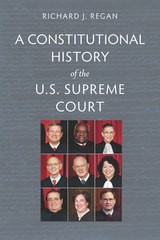
A Constitutional History of the U.S. Supreme Court
Richard Regan
Catholic University of America Press, 2015
A Democracy of Distinction
Aristotle and the Work of PoliticsJill Frank
University of Chicago Press, 2004
Moving back and forth between Aristotle's writings and contemporary legal and political theory, Frank breathes new life into our conceptions of property, justice, and law by viewing them not only as institutions but as dynamic activities as well. Frank's innovative approach to Aristotle stresses his appreciation of the tensions and complexities of politics so that we might rethink and reorganize our own political ideas and practices. A Democracy of Distinction will be of enormous value to classicists, political scientists, and anyone interested in revitalizing democratic theory and practice.
A Good Quarrel
America's Top Legal Reporters Share Stories from Inside the Supreme CourtTimothy R. Johnson and Jerry Goldman, Editors
University of Michigan Press, 2009
While reading what top legal reporters say about some of the most important U.S. Supreme Court oral arguments in recent history, go to www.goodquarrel.com to listen to audio and hear for yourself the very style and delivery of the oral arguments that have shaped the history of our nation's highest law. See Preface for full instructions.
Contributors
- Charles Bierbauer, CNN
- Lyle Denniston, scotusblog.com
- Fred Graham, Court TV
- Brent Kendall, Los Angeles Daily Journal
- Steve Lash, Houston Chronicle
- Dahlia Lithwick, Slate.com
- Tony Mauro, American Lawyer Media
- Tim O'Brien, ABC News
- David Savage, Los Angeles Times
- Greg Stohr, Bloomberg News
- Nina Totenberg, NPR
Timothy R. Johnson teaches in the Department of Political Science and the Law School at the University of Minnesota.
Jerry Goldman teaches political science at Northwestern University and directs the OYEZ Project, a multimedia archive devoted to the Supreme Court, at www.oyez.org.
Cover sketch by Dana Verkouteren
"Supreme Court oral arguments are good government in action. A Good Quarrel brilliantly showcases this important aspect of the Court's work."
---Paul Clement, Partner, King & Spalding, and former United States Solicitor General
"Few legal experiences are as exhilarating as a Supreme Court oral argument---a unique art form that this superb collection brings vividly to life."
---Kathleen Sullivan, Partner, Quinn Emanuel Urquhart Oliver and Hedges, and former Dean, Stanford Law School
"[A Good Quarrel] shines a brilliant spotlight on the pivotal moment of advocacy when the Supreme Court confronts the nation's most profound legal questions."
---Thomas C. Goldstein, Partner, Akin Gump, and Lecturer, Supreme Court Litigation, Harvard Law School and Stanford Law School
"A brilliant way to understand America's most important mysterious institution."
---Lawrence Lessig, Stanford Law School