Results by title
54 books match the query 'Cooking, American' and 8 start with a
A Cook's Tour of Iowa
Susan Puckett
University of Iowa Press, 1990
A Selection of Modernized Recipes from Food in the Civil War
The NorthJennifer Billock
Michigan State University Press, 2015
A Selection of Modernized Recipes from Food in the Civil War
The SouthJennifer Billock
Michigan State University Press, 2015

America Eats
Nelson Algren
University of Iowa Press, 1992
Think of Nelson Algren, and many images come to mind—Chicago's unappreciated genius, champion of the poor and disenfranchised, lover of Simone de Beauvoir, author ofThe Man with the Golden Arm and A Walk on the Wild Side—but the author of a cookbook? Here it is: the never-before-published America Eats, a delightful, thoroughly entertaining look at who we are and what we love to eat.
The origins of America Eats are as fascinating as the book itself. In the late 1930s Nelson Algren joined such writers as Saul Bellow, Richard Wright, Margaret Alexander, and Arna Bontemps in the employ of the Illinois Writers Project, a branch of the federal Works Progress Administration. Algren's assignment: to collect information for the national "America Eats" program, a pioneering enterprise whose members hoped to produce a series of regional guides describing types of immigration, settlement, and customs as these factors related to the universal language of food. Algren completed his project, a look at the foodways of the Midwest, but by the early 1940s the fruits of "America Eats" had been filed away as the government mobilized for war.
Now at long last Algren's America Eats is published as one of the inaugural volumes in the Iowa Szathmáry Culinary Arts Series. This cookbook, part anecdotal history, part culinary commentary, is an engaging romp through the attitudes and activities surrounding food in the Midwest. An enticing and useful feature of the book is an all-new recipe section tested in the kitchens of the Culinary Arts Division of Johnson &Wales University under the watchful eye of Chef Laureate Louis Szathmáry.
Those same interviewing skills that led to Algren's successful depiction of Chicago's inner-city residents served him well as he spoke with a variety of cooks, casual and accomplished, and gathered all kinds of recipes, tried and traditional. Algren recorded it all in his inimitable style, and modern readers are richer for his efforts. From descriptions of the rituals at an Indiana family reunion ("When a slacking off in the first rush of eating is indicated by the gradual resumption of conversation, the servers start a second attack, urging everyone to have another helping of everything") to the holiday specialty on a Minnesota immigrant's table, lutefisk ("Any newcomer present will be assured, 'You won't like it, nobody likes lutefisk at first'"), America Eats offers all readers a true feast.
An Archive of Taste
Race and Eating in the Early United StatesLauren F. Klein
University of Minnesota Press, 2020
A groundbreaking synthesis of food studies, archival theory, and early American literature
There is no eating in the archive. This is not only a practical admonition to any would-be researcher but also a methodological challenge, in that there is no eating—or, at least, no food—preserved among the printed records of the early United States. Synthesizing a range of textual artifacts with accounts (both real and imagined) of foods harvested, dishes prepared, and meals consumed, An Archive of Taste reveals how a focus on eating allows us to rethink the nature and significance of aesthetics in early America, as well as of its archive.
Lauren F. Klein considers eating and early American aesthetics together, reframing the philosophical work of food and its meaning for the people who prepare, serve, and consume it. She tells the story of how eating emerged as an aesthetic activity over the course of the eighteenth century and how it subsequently transformed into a means of expressing both allegiance and resistance to the dominant Enlightenment worldview. Klein offers richly layered accounts of the enslaved men and women who cooked the meals of the nation’s founders and, in doing so, directly affected the development of our national culture—from Thomas Jefferson’s emancipation agreement with his enslaved chef to Malinda Russell’s Domestic Cookbook, the first African American–authored culinary text.
The first book to examine the gustatory origins of aesthetic taste in early American literature, An Archive of Taste shows how thinking about eating can help to tell new stories about the range of people who worked to establish a cultural foundation for the United States.
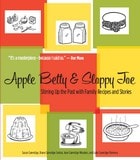
Apple Betty and Sloppy Joe
Stirring Up the Past with Family Recipes and StoriesSusan Sanvidge
Wisconsin Historical Society Press, 2007
Compiled by four sisters and based on their recollections of their childhood in Oshkosh, Wisconsin, Apple Betty & Sloppy Joe captures the glow of memories formed while growing up in a midwestern kitchen. From Lemon Meringue Pie to Tomato Soup Cake, from Mom's Chicken Pie to Grandma Noffke's Sliced Cucumber Pickles, this charming book features hundreds of recipes (some classic, some quirky), plus dozens of food and cooking-related anecdotes, memories, humorous asides, and period photos that transport readers back to Mom's or Grandma's kitchen, circa 1950.
The Sanvidges share a legacy of beloved dishes and food memories that resonate not just for their family, but for readers everywhere who grew up in a small midwestern town - or wish they had. Nostalgic, funny, and warmhearted, Apple Betty & Sloppy Joe celebrates the ways food and food memories link us to our past, and to each other. A delightful gift for food lovers of any generation.
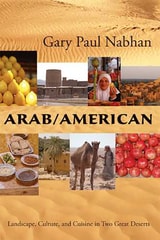
Arab/American
Landscape, Culture, and Cuisine in Two Great DesertsGary Paul Nabhan
University of Arizona Press, 2008
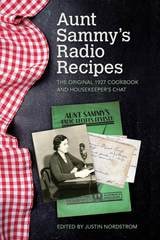
Aunt Sammy's Radio Recipes
The Original 1927 Cookbook and Housekeeper's ChatJustin Nordstrom
University of Arkansas Press, 2018
From the 1920s through the 1940s, American kitchens had a welcome guest in “Aunt Sammy,” a creation of the US Department of Agriculture and its Bureau of Home Economics. Through the radio program Housekeeper’s Chat, Aunt Sammy gave lively advice on food preparation, household chores, parenting and children, and gender dynamics as she encouraged women to embrace the radio and a host of modern consumer household products. The recipes she shared were gathered, in 1927, into a cookbook that became a valuable household manual for tens of thousands of Americans.
Aunt Sammy’s Radio Recipes revives the famous cookbook and joins it with extensive excerpts from the accompanying radio broadcasts, providing a fascinating study of how a witty and charming fictionalized personae became one of the early celebrity chefs of the radio age.