Results by title
110 books match the query 'Cultural pluralism' and 8 start with a
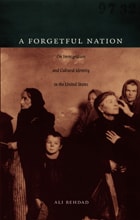
A Forgetful Nation
On Immigration and Cultural Identity in the United StatesAli Behdad
Duke University Press, 2005
Behdad shows how political, cultural, and legal texts have articulated American anxiety about immigration from the Federalist period to the present day. He reads texts both well-known—J. Hector St. John de Crèvecoeur’s Letters from an American Farmer, Alexis de Tocqueville’s Democracy in America, and Walt Whitman’s Leaves of Grass—and lesser-known—such as the writings of nineteenth-century nativists and of public health officials at Ellis Island. In the process, he highlights what is obscured by narratives and texts celebrating the United States as an open-armed haven for everyone: the country’s violent beginnings, including its conquest of Native Americans, brutal exploitation of enslaved Africans, and colonialist annexation of French and Mexican territories; a recurring and fierce strand of nativism; the need for a docile labor force; and the harsh discipline meted out to immigrant “aliens” today, particularly along the Mexican border.
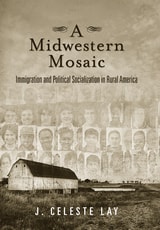
A Midwestern Mosaic
Immigration and Political Socialization in Rural AmericaJ. Celeste Lay
Temple University Press, 2012
Drawn by low-skilled work and the safety and security of rural life, increasing numbers of families from Latin America and Southeast Asia have migrated to the American heartland. In the path-breaking book A Midwestern Mosaic, J. Celeste Lay examines the effects of political socialization on native white youth growing up in small towns.
Lay studies five Iowa towns to investigate how the political attitudes and inclinations of native adolescents change as a result of rapid ethnic diversification. Using surveys and interviews, she discovers that native adolescents adapt very well to foreign-born citizens, and that over time, gaps diminish between diverse populations and youth in all-white/Anglo towns in regard to tolerance, political knowledge, efficacy, and school participation.
A Midwestern Mosaic looks at the next generation to show how exposure to ethnic and cultural diversity during formative years can shape political behavior and will influence politics in the future.
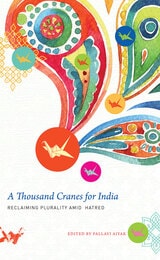
A Thousand Cranes for India
Reclaiming Plurality Amid HatredEdited by Pallavi Aiyar
Seagull Books, 2020
This anthology uses origami cranes as a way for some of India’s best-known writers, poets, and artists to form a shared civic space for a conversation about the fault lines in India at a time of darkness. The twenty-three pieces collected here encompass reportage, stories, poems, memoir, and polemic—the kind of complex and enriching diversity that India demands and deserves. The paper crane becomes a motif of connection, beauty, and reclamation in an otherwise degraded country, enabling those who fight with words to become the best army they can be.
A World of Becoming
William E. Connolly
Duke University Press, 2010
Attunement to a world of becoming, Connolly argues, may help us address dangerous resonances between global finance capital, cross-regional religious resentments, neoconservative ideology, and the 24-hour mass media. Coming to terms with subliminal changes in the contemporary experience of time that challenge traditional images can help us grasp how these movements have arisen and perhaps even inspire creative counter-movements. The book closes with the chapter “The Theorist and the Seer,” in which Connolly draws insights from early Greek ideas of the Seer and a Jerry Lewis film, The Nutty Professor, to inform the theory enterprise today.
Achieving Against The Odds
edited by Esther Kingston-Mann and Tim Sieber
Temple University Press, 2001
Today's diverse and financially burdened students enter higher education eager to succeed at institutions originally designed for culturally homogenous and predominantly white middle-class populations. They are expected to learn from faculty trained primarily as researchers. Unsurprisingly, student dropout and faculty burnout rates are high, leading some conservatives to demand that higher education purge itself of "unqualified" students and teachers. But, as Achieving Against the Odds demonstrates, new and better solutions emerge once we assume that both faculty and students still possess a mutual potential for learning when they meet in the college classroom.
This collection -- drawing on the experiences of faculty at the University of Massachusetts-Boston -- documents a complex and challenging process of pedagogical transformation. The contributors come from a wide range of disciplines -- American studies, anthropology, Asian American studies, English, ESL, history, language, political science, psychology, sociology, and theology. Like their students, they bring a variety of backgrounds into the classroom -- as people of color, women, gays, working class people, and "foreigners" of one sort or another. Together they have engaged in an exciting struggle to devise pedagogies which respond to the needs and life experiences of their students and to draw each of them into a dialogue with the content and methodology of their disciplines. Courageously airing their own mistakes and weaknesses alongside their breakthroughs, they illuminate for the reader a process of teaching transformation by which discipline-trained scholars discover how to promote the learning of diverse students.
As one reads their essays, one is struck by how much these faculty have benefited from the insights they have gleaned from colleagues as well as students. Through argument and examples, personal revelation and references as well as students. Through argument and examples, personal revelation and references to authority, they draw the reader into their community. This is a book to inspire and enlighten everyone interested in making higher education more truly democratic, inclusive and intellectually challenging for today's students.
Adoptive Families in a Diverse Society
Wegar, Katarina
Rutgers University Press, 2006
In recent years, different family types have begun demanding recognition to an unprecedented extent. Despite notable changes to our cultural and academic landscapes, however, adoptive families remain overlooked. According to census data, about two and a half percent of children in the United States are adopted. But mere numbers do not begin to indicate the profound impact that these families have on cultural definitions of kinship.
Adoptive Families in a Diverse Society brings together twenty-one prominent scholars to explore the experience, practice, and policy of adoption in North America. While much existing literature tends to stress the potential problems inherent in non-biological kinship, the essays in this volume consider adoptive family life in a broad and balanced context.
Essays explore our current fascination with genetics, showing how our intense belief that we are produced, shaped, and controlled by our genes has affected the authenticity and value that we credit to adoptive parent/child relations. Other essays look at identity development, community attitudes toward adoption, gay adoptive fathers’ experiences, the ways in which single mother adoptive families create kinship, and the ways in which cultural assumptions about race and class operate in the system.
Bringing new perspectives to the topics of kinship, identity, and belonging, this path-breaking book expands more than our understandings of adoptive family life; it urges us to rethink the limits and possibilities of diversity and assimilation in American society.
Alternative Modernities, Volume 11
Dilip Parameshwar Gaonkar, ed.
Duke University Press, 2001
The idea of “alternative modernities” holds that modernity always unfolds within specific cultures or civilizations and that different starting points of the transition to modernity lead to different outcomes. Without abandoning the Western discourse on the subject, the contributors to this volume write from the standpoint that modernity is in truth a richly mulitiplicitous concept. Believing that the language and lessons of Western modernity must be submitted to comparative study of its global receptions, they focus on such sites as China, Russia, India, Trinidad, and Mexico. Other essays treat more theoretical aspects of modernity, such as its self-understanding and the potential reconcilability of cosmopolitanism and diversity.
Contributors. Homi Bhabha, William Cunningham Bissell, Dipesh Chakrabarty, Dilip Parameshwar Gaonkar, Michael Hanchard, Beatriz Jaguaribe, Leo Ou-fan Lee, Claudio Lomnitz, Thomas McCarthy, Tejaswini Niranjana, Elizabeth A. Povinelli, Shahzia Sikander, Charles Taylor, Andrew Wachtel

American Ethnic History
Themes and PerspectivesMcDonald, Jason J
Rutgers University Press, 2007
Chapters explore a range of topics, including how different ethnic groups arrived in the United States—whether through violence and coercion or willing immigration; the peculiar identification of Native Americans as “ethnic,” despite the fact that they are indigenous to the land; whether the American public’s attitudes toward and treatment of difference has been consistent with the nation’s professed egalitarian ideals; and how factors such as language, religion, class, gender, and intermarriage play in either strengthening or weakening ethnic identity and group solidarity.
An engaging and critical look at a term that remains stubbornly ambiguous in both scholarly discussion and the vernacular, this book makes an important contribution to the ongoing debates about “difference” in American society.