Results by title
78 books match the query 'Editors, Journalists, Publishers' and 12 start with a
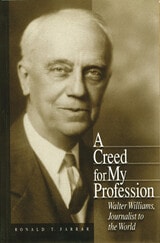
A Creed for My Profession
Walter Williams, Journalist to the WorldRonald T. Farrar
University of Missouri Press, 1998
This superb biography provides for the first time a candid look at the remarkable life of Walter Williams, the man who founded the world's first school of journalism and perhaps contributed more toward the promotion of professional journalism than any other person of his time.
Williams, the youngest of six children, was born in Boonville, Missouri, in 1864. Never an athletic child, he always had a love of books and of learning; yet, he scarcely had a high school education. He began his journalistic career as a printer's devil at seventy cents per week and eventually became editor and part- owner of a weekly in Columbia, Missouri. During his time as an editor, Williams became convinced that journalism would never reach its potential until its practitioners had the opportunity for university training in their field. After years of crusading, he established the first journalism school, on the University of Missouri campus. Later, he was chosen president of the University of Missouri, which he led with distinction during the Great Depression.
Williams was an unwavering advocate of high professional standards. His Journalist's Creed became one of the most widely circulated codes of professional ethics. Williams inspired the confidence of his fellow journalists, and he carried his message to nearly every country in which newspapers were published. Not only did he invent journalism education, he also created global organizations of journalists and spread the gospel of professionalism throughout the world. His death, in 1935, was mourned throughout the United States, and editorial tributes came from around the world. As one British editor succinctly put it, "Williams was not born to greatness. Neither was it thrust upon him. Literally, he achieved greatness."
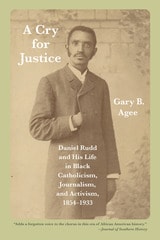
A Cry for Justice
Daniel Rudd and His Life in Black Catholicism, Journalism, and Activism, 1854-1933Gary B. Agee
University of Arkansas Press, 2017
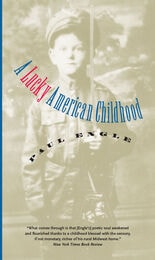
A Lucky American Childhood
Paul Engle
University of Iowa Press, 1996
A Lucky American Childhood will appeal to people with memories of the small-town America that Paul Engle describes with such affectionate realism and to all those interested in the roots of this renowned man of letters.
A Woman of the Times
Journalism, Feminism, and the Career of Charlotte CurtisMarilyn S. Greenwald
Ohio University Press, 1999
For twenty-five years, Charlotte Curtis was a society/women's reporter and editor and an op-ed editor at the New York Times. As the first woman section editor at the Times, Curtis was a pioneering journalist and one of the first nationwide to change the nature and content of the women's pages from fluffy wedding announcements and recipes to the more newsy, issue-oriented stories that characterize them today. In this riveting biography, Marilyn Greenwald describes how a woman reporter from Columbus, Ohio, broke into the ranks of the male-dominated upper echelon at the New York Times. It documents what she did to succeed and what she had to sacrifice.
Charlotte Curtis paved the way for the journalists who followed her. A Woman of the Times offers a chronicle of her hard-won journey as she invents her own brand of feminism during the 1960s and 1970s. In the telling of this remarkable woman’s life is the story, as well, of a critical era in the nation’s social history.
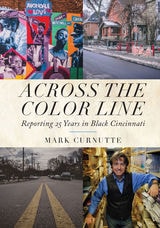
Across the Color Line
Reporting 25 Years in Black CincinnatiMark Curnutte
Ohio University Press, 2019
Published by the University of Cincinnati Press
Across the Color Line: Reporting 25 Years in Black Cincinnati presents newspaper reporter Mark Curnutte’s stories published in The Cincinnati Enquirer over a twenty-five-year period beginning in 1993. With hard-won insights gained from years of community reporting, Curnutte describes experiences of African-Americans living in Cincinnati through individual and neighborhood profiles, explorations of community institutions, historical perspectives, and issue stories. The anthology tells a sweeping narrative of a city suffering and maturing through turn-of-the-century racial growing pains and increased racial sophistication and diversity. These stories are complimented by excerpts from Curnutte’s personal journal, providing his reflection on his role as a white man and reporter making the intentional decision to work and live across the color line.
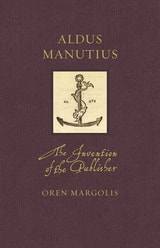
Aldus Manutius
The Invention of the PublisherOren Margolis
Reaktion Books, 2023
Now in paperback, a fresh reading of Aldus Manutius, preeminent in the history of the printed book.
Aldus Manutius is perhaps the greatest figure in the history of the printed book: in Venice, Europe’s capital of printing, he invented the italic type and issued more first editions of the classics than anyone before or since, as well as Hypnerotomachia Poliphili, the most beautiful and mysterious printed book of the Italian Renaissance.
This is the first monograph in English on Aldus Manutius in over forty years. It shows how Aldus redefined the role of a book printer, from mere manual laborer to a learned publisher. As a consequence, Aldus participated in the same debates as contemporaries such as Leonardo da Vinci and Erasmus of Rotterdam, making this book an insight into their world too.
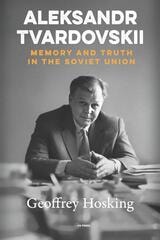
Aleksandr Tvardovskii
Memory and Truth in the Soviet UnionGeoffrey Hosking
Central European University Press, 2025
By giving a balanced account of his strengths and weaknesses, his achievements and failures, the author succeeds in giving the fullest picture available anywhere of a controversial man who turns out to be more complex than he has been portrayed so far. To understand him better is to understand why the Soviet intelligentsia changed so fundamentally in the USSR’s final decades, a change that helps to explain the rise of Gorbachev twenty years later. The study—which includes an in-depth analysis of Tvardovskii’s major works—also helps to better understand the fate of culture under an authoritarian regime and the intricacies of the struggle against censorship.
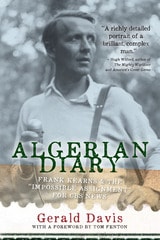
Algerian Diary
Frank Kearns and the "Impossible Assignment" for CBS NewsGerald Davis
West Virginia University Press, 2016
Frank Kearns was the go-to guy at CBS News for danger- ous stories in Africa and the Middle East in the 1950s, ‘60s, and early ‘70s. By his own account, he was nearly killed 114 times. He took stories that nobody else wanted to cover and was challenged to get them on the air when nobody cared about this part of the world. But his stories were warning shots for conflicts that play out in the headlines today.
In 1957, Senator John Kennedy described America’s view of the Algerian war for independence as the Eisenhower Administration’s “head in the sand policy.” So CBS News decided to find out what was really happening there and to determine where Algeria’s war for independence fit into the game plan for the Cold War. They sent Frank Kearns to find out.
Kearns took with him cameraman Yousef (“Joe”) Masraff and 400 pounds of gear, some of which they shed, and they hiked with FLN escorts from Tunisia, across a wide “no-man’s land,” and into the Aures Mountains of eastern Algeria, where the war was bloodiest. They carried no passports or visas. They dressed as Algerians. They refused to bear weapons. And they knew that if captured, they would be executed and left in unmarked graves. But their job as journalists was to seek the truth whatever it might turn out to be.
This is Frank Kearns’s diary.
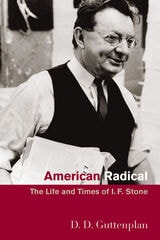
American Radical
The Life and Times of I. F. StoneD. D. Guttenplan
Northwestern University Press, 2012
In an era when the old radical questions—about war, the economy, health care, and the right to dissent—are suddenly new again, Guttenplan’s lively, provocative book makes clear why so many of Stone’s pronouncements have acquired the force of prophecy.
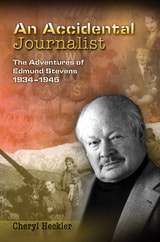
An Accidental Journalist
The Adventures of Edmund Stevens, 1934-1945Cheryl Heckler
University of Missouri Press, 2007
When an idealistic American named Edmund Stevens arrived in Moscow in 1934, his only goal was to do his part for the advancement of international Communism. His job writing propaganda led to a reporting career and an eventual Pulitzer Prize in 1950 for his uncensored descriptions of Stalin’s purges. This book tells how Stevens became an accidental journalist—and the dean of the Moscow press corps.
The longest-serving American-born correspondent working from within the Soviet Union, Stevens was passionate about influencing the way his stateside readers thought about Russia’s citizens, government, and social policy. Cheryl Heckler now traces a career that spanned half a century and four continents, focusing on Stevens’s professional work and life from 1934 to 1945 to tell how he set the standards for reporting on Soviet affairs for the Christian Science Monitor.
Stevens was a keen observer and thoughtful commentator, and his analytical mind was just what the Monitor was looking for in a foreign correspondent. He began his journalism career reporting on the Russo-Finnish War in 1939 and was the Monitor’s first man in the field to cover fighting in World War II. He reported on the Italian invasion of Greece, participated in Churchill’s Moscow meeting with Stalin as a staff translator, and distinguished himself as a correspondent with the British army in North Africa.
Drawing on Stevens’s memoirs—to which she had exclusive access—as well as his articles and correspondence and the unpublished memoirs of his wife, Nina, Heckler traces his growth as a frontline correspondent and interpreter of Russian culture. She paints a picture of a man hardened by experience, who witnessed the brutal crushing of the Iron Guard in 1941 Bucharest and the Kharkov hangings yet who was a failure on his own home front and who left his wife during a difficult pregnancy in order to return to the war zone. Heckler places his memoirs and dispatches within the larger context of events to shed new light on both the public and the private Stevens, portraying a reporter adapting to new roles and circumstances with a skill that journalists today could well emulate.
By exposing the many facets of Stevens’s life and experience, Heckler gives readers a clear understanding of how this accidental journalist was destined to distinguish himself as a war reporter, analyst, and cultural interpreter. An Accidental Journalist is an important contribution to the history of war reporting and international journalism, introducing readers to a man whose inside knowledge of Stalinist Russia was beyond compare as it provides new insight into the Soviet era.

Artists as Writers
Living and Sustaining a Creative LifeEdited by Seph Rodney and Steven G. Fullwood
Intellect Books, 2025
Part of the Living and Sustaining a Creative Life series, Artists as Writers joins the tradition of books designed or intended to inspire would-be writers to write. Yet, it distinguishes itself by offering succinct first-person narratives by writers of varied genres about the day-to-day life of writing for a living.
Artists as Writers offers accounts of the journeys that thirty-two writers have taken, including what decisions were made; which paths were taken, rejected, and charted; and why. It answers the question: What magic keeps a writer writing?
Writers from Ethiopia, Guatemala, Nigeria, Palestine, Poland, and Sweden, as well as several American artists, contribute their stories. They each provide vividly detailed accounts of the circuitous roads that each individual took to earn the title “writer.” These are richly descriptive stories from writers who write consistently, relating how they came to the writing life, who helped them get there, and what sustains them as writers.
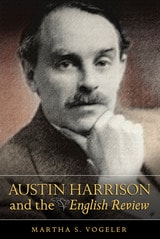
Austin Harrison and the English Review
Martha S. Vogeler
University of Missouri Press, 2008