Results by title
198 books match the query 'Educational Policy & Reform' and 17 start with a
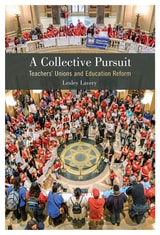
A Collective Pursuit
Teachers' Unions and Education ReformLesley Lavery
Temple University Press, 2020
Teachers’ unions are the organizations responsible for safeguarding the conditions of teachers’ employment. Union supporters claim strong synergies between teachers’ interests and students’ interests, but critics of unions insist that the stance of teachers in collective bargaining may disadvantage students as unions reduce the power of administrators to manage, remove, reward or retain excellent teachers.
In A Collective Pursuit, Lesley Laveryunpacks how teachers’ unions today are fighting for contracts that allow them to earn a decent living and build “schools all students deserve.” She explains the form and function of the nation’s largest teachers’ unions. Lavery then explores unionization campaigns in the Twin Cities charter schools. A Collective Pursuit also examines teacher strikes and contract negotiations, school finance and finance reform, and district and union attempts to address racial achievement gaps, to provide a context for understanding the economic, political, and demographic forces that inspire teachers to improve conditions for students.
A Collective Pursuit emphasizes that while teachers’ unions serve a traditional, economic role, they also provide a vast array of valuable services to students, educators, parents, and community members.
A Contest without Winners
How Students Experience Competitive School ChoiceKate Phillippo
University of Minnesota Press, 2019
Seeing the consequences of competitive school choice policy through students’ eyes
While policymakers often justify school choice as a means to alleviate opportunity and achievement gaps, an unanticipated effect is increased competition over access to coveted, high-performing schools. In A Contest without Winners, Kate Phillippo follows a diverse group of Chicago students through the processes of researching, applying to, and enrolling in public high school. Throughout this journey, students prove themselves powerful policy actors who carry out and redefine competitive choice.
Phillippo’s work amplifies the voices of students—rather than the parents, educators, public intellectuals, and policymakers who so often inform school choice research—and investigates how students interact with and emerge from competitive choice academically, developmentally, and civically. Through students’ experiences, she shows how competitive choice legitimates and exacerbates existing social inequalities; collides with students’ developmental vulnerability to messages about their ability, merit, and potential; and encourages young people’s individualistic actions as they come to feel that they must earn their educational rights. From urban infrastructure to income inequality to racial segregation, Phillippo examines the factors that shape students’ policy enactment and interpretation, as policymakers and educators ask students to compete for access to public resources.
With competitive choice, even the winners—the lucky few admitted to their dream schools—don’t outright win. A Contest without Winners challenges meritocratic and market-driven notions of opportunity creation for young people and raises critical questions about the goals we have for public schooling.
A Curriculum of Fear
Homeland Security in U.S. Public SchoolsNicole Nguyen
University of Minnesota Press, 2016
Welcome to Milton High School, where fear is a teacher’s best tool and every student is a soldier in the war on terror. A struggling public school outside the nation’s capital, Milton sat squarely at the center of two trends: growing fear of resurgent terrorism and mounting pressure to run schools as job training sites. In response, the school established a specialized Homeland Security program.
A Curriculum of Fear takes us into Milton for a day-to-day look at how such a program works, what it means to students and staff, and what it says about the militarization of U.S. public schools and, more broadly, the state of public education in this country. Nicole Nguyen guides us through a curriculum of national security–themed classes, electives, and internships designed through public-private partnerships with major defense contractors like Northrop Grumman and federal agencies like the NSA. She introduces us to students in the process of becoming a corps of “diverse workers” for the national security industry, learning to be “vigilant” citizens; and she shows us the everyday realities of a program intended to improve the school, revitalize the community, and eliminate the achievement gap.
With reference to critical work on school militarization, neoliberal school reform, the impact of the global war on terror on everyday life, and the political uses of fear, A Curriculum of Fear maps the contexts that gave rise to Milton’s Homeland Security program and its popularity. Ultimately, as the first ethnography of such a program, the book provides a disturbing close encounter with the new normal imposed by the global war on terror—a school at once under siege and actively preparing for the siege itself.
A Democratic Constitution for Public Education
Paul T. Hill and Ashley E. Jochim
University of Chicago Press, 2014
Most reformers focus on who should control education, but Hill and Jochim show that who governs is less important than determining what powers they have. They propose a Civic Education Council—a democratic body subject to checks and balances that would define the boundaries of its purview as well as each school’s particular freedoms. They show how such a system would prevent regulations meant to satisfy special interests and shift the focus to the real task at hand: improving school performance. Laying out the implications of such a system for parents, students, teachers, unions, state and federal governments, and courts, they offer a vision of educational governance that stays true to—and draws on the strengths of—one of the greatest democratic tools we have ever created.
A New Deal for the Humanities
Liberal Arts and the Future of Public Higher EducationHutner, Gordon
Rutgers University Press, 2015
The contributors offer spirited and thought-provoking debates on a diverse range of topics. For instance, they deplore the push by administrations to narrow learning into quantifiable outcomes as well as the demands of state governments for more practical, usable training. Indeed, for those who suggest that a college education should be “practical”—that it should lean toward the sciences and engineering, where the high-paying jobs are—this book points out that while a few nations produce as many technicians as the United States does, America is still renowned worldwide for its innovation and creativity, skills taught most effectively in the humanities. Most importantly, the essays in this collection examine ways to make the humanities even more effective, such as offering a broader array of options than the traditional major/minor scheme, options that combine a student’s professional and intellectual interests, like the new medical humanities programs.
A democracy can only be as energetic as the minds of its citizens, and the questions fundamental to the humanities are also fundamental to a thoughtful life. A New Deal for the Humanities takes an intrepid step in making the humanities—and our citizens—even stronger in the future.
A Question of Justice
New South Governors and Education, 1968-1976Gordon E. Harvey
University of Alabama Press, 2005
The governors who used education to transform the modern South.
In southern politics, 1970 marked a watershed. A group of southern governors entered office that year and changed both the way the nation looked at the South and the way the constituents of those states viewed themselves. Reubin Askew in Florida, John West in South Carolina, Jimmy Carter in Georgia, and Albert Brewer in Alabama all represented a new breed of progressive moderate politician that helped demolish Jim Crow segregation and the dual economies, societies, and educational systems notorious to the Sunbelt South. Historian Gordon Harvey explores the political lives and legacies of three of these governors, examining the conditions that led to such a radical change in political leadership, the effects their legislative agendas had on the identity of their states, and the aftermath of their terms in elected office.
A common thread in each governor's agenda was educational reform. Albert Brewer's short term as Alabama governor resulted in a sweeping education package that still stands as the most progressive the state has seen. Reubin Askew, far more outspoken than Brewer, won the Florida gubernatorial election through a campaign that openly promoted desegregation, busing, and tax reform as a means of equal school funding. John West's commitment to a policy of inclusion helped allay fears of both black and white parents and made South Carolina's one of the smoothest transitions to integrated schools.
As members of the first generation of New South governors, Brewer, Askew, and West played the role of trailblazers. Their successful assaults on economic and racial injustice in their states were certainly aided by such landmark events as Brown v. Board of Education, the civil rights movement, and the expansion of voting rights-all of which sounded the death knell for the traditional one-party segregated South. But in this critical detailing of their work for justice, we learn how these reform-minded men made education central to their gubernatorial terms and, in doing so, helped redefine the very character of the place they called home.
A Task for Sisyphus
Why Europe’s Roma Policies FailIulius Rostas
Central European University Press, 2020
Academic Engagement in Public and Political Discourse
Proceedings of the Michigan Meeting, May 2015Andrew J. Hoffman, Kirsti Ashworth, Chase Dwelle, Peter Goldberg, Andrew Henderson, Louis Merlin, Yulia Muzyrya, Norma-Jean Simon, Veronica Taylor, Corinne Weisheit, and Sarah Wilson
Michigan Publishing Services, 2015
To answer these questions and many more, the University of Michigan hosted a Michigan Meeting that involved over 40 speakers, including 4 University Presidents, and 225 registrants. This report summarizes that three-day meeting with a focus on four key themes. First, what is engagement and should we do it? Second, what are the ground rules for public and political engagement? Third, what are some models that have worked and what can we learn from them? Fourth and finally, what are the obstacles to engagement and how can they be overcome?
Academic Freedom
The Global ChallengeMichael Ignatieff
Central European University Press, 2018
Accountability-Based Reforms
The Impact on Deaf and Hard of Hearing StudentsStephanie W. Cawthon
Gallaudet University Press, 2011
For years, school reform efforts targeted either students in regular education or those with special needs, but not both. As a result of the No Child Left Behind legislation (NCLB) and its focus on accountability, administrators established policies that would integrate the needs of students who previously were served under separate frameworks. Using the NCLB structure as a starting point, Stephanie W. Cawthon’s new book Accountability-Based Reforms: The Impact on Deaf and Hard of Hearing Students discusses key assumptions behind accountability reforms. She specifically examines how elements of these reforms affect students who are deaf or hard of hearing, their teachers, and their families.
Cawthon begins by providing a brief introduction to the deaf education context, offering detailed information on student demographics, settings, and academic outcomes for deaf students. She then outlines the evolution of accountability-based education reforms, following with a chapter on content standards, assessment accommodations, accountability as sanctions, and students with disabilities. The remaining chapters in Accountability-Based Reforms closely examine educational professionals, accountability, and students who are deaf or hard of hearing; school choice policies and parents; and deaf education and measures of success. Each chapter presents an overview of an important component of accountability reform, available research, and how it has been implemented in the United States. These chapters also offer recommendations for future action by educators, parents, researchers, and education policymakers.
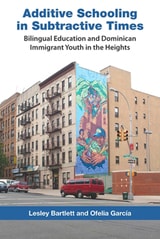
Additive Schooling in Subtractive Times
Bilingual Education and Dominican Immigrant Youth in the HeightsLesley Bartlett
Vanderbilt University Press, 2011
After offering a history of the school's formation, the authors detail the ways in which federal No Child Left Behind policies, New York State accountability measures, and New York City's educational reforms under Mayor Michael Bloomberg complicated the school's efforts. The book then describes the dynamic bilingual pedagogical approach adopted within the school to help students develop academic Spanish and English. Focusing on the lives of twenty immigrant youth, Bartlett and Garcia also show that, although the school achieves high completion rates, the graduating students nevertheless face difficult postsecondary educational and work environments that too often consign them to the ranks of the working poor.
Agency, Updated Edition
The Four Point Plan (F.R.E.E.) for ALL Children to Overcome the Victimhood Narrative and Discover Their Pathway to PowerIan V. Rowe
Templeton Press, 0
Some children thrive where others do not. Why? Are there personal behaviors and institutional supports that make a difference in helping young people chart a course for their futures? Agency answers with a loud and clear “yes!”
This book describes the FREE framework, four pillars that can uplift every young person as they make the passage into adulthood: Family, Religion, Education, and Entrepreneurship.
With this framework in place, children are empowered to develop agency, which Ian V. Rowe defines as the force of one’s free will, guided by moral discernment.
Rowe champions a game plan for creating new agents of agency and shows them the path that will set them FREE. Revised and expanded, this updated edition includes a new introduction and supplementary material, including a study guide for educators, sample lesson plans, and a student self-assessment.
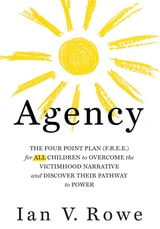
Agency
The Four Point Plan (F.R.E.E.) for ALL Children to Overcome the Victimhood Narrative and Discover Their Pathway to PowerRowe, Ian V.
Templeton Press, 2021
Every child in America deserves to know that a path to a successful life exists and that they have the power to follow it. But many never set foot on that path because they grow up hearing the message that systemic forces control their destinies, or that they are at fault for everything that has gone wrong in their lives.
These children often come from difficult circumstances. Many are raised by young, single parents, live in disadvantaged neighborhoods, attend substandard schools, and lack the moral safeguards of religious and civic institutions. As a result, they can be dispirited into cycles of learned helplessness rather than inspired to pursue their own possibilities.
Yet this phenomenon is not universal. Some children thrive where others do not. Why? Are there personal behaviors and institutional supports that have proven to make a difference in helping young people chart a course for their futures? Agency answers with a loud and clear “yes!”
This book describes four pillars that can uplift every young person as they make the passage into adulthood: Family, Religion, Education, and Entrepreneurship. Together, these pillars embody the true meaning of freedom, wherein people are motivated to embrace the ennobling responsibilities of building healthy social structures and shaping the outcomes of their own lives.
For that reason, Ian Rowe calls the four pillars the FREE framework. With this framework in place, children are empowered to develop agency, which Rowe defines as the force of one’s free will, guided by moral discernment. Developing agency is the alternative to the debilitating ‘blame-the-system’ and ‘blame-the-victim’ narratives. It transcends our political differences and beckons all who dare to envision lives unshackled by present realities.
In addition to making the case for agency, Rowe shares his personal story of success coming from an immigrant family. He defends America as an ever-improving country worthy of our esteem. He corrects misguided calls for “anti-racism” and “equity,” and champions a game plan for creating new agents of agency, dedicated to promoting the aspirational spirit of America’s children, and showing them the path that will set them FREE.

American Educational Governance on Trial
Change and ChallengesEdited by William L. Boyd and Debra Miretzky
University of Chicago Press, 2003
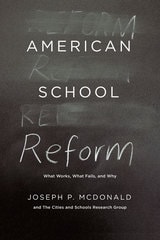
American School Reform
What Works, What Fails, and WhyJoseph P. McDonald and the Cities and Schools Research Group
University of Chicago Press, 2014
McDonald and his colleagues lay out several interrelated ideas in what they call a theory of action space. Frequently education policy gets so ambitious that implementing it becomes a near impossibility. Action space, however, is what takes shape when talented educators, leaders, and reformers guide the social capital of civic leaders and the financial capital of governments, foundations, corporations, and other backers toward true results. Exploring these extraordinary collaborations through their lifespans and their influences on future efforts, the authors provide political hope—that reform efforts can work, and that our schools can be made better.
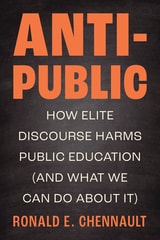
Anti-Public
How Elite Discourse Harms Public Education (and What We Can Do About It)Ronald E. Chennault
Rutgers University Press, 2026
Consider this: Restrictions placed by state legislatures on what schools can teach about America's history of conquest and enslavement. Broad bans enacted by local school boards that remove meaningful books from school curricula and the shelves of libraries. Court rulings that muddy the distinction between what counts as private versus public expressions of religion in public school settings and that open the door to publicly funded religious education. All of these recent actions chip away at the foundation of public education in America. But how did we get here? Decades of elite public discourse (talk and text) about public education helped to bring us to this point. Much of this conversation is anti-public. It includes statements by major elected officials, education advocacy organizations, journalists in mainstream press outlets, and other influential actors. Chennault casts light on the cultural and political processes at work and challenges the unquestioned assumptions beneath the surface of this discourse, with the hopes that we can transform and strengthen public education.
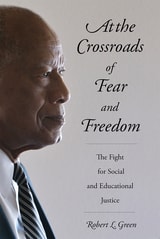
At the Crossroads of Fear and Freedom
The Fight for Social and Educational JusticeRobert L. Green
Michigan State University Press, 2016
This memoir relates previously untold stories about major Civil Rights campaigns that helped put an end to voting rights violations and Jim Crow education; explains how Green has helped urban school districts improve academic achievement levels; and explains why this history should inform our choices as we attempt to reform and improve American education. Green’s quest began when he helped the Kennedy Administration resolve a catastrophic education-related impasse and has continued through his service as one of the participants at an Obama administration summit on a current academic crisis.
It is commonly said that education is the new Civil Rights battlefield. Green’s memoir, At the Crossroads of Fear and Freedom: The Fight for Social and Educational Justice, helps us understand that educational equity has always been a central objective of the Civil Rights movement.