Results by title
153 books match the query 'Egypt' and 24 start with a
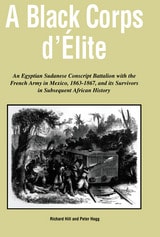
A Black Corps d'Elite
An Egyptian Sudanese Conscript Battalion with the French Army in Mexico, 1863-1867, and its Survivors in Subsequent African HistoryRichard Hill
Michigan State University Press, 1995
For several years, the armies of Napoleon III deployed some 450 Muslim Sudanese slave soldiers in Veracruz, the port of Mexico City. As in the other case of Western hemisphere military slavery (the West India Regiments, a British unit in existence 1795-1815), the Sudanese were imported from Africa in the hopes that they would better survive the tropical diseases that so terribly afflicted European soldiers. In both cases, the Africans did indeed fulfill these expectations. The mixture of cultures embodied by this event has piqued the interest of several historians, so it is by no means unknown. Hill and Hogg provide a particularly thorough account of this exotic interlude, explaining its background, looking in detail at the battle record in Mexico, and figuring out who exactly made up the battalion. Much in their account is odd and interesting, for example, the Sudanese superiority to Austrian troops and their festive nine-day spree in Paris on the emperor's tab. The authors also assess the episode's longer-term impact on the Sudan, showing that the veterans of Mexico, having learnt much from their extended exposure to French military practices, rose quickly in the ranks, then taught these methods to others.
A Concise Coptic-English Lexicon, Second Edition
Richard Smith
SBL Press, 1999
A Historical Archaeology of Jerusalem
Bronze and Iron AgesYuval Gadot
SBL Press, 2026
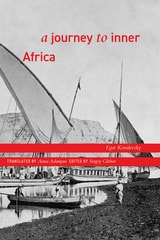
A Journey to Inner Africa
Egor Kovalevsky
Amherst College Press, 2020
Contributions by Egor Kovalevsky, Anna Aslanyan, Sergey Glebov, David Schimmelpenninck, Mukaram Hhana, and Michal Wasiucionek
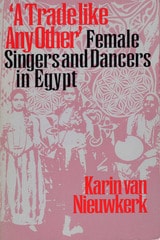
A Trade like Any Other
Female Singers and Dancers in EgyptBy Karin van Nieuwkerk
University of Texas Press, 1995
In Egypt, singing and dancing are considered essential on happy occasions. Professional entertainers often perform at weddings and other celebrations, and a host family's prestige rises with the number, expense, and fame of the entertainers they hire. Paradoxically, however, the entertainers themselves are often viewed as disreputable people and are accorded little prestige in Egyptian society.
This paradox forms the starting point of Karin van Nieuwkerk's look at the Egyptian entertainment trade. She explores the lives of female performers and the reasons why work they regard as "a trade like any other" is considered disreputable in Egyptian society. In particular, she demonstrates that while male entertainers are often viewed as simply "making a living," female performers are almost always considered bad, seductive women engaged in dishonorable conduct. She traces this perception to the social definition of the female body as always and only sexual and enticing—a perception that stigmatizes women entertainers even as it simultaneously offers them a means of livelihood.
Drawn from extensive fieldwork and enriched with the life stories of entertainers and nightclub performers, this is the first ethnography of female singers and dancers in present-day Egypt. It will be of interest to a wide audience in anthropology, women's studies, and Middle Eastern culture, as well as anyone who enjoys belly dancing.
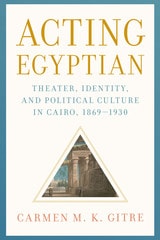
Acting Egyptian
Theater, Identity, and Political Culture in Cairo, 1869–1930By Carmen M. K. Gitre
University of Texas Press, 2019
In the late nineteenth and early twentieth centuries, during the “protectorate” period of British occupation in Egypt—theaters and other performance sites were vital for imagining, mirroring, debating, and shaping competing conceptions of modern Egyptian identity. Central figures in this diverse spectrum were the effendis, an emerging class of urban, male, anticolonial professionals whose role would ultimately become dominant. Acting Egyptian argues that performance themes, spaces, actors, and audiences allowed pluralism to take center stage while simultaneously consolidating effendi voices.
From the world premiere of Verdi’s Aida at Cairo’s Khedivial Opera House in 1871 to the theatrical rhetoric surrounding the revolution of 1919, which gave women an opportunity to link their visibility to the well-being of the nation, Acting Egyptian examines the ways in which elites and effendis, men and women, used newly built performance spaces to debate morality, politics, and the implications of modernity. Drawing on scripts, playbills, ads, and numerous other sources, the book brings to life provocative debates that fostered a new image of national culture and performances that echoed the events of urban life in the struggle for independence.

After the Nobel Prize 1989-1994
The Non-fiction Writing of Naguib Mahfouz, Volume IVNaguib Mahfouz
Gingko, 2015
In carefully crafted short texts, his social conscience is revealed as he highlights political shortcomings, economic injustice, and corruption in Egypt and the wider Arab world. His philosophical sensitivity comes to the fore as he contemplates the meaning of a historic events, contributions of an influential people, and what is required to lead a good life. The collapse of the Soviet Union, the Oslo peace accords, the spread of terrorism, the Cairo earthquake, the passing of Louis Awad, Yusuf Idris, Yahya Hakki, the third term of Hosni Mubarak, climate change, and more come under Naguib Mahfouz’s fine scrutiny. For any fan of Mahfouz’s fiction, this collection opens a window on a different side of his intellect, and it offers insights from one of the region’s greatest modern minds.
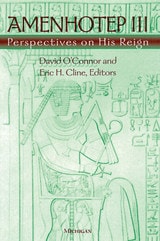
Amenhotep III
Perspectives on His ReignDavid O'Connor and Eric H. Cline, Editors
University of Michigan Press, 2001
Amenhotep III: Perspectives on His Reign, edited by David O'Connor and Eric H. Cline consists of a series of essays on this complex individual and his reign. In addition to offering several provocative and ground-breaking essays, this volume serves as a compendium and sourcebook for hard-to-obtain details about the reign of Amenhotep III.
The volume begins with an overview of the pharaoh by Larry Berman: his life, his family, and the history of his reign. Betsy Bryan describes the historical antecedents of Amenhotep's reign. Ray Johnson deals first with the building activities of Amen-hotep III and then presents a study of his carved relief decoration, with particular emphasis on the tendencies towards "Atenism." Arielle Kozloff discusses a variety of small objects including cosmetic spoons, glass vessels, jewelry, and funerary equipment. David O'Connor discusses city planning, building functions, and aspects of religion in light of the contemporary Egyptian worldview. Bill Murnane's chapter on government is a fascinating glimpse of the system of government in place at the time. Extensive documentation is provided on the activities of Amenhotep in the Aegean and Anatolia, Mesopotamia, Nubia, and Syro-Palestine. The volume concludes with John Baines's chapter on the Amarna Age.
Amenhotep III: Perspectives on His Reign is a valuable contribution to pharaonic studies. It will be of interest to a wide range of scholars interested in Mediterranean literatures and cultures. It draws on literary, archaeological, and historical material to form an interdisciplinary study of a complex figure in pharaonic Egypt.
David O'Connor is Lila Acheson Wallace Professor of Ancient Egyptian Art, Institute of Fine Arts, New York University. Eric H. Cline is Assistant Professor of History, Xavier University.
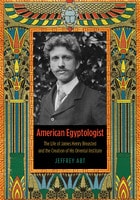
American Egyptologist
The Life of James Henry Breasted and the Creation of His Oriental InstituteJeffrey Abt
University of Chicago Press, 2011
James Henry Breasted (1865–1935) had a career that epitomizes our popular image of the archaeologist. Daring, handsome, and charismatic, he traveled on expeditions to remote and politically unstable corners of the Middle East, helped identify the tomb of King Tut, and was on the cover of Time magazine. But Breasted was more than an Indiana Jones—he was an accomplished scholar, academic entrepreneur, and talented author who brought ancient history to life not just for students but for such notables as Teddy Roosevelt and Sigmund Freud.
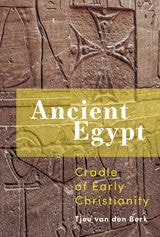
Ancient Egypt
Cradle of Early ChristianityTjeu van den Berk
Eburon Academic Publishers, 2021
The earliest Christian myths emerged in the melting pot of gnostic Alexandria—not in orthodox Jerusalem, classical Athens, or legalistic Rome. In this book, Tjeu van den Berk traces the sources of the Christian faith to the banks of the river Nile. Focusing on ancient archetypes, van den Berk underscores the striking similarities between the Egyptian and Christian religions. In this fascinating study, he explores the symbolism of the Trinity, the cross, and the myths of a god born of a virgin. He also traces the origins of the stories of Lazarus and Saint George, and he finds stunning parallels between Egyptian mythology and the Book of Revelation.
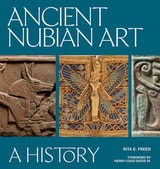
Ancient Nubian Art
A HistoryGates
J. Paul Getty Trust, The, 0
Lushly illustrated with stunning artifacts, this volume is the first comprehensive and accessible publication to explore the art, architecture, and material culture of ancient Nubia.
Kings and queens of Nubia reigned over one of the largest empires in the ancient world and had contacts extending north to Greece and Rome, south to sub-Saharan Africa, east to the Red Sea, and west across much of the Sahel. Even a quick look at Nubia’s artifacts reveals the incredible creativity of its artists, architects, craftspeople, and thinkers. Despite their significance, the achievements of ancient Nubia are little known to the public and are often viewed as a subculture, a derivative offshoot of Egypt, Nubia’s northern neighbor. Nothing could be further from the truth. During its over eight-thousand-year lifespan (beginning around 8000 BCE), Nubia indelibly shaped the art and architecture of the ancient world, an influence still felt today.
Ancient Nubian Art is the first comprehensive and accessible treatment of Nubian artistic culture and showcases its vast range—from ceramics, sculptures, and jewelry to tombs, temples, and palaces. Rita E. Freed, curator emerita at the Museum of Fine Arts, Boston, which has the largest collection of Nubian artifacts outside the Nile Valley, contextualizes the development of Nubian art against a vivid backdrop of kingship, power, worship, identity, gender, technology, and internationalism. Her text is accompanied by a foreword by Henry Louis Gates Jr. and sidebars by expert voices from the field.
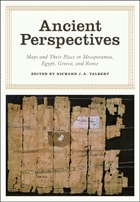
Ancient Perspectives
Maps and Their Place in Mesopotamia, Egypt, Greece, and RomeEdited by Richard J. A. Talbert
University of Chicago Press, 2012
Ancient Perspectives encompasses a vast arc of space and time—Western Asia to North Africa and Europe from the third millennium BCE to the fifth century CE—to explore mapmaking and worldviews in the ancient civilizations of Mesopotamia, Egypt, Greece, and Rome. In each society, maps served as critical economic, political, and personal tools, but there was little consistency in how and why they were made. Much like today, maps in antiquity meant very different things to different people.

Ancient Records of Egypt
VOL. 2: THE EIGHTEENTH DYNASTYTranslated and Edited by James Henry Breasted
University of Illinois Press, 2001
The Eighteenth Dynasty saw the consolidation of the cult of Amun and the expansion of the temple of Amun-Re at Karnak, as well as a religious revolution under King Akhenaten that involved abandoning Thebes as a religious capital and royal residence and founding a new city devoted to the service of the new solar god, Aten. Breasted presents records of the biography and coronation of Queen Hatshepsut, including reliefs that depict the queen's expedition to the land of Punt. Also in this volume are the annals of Thutmose III, providing the most complete account of the military achievements of any Egyptian king; scenes representing the supernatural birth and coronation by the gods of his son, Amenhotep II; and inscriptions from the tomb of Rekhmire, prime minister or vizier under Thutmose III, that include a listing of taxes paid to the temple and foreign tribute proceeding from the king's two decades of military activity in Asia.
A herculean assemblage of primary documents, many of which have deteriorated to illegibility since its original publication, Ancient Records of Egypt illuminates both the incredible complexity of Egyptian society and the almost insuperable difficulties of reconstructing a lost civilization.
Ancient Records of Egypt
Vol. 3: The Nineteenth DynastyTranslated and Edited by James Henry Breasted
University of Illinois Press, 2001
In the context of a long history of mutilating and altering reliefs for political purposes, Breasted discusses the insertion into a relief of the figure of Ramesses II in order to reinforce his claim to the throne. This volume also includes the treaty of alliance that sealed peace with the Hittites under Ramesses II; a series of documents that record the invasion of Libyans and Mediterranean Sea people during the reign of Merneptah; and the Great Temple of Abu Simbel, the most remarkable of the rock-cut temples of Egypt.
This first complete paperback edition of Breasted's five-volume Ancient Records of Egypt makes available to a new audience a milestone in Egyptology and in the compilation of documentary histories. Clearly annotated for the lay reader, the documents provide copious evidence of trade relations, construction activities, diplomatic envoys, foreign expeditions, and other aspects of a vigorous, highly organized, and centrally controlled society. Breasted's commentary is both rigorously documented and accessible, suffused with a contagious fascination for the events, the personalities, the cultural practices, and the sophistication these records indicate
Ancient Records of Egypt
Vol. 5: Supplementary Bibliographies and IndicesTranslated and Edited by James Henry Breasted: Supplementary Bibliographies by Peter A. Piccione
University of Illinois Press, 2001
An indispensable companion to any of the other volumes of Ancient Records of Egypt, the Supplementary Bibliographies and Indices facilitates direct access to specific information on the people, places, and inscriptions catalogued by James Henry Breasted. Exhaustively compiled and intelligently arranged, these indices include the kings and queens, temples and geographical locations, divine names, and titles and ranks encompassed by three thousand years of Egyptian history. Also provided are indices of all Egyptian, Hebrew, and Arabic terms mentioned in the texts, as well as a complete listing of the records with their location in Lepsius's Denkmäler.
This first paperback edition of Ancient Records of Egypt features the important addition of bibliographies by Peter A. Piccione, together with an introduction that puts Breasted's historical commentaries into modern perspective. These bibliographies offer valuable guidance on new translations and modern treatments of the inscriptions included in Ancient Records of Egypt. Professor Piccione points the reader toward recent studies of Egyptian chronology and modern scholarship on Egyptian and Nubian history. He also provides information on anthologies of Egyptian texts in translation and topographical bibliographies that suggest further reading on specific ancient Egyptian monuments, texts, and reliefs.
Ancient Records of Egypt
vol. 1: The First through the Seventeenth DynastiesTranslated and Edited by James Henry Breasted: Introduction by Peter A. Piccione
University of Illinois Press, 2001
Breasted's monumental work, originally published from 1906 to 1907, encompasses twenty-six dynasties spanning more than three millennia: from ca. 3050 B.C. to 525 B.C. For each document, Breasted provides information on location, condition, historical significance, and content. Beginning with the earliest known official annals of Egypt, the Palermo Stone, Breasted catalogs the realm's official activities, including royal succession, temple construction, property distribution, and foreign conquest. He tracks the careers of scores of kings, queens, government officials, military leaders, powerful statesmen, and influential courtiers, reproducing their autobiographies, letters of favor, paeans, mortuary gifts, and tomb inscriptions. Clearly annotated for the lay reader, the documents provide copious evidence of trade relations, construction activities, diplomatic envoys, foreign expeditions, and other aspects of a vigorous, highly organized, and centrally controlled society.
Breasted's commentary is both rigorously documented and accessible, suffused with a contagious fascination for the events, the personalities, the cultural practices, and the sophistication these records indicate. A herculean assemblage of primary documents, many of which have deteriorated to illegibility in the intervening century, Ancient Records of Egypt illuminates both the incredible complexity of Egyptian society and the almost insuperable difficulties of reconstructing a lost civilization.
This first paperback edition of Ancient Records of Egypt features a new introduction and supplementary bibliographies by Peter A. Piccione. Setting Breasted's work in the context of the development of American Egyptology, Piccione discusses Breasted's establishment of the Oriental Institute of the University of Chicago, with corporate support by John D. Rockefeller and other benefactors, and surveys the ambitious body of publications with which Breasted laid the foundation for future Egyptian studies.
Ancient Records of Egypt
vol. 4: The Twentieth through the Twenty-sixth DynastiesTranslated and Edited by James Henry Breasted
University of Illinois Press, 2001
Volume 4 includes intriguing records of the harem conspiracy and legal documents that indicate the extent of robberies of royal tombs. Records of the Nile levels at Karnak provide important chronological landmarks, while the Stela of Piye (Piankhi), which documents the Nubian kingdom already in existence as a full-fledged power, provides information on the internal political climate of Egypt during a time when no aggressive monarch controlled the whole country. Breasted also notes where these ancient Egyptian records intersect with accounts of the same events from other sources, such as the mutiny of Psamtik I's troops as inscribed on the alabaster statue of Nesuhor and as narrated by Herodotus.
In effect, Ancient Records of Egypt offers a valuable dual record. On the one hand, Breasted presents the events and personages of ancient Egypt as recorded in the documents. On the other hand, he presents a history of the documents themselves. Fragmentary or partially destroyed, carved on temple and tomb walls or written on fragile scrolls of leather or papyrus, even inscribed on the coffins and temple linens of the royal and priestly mummy wrappings, these records offer an irreplaceable primary source on a fascinating civilization.
Angry Voices
An Anthology of the Off-Beat New Egyptian PoetsMohamed Enani
University of Arkansas Press, 2003
Antony and Cleopatra
William Shakespeare
Arizona Center for Medieval and Renaissance Studies, 2023
In Antony and Cleopatra, Christopher Chen tackles the sweeping epic of love and betrayal at the center of the story of the rulers Antony of Rome and Cleopatra of Egypt. In this contemporary translation of the play, Chen brings the political intrigue and historical storytelling of Shakespeare to modern audiences while preserving the poetic foundation of the play’s language.
This translation of Antony and Cleopatra was written as part of the Oregon Shakespeare Festival’s Play On! project, which commissioned new translations of thirty-nine Shakespeare plays. These translations present the work of “The Bard” in language accessible to modern audiences while never losing the beauty of Shakespeare’s verse. Enlisting the talents of a diverse group of contemporary playwrights, screenwriters, and dramaturges from diverse backgrounds, this project reenvisions Shakespeare for the twenty-first century. These volumes make these works available for the first time in print—a new First Folio for a new era.
Arabs in the Mirror
Images and Self-Images from Pre-Islamic to Modern TimesBy Nissim Rejwan
University of Texas Press, 2008
What is an Arab? Though many in the West would answer that question with simplistic stereotypes, the reality is far more complex and interesting. Arabs themselves have been debating Arab identity since pre-Islamic times, coming to a variety of conclusions about the nature and extent of their “Arabness.” Likewise, Westerners and others have attempted to analyze Arab identity, reaching mostly negative conclusions about Arab culture and capacity for self-government.
To bring new perspectives to the question of Arab identity, Iraqi-born scholar Nissim Rejwan has assembled this fascinating collection of writings by Arab and Western intellectuals, who try to define what it means to be Arab. He begins with pre-Islamic times and continues to the last decades of the twentieth century, quoting thinkers ranging from Ibn Khaldun to modern writers such as al-Ansari, Haykal, Ahmad Amin, al-'Azm, and Said. Through their works, Rejwan shows how Arabs have grappled with such significant issues as the influence of Islam, the rise of nationalism, the quest for democracy, women's status, the younger generation, Egypt's place in the Arab world, Israel's role in Middle Eastern conflict, and the West's "cultural invasion."
By letting Arabs speak for themselves, Arabs in the Mirror refutes a prominent Western stereotype—that Arabs are incapable of self-reflection or self-government. On the contrary, it reveals a rich tradition of self-criticism and self-knowledge in the Arab world.
Aramaic Literature from Egypt and the Levant
Tawny L. Holm
SBL Press, 2026
Archaic Bookkeeping
Early Writing and Techniques of Economic Administration in the Ancient Near EastHans J. Nissen, Peter Damerow, and Robert K. Englund
University of Chicago Press, 1993
scholarship on the earliest true writing system in human
history. Invented by the Babylonians at the end of the
fourth millennium B.C., this script, called proto-cuneiform,
survives in the form of clay tablets that have until now
posed formidable barriers to interpretation. Many tablets,
excavated in fragments from ancient dump sites, lack a clear
context. In addition, the purpose of the earliest tablets
was not to record language but to monitor the administration
of local economies by means of a numerical system.
Using the latest philological research and new methods
of computer analysis, the authors have for the first time
deciphered much of the numerical information. In
reconstructing both the social context and the function of
the notation, they consider how the development of our
earliest written records affected patterns of thought, the
concept of number, and the administration of household
economies. Complete with computer-generated graphics keyed
to the discussion and reproductions of all documents referred
to in the text, Archaic Bookkeeping will interest
specialists in Near Eastern civilizations, ancient history,
the history of science and mathematics, and cognitive
psychology.
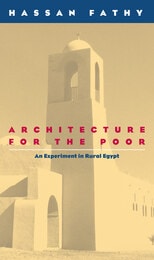
Architecture for the Poor
An Experiment in Rural EgyptHassan Fathy
University of Chicago Press, 1976
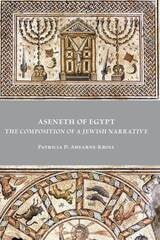
Aseneth of Egypt
The Composition of a Jewish NarrativePatricia D. Ahearne-Kroll
SBL Press, 2020
An exploration of Aseneth's beginnings
In Aseneth of Egypt: The Composition of a Jewish Narrative, Patricia D. Ahearne-Kroll challenges reliance on reconstructed texts in previous scholarship on the book of Joseph and Aseneth. After outlining the problems with previous prototypes of the Hellenistic narrative, she proposes a way to talk about the story in its initial setting without ignoring the manuscript evidence. Her thorough analysis of the evidence reveals how Joseph and Aseneth reflects the literary impulse of Greek-speaking Jewish writers to redescribe their identity in Egypt and Judean connections to the land of Egypt, while incorporating Ptolemaic strategies of legitimation of power. In the end, Ahearne-Kroll concludes that the base storyline preserved in all the copies of this story demonstrates that it was written for Jewish communities living in Hellenistic Egypt.
Features:
- A focus on Hellenistic stories of heroic ancestors
- A discussion of the possible lives of Jews in Hellenistic Egypt drawn from the narrative of Aseneth
- An examination of the complexities involved in dating the composition of literary texts