Results by title
83 books match the query 'Enlightenment' and 4 start with a
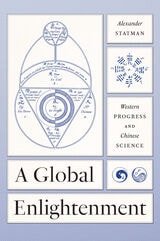
A Global Enlightenment
Western Progress and Chinese ScienceAlexander Statman
University of Chicago Press, 2023
A revisionist history of the idea of progress reveals an unknown story about European engagement with Chinese science.
The Enlightenment gave rise not only to new ideas of progress but consequential debates about them. Did distant times and places have anything to teach the here and now? Voltaire could believe that they did; Hegel was convinced that they did not. Early philosophes praised Chinese philosophy as an enduring model of reason. Later philosophes rejected it as stuck in the past. Seeking to vindicate ancient knowledge, a group of French statesmen and savants began a conversation with the last great scholar of the Jesuit mission to China. Together, they drew from Chinese learning to challenge the emerging concept of Western advancement.
A Global Enlightenment traces this overlooked exchange between China and the West to make compelling claims about the history of progress, notions of European exceptionalism, and European engagement with Chinese science. To tell this story, Alexander Statman focuses on a group of thinkers he terms “orphans of the Enlightenment,” intellectuals who embraced many of their contemporaries’ ideals but valued ancient wisdom. They studied astronomical records, gas balloons, electrical machines, yin-yang cosmology, animal magnetism, and Daoist medicine. And their inquiries helped establish a new approach to the global history of science.
Rich with new archival research and fascinating anecdotes, A Global Enlightenment deconstructs two common assumptions about the early to late modern period. Though historians have held that the idea of a mysterious and inscrutable East was inherent in Enlightenment progress theory, Statman argues that it was the orphans of the Enlightenment who put it there: by identifying China as a source of ancient wisdom, they turned it into a foil for scientific development. But while historical consensus supposes that non-Western ideas were banished from European thought over the course of the Enlightenment, Statman finds that Europeans became more interested in Chinese science—as a precursor, then as an antithesis, and finally as an alternative to modernity.
[more]
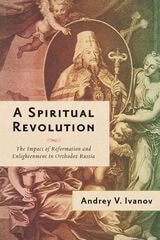
A Spiritual Revolution
The Impact of Reformation and Enlightenment in Orthodox Russia, 1700–1825Andrey V. Ivanov
University of Wisconsin Press, 2023
The ideas of the Protestant Reformation, followed by the European Enlightenment, had a profound and long-lasting impact on Russia’s church and society in the eighteenth century. Though the traditional Orthodox Church was often assumed to have been hostile toward outside influence, Andrey V. Ivanov’s study argues that the institution in fact embraced many Western ideas, thereby undergoing what some observers called a religious revolution.
Embedded with lively portrayals of historical actors and vivid descriptions of political details, A Spiritual Revolution is the first large-scale effort to fully identify exactly how Western progressive thought influenced the Russian Church. These new ideas played a foundational role in the emergence of the country as a modernizing empire and the rise of the Church hierarchy as a forward-looking agency of institutional and societal change. Ivanov addresses this important debate in the scholarship on European history, firmly placing Orthodoxy within the much wider European and global continuum of religious change.
Embedded with lively portrayals of historical actors and vivid descriptions of political details, A Spiritual Revolution is the first large-scale effort to fully identify exactly how Western progressive thought influenced the Russian Church. These new ideas played a foundational role in the emergence of the country as a modernizing empire and the rise of the Church hierarchy as a forward-looking agency of institutional and societal change. Ivanov addresses this important debate in the scholarship on European history, firmly placing Orthodoxy within the much wider European and global continuum of religious change.
[more]
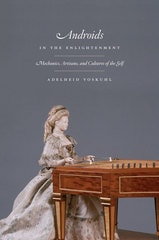
Androids in the Enlightenment
Mechanics, Artisans, and Cultures of the SelfAdelheid Voskuhl
University of Chicago Press, 2013
The eighteenth century saw the creation of a number of remarkable mechanical androids: at least ten prominent automata were built between 1735 and 1810 by clockmakers, court mechanics, and other artisans from France, Switzerland, Austria, and the German lands. Designed to perform sophisticated activities such as writing, drawing, or music making, these “Enlightenment automata” have attracted continuous critical attention from the time they were made to the present, often as harbingers of the modern industrial age, an era during which human bodies and souls supposedly became mechanized.
In Androids in the Enlightenment, Adelheid Voskuhl investigates two such automata—both depicting piano-playing women. These automata not only play music, but also move their heads, eyes, and torsos to mimic a sentimental body technique of the eighteenth century: musicians were expected to generate sentiments in themselves while playing, then communicate them to the audience through bodily motions. Voskuhl argues, contrary to much of the subsequent scholarly conversation, that these automata were unique masterpieces that illustrated the sentimental culture of a civil society rather than expressions of anxiety about the mechanization of humans by industrial technology. She demonstrates that only in a later age of industrial factory production did mechanical androids instill the fear that modern selves and societies had become indistinguishable from machines.
[more]
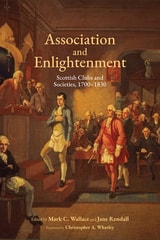
Association and Enlightenment
Scottish Clubs and Societies, 1700-1830Mark C. Wallace
Bucknell University Press, 2021
Social clubs as they existed in eighteenth- and early nineteenth-century Scotland were varied: they could be convivial, sporting, or scholarly, or they could be a significant and dynamic social force, committed to improvement and national regeneration as well as to sociability. The essays in this volume examine the complex history of clubs and societies in Scotland from 1700 to 1830. Contributors address attitudes toward associations, their meeting places and rituals, their links with the growth of the professions and with literary culture, and the ways in which they were structured by both class and gender. By widening the context in which clubs and societies are set, the collection offers a new framework for understanding them, bringing together the inheritance of the Scottish past, the unique and cohesive polite culture of the Scottish Enlightenment, and the broader context of associational patterns common to Britain, Ireland, and beyond.
[more]