Results by title
50 books match the query 'Experiments' and 2 start with a
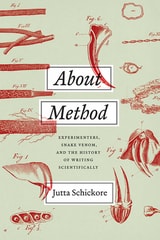
About Method
Experimenters, Snake Venom, and the History of Writing ScientificallyJutta Schickore
University of Chicago Press, 2017
Scientists’ views on what makes an experiment successful have developed dramatically throughout history. Different criteria for proper experimentation were privileged at different times, entirely new criteria for securing experimental results emerged, and the meaning of commitment to experimentation altered. In About Method, Schickore captures this complex trajectory of change from 1660 to the twentieth century through the history of snake venom research. As experiments with poisonous snakes and venom were both challenging and controversial, the experimenters produced very detailed accounts of their investigations, which go back three hundred years—making venom research uniquely suited for such a long-term study. By analyzing key episodes in the transformation of venom research, Schickore is able to draw out the factors that have shaped methods discourse in science.
About Method shows that methodological advancement throughout history has not been simply a steady progression toward better, more sophisticated and improved methodologies of experimentation. Rather, it was a progression in awareness of the obstacles and limitations that scientists face in developing strategies to probe the myriad unknown complexities of nature. The first long-term history of this development and of snake venom research, About Method offers a major contribution to integrated history and philosophy of science.
About Method shows that methodological advancement throughout history has not been simply a steady progression toward better, more sophisticated and improved methodologies of experimentation. Rather, it was a progression in awareness of the obstacles and limitations that scientists face in developing strategies to probe the myriad unknown complexities of nature. The first long-term history of this development and of snake venom research, About Method offers a major contribution to integrated history and philosophy of science.
[more]
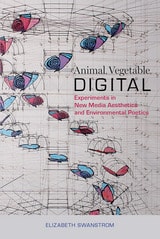
Animal, Vegetable, Digital
Experiments in New Media Aesthetics and Environmental PoeticsElizabeth Swanstrom
University of Alabama Press, 2016
Winner of the Elizabeth Agee Prize in American Literature
An audacious, interdisciplinary study that combines the burgeoning fields of digital aesthetics and eco-criticism
In Animal, Vegetable, Digital, Elizabeth Swanstrom makes a confident and spirited argument for the use of digital art in support of ameliorating human engagement with the environment and suggests a four-part framework for analyzing and discussing such applications.
Through close readings of a panoply of texts, artworks, and cultural artifacts, Swanstrom demonstrates that the division popular culture has for decades observed between nature and technology is artificial. Not only is digital technology not necessarily a brick in the road to a dystopian future of environmental disaster, but digital art forms can be a revivifying bridge that returns people to a more immediate relationship to nature as well as their own embodied selves.
To analyze and understand the intersection of digital art and nature, Animal, Vegetable, Digital explores four aesthetic techniques: coding, collapsing, corresponding, and conserving. “Coding” denotes the way artists use operational computer code to blur distinctions between the reader and text, and, hence, the world. Inviting a fluid conception of the boundary between human and technology, “collapsing” voids simplistic assumptions about the human body’s innate perimeter. The process of translation between natural and human-readable signs that enables communication is described as “corresponding.” “Conserving” is the application of digital art by artists to democratize large- and small-scale preservation efforts.
A fascinating synthesis of literary criticism, communications and journalism, science and technology, and rhetoric that draws on such disparate phenomena as simulated environments, video games, and popular culture, Animal, Vegetable, Digital posits that partnerships between digital aesthetics and environmental criticism are possible that reconnect humankind to nature and reaffirm its kinship with other living and nonliving things.
[more]