Results by title
86 books match the query 'Gerontology' and 18 start with a
A Generation of Change
A Profile of America's Older PopulationJacob S. Siegel
Russell Sage Foundation, 1993
A View from Life's Edge
Discovering What Really Matters with Older Women Across the GlobeCorinne G. Dempsey
Rutgers University Press, 2026
Speaking with nearly one hundred women over the age of eighty in four locations—northern Iceland, south India, a retirement community in California, and a convent in upstate New York—Corinne G. Dempsey finds that, as we near life’s end, we gain clarity about what really matters in life. Women’s stories and reflections, in which sorrow and loss are central to a life well lived, help to expand our sense of what it means to be human.
Drawing on the paradoxical wisdom of world religions and mystical traditions to frame late-life tendencies across cultures, Dempsey portrays these accounts as a corrective to mainstream values that defeat and diminish us. Dempsey encourages us to turn away from ageist fears rather than denying life’s inevitable end. Learning from older women’s perspectives, we might move their edge-of-life views closer to the center.

Adulthood in Britain and the United States from 1350 to Generation Z
Edited by Maria Cannon and Laura Tisdall
University of London Press, 2024
Who gets to be an adult—and who decides? This book argues that consideration of age is a crucial element in scholarship that addresses power and inequality. Exploring how concepts of adulthood have changed over time in Britain and the United States from 1350 to the present day, the essays collected here engage with the intersectional identities of gender, race, class, sexuality, and disability, and ask how these affect understandings of adulthood.
Advances in the Economics of Aging
Edited by David A. Wise
University of Chicago Press, 1996
Specific topics include the effect of labor market rigidities on the employment of older workers; the effect on retirement of the availability of continuation coverage benefits; and the influence of the prospective payment system (PPS) on rising Medicare costs. Also considered are the effects of health and wealth on living arrangement decisions; the incentive effects of employer-provided pension plans; the degree of substitution between 401(k) plans and other employer-provided retirement saving arrangements; and the extent to which housing wealth determines how much the elderly save and consume.
Two final studies use simulations that describe the implications of stylized economic models of behavior among the elderly. This timely volume will be of interest to anyone concerned with the economics of aging.
Aged by Culture
Margaret Morganroth Gullette
University of Chicago Press, 2003
In this illuminating book, Margaret Morganroth Gullette reveals that aging doesn't start in our chromosomes, but in midlife downsizing, the erosion of workplace seniority, threats to Social Security, or media portrayals of "aging Xers" and "greedy" Baby Boomers. To combat the forces aging us prematurely, Gullette invites us to change our attitudes, our life storytelling, and our society. Part intimate autobiography, part startling cultural expose, this book does for age what gender and race studies have done for their categories. Aged by Culture is an impassioned manifesto against the pernicious ideologies that steal hope from every stage of our lives.
Agewise
Fighting the New Ageism in AmericaMargaret Morganroth Gullette
University of Chicago Press, 2011
Let’s face it: almost everyone fears growing older. We worry about losing our looks, our health, our jobs, our self-esteem—and being supplanted in work and love by younger people. It feels like the natural, inevitable consequence of the passing years, But what if it’s not? What if nearly everything that we think of as the “natural” process of aging is anything but?
In Agewise, renowned cultural critic Margaret Morganroth Gullette reveals that much of what we dread about aging is actually the result of ageism—which we can, and should, battle as strongly as we do racism, sexism, and other forms of bigotry. Drawing on provocative and under-reported evidence from biomedicine, literature, economics, and personal stories, Gullette probes the ageism thatdrives discontent with our bodies, our selves, and our accomplishments—and makes us easy prey for marketers who want to sell us an illusory vision of youthful perfection. Even worse, rampant ageism causes society to discount, and at times completely discard, the wisdom and experience acquired by people over the course of adulthood. The costs—both collective and personal—of this culture of decline are almost incalculable, diminishing our workforce, robbing younger people of hope for a decent later life, and eroding the satisfactions and sense of productivity that should animate our later years.
Once we open our eyes to the pervasiveness of ageism, however, we can begin to fight it—and Gullette lays out ambitious plans for the whole life course, from teaching children anti-ageism to fortifying the social safety nets, and thus finally making possible the real pleasures and opportunities promised by the new longevity. A bracing, controversial call to arms, Agewise will surprise, enlighten, and, perhaps most important, bring hope to readers of all ages.
Aging Issues in the United States and Japan
Edited by Seiritsu Ogura, Toshiaki Tachibanaki, and David A. Wise
University of Chicago Press, 2001
Given the undeniable global importance of the Japanese and U.S. economies, these innovative essays shed welcome new light on the complex correlations between aging and economic behavior. This insightful work not only deepens our understanding of the Japanese and American economic landscapes but, through careful examination of the comparative social and economic data, clarifies the complex relation between aging societies, public policies, and economic outcomes.

Aging Nationally in Contemporary Poland
Memory, Kinship, and PersonhoodJessica C. Robbins
Rutgers University Press, 2021

Aging and Loss
Mourning and Maturity in Contemporary JapanDanely, Jason
Rutgers University Press, 2015
Based on nearly a decade of research, Aging and Loss examines how the landscape of aging is felt, understood, and embodied by older adults themselves. In detailed portraits, anthropologist Jason Danely delves into the everyday lives of older Japanese adults as they construct narratives through acts of reminiscence, social engagement and ritual practice, and reveals the pervasive cultural aesthetic of loss and of being a burden.
Aging and Old Age
Richard A. Posner
University of Chicago Press, 1995
Aging and Old Age offers fresh insight into a wide range of social and political issues relating to the elderly, such as health care, crime, social security, and discrimination. From the dread of death to the inordinate law-abidingness of the old, from their loquacity to their penny-pinching, Posner paints a surprisingly rich, revealing, and unsentimental portrait of the millions of elderly people in the United States. He explores issues such as age discrimination in employment, creativity and leadership as functions of age, and the changing social status of the elderly. Why are old people, presumably with less to lose, more unwilling to take risks than young people? Why don't the elderly in the United States command the respect and affection they once did and still do in other countries? How does aging affect driving and criminal records? And how does aging relate to creativity across different careers?
Aging and Society
A Sociology of Age StratificationMatilda White Riley
Russell Sage Foundation, 1972
Aging and Society
Aging and the ProfessionsMatilda White Riley
Russell Sage Foundation, 1969
Aging and Society
An Inventory of Research FindingsMatilda White Riley
Russell Sage Foundation, 1968
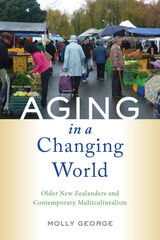
Aging in a Changing World
Older New Zealanders and Contemporary MulticulturalismMolly George
Rutgers University Press, 2022
Aging in the Church
How Social Relationships Affect HealthNeal M. Krause
Templeton Press, 2008
A growing number of studies indicate that older people in the church form social ties that have a significant positive impact on their physical and mental health. In Aging in the Church, Neal Krause comprehensively assesses the various relationships that stem from church involvement.
Among the many types of relationships Krause explores are close companion friendships, social-support structures (such as assistance provided by fellow church members during difficult times), and interactions that arise from Bible study and prayer groups. Through his thorough investigation of the underlying links between these relationships and the ways they relate to attributes like forgiveness, hope, gratitude, and altruism, the author hopes to explain why older adults who are involved in religious activities tend to enjoy better physical and mental health than those who are not engaged in religious communities. Going beyond merely reviewing the existing research on this subject, Aging in the Church provides a blueprint for taking research on church-based social relationships and health to the next level by identifying conceptual and methodological issues that investigators will confront as they delve more deeply into these connections.
Though these are complex issues, readers will find plain language and literature drawn from a wide array of disciplines, including sociology, psychology, public health, medicine, psychiatry, nursing, social work, gerontology, and theology. Literature, poetry, philosophy, and ethical ideas supplement the insights from these diverse fields. As a result, Aging in the Church takes on a genuinely interdisciplinary focus that will appeal to various scholars, researchers, and students.
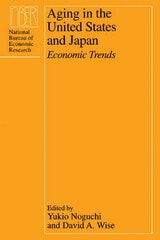
Aging in the United States and Japan
Economic TrendsEdited by Yukio Noguchi and David A. Wise
University of Chicago Press, 1994
With essays on labor force participation and retirement, housing equity and the economic status of the elderly, budget implications of an aging population, and financing social security and health care in the 1990s, this volume covers a broad spectrum of issues related to the economics of aging. Among the book's findings are that workers are retiring at an increasingly earlier age in both countries and that, as the populations age, baby boomers in the United States will face diminishing financial resources as the ratio of retirees to workers sharply increases.
The result of a joint venture between the National Bureau of Economic Research and the Japan Center for Economic Research, this book complements Housing Markets in the United States and Japan (1994) by integrating research on housing markets with economic issues of the aged in the United States and Japan.
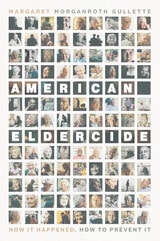
American Eldercide
How It Happened, How to Prevent ItMargaret Morganroth Gullette
University of Chicago Press, 2024
A bracing spotlight on the avoidable causes of the COVID-19 Eldercide in the United States.
Twenty percent of the Americans who have died of COVID since 2020 have been older and disabled adults residing in nursing homes—even though they make up fewer than 1 percent of the US population. Something about this catastrophic loss of life in government-monitored facilities has never added up.
Until now. In American Eldercide, activist and scholar Margaret Morganroth Gullette investigates this tragic public health crisis with a passionate voice and razor-sharp attention to detail, showing us that nothing about it was inevitable. By unpacking the decisions that led to discrimination against nursing home residents, revealing how governments, doctors, and media reinforced ageist or ableist biases, and collecting the previously little-heard voices of the residents who survived, Gullette helps us understand the workings of what she persuasively calls an eldercide.
Gullette argues that it was our collective indifference, fueled by the heightened ageism of the COVID-19 era, that prematurely killed this vulnerable population. Compounding that deadly indifference is our own panic about aging and a social bias in favor of youth-based decisions about lifesaving care. The compassion this country failed to muster for the residents of our nursing facilities motivated Gullette to pen an act of remembrance, issuing a call for pro-aging changes in policy and culture that would improve long-term care for everyone.
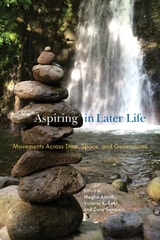
Aspiring in Later Life
Movements across Time, Space, and GenerationsMegha Amrith
Rutgers University Press, 2023
This book is also freely available online as an open-access digital edition.
Download the open access book here.