Results by title
56 books match the query 'Great Basin' and 7 start with a
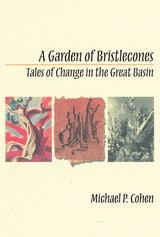
A Garden Of Bristlecones
Tales Of Change In The Great BasinMichael P. Cohen
University of Nevada Press, 1998
An engaging, well-illustrated natural and cultural history of the oldest living organism—the bristlecone pine. Since Edmund Schulman discovered in 1958 that individual bristlecones live nearly 5,000 years, the trees have been investigated primarily for the elaborate record their rings contain. The trees have been "read' closely, with major consequences for natural and human history. Historians have read local and global environmental change. Archaeologists have rewritten the history of civilization. Writers have transformed them into figures pertinent to the human dilemmas of time and eternity. A Garden of Bristlecones investigates professional and popular conceptions as a set of narratives drawn from the outside and inside of the trees. It reveals the premises of the investigators, the nature of their inquiry, and the extent of their knowledge, while also revealing the Great Basin bristlecone itself. Illustrations by Valerie Cohen.
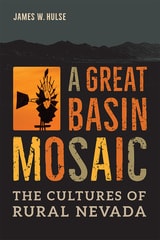
A Great Basin Mosaic
The Cultures of Rural NevadaJames W. Hulse
University of Nevada Press, 2017
The Nevada of lesser-known cities, towns, and outposts deserve their separate chronicles, and here Hulse fills a wide gap. He contributes in a text rich with memories tramping through rural Nevada as a child, then as a journalist seeking news and gossip, then later as an academic historian and a parent trying to share the wonders of the high desert with his family. Nobody is more qualified to write about the cultural nuances of rural Nevada than Hulse, who retired after 35 years as a professor of history at University of Nevada, Reno.
Robert Laxalt wrote an article in National Geographic in 1974 entitled “The Other Nevada” in which he referred to “the Nevada that has been eclipsed by the tinsel trimmings of Las Vegas, the round-the-clock casinos, the ski slopes of the Sierra. It is a Nevada that few tourists see.” With this book Hulse reflects on Laxalt’s insights and shows changes—often slow-moving and incremental—that have occurred since then. Much of the terrain of rural Nevada has not changed at all, while others have adapted to technological revolutions of recent times. Hulse states that there is no single “other” Nevada, but several subcultures with distinct features. He offers a tour of sorts to what John Muir called the “bewildering abundance” of the Nevada landscape.
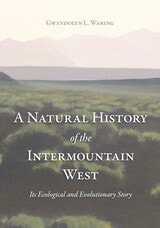
A Natural History of the Intermountain West
Its Ecological and Evolutionary StoryGwendolyn L Waring
University of Utah Press, 2010
A Natural History of the Intermountain West was written to inform people about the wild world around us, with the idea that we all crave a connection to the natural world to ground us and give us a sense of place. It is also a book about change. While species are described throughout the chapters, the text is focused more on the profound processes that have shaped western ecosystems, based on a belief that understanding those processes is more meaningful than a list of names. The ways and the rapidity with which enormous ecosystems replace one another and sometimes even return as climates change are a magnificent testament to the tenacity of life.
The first book of its kind for this region, A Natural History of the Intermountain West takes a fresh look at the natural history of the southern Rockies and the Intermountain Region based on cutting-edge research, interviews with numerous scientists, and the author’s personal experience. Drawing together many disparate fields, the book integrates the evolution of western ecosystems with the geological and climatic history of the region. It is a passionate, humanistic, and scientific treatment of this area’s ecosystems, how they function, and how they came to be through time; it is a wonderful guide for the general public and scientists alike.

An Incomplete History of the American West
Storiesurza
University of Nevada Press, 2026
Rooted in the traditions of Western literature but unafraid to challenge them, author Gabriel Urza brings a fresh and unflinching perspective to stories that span race, class, and time. Unsentimental yet deeply humane, An Incomplete History of the American West asks readers to reconsider what the West truly means—and why the stories we tell about it still matter.
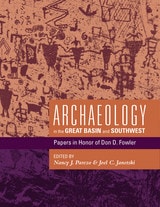
Archaeology in the Great Basin and Southwest, Part 2
Papers in Honor of Don D. FowlerNancy J. Parezo
University of Utah Press, 2014
Archaeology in the Great Basin and Southwest, Part 3
Papers in Honor of Don D. FowlerNancy J. Parezo
University of Utah Press, 2014
Archaeology in the Great Basin and Southwest
Papers in Honor of Don D. FowlerNancy J. Parezo
University of Utah Press, 2014