Results by title
54 books match the query 'Hiking' and 5 start with a

A Dog Lover's Guide to Hiking Wisconsin's State Parks
Danielle St. Louis
University of Wisconsin Press, 2022
A Dog Lover’s Guide to Hiking Wisconsin’s State Parks divides Wisconsin into five regions and further details specific trails, graded for dog reactivity as well as the fitness level of human and canine alike. St. Louis also helpfully notes the availability of nearby facilities such as bathrooms, water stations, trashcans, designated dog swimming areas, and veterinarians. Truly one of a kind, this book is a must have for any Wisconsin dog lover looking to go out into nature with their pup.
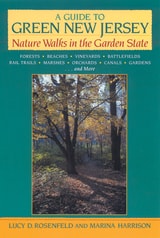
A Guide to Green New Jersey
Nature Walks in the Garden StateRosenfeld, Lucy D
Rutgers University Press, 2003
New Jersey is a state of surprises. Did you know there was a castle in Passaic County? Or that Essex County’s Branch Brook Park, rather than Washington, D.C., has the largest concentration of flowering cherry trees outside of Japan? Did you know you could walk through a bamboo forest on the Rutgers University campus, dig for fossils in Middletown’s Poricy Brook, visit an owl haven on the site of the Battle of Monmouth, or see wild river otters in Salem County?
Despite its proximity to major urban areas and its high population density, the state has dozens of absolutely marvelous natural areas and preserved spaces. It boasts something for everyone, from Atlantic seashore to rugged mountains, rolling farmland to winding canals, historic trails to formal gardens, bird-filled marshes to hardwood forests, pine barrens to fragrant vineyards and orchards. There are outings for hikers, bikers, beachcombers, gardeners, power-walkers, and strollers of all kinds, and A Guide to Green NewJersey is your key to finding it all.
The book is conveniently organized into forty geographic areas, spotlighting more than 200 nature walks. Each entry includes a description, visitor hours, fees, driving accessibility, and other pertinent information for walkers. At the end of the book, the authors provide an index with the names of each site, and their guide to choosing an outing according to individual tastes and interests. They identify sites that are wheelchair accessible, especially fun for kids, best for bicyclists, and those that are particularly physically challenging.
Newcomers to the state will find the book indispensable, and long-time New Jerseyans will find it a pleasantly eye-opening guide to wonderful walks right in their own backyards.
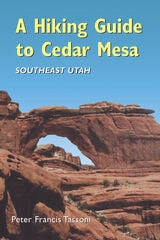
A Hiking Guide To Cedar Mesa
Peter Francis Tassoni
University of Utah Press, 2001
A Hiking Guide to Cedar Mesa describes sixty-three routes, ranging from quarter-mile walks to fifteen-mile day hikes, loops, and multi-day backpack trips. There is essential information on permits, weather, gear, road, trailhead access, geology, human history in the region, and leave-no-trace camping.
Care is given to name only those well-known archaeological sites that are visible or immediately accessible from roads. Throughout, the author emphasizes proper visitation protocol for fragile archaeological sites. He states, "I have been touched by this landscape and would prefer to keep its teachings and secrets to myself, but I cannot. The experience of the desert should be available to everyone with the motivation to encounter it."
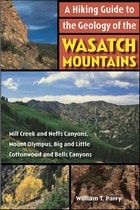
A Hiking Guide to the Geology of the Wasatch Mountains
Mill Creek and Neffs Canyons, Mount Olympus, Big and Little Cottonwood and Bells CanyonsWilliam T Parry
University of Utah Press, 2005
Northern Utah’s Wasatch Mountains are popular destinations for outdoor enthusiasts in every season. These mountains rise spectacularly from the relatively flat valley floor to thirteen peaks over 11,000 feet in elevation. An additional nineteen peaks rise more than 10,000 feet in elevation. Although many hiking guides exist for the Wasatch Mountains, there has been no guide book that focuses on the geologic features visible from the trails—until now.
Written by a recognized authority on the geology of the Wasatch Mountains, this guide is meant to enrich the experience of outdoor enthusiasts who want to understand the geological history and development of the Wasatch range. The first section of the book introduces the major geological time periods—the record of mountain building events from oldest to youngest, the effects of glaciation, and the development of the present topography. It then follows with a descriptive trail guide for each major trail system, including Mill Creek and Neffs Canyons, Mount Olympus, Little and Big Cottonwood Canyons, and Bells Canyon. Trail length, elevation gain, relative difficulty, and major geological features are outlined for each trail. Now you can hike these trails with the answers to all your geologic questions right at your fingertips.
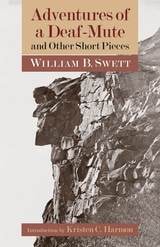
Adventures of a Deaf-Mute and Other Short Pieces
William B. Swett
Gallaudet University Press, 2017
Confident in his identity as a Deaf “mute,” he notes with wry humor the varied perceptions of deafness that he encounters. As a signing Deaf person from a prominent multigenerational Deaf family, he counters negative stereotypes with generosity and a smart wit. He takes pride in his physical abilities, which he showcases through various stunts and arduous treks in the wilderness. However, Swett’s writing also reveals a deep awareness of the fragility and precariousness of life. This is a portrait of a man testing his physical and emotional limits, written from the vantage point of someone who is no longer a young man but is still very much in the prime of his life.
This collection also includes “Mr. Swett and His Diorama,” an article from 1859 in which Swett describes his miniature recreation of the Battle of Lexington, as well as Manual Alphabets, a pamphlet published in 1875 on the history of manual alphabets that includes short biographies of Thomas Hopkins Gallaudet and Laurent Clerc, two pioneers of Deaf education in the United States. The work is accompanied by a new introduction that offers a reflection on Swett’s life and the time in which he lived.