Results by title
783 books match the query 'History & Theory' and 71 start with a
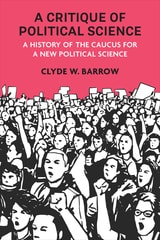
A Critique of Political Science
A History of the Caucus for a New Political ScienceClyde W. Barrow
University of Michigan Press, 2026
A Critique of Political Science distinguishes between the discipline of political science (methods and concepts) and the profession of political science (persons and institutions) to move disciplinary history beyond its current form as intellectual history toward a politics of political science. The book argues that understanding the development of a discipline requires the same type of theoretical analysis that political scientists apply to other political institutions. By examining universities and professional associations as political institutions, this approach puts political struggles and ideological conflict at the very core of disciplinary history. In reviewing 50 years of debate, controversy, and in-fighting in the political science profession, the book serves as a critique of the profession and the discipline of political science, which remains woefully disengaged from the concerns of ordinary citizens, particularly the working class and the poor throughout the world.
A Democratic Enlightenment
The Reconciliation Image, Aesthetic Education, Possible PoliticsMorton Schoolman
Duke University Press, 2020
A Democratic Theory of Judgment
Linda M. G. Zerilli
University of Chicago Press, 2016
Zerilli deftly outlines the limitations of existing debates, both those that concern themselves with the impossibility of judging across cultures and those that try to find transcendental, rational values to anchor judgment. Looking at Kant through the lens of Arendt, Zerilli develops the notion of a public conception of truth, and from there she explores relativism, historicism, and universalism as they shape feminist approaches to judgment. Following Arendt even further, Zerilli arrives at a hopeful new pathway—seeing the collapse of philosophical criteria for judgment not as a problem but a way to practice judgment anew as a world-building activity of democratic citizens. The result is an astonishing theoretical argument that travels through—and goes beyond—some of the most important political thought of the modern period.

A Future for Marxism?
Althusser, the Analytical Turn and the Revival of Socialist TheoryAndrew Levine
Pluto Press, 2003
To do this, Andrew Levine examines two recent departures in Marxist thought -- Althusserian and Analytical Marxism. The former is currently defunct; the latter, very nearly so. He assesses the shortcomings of each, while emphasising their considerable, and still timely, merits. The discussion is framed against an analysis of socialism's place in the political life of the past two centuries. Levine assesses the apparent historical defeat of the Left generally since the consolidation of the Reagan-Thatcher era and speculates on current signs of renewal.
He argues that both Althusserian and analytical Marxism represent new and deeply important philosophical departures within the Marxist tradition as they force a rethinking of Marxism's scientific and political project. For all their differences in style and substance, these strains of Marxist thought share important thematic and sociological features and Levine concludes that both traditions provide a legacy upon which a revived Left can build.

A Guerrilla Guide to Refusal
Andrew Culp
University of Minnesota Press, 2022
A field guide to a nonfascist life at the end of the world as we know it
A Guerrilla Guide to Refusal is an unexpected approach to philosophy from a guerrilla-logic point of view. Harnessing critical theory to creatively reimagine counterinsurgency, guerrilla warfare, and interventions beyond the political mainstream, it takes us on a journey through anarchist infowar, queer outlaws, and black insurgency—through a subterranean network of communiques, military documents, contemporary art, political slogans, adversarial blogs, and captive media. In doing so, it provides powerful new insight into contemporary political movements that pose no demands, refuse labels, and offer no solutions.
Written to both inspire and provoke, A Guerrilla Guide to Refusal urges us to think through the refusal to participate in politics as usual. Author Andrew Culp demonstrates how evasion can combatively deny the existing order its power. Focusing on punk cinema, anarchist pamphlets, feminist art projects, hacker manifestos, and guerrilla manuals, he foregrounds invisibility as a novel force of disruption. He draws on concepts of criminality, fugitivity, and anonymity to bring a more nuanced understanding of how power makes things—and people—visible.
The book’s unique format is that of a theoretical manual, comprising freestanding segments instead of blueprints. Poised to reach beyond the academy into activist circles, this potent theory-in-action intervention forces us to reconsider the terrain upon which our struggles against patriarchy, anti-Blackness, capitalism, and the state operate.
A History of Trust in Ancient Greece
Steven Johnstone
University of Chicago Press, 2011
A History of the People’s Action Party, 1985-2021
Shashi Jayakumar
National University of Singapore Press, 2020
This narrative history of the PAP follows the story through decisions made by party leaders as they sought to respond to the changing demands and expectations of the Singapore electorate over a thirty-year period that saw Singapore enter the ranks of developed nations. The focus is on change in four dimensions: in the communications methods and styles the party adopted, the mechanisms it developed for managing institutional change, the sometimes vexed question of party renewal, and the evolution of economic and social policy. Drawing on internal party documents and multiple interviews with key leaders over the course of a decade, this book provides a detailed portrait of a robust political institution and establishes a distinctive new narrative of Singapore politics.
A Kinder, Gentler America
Melancholia and the Mythical 1950sMary Caputi
University of Minnesota Press, 2005
Analyzing these competing uses of the past, A Kinder, Gentler America reveals how longing for the era of “the greatest generation” actually exposes a disillusionment with the present. Caputi draws on the theoretical frameworks of Julia Kristeva and Walter Benjamin to look at how the decade has been portrayed in movies such as Pleasantville and Far from Heaven and delves further to investigate our disenchantment’s lost origins in early modernity through a reading of the poetry of Baudelaire. What emerges is a stark contrast between the depictions of a melancholic present and a cheerful, shiny past. In the right’s invocation of the mythical 1950s and the left’s criticism of the same, Caputi recognizes a common unfulfilled desire, and proposes that by understanding this loss both sides can begin to accept that American identity, despite chaos and confusion, lies in the here and now.
Mary Caputi is professor of political science at California State University, Long Beach, and is author of Voluptuous Yearnings: A Feminist Theory of the Obscene.

A Leftist Ontology
Beyond Relativism and Identity PoliticsCarsten Strathausen
University of Minnesota Press, 2009
A new ontology for a globalized world
Rich with analyses of concepts from deconstruction, systems theory, and post-Marxism, with critiques of fundamentalist thought and the war on terror, this volume argues for developing a philosophy of being in order to overcome the quandary of postmodern relativism. Undergirding the contributions are the premises that ontology is a vital concept for philosophy today, that an acceptable leftist ontology must avoid the kind of identity politics that has dominated recent cultural studies, and that a new ontology must be situated within global capitalism.
A Leftist Ontology offers a timely intervention in political philosophy, featuring some of the leading voices of our time.Contributors: Bruno Bosteels, Cornell U; Christopher Breu, Illinois State U; Nicholas Brown, U of Illinois at Chicago; Sorin Radu Cucu, Manhattan College; George Edmondson, Dartmouth College; Eva Geulen, U of Bonn; Philip Goldstein, U of Delaware; Klaus Mladek, Dartmouth College; Alberto Moreiras, U of Aberdeen; Jeffrey T. Nealon, Pennsylvania State U; William Rasch, Indiana U; Ben Robinson, Indiana U; Imre Szeman, McMaster U; Roland Vegso, U of Tennessee, Knoxville.
A Miracle, A Universe
Settling Accounts with TorturersLawrence Weschler
University of Chicago Press, 1998
"Disturbing and often enthralling."—New York Times Book Review
"Extraordinarily moving. . . . Weschler writes brilliantly."—Newsday
"Implausible, intricate and dazzling."—Times Literary Supplement
"As Weschler's interviewees told their tales, I paced agitatedly, choked back tears. . . . Weschler narrates these two episodes with skill and tact. . . . An inspiring book."—George Scialabba, Los Angeles Weekly
A New Insurgency
The Port Huron Statement and Its TimesHoward Brick and Gregory Parker, eds.
Michigan Publishing Services, 2018
This volume features three never-before-published “manifesto drafts” written by Tom Hayden in early 1962 that generated the discussion leading to the Port Huron meeting. Other highlights include recollections from leading women in the Port Huron deliberations who, three years later, protested the subordination of women within the radical movements, thus setting the stage for the rise of women’s liberation. A New Insurgency is based on the University of Michigan’s conference commemorating the fiftieth anniversary of the Port Huron Statement in 2012.
“The fiftieth anniversary of the Port Huron Statement has drawn a great number of reflections and commemorations, but this carefully conceived volume offers an account of unrivaled ambition, exceptional breadth, and surprising insight. It both excavates the event itself—vividly, perceptively, exhaustively—and gives it the largest and most illuminating of contexts. A New Insurgency is as close to definitive as any volume of this kind can become.”
—Geoff Eley, Karl Pohrt Distinguished University Professor of Contemporary History, University of Michigan
A Noble Fight
African American Freemasonry and the Struggle for Democracy in AmericaCorey D. B. Walker
University of Illinois Press, 2008
With great care and detail, Walker argues that African American freemasonry provides a critical theoretical lens for understanding the distinctive ways African Americans have constructed a radically democratic political imaginary through racial solidarity and political nationalism, forcing us to reconsider much more circumspectly the complex relationship between voluntary associations and democratic politics.
Mapping the discursive logics of the language of freemasonry as a metaphoric rendering of American democracy, this study interrogates the concrete forms of an associational culture, revealing how paradoxical aspects of freemasonry such as secrecy and public association inform the production of particular ideas and expressions of democracy in America.
A Peaceful Conquest
Woodrow Wilson, Religion, and the New World OrderCara Lea Burnidge
University of Chicago Press, 2016
With A Peaceful Conquest, Cara Lea Burnidge presents the most detailed analysis yet of how Wilson’s religious beliefs affected his vision of American foreign policy, with repercussions that lasted into the Cold War and beyond. Framing Wilson’s intellectual development in relationship to the national religious landscape, and paying greater attention to the role of religion than in previous scholarship, Burnidge shows how Wilson’s blend of Southern evangelicalism and social Christianity became a central part of how America saw itself in the world, influencing seemingly secular policy decisions in subtle, lasting ways. Ultimately, Burnidge makes a case for Wilson’s religiosity as one of the key drivers of the emergence of the public conception of America’s unique, indispensable role in international relations.
As the presidential election cycle once again raises questions of America’s place in the world, A Peaceful Conquest offers a fascinating excavation of its little-known roots.
A Political Economy of Justice
Edited by Danielle Allen, Yochai Benkler, Leah Downey, Rebecca Henderson, and Josh Simons
University of Chicago Press, 2022
If we can agree that our current social-political moment is tenuous and unsustainable—and indeed, that may be the only thing we can agree on right now—then how do markets, governments, and people interact in this next era of the world? A Political Economy of Justice considers the strained state of our political economy in terms of where it can go from here. The contributors to this timely and essential volume look squarely at how normative and positive questions about political economy interact with each other—and from that beginning, how to chart a way forward to a just economy.
A Political Economy of Justice collects fourteen essays from prominent scholars across the social sciences, each writing in one of three lanes: the measures of a just political economy; the role of firms; and the roles of institutions and governments. The result is a wholly original and urgent new benchmark for the next stage of our democracy.

A Political Theology of Negative Sovereignty
Claudio Lomnitz
Duke University Press, 2027
A Question of Voice
Philosophy and the Search for LegitimacyRon Scapp
University of Michigan Press, 2020
A Slaveholders' Union
Slavery, Politics, and the Constitution in the Early American RepublicGeorge William Van Cleve
University of Chicago Press, 2010
After its early introduction into the English colonies in North America, slavery in the United States lasted as a legal institution until the passage of the Thirteenth Amendment to the Constitution in 1865. But increasingly during the contested politics of the early republic, abolitionists cried out that the Constitution itself was a slaveowners’ document, produced to protect and further their rights. A Slaveholders’ Union furthers this unsettling claim by demonstrating once and for all that slavery was indeed an essential part of the foundation of the nascent republic.
In this powerful book, George William Van Cleve demonstrates that the Constitution was pro-slavery in its politics, its economics, and its law. He convincingly shows that the Constitutional provisions protecting slavery were much more than mere “political” compromises—they were integral to the principles of the new nation. By the late 1780s, a majority of Americans wanted to create a strong federal republic that would be capable of expanding into a continental empire. In order for America to become an empire on such a scale, Van Cleve argues, the Southern states had to be willing partners in the endeavor, and the cost of their allegiance was the deliberate long-term protection of slavery by America’s leaders through the nation’s early expansion. Reconsidering the role played by the gradual abolition of slavery in the North, Van Cleve also shows that abolition there was much less progressive in its origins—and had much less influence on slavery’s expansion—than previously thought.
Deftly interweaving historical and political analyses, A Slaveholders’ Union will likely become the definitive explanation of slavery’s persistence and growth—and of its influence on American constitutional development—from the Revolutionary War through the Missouri Compromise of 1821.
A War for the Soul of America, Second Edition
A History of the Culture WarsAndrew Hartman
University of Chicago Press, 2019
“As a guide to the late twentieth-century culture wars, Hartman is unrivalled. . . . Incisive portraits of individual players in the culture wars dramas. . . . Reading Hartman sometimes feels like debriefing with friends after a raucous night out, an experience punctuated by laughter, head-scratching, and moments of regret for the excesses involved.”—New Republic
A War for the Soul of America
A History of the Culture WarsAndrew Hartman
University of Chicago Press, 2015
Buchanan’s fiery speech marked a high point in the culture wars, but as Andrew Hartman shows in this richly analytical history, their roots lay farther back, in the tumult of the 1960s—and their significance is much greater than generally assumed. Far more than a mere sideshow or shouting match, the culture wars, Hartman argues, were the very public face of America’s struggle over the unprecedented social changes of the period, as the cluster of social norms that had long governed American life began to give way to a new openness to different ideas, identities, and articulations of what it meant to be an American. The hot-button issues like abortion, affirmative action, art, censorship, feminism, and homosexuality that dominated politics in the period were symptoms of the larger struggle, as conservative Americans slowly began to acknowledge—if initially through rejection—many fundamental transformations of American life.
As an ever-more partisan but also an ever-more diverse and accepting America continues to find its way in a changing world, A War for the Soul of America reminds us of how we got here, and what all the shouting has really been about.
A World of Becoming
William E. Connolly
Duke University Press, 2010
Attunement to a world of becoming, Connolly argues, may help us address dangerous resonances between global finance capital, cross-regional religious resentments, neoconservative ideology, and the 24-hour mass media. Coming to terms with subliminal changes in the contemporary experience of time that challenge traditional images can help us grasp how these movements have arisen and perhaps even inspire creative counter-movements. The book closes with the chapter “The Theorist and the Seer,” in which Connolly draws insights from early Greek ideas of the Seer and a Jerry Lewis film, The Nutty Professor, to inform the theory enterprise today.
A World of Homeowners
American Power and the Politics of Housing AidNancy H. Kwak
University of Chicago Press, 2015
A World of Homeowners charts the emergence of democratic homeownership in the postwar landscape and booming economy; its evolution as a tool of foreign policy and a vehicle for international investment in the 1950s, ’60s, and ’70s; and the growth of lower-income homeownership programs in the United States from the 1960s to today. Kwak unravels all these threads, detailing the complex stories and policy struggles that emerged from a particularly American vision for global democracy and capitalism. Ultimately, she argues, the question of who should own homes where—and how—is intertwined with the most difficult questions about economy, government, and society.
Abolition Archives, Feminist Futures
Kathi Weeks
Duke University Press, 2026
Abolitionist Politics and the Coming of the Civil War
James Brewer Stewart
University of Massachusetts Press, 2008
Before the Civil War, slaveholders made themselves into the most powerful, most deeply rooted, and best organized private interest group within the United States. Not only did slavery represent the national economy's second largest capital investment, exceeded only by investment in real estate, but guarantees of its perpetuation were studded throughout the U.S. Constitution. The vast majority of white Americans, in North and South, accepted the institution, and pro-slavery presidents and congressmen consistently promoted its interests.
In Abolitionist Politics and the Coming of the Civil War, James Brewer Stewart explains how a small group of radical activists, the abolitionist movement, played a pivotal role in turning American politics against this formidable system. He examines what influence the movement had in creating the political crises that led to civil war and evaluates the extent to which a small number of zealous reformers made a truly significant political difference when demanding that their nation face up to its most excruciating moral problem. In making these assessments, Stewart addresses a series of more specific questions: What were the abolitionists actually up against when seeking the overthrow of slavery and white supremacy? What motivated and sustained them during their long and difficult struggles? What larger historical contexts (religious, social, economic, cultural, and political) influenced their choices and determined their behavior? What roles did extraordinary leaders play in shaping the movement, and what were the contributions of abolitionism's unheralded “foot soldiers”? What factors ultimately determined, for better or worse, the abolitionists' impact on American politics and the realization of their equalitarian goals?
Abraham Lincoln’s Statesmanship and the Limits of Liberal Democracy
Jon D. Schaff
Southern Illinois University Press, 2019
Though Lincoln’s presidency is inextricably linked to the Civil War, and he is best known for his defense of the Union and executive wartime leadership, Lincoln believed that Congress should be at the helm of public policy making. Likewise, Lincoln may have embraced limited government in vague terms, but he strongly supported effective rule of law and distribution of income and wealth. Placing the Lincoln presidency within a deeper and more meaningful historical context, Abraham Lincoln’s Statesmanship and the Limits of Liberal Democracy highlights Lincoln’s significance in the development of American power institutions and social movement politics.
Using Lincoln’s prepresidential and presidential words and actions, this book argues that decent government demands a balance of competing goods and the strong statesmanship that Lincoln exemplified. Instead of relying too heavily on the will of the people and institutional solutions to help prevent tyranny, Jon D. Schaff proposes that American democracy would be better served by a moderate and prudential statesmanship such as Lincoln’s, which would help limit democratic excesses.
Schaff explains how Lincoln’s views on prudence, moderation, natural rights, and economics contain the notion of limits, then views Lincoln’s political and presidential leadership through the same lens. He compares Lincoln’s views on governmental powers with the defense of unlimited government by twentieth-century progressives and shows how Lincoln’s theory of labor anticipated twentieth-century distributist economic thought. Schaff’s unique exploration falls squarely between historians who consider Lincoln a protoprogressive and those who say his presidency was a harbinger of industrialized, corporatized America.
In analyzing Lincoln’s approach, Abraham Lincoln’s Statesmanship and the Limits of Liberal Democracy rejects the idea he was a revolutionary statesman and instead lifts up Lincoln’s own affinity for limited presidential power, making the case for a modest approach to presidential power today based on this understanding of Lincoln’s statesmanship. As a counterpoint to the contemporary landscape of bitter, uncivil politics, Schaff points to Lincoln’s statesmanship as a model for better ways of engaging in politics in a democracy.
Addiction Becomes Normal
On the Late-Modern American SubjectJaeyoon Park
University of Chicago Press, 2024
Over the last forty years, a variety of developments in American science, politics, and culture have reimagined addiction in their own ways, but they share an important understanding: increasingly, addiction is described as normal, the natural result of a body that has been exposed to potent stimuli. This shift in thinking suggests that addiction is a condition latent in all of us, a common response to a society rich in thrills.
In Addiction Becomes Normal, Jaeyoon Park provides a history and critical analysis of the normalization of addiction in late-modern American society. By exploring addiction science, diagnostic manuals, judicial reform, and public health policy, he shows how seeing addiction as normal has flourished in recent decades and is supported throughout cultural life in the United States by the language of wellness, psychotherapy, and more. Building on Michel Foucault’s depiction of the human figure, Park argues that this shift reflects the emergence of a new American subject, one formed by the accretion of experiences. This view of the human subject challenges the idea that our compulsions reflect our characters, wills, or spirits. For if addiction is an extreme but ordinary attachment, and if compulsive consumption resembles healthy behavior, then desire is no longer an expression of the soul so much as the pursuit of a past reward. A perceptive work of recent history and political theory, Addiction Becomes Normal raises new questions about what it means to be human in America today.
Addiction Becomes Normal
On the Late-Modern American SubjectJaeyoon Park
University of Chicago Press, 2024
Addiction is now seen as an ordinary feature of human nature, an idea that introduces new doubts about the meaning of our desires.
Over the last forty years, a variety of developments in American science, politics, and culture have reimagined addiction in their own ways, but they share an important understanding: increasingly, addiction is described as normal, the natural result of a body that has been exposed to potent stimuli. This shift in thinking suggests that addiction is a condition latent in all of us, a common response to a society rich in thrills.
In Addiction Becomes Normal, Jaeyoon Park provides a history and critical analysis of the normalization of addiction in late-modern American society. By exploring addiction science, diagnostic manuals, judicial reform, and public health policy, he shows how seeing addiction as normal has flourished in recent decades and is supported throughout cultural life in the United States by the language of wellness, psychotherapy, and more. Building on Michel Foucault’s depiction of the human figure, Park argues that this shift reflects the emergence of a new American subject, one formed by the accretion of experiences. This view of the human subject challenges the idea that our compulsions reflect our characters, wills, or spirits. For if addiction is an extreme but ordinary attachment, and if compulsive consumption resembles healthy behavior, then desire is no longer an expression of the soul so much as the pursuit of a past reward. A perceptive work of recent history and political theory, Addiction Becomes Normal raises new questions about what it means to be human in America today.
Affective Communities
Anticolonial Thought, Fin-de-Siecle Radicalism, and the Politics of FriendshipLeela Gandhi
Duke University Press, 2006
Gandhi weaves together the stories of a number of South Asian and European friendships that flourished between 1878 and 1914, tracing the complex historical networks connecting figures like the English socialist and homosexual reformer Edward Carpenter and the young Indian barrister M. K. Gandhi, or the Jewish French mystic Mirra Alfassa and the Cambridge-educated Indian yogi and extremist Sri Aurobindo. In a global milieu where the battle lines of empire are reemerging in newer and more pernicious configurations, Affective Communities challenges homogeneous portrayals of “the West” and its role in relation to anticolonial struggles. Drawing on Derrida’s theory of friendship, Gandhi puts forth a powerful new model of the political: one that finds in friendship a crucial resource for anti-imperialism and transnational collaboration.
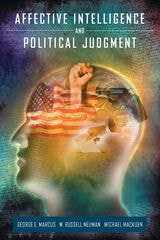
Affective Intelligence and Political Judgment
George E. Marcus, W. Russell Neuman, and Michael MacKuen
University of Chicago Press, 2000
The authors draw on research in neuroscience, physiology, and experimental psychology to conceptualize habit and reason as two mental states that interact in a delicate, highly functional balance controlled by emotion. Applying this approach to more than fifteen years of election results, they shed light on a wide range of political behavior, including party identification, symbolic politics, and negative campaigning.
Remarkably accessible, Affective Intelligence and Political Judgment urges social scientists to move beyond the idealistic notion of the purely rational citizen to form a more complete, realistic model that includes the emotional side of human judgment.
Affirmative Action and the Stalled Quest for Black Progress
W. Avon Drake and Robert D. Holsworth
University of Illinois Press, 1996
Insightful and path-breaking, Affirmative Action and the Stalled Quest for Black Progress examines the accomplishments and limitations of the set-aside programs once at the center of political debates about affirmative action in the United States.
African American Political Thought
A Collected HistoryEdited by Melvin L. Rogers and Jack Turner
University of Chicago Press, 2021
While African American political thought is inextricable from the historical movement of American political thought, this volume stresses the individuality of Black thinkers, the transnational and diasporic consciousness, and how individual speakers and writers draw on various traditions simultaneously to broaden our conception of African American political ideas. This landmark volume gives us the opportunity to tap into the myriad and nuanced political theories central to Black life. In doing so, African American Political Thought: A Collected History transforms how we understand the past and future of political thinking in the West.
After Capitalism
Horizons of Finance, Culture, and CitizenshipFerguson, Kennan
Rutgers University Press, 2016
After Queer Theory
The Limits of Sexual PoliticsJames Penney
Pluto Press, 2013
After Queer Theory makes the provocative claim that queer theory has run its course, made obsolete by the elaboration of its own logic within capitalism. James Penney argues that far from signalling the end of anti-homophobic criticism, however, the end of queer presents the occasion to rethink the relation between sexuality and politics.
Through a critical return to Marxism and psychoanalysis (Freud and Lacan), Penney insists that the way to implant sexuality in the field of political antagonism is paradoxically to abandon the exhausted premise of a politicised sexuality.
After Queer Theory argues that it is necessary to wrest sexuality from the dead end of identity politics, opening it up to a universal emancipatory struggle beyond the reach of capitalism's powers of commodification.
After the End of History
The Curious Fate of American MaterialismRobert E. Lane
University of Michigan Press, 2005
--David O. Sears, Professor of Psychology and Political Science, UCLA
"Lane's deep knowledge of the sources of human happiness enables him to develop a powerful critique of economic theory."
---Robert A. Dahl, Sterling Professor Emeritus of Political Science, Yale University
Robert E. Lane is the Eugene Meyer Professor Emeritus of Political Science at Yale University. His previous publications include The Loss of Happiness in Market Democracies (2000) and The Market Experience (1991).
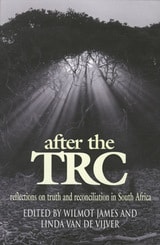
After the TRC
Reflections on Truth and ReconciliationWilmot James
Ohio University Press, 2001
Has South Africa dealt effectively with the past, and is the country ready to face the future? What are the challenges facing both government and civil society in the years ahead? These and other questions are explored in this collection of essays by international and local commentators on the Truth and Reconciliation Commission.
A range of perspectives on whether the TRC met its objectives of truth and reconciliation is presented. The areas of particular contention-the payment of reparation, the granting of amnesty, and memorialization-are also examined.
Finally, the major challenges facing South Africa are identified, and ways of meeting these challenges and developing the assets of the nation are explored.
Contributors: Haribert Adam, Kanya Adam, Alex Boraine, Colin Bundy, Mary Burton, John de Gruchy, Richard Goldstone, Willem Heath, Wilmot James, Jeffrey Lever, Mahmood Mamdani, Gary Minkley, Njabulo Ndebele, Dumisa Ntsebeza, Kaizer Nyatsumba, Grace Naledi Pandor, Mamphela Ramphele, Ciraj Rassool, Albie Sachs, Patricia Valdez, Linda van de Vijver, Jan van Eck, Frederik Van Zyl Slabbert, Charles Villa-Vicencio, Francis Wilson, and Leslie Witz
Alexis de Tocqueville
Threats to Freedom in DemocracyMichael Hereth
Duke University Press, 1986
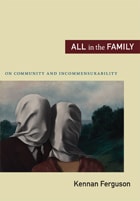
All in the Family
On Community and IncommensurabilityKennan Ferguson
Duke University Press, 2012
By closely observing the attachments that arise in families despite profound disagreements and incommensurabilities, Ferguson argues, we can imagine a political engagement that accommodates radical differences without sacrificing community. After examining how the concept of the family has been deployed and misused in political philosophy, Ferguson turns to the ways in which families actually operate: the macropolitical significance of family coping strategies such as silence and the impact that disability and caregiving have on conceptions of spatiality, sameness, and disparity. He also considers the emotional attachment between humans and their pets as an acknowledgment that compassion and community can exist even under conditions of profound difference.
Althusser and His Contemporaries
Philosophy's Perpetual WarWarren Montag
Duke University Press, 2013
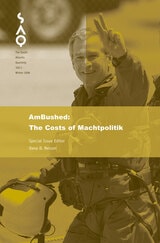
AmBushed
A Critique of Machtpolitik, Volume 105Dana D. Nelson
Duke University Press, 0
One essay argues that the Left has ceded its political vision—forgoing active political organization in favor of simply voicing political criticism of the president—allowing its activist sensibilities and abilities to atrophy. Others explore the Bush administration, its masterful machtpolitik (power politics), its strategic feminization of its opposition, its aggressive expansion of executive-branch powers, and its flirtation with what some have labeled American fascism or totalitarianism; still others reflect on how the Left has insulated itself from both reality and politics. A contributor from South Africa draws parallels between apartheid proponents and their tactics and President Bush. Others analyze “Bush II” as the leader of the Christian Right, as a skillful exploiter and manipulator of the mainstream media, as the chief spokesman for “evangelical capitalism,” and as the world’s most powerful lobbyist for corporate interests.
Contributors. Wendell Berry, Michael Bérubé, Timothy Brennan, Sharad Chari, Matthew A. Crenson, Ariel Dorfman, Thomas L. Dumm, Keya Ganguly, Benjamin Ginsberg, Pierre Guerlain, Stephen Hartnett, Dana D. Nelson, Chris Newfield, Melissa A. Orlie, Stanley G. M. Ridge, Larry Schehr, Nikhil Singh, Neil Smith, Laura Ann Stengrim
America and the Political Philosophy of Common Sense
Scott Philip Segrest
University of Missouri Press, 2009

American Community
Radical Experiments in Intentional LivingMark S. Ferrara
Rutgers University Press, 2020
American Community takes us inside forty of the most interesting intentional communities in the nation’s history, from the colonial era to the present day. You will learn about such little-known experiments in cooperative living as the Icarian communities, which took the utopian ideas expounded in a 1840 French novel and put them into practice, ultimately spreading to five states over fifty years. Plus, it covers more recent communities such as Arizona’s Arcosanti, designed by architect Paolo Soleri as a model for ecologically sustainable living.
In this provocative and engaging book, Mark Ferrara guides readers through an array of intentional communities that boldly challenged capitalist economic arrangements in order to attain ideals of harmony, equality, and social justice. By shining a light on these forgotten histories, it shows that far from being foreign concepts, communitarianism and socialism have always been vital parts of the American experience.
American Corruption Talk
A Political EtymologyRobert G. Boatright and Molly Brigid McGrath
Temple University Press, 2025
Robert Boatright and Molly Brigid McGrath focus on the role corruption talk plays in American political discourse. They distinguish between two ways people speak about corruption—corruption talk in the style of a purifier, who wishes to expunge the evil forces or drain the swamp, and corruption talk in the style of the mender, who thinks of managing, replacing, or repairing.
American Corruption Talk begins by tracing how the concept of political corruption was developed by philosophers and political thinkers, leading up to its use in the American context, especially in the Progressive Era. It also compares modes of contemporary corruption talk in different areas of public life. In doing so, the authors hope to resolve confusion and partisan disagreements about what corruption is and to discourage the tendency to label actions, events, and ideas that we merely disagree with as corrupt.
American Intelligence
Small-Town News and Political Culture in Federalist New HampshireBen P. Lafferty
University of Massachusetts Press, 2020
Taking up the New Hampshire newspaper industry as its case study, American Intelligence unpacks the ways in which an unprecedented quantity of printed material was gathered, distributed, marketed, and consumed, as well as the strong influence that it had on the shaping of the American political imagination. Ben P. Lafferty also considers the lives of the printers themselves and asks why so many men chose to pursue such a fraught and turbulent profession. This snapshot resonates with the contemporary media-saturated and politically chaotic age.

American Jewish Identity Politics
Deborah Dash Moore, editor
University of Michigan Press, 2009
"Displays the full range of informed, thoughtful opinion on the place of Jews in the American politics of identity."
---David A. Hollinger, Preston Hotchkis Professor of American History, University of California, Berkeley
"A fascinating anthology whose essays crystallize the most salient features of American Jewish life in the second half of the twentieth century."
---Beth S. Wenger, Katz Family Associate Professor of American Jewish History and Director of the Jewish Studies Program, University of Pennsylvania
"A wonderful collection of important essays, indispensable for understanding the searing conflicts over faith, familial, and political commitments marking American Jewry's journey through the paradoxes of the post-Holocaust era."
---Michael E. Staub, Professor of English, Baruch College, CUNY, and author of Torn at the Roots: The Crisis of Jewish Liberalism in Postwar America
"This provocative anthology offers fascinating essays on Jewish culture, politics, religion, feminism, and much more. It is a must-read for all those interested in the intersection of Jewish life and identity politics in the modern period."
---Joyce Antler, Samuel Lane Professor of American Jewish History and Culture, Brandeis University
"This collection of essays invites the reader to engage with some of the best writing and thinking about American Jewish life by some of the finest scholars in the field. Deborah Moore's introduction offers an important framework to understand not only the essays, but the academic and political contexts in which they are rooted."
---Riv-Ellen Prell, Professor and Chair, American Studies, University of Minnesota, and editor of Women Remaking American Judaism
American Prophecy
Race and Redemption in American Political CultureGeorge Shulman
University of Minnesota Press, 2008
The political meaning of prophetic language in America
Prophecy is the fundamental idiom of American politics—a biblical rhetoric about redeeming the crimes, suffering, and promise of a special people. Yet American prophecy and its great practitioners—from Frederick Douglass and Henry Thoreau to Martin Luther King, James Baldwin, and Toni Morrison—are rarely addressed, let alone analyzed, by political theorists. This paradox is at the heart of American Prophecy, a work in which George Shulman unpacks and critiques the political meaning of American prophetic rhetoric.
In the face of religious fundamentalisms that associate prophecy and redemption with dogmatism and domination, American Prophecy finds connections between prophetic language and democratic politics, particularly racial politics. Exploring how American critics of white supremacy have repeatedly reworked biblical prophecy, Shulman demonstrates how these writers and thinkers have transformed prophecy into a political language and given redemption a political meaning. To examine how antiracism is linked to prophecy as a vernacular idiom is to rethink political theology, recast democratic theory, and reassess the bearing of religion on American political culture. Still, prophetic language is not always liberatory, and American Prophecy maintains a critical dispassion about a rhetoric that is both prevalent and problematic.
American Public Opinion on the Iraq War
Ole R. Holsti
University of Michigan Press, 2011
"A substantial contribution to understanding the role of public opinion and the news media during the Iraq War. Equally impressive, it effectively puts the domestic context of U.S. policy in historical perspective, making the book useful to historians as well as to political scientists."
---Ralph B. Levering, Davidson College
"American Public Opinion on the Iraq War sets out to chart against a detailed account of the war a nuanced assessment of how public opinion on the conflict evolved, the partisan differences that emerged, how the issue affected other areas of foreign policy opinion, and the limits of public opinion on policy. It succeeds at all of this, and it does so in a manner that is at once informative, inherently interesting, and exceptionally easy to read."
---Randolph M. Siverson, University of California, Davis
Ole R. Holsti explores the extent to which changes in public opinion reflected the vigorous public relations efforts of the Bush administration to gain support for the war and the partisanship marking debates over policies toward Iraq. Holsti investigates the ways in which the Iraq experience has led substantial numbers of Americans to reconsider their nation's proper international role, and he assesses the impact that public opinion has had on policymakers. Significantly, Holsti places his findings in a broader context to address the role of public opinion and of the media in democratic governance.
American Public Philosophy and the Mystery of Lincolnism
Eric C. Sands
University of Missouri Press, 2009

An Education in Judgment
Hannah Arendt and the HumanitiesD. N. Rodowick
University of Chicago Press, 2021
Rodowick takes after the theories of Hannah Arendt and argues that thinking is an art we practice with and for each other in our communities.
In An Education in Judgment, philosopher D. N. Rodowick makes the definitive case for a philosophical humanistic education aimed at the cultivation of a life guided by both self-reflection and interpersonal exchange. Such a life is an education in judgment, the moral capacity to draw conclusions alone and with others, and letting one’s own judgments be answerable to the potentially contrasting judgments of others. Thinking, for Rodowick, is an art we practice with and learn from each other on a daily basis.
In taking this approach, Rodowick follows the lead of Hannah Arendt, who made judgment the cornerstone of her conception of community. What is important for Rodowick, as for Arendt, is the cultivation of “free relations,” in which we allow our judgments to be affected and transformed by those of others, creating “an ever-widening fabric of intersubjective moral consideration.” That is a fragile fabric, certainly, but one that Rodowick argues is worth pursuing, caring for, and preserving. This original work thinks with and beyond Arendt about the importance of the humanities and what “the humanities” amounts to beyond the walls of the university.
An Empire of Indifference
American War and the Financial Logic of Risk ManagementRandy Martin
Duke University Press, 2007
Drawing on theorists including Michel Foucault, Giorgio Agamben, Michael Hardt, Antonio Negri, and Achille Mbembe, Martin illuminates a frightening financial logic that must be understood in order to be countered. Martin maintains that finance divides the world between those able to avail themselves of wealth opportunities through risk taking (investors) and those who cannot do so, who are considered “at risk.” He contends that modern-day American imperialism differs from previous models of imperialism, in which the occupiers engaged with the occupied to “civilize” them, siphon off wealth, or both. American imperialism, by contrast, is an empire of indifference: a massive flight from engagement. The United States urges an embrace of risk and self-management on the occupied and then ignores or dispossesses those who cannot make the grade.
Anarchist Prophets
Disappointing Vision and the Power of Collective SightJames R. Martel
Duke University Press, 2022
Anarcho-Syndicalism
Rudolf Rocker
Pluto Press, 1998