Results by title
163 books match the query 'Homosexuality' and 13 start with a
A Desired Past
A Short History of Same-Sex Love in AmericaLeila J. Rupp
University of Chicago Press, 1999
"Most extraordinary about Leila J. Rupp's indeed short, two-hundred-page history of 'same-sex love and sexuality' is not that it manages to account for such a variety of individuals, races, and classes or take in such a broad chronological and thematic range, but rather that it does all this with such verve, lucidity, and analytical rigor. . . . [A]n elegant, inspiring survey." —John Howard, Journal of American History

A History of Bisexuality
Steven Angelides
University of Chicago Press, 2001
In a book that will become the center of debate about the nature of sexuality for years to come, A History of Bisexuality compels us to rethink contemporary discourses of sexual theory and politics.
A Queer History of Flamenco
Diversions, Transitions, and Returns in Flamenco Dance (1808–2018)Fernando López Rodríguez, translation by Ryan Rockmore
University of Michigan Press, 2024
Tracing flamenco’s development from its birth up to the contemporary era, the book places flamenco within significant historical periods such as the Spanish Civil War, Franco’s dictatorship, the transition to democracy, and the economic crisis of 2008, up to contemporary performances of the late 2010s. In taking a queer approach to History, the author abandons antiquated debates about purities and impurities; anecdotes about the lives of artists that are completely detached from their processes of creation; and myths about geniuses who seem to make art alone and completely detached from their collaborators and the historical, social, economic and artistic moment in which they lived. A Queer History of Flamenco is not only about the present and the queerness of people living, performing, or creating in it, but also about flamenco’s past in which so many queer artists and practices and their lives have remained unearthed and unaddressed.
A Very Queer Family Indeed
Sex, Religion, and the Bensons in Victorian BritainSimon Goldhill
University of Chicago Press, 2016
So begins A Very Queer Family Indeed, which introduces us to the extraordinary Benson family. Edward White Benson became Archbishop of Canterbury at the height of Queen Victoria’s reign, while his wife, Mary, was renowned for her wit and charm—the prime minister once wondered whether she was “the cleverest woman in England or in Europe.” The couple’s six precocious children included E. F. Benson, celebrated creator of the Mapp and Lucia novels, and Margaret Benson, the first published female Egyptologist.
What interests Simon Goldhill most, however, is what went on behind the scenes, which was even more unusual than anyone could imagine. Inveterate writers, the Benson family spun out novels, essays, and thousands of letters that open stunning new perspectives—including what it might mean for an adult to kiss and propose marriage to a twelve-year-old girl, how religion in a family could support or destroy relationships, or how the death of a child could be celebrated. No other family has left such detailed records about their most intimate moments, and in these remarkable accounts, we see how family life and a family’s understanding of itself took shape during a time when psychoanalysis, scientific and historical challenges to religion, and new ways of thinking about society were developing. This is the story of the Bensons, but it is also more than that—it is the story of how society transitioned from the high Victorian period into modernity.
AIDS in French Culture
Social Ills, Literary CuresDavid Caron
University of Wisconsin Press, 2001
The deluge of metaphors triggered in 1981 in France by the first public reports of what would turn out to be the AIDS epidemic spread with far greater speed and efficiency than the virus itself. To understand why it took France so long to react to the AIDS crisis, AIDS in French Culture analyzes the intersections of three discourses—the literary, the medical, and the political—and traces the origin of French attitudes about AIDS back to nineteenth-century anxieties about nationhood, masculinity, and sexuality.
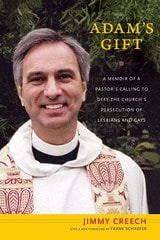
Adam's Gift
A Memoir of a Pastor's Calling to Defy the Church's Persecution of Lesbians and GaysJimmy Creech
Duke University Press, 2011
Adam’s visit prompted Creech to re-evaluate his belief that homosexuality was a sin, and to research the scriptural basis for the church’s position. He determined that the church was mistaken, that scriptural translations and interpretations had been botched and dangerously distorted. As a Christian, Creech came to believe that discriminating against lesbian, gay, bisexual, and transgender people was morally wrong. This understanding compelled him to perform same-gender commitment ceremonies, which conflicted with church directives. Creech was tried twice by The United Methodist Church, and, after the second trial, his ordination credentials were revoked. Adam’s Gift is a moving story and an important chapter in the unfinished struggle for lesbian, gay, bisexual, and transgender civil and human rights.
African Intimacies
Race, Homosexuality, and GlobalizationNeville Hoad
University of Minnesota Press, 2007
After Love
Queer Intimacy and Erotic Economies in Post-Soviet CubaNoelle Stout
Duke University Press, 2014

After Queer Theory
The Limits of Sexual PoliticsJames Penney
Pluto Press, 2013
After Queer Theory makes the provocative claim that queer theory has run its course, made obsolete by the elaboration of its own logic within capitalism. James Penney argues that far from signalling the end of anti-homophobic criticism, however, the end of queer presents the occasion to rethink the relation between sexuality and politics.
Through a critical return to Marxism and psychoanalysis (Freud and Lacan), Penney insists that the way to implant sexuality in the field of political antagonism is paradoxically to abandon the exhausted premise of a politicised sexuality.
After Queer Theory argues that it is necessary to wrest sexuality from the dead end of identity politics, opening it up to a universal emancipatory struggle beyond the reach of capitalism's powers of commodification.
American Gay
Stephen O. Murray
University of Chicago Press, 1996
Murray's erudite scholarship challenges prevailing assumptions about gay history and society. He questions conventional wisdom about the importance of World War II and the Stonewall riots for conceiving and challenging shared oppression. He reviews gay complicity in the repathologizing of homosexuality during the early years of the AIDS epidemic. Discussing recent demands for inclusion in the "straight" institutions of marriage and the US military, he concludes that these are new forms of resistance, not attempts to assimilate. Finally, Murray examines racial and ethnic differences in self-representation and identification.
Drawing on two decades of studying gay life in North America, this tour de force of empirical documentation and social theory critically reviews what is known about the emergence, growth, and internal diversity of communities of openly gay men and lesbians. American Gay thus deepens our understanding of the ways individuals construct sexualities through working and living together.

An American Obsession
Science, Medicine, and Homosexuality in Modern SocietyJennifer Terry
University of Chicago Press, 1999
Terry's overarching argument is compelling: that homosexuality served as a marker of the "abnormal" against which malleable, tenuous, and often contradictory concepts of the "normal" were defined. One of the few histories to take into consideration homosexuality in both women and men, Terry's work also stands out in its refusal to erase the agency of people classified as abnormal. She documents the myriad ways that gays, lesbians, and other sexual minorities have coauthored, resisted, and transformed the most powerful and authoritative modern truths about sex. Proposing this history as a "useable past," An American Obsession is an indispensable contribution to the study of American cultural history.
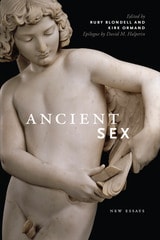
Ancient Sex
New EssaysEdited by Ruby Blondell and Kirk Ormand, epilogue by David M. Halperin
The Ohio State University Press, 2015
Rather than reopening old debates, Ancient Sex takes up Foucault’s call for discursive analysis and elucidates some of the ways that ancient Greek and Roman texts and visual arts articulate a culturally specific discourse about sexual matters. Each contributor presupposes that sexual and gendered identities are discursively produced, and teases out some of the ways that the Greeks and Romans spoke and thought about these issues. Comprising essays by emerging and established scholars, this volume emphasizes in particular: sexual discourses about women; the interaction between sexual identities and class status; gender as an unstable discursive category (even in antiquity); and the relationships between ancient and modern sexual categories.
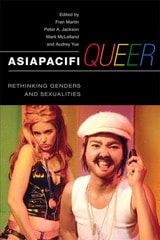
AsiaPacifiQueer
Rethinking Genders and SexualitiesEdited by Fran Martin, Peter A. Jackson, Mark McLelland, and Audrey Yue
University of Illinois Press, 2007