Results by title
57 books match the query 'Horror' and 6 start with a
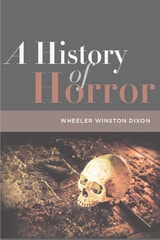
A History of Horror
Wheeler Winston Dixon
Rutgers University Press, 2010
Arranged by decades, with outliers and franchise films overlapping some years, this one-stop sourcebook unearths the historical origins of characters such as Dracula, Frankenstein, and the Wolfman and their various incarnations in film from the silent era to comedic sequels. A History of Horror explores how the horror film fits into the Hollywood studio system and how its enormous success in American and European culture expanded globally over time.
Dixon examines key periods in the horror film-in which the basic precepts of the genre were established, then banished into conveniently reliable and malleable forms, and then, after collapsing into parody, rose again and again to create new levels of intensity and menace. A History of Horror, supported by rare stills from classic films, brings over fifty timeless horror films into frightfully clear focus, zooms in on today's top horror Web sites, and champions the stars, directors, and subgenres that make the horror film so exciting and popular with contemporary audiences.
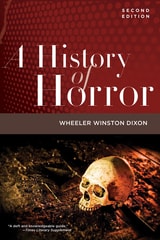
A History of Horror, 2nd Edition
Wheeler Winston Dixon
Rutgers University Press, 2023
Ever since horror leapt from popular fiction to the silver screen in the late 1890s, viewers have experienced fear and pleasure in exquisite combination. Wheeler Winston Dixon's fully revised and updated A History of Horror is still the only book to offer a comprehensive survey of this ever-popular film genre.
Arranged by decades, with outliers and franchise films overlapping some years, this one-stop sourcebook unearths the historical origins of characters such as Dracula, Frankenstein, and the Wolfman and their various incarnations in film from the silent era to comedic sequels. In covering the last decade, this new edition includes coverage of the resurgence of the genre, covering the swath of new groundbreaking horror films directed by women, Black and queer horror films, and a new international wave in body horror films.
A History of Horror explores how the horror film fits into the Hollywood studio system, how the distribution and exhibition of horror films have changed in a post-COVID world, and how its enormous success in American and European culture expanded globally over time.
Dixon examines key periods in the horror film-in which the basic precepts of the genre were established, then banished into conveniently reliable and malleable forms, and then, after collapsing into parody, rose again and again to create new levels of intensity and menace. A History of Horror, supported by rare stills from classic films, brings over sixty timeless horror films into frightfully clear focus, zooms in on today's top horror Web sites, and champions the stars, directors, and subgenres that make the horror film so exciting and popular with contemporary audiences.
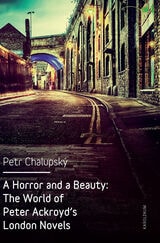
A Horror and a Beauty
The World of Peter Ackroyd's London NovelsPetr Chalupský
Karolinum Press, 2016
This idiosyncratic London construct is particularly prominent in Ackroyd’s novels, in which his ideas about the city’s nature and his connection to English literary sensibilities combine to create a distinct chronotope with its own spatial and temporal properties. A Horror and a Beauty explores this world through six defining aspects of the city as Ackroyd identifies them: the relationship between London’s past and present, its uncanny manifestations, its felonious tendencies, its inhabitants’ psychogeographic and antiquarian strategies, its theatricality, and its inherently literary character.
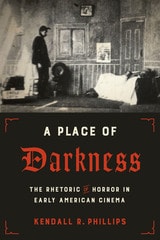
A Place of Darkness
The Rhetoric of Horror in Early American CinemaBy Kendall R. Phillips
University of Texas Press, 2018
Horror is one of the most enduringly popular genres in cinema. The term “horror film” was coined in 1931 between the premiere of Dracula and the release of Frankenstein, but monsters, ghosts, demons, and supernatural and horrific themes have been popular with American audiences since the emergence of novelty kinematographic attractions in the late 1890s. A Place of Darkness illuminates the prehistory of the horror genre by tracing the way horrific elements and stories were portrayed in films prior to the introduction of the term “horror film.”
Using a rhetorical approach that examines not only early films but also the promotional materials for them and critical responses to them, Kendall R. Phillips argues that the portrayal of horrific elements was enmeshed in broader social tensions around the emergence of American identity and, in turn, American cinema. He shows how early cinema linked monsters, ghosts, witches, and magicians with Old World superstitions and beliefs, in contrast to an American way of thinking that was pragmatic, reasonable, scientific, and progressive. Throughout the teens and twenties, Phillips finds, supernatural elements were almost always explained away as some hysterical mistake, humorous prank, or nefarious plot. The Great Depression of the 1930s, however, constituted a substantial upheaval in the system of American certainty and opened a space for the reemergence of Old World gothic within American popular discourse in the form of the horror genre, which has terrified and thrilled fans ever since.
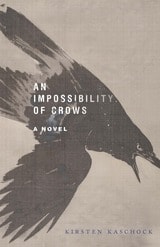
An Impossibility of Crows
A NovelKirsten Kaschock
University of Massachusetts Press, 2026
A story of mothers, monsters, and the science of longing
In this daring and evocative tale, Agnes Krahn, a chemist trained in Philadelphia, returns to her childhood home after the death of her father. Just a stone's throw from the haunted fields of Gettysburg, the small town of Letort, Pennsylvania is where the Krahn family has lived for six generations—bound by twisted folk wisdom and an uncanny kinship with the crows that loom over their land.
Back in the grim farmhouse of her youth, Agnes is drawn into the strange legacy she tried to leave behind. When she discovers an abandoned nest in the barn, she becomes consumed by a scientific—and deeply personal—experiment: to breed a crow large and intelligent enough to carry her daughter, Mina, to a freedom Agnes has never known herself. As the bird grows, so does its terrifying potential—manifest in language, cunning, and a violent will of its own. What begins as a gesture of love and liberation turns darkly obsessive, echoing the dangerous ambition of Frankenstein’s monster and the generational trauma buried in the soil of her family’s past.
A thoroughly modern, feminist novel, this is a story of mothers and daughters, inheritance and isolation, and the thin line between care and control. It confronts themes of self-harm and self-preservation, as well as memory and myth, in a narrative as visceral and uncanny as the bird that rises at its heart.
Apocalypse Cinema
Stephen Prince
Rutgers University Press, 2021
This book provides a lively overview of apocalypse cinema, including alien invasions, nuclear annihilation, asteroid collisions, climate change, and terrifying plagues. Covering pivotal films from the silent era to the present day, including Metropolis, Invasion of the Body Snatchers, Dr. Strangelove, Contagion, and Avengers: Endgame, Stephen Prince explores how these dark visions are rooted in religious and prophetic traditions, and he considers how our love for apocalypse cinema is tied to fundamental existential questions and anxieties that never go out of fashion.