Results by title
260 books match the query 'Human ecology' and 25 start with a
A Book of Waves
Stefan Helmreich
Duke University Press, 2023
A Field on Fire
The Future of Environmental HistoryEdited by Mark D. Hersey and Ted Steinberg
University of Alabama Press, 2019
Inspired by the pioneering work of preeminent environmental historian Donald Worster, the contributors to A Field on Fire: The Future of Environmental History reflect on the past and future of this discipline. Featuring wide-ranging essays by leading environmental historians from the United States, Europe, and China, the collection challenges scholars to rethink some of their orthodoxies, inviting them to approach familiar stories from new angles, to integrate new methodologies, and to think creatively about the questions this field is well positioned to answer.
Worster’s groundbreaking research serves as the organizational framework for the collection. Editors Mark D. Hersey and Ted Steinberg have arranged the book into three sections corresponding to the primary concerns of Worster’s influential scholarship: the problem of natural limits, the transnational nature of environmental issues, and the question of method. Under the heading “Facing Limits,” five essays explore the inherent tensions between democracy, technology, capitalism, and the environment. The “Crossing Borders” section underscores the ways in which environmental history moves easily across national and disciplinary boundaries. Finally, “Doing Environmental History” invokes Worster’s work as an essayist by offering self-conscious reflections about the practice and purpose of environmental history.
The essays aim to provoke a discussion on the future of the field, pointing to untapped and underdeveloped avenues ripe for further exploration. A forward thinker like Worster presents bold challenges to a new generation of environmental historians on everything from capitalism and the Anthropocene to war and wilderness. This engaging volume includes a very special afterword by one of Worster’s oldest friends, the eminent intellectual historian Daniel Rodgers, who has known Worster for close to fifty years.
A Primer for Teaching Environmental History
Ten Design PrinciplesEmily Wakild and Michelle K. Berry
Duke University Press, 2018
A Prosperous Way Down
Principles and PoliciesHoward T. Odum
University Press of Colorado, 2008
A Prosperous Way Down considers ways in which a future with less fossil fuel could be peaceful and prosperous. Although history records the collapse of countless civilizations, some societies and ecosystems have managed to descend in orderly stages, reducing demands and selecting and saving what is most important.
The authors make recommendations for a more equitable and cooperative world society, with specific suggestions based on their evaluations of trends in global population, wealth distribution, energy sources, conservation, urban development, capitalism and international trade, information technology, and education.
Available for the first time in paperback, this thoughtful, provocative book forces us to confront assumptions about our world 's future and provides both a steadying hand and a call to action with its pragmatic analysis of a global transition.
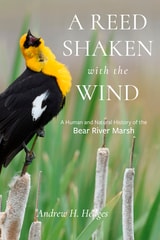
A Reed Shaken with the Wind
A Human and Natural History of the Bear River MarshAndrew H. Hedges
University of Utah Press, 2025
A Reed Shaken with the Wind tells the story of the Bear River Marsh, freshwater and sheltered grasslands on the northeast end of the Great Salt Lake with a complex past. Despite being one of Utah’s most renowned hunting and birdwatching locations, the marsh today holds only a shadow of its former ecological vitality.
Tracing the marsh from its creation during the last ice age to its current status as an imperiled national wildlife refuge, Andrew Hedges draws on geology, ecology, archaeology, wildlife biology, and water resource management to explore the natural and human forces that shaped the marsh and contributed to its decline. Covering Indigenous relationships with land, market economies’ impacts, and the intersection of ecology, science, and politics in establishing the Bear River Migratory Bird Refuge, this volume deepens discussions of humanity’s place in the environment and efforts to restore balance with our planet.
A Sustainable Life
Douglas Gwyn
QuakerPress, 2014

A User's Guide to the Crisis of Civilization
And How to Save ItNafeez Mosaddeq Ahmed
Pluto Press, 2010
It often seems that different crises are competing to devastate civilisation. This book argues that financial meltdown, dwindling oil reserves, terrorism and food shortages need to be considered as part of the same ailing system.
Most accounts of our contemporary global crises such as climate change, or the threat of terrorism, focus on one area, or another, to the exclusion of others. Nafeez Mosaddeq Ahmed argues that the unwillingness of experts to look outside their own fields explains why there is so much disagreement and misunderstanding about particular crises. This book attempts to investigate all of these crises, not as isolated events, but as trends and processes that belong to a single global system. We are therefore not dealing with a 'clash of civilisations', as Huntington argued. Rather, we are dealing with a fundamental crisis of civilisation itself.
This book provides a stark warning of the consequences of failing to take a broad view of the problems facing the world and shows how catastrophe can be avoided.
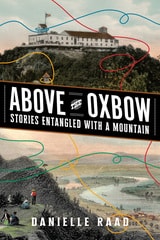
Above the Oxbow
Stories Entangled with a MountainDanielle R. Raad
West Virginia University Press, 2026
Above the Oxbow is a journey through the tangle of rich narratives surrounding Mount Holyoke, a locally cherished mountain in Western Massachusetts. It explores how visitors have forged connections with the mountain through various activities over the past two centuries. In an accessible blend of storytelling and scholarly analysis, Danielle Raad shows the significance of the landscape, historic sites, and material culture, revealing how cultural perspectives, community activism, collective memory, and personal experiences shape our understanding of a place. Situated at the intersection of public history and environmental history, this ethnography of place also discloses the curious stories of the Summit House, an erstwhile tramway, an airplane crash, and the local fight to conserve Mount Holyoke as a natural space and celebrates its myriad uses today.
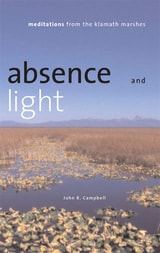
Absence And Light
Meditations From The Klamath MarshesJohn R. Campbell
University of Nevada Press, 2002
Acting with the World
Agency in the AnthropoceneAndrew Pickering
Duke University Press, 2025
African Ecomedia
Network Forms, Planetary PoliticsCajetan Iheka
Duke University Press, 2021

Against Ecological Sovereignty
Ethics, Biopolitics, and Saving the Natural WorldMick Smith
University of Minnesota Press, 2011
Against Ecological Sovereignty is a passionate defense of radical ecology that speaks directly to current debates concerning the nature, and dangers, of sovereign power. Engaging the work of Bataille, Arendt, Levinas, Nancy, and Agamben, among others, Mick Smith reconnects the political critique of sovereign power with ecological considerations, arguing that ethical and political responsibilities for the consequences of our actions do not end with those defined as human.
Against Ecological Sovereignty is the first book to turn Agamben’s analysis of sovereignty and biopolitics toward an investigation of ecological concerns. In doing so it exposes limits to that thought, maintaining that the increasingly widespread biopolitical management of human populations has an unrecognized ecological analogue—reducing nature to a “resource” for human projects. Smith contends that a radical ecological politics must resist both the depoliticizing exercise of sovereign power and the pervasive spread of biopolitics in order to reveal new possibilities for creating healthy human and nonhuman communities.
Presenting a stinging critique of human claims to sovereignty over the natural world, Smith proposes an alternative way to conceive of posthumanist ecological communities—one that recognizes the utter singularity of the beings in them.
Alterhumanism
Becoming Human on a Conservation FrontierPiergiorgio Di Giminiani
University of Arizona Press, 2025
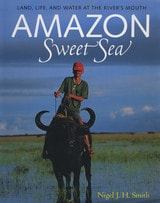
Amazon Sweet Sea
Land, Life, and Water at the River's MouthBy Nigel J. H. Smith
University of Texas Press, 2002
Far into the Atlantic Ocean, the outflow from the Amazon River creates a "sweet sea" of fresh water. At the river's mouth, a vast delta of river channels and marshes, floodplain and upland forests, open and scrub savannas, floating meadows, and mangrove swamps hosts an astonishingly diverse assemblage of plant and animal life. So rich is this biological treasure house that early European explorers deemed it inexhaustible.
In this highly readable book, Nigel Smith explores how human use of the Amazon estuary's natural resources has been affected by technological change, rapid urban growth, and accelerated market integration. Avoiding alarmist rhetoric, he shows how human intervention in the estuary has actually diversified agriculture and helped save floodplain forests from wanton destruction. His findings underscore the importance of understanding the history of land use and the ecological knowledge of local people when formulating development and conservation policies. The book will be of interest to everyone concerned with the fate of tropical forests, conserving biodiversity, and developing natural resources in a sustainable manner.
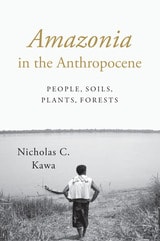
Amazonia in the Anthropocene
People, Soils, Plants, ForestsBy Nicholas C. Kawa
University of Texas Press, 2016
Widespread human alteration of the planet has led many scholars to claim that we have entered a new epoch in geological time: the Anthropocene, an age dominated by humanity. This ethnography is the first to directly engage the Anthropocene, tackling its problems and paradoxes from the vantage point of the world’s largest tropical rainforest.
Drawing from extensive ethnographic research, Nicholas Kawa examines how pre-Columbian Amerindians and contemporary rural Amazonians have shaped their environment, describing in vivid detail their use and management of the region’s soils, plants, and forests. At the same time, he highlights the ways in which the Amazonian environment resists human manipulation and control—a vital reminder in this time of perceived human dominance. Written in engaging, accessible prose, Amazonia in the Anthropocene offers an innovative contribution to debates about humanity’s place on the planet, encouraging deeper ecocentric thinking and a more inclusive vision of ecology for the future.
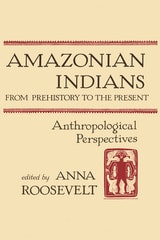
Amazonian Indians from Prehistory to the Present
Anthropological PerspectivesAnna Roosevelt
University of Arizona Press, 1994
CONTENTS
Amazonian Anthropology: Strategy for a New Synthesis, Anna C. Roosevelt
The Ancient Amerindian Polities of the Amazon, Orinoco and Atlantic Coast: A Preliminary Analysis of Their Passage from Antiquity to Extinction, Neil Lancelot Whitehead
The Impact of Conquest on Contemporary Indigenous Peoples of the Guiana Shield: The System of Orinoco Regional Interdependence, Nelly Arvelo-Jiménez and Horacio Biord
Social Organization and Political Power in the Amazon Floodplain: The Ethnohistorical Sources, Antonio Porro
The Evidence for the Nature of the Process of Indigenous Deculturation and Destabilization in the Amazon Region in the Last 300 Years: Preliminary Data, Adélia Engrácia de Oliveira
Health and Demography of Native Amazonians: Historical Perspective and Current Status, Warren M. Hern
Diet and Nutritional Status of Amazonian Peoples, Darna L. Dufour
Hunting and Fishing in Amazonia: Hold the Answers, What are the Questions?, Stephen Beckerman
Homeostasis as a Cultural System: The Jivaro Case, Philippe Descola
Farming, Feuding, and Female Status: The Achuara Case, Pita Kelekna
Subsistence Strategy, Social Organization, and Warfare in Central Brazil in the Context of European Penetration, Nancy M. Flowers
Environmental and Social Implications of Pre- and Post-Contact Situations on Brazilian Indians: The Kayapo and a New Amazonian Synthesis, Darrell Addison Posey
Beyond Resistance: A Comparative Study of Utopian Renewal in Amazonia, Michael F. Brown
The Eastern Bororo Seen from an Archaeological Perspective, Irmhilde Wüst
Genetic Relatedness and Language Distributions in Amazonia, Harriet E. Manelis Klein
Language, Culture, and Environment: Tup¡-Guaran¡ Plant Names Over Time, William Balée and Denny Moore
Becoming Indian: The Politics of Tukanoan Ethnicity, Jean E. Jackson
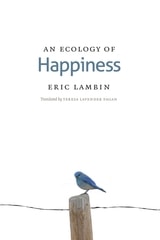
An Ecology of Happiness
Eric Lambin
University of Chicago Press, 2012
In this clever and wide-ranging work, Lambin draws on new scientific evidence in the fields of geography, political ecology, environmental psychology, urban studies, and disease ecology, among others, to answer such questions as: To what extent do we need nature for our well-being? How does environmental degradation affect our happiness? What can be done to protect the environment and increase our well-being at the same time? Drawing on case studies from Asia, Africa, Europe, and North America, Lambin makes a persuasive case for the strong link between healthy ecosystems and happy humans.
Unique in its scope and evenhanded synthesis of research from many fields, An Ecology of Happiness offers a compelling human-centered argument that is impossible to overlook when we marvel at murmurations of starlings or seek out the most brilliant fall foliage: nature makes our steps a little lighter and our eyes a little brighter. What better reason to protect an ecosystem or save a species than for our own pleasure?
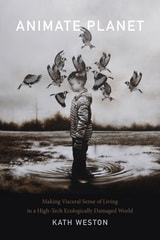
Animate Planet
Making Visceral Sense of Living in a High-Tech Ecologically Damaged WorldKath Weston
Duke University Press, 2017
Anthropos and the Material
Penny Harvey, Christian Krohn-Hansen, and Knut Nustad, editors
Duke University Press, 2019
Archaeological Landscapes on the High Plains
Laura L. Scheiber
University Press of Colorado, 2008
Focusing on long-term change, this book considers ethnographic literature, archaeological evidence, and environmental data spanning thousands of years of human presence to understand human perception and construction of landscape. The contributors offer cohesive and synthetic studies emphasizing hunter-gatherers and subsistence farmers.
Using landscape as both reality and metaphor, Archaeological Landscapes on the High Plains explores the different and changing ways that people interacted with place in this transitional zone between the Rocky Mountains and the eastern prairies.
The contemporary archaeologists working in this small area have chosen diverse approaches to understand the past and its relationship to the present. Through these ten case studies, this variety is highlighted but leads to a common theme - that the High Plains contains important locales to which people, over generations or millennia, return. Providing both data and theory on a region that has not previously received much attention from archaeologists, especially compared with other regions in North America, this volume is a welcome addition to the literature. Contributors:
o Paul Burnett
o Oskar Burger
o Minette C. Church
o Philip Duke
o Kevin Gilmore
o Eileen Johnson
o Mark D. Mitchell
o Michael R. Peterson
o Lawrence Todd
Archives of the Anthropocene
Visual Grammars of Deep TimeYuriko Furuhata
Duke University Press, 2026
Arctic Adaptations
Native Whalers and Reindeer Herders of Northern EurasiaIgor Krupnik
Dartmouth College Press, 2002
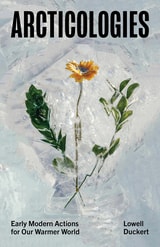
Arcticologies
Early Modern Actions for Our Warmer WorldLowell Duckert
University of Minnesota Press, 2025
Exploring the frozen past to rethink our warming future
Do we really know what cold is? In Arcticologies, Lowell Duckert delves into early modern European texts to trace how representations of frigidity from the sixteenth and seventeenth centuries have contributed to historical understandings of climate and contemporary debates on climate change. Arguing that human culture and science are, in fact, indebted to the cold, Duckert suggests that these early depictions offer critical terms for advancing the aims of climate-change activism and assisting in counterapocalyptic thinking.
An imaginative and intellectual journey, Arcticologies reveals the enduring role of cold in wide-ranging storytelling traditions. It draws on Shakespeare’s Hamlet and Othello and the works of Thomas Dekker, René Descartes, and Thomas Hobbes and is informed throughout by contemporary Indigenous writing, including that of Sheila Watt-Cloutier and Leanne Betasamosake Simpson. In reflecting on these assorted accounts, Duckert sees cold as not only an environmental hardship but a source of cultural creativity and resilience, highlighting moments of collaboration between humans and the icy world, from arctic exploration to urban fairs on frozen rivers.
Cold, Duckert makes clear, is more than the absence of warmth. Situating our contemporary obsession with impending planetary meltdown within the mazelike arcticologies of the past, Duckert shows how early modern cold brought about forms of curiosity, vocabulary, and interspecies relationality that can serve us today. In doing so, he asks us to identify what has been lost and who is at risk in today’s thinning cold—while also urging us to imagine alternative futures focused not on inevitable and total collapse but on adaptation and preserving what remains.
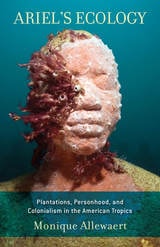
Ariel's Ecology
Plantations, Personhood, and Colonialism in the American TropicsMonique Allewaert
University of Minnesota Press, 2013
What happens if we abandon the assumption that a person is a discrete, world-making agent who acts on and creates place? This, Monique Allewaert contends, is precisely what occurred on eighteenth-century American plantations, where labor practices and ecological particularities threatened the literal and conceptual boundaries that separated persons from the natural world.
Integrating political philosophy and ecocriticism with literary analysis, Ariel’s Ecology explores the forms of personhood that developed out of New World plantations, from Georgia and Florida through Jamaica to Haiti and extending into colonial metropoles such as Philadelphia. Allewaert’s examination of the writings of naturalists, novelists, and poets; the oral stories of Africans in the diaspora; and Afro-American fetish artifacts shows that persons in American plantation spaces were pulled into a web of environmental stresses, ranging from humidity to the demand for sugar. This in turn gave rise to modes of personhood explicitly attuned to human beings’ interrelation with nonhuman forces in a process we might call ecological.
Certainly the possibility that colonial life revokes human agency haunts works from Shakespeare’s Tempest and Montesquieu’s Spirit of the Laws to Spivak’s theories of subalternity. In Allewaert’s interpretation, the transformation of colonial subjectivity into ecological personhood is not a nightmare; it is, rather, a mode of existence until now only glimmering in Che Guevara’s dictum that postcolonial resistance is synonymous with “perfect knowledge of the ground.”
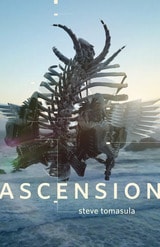
Ascension
A NovelSteve Tomasula
University of Alabama Press, 2022
A visually stunning narrative of three eras in humankind’s vexed relationship with nature.
Ascension is a novel about the end of nature, or rather, the end of three “natures”: the time just before Darwin changed the natural world; the 1980s, just as the digital and genetic revolutions begin to replace “nature” with “environment”; and today, a time when we have the ability to manipulate nature at both the scale of the planet and at the genome. The narrative follows three different biologists on the brink of each of these cultural extinctions to explore how nature occupies our imaginations and how our imaginations bring the natural world, and our place in it, into existence.
Ascension is a story of how we continually remake the world and are in turn remade by the new nature we’ve created. It is the story of humans yearning to understand their families, themselves, and the world they live in as it comes to a close, leaving them to anticipate what will follow. Rich in visual depictions of the natural world—from nineteenth century engraving and paintings to twentieth century photography and twenty-first century databases—Ascension uses the materials of three eras to drive home our inability to escape nature, and the ways our fates are irrevocably bound together even as our actions usher in an end-time.