Results by title
192 books match the query 'Humor' and 10 start with a
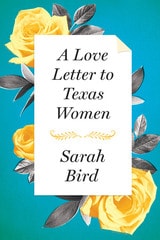
A Love Letter to Texas Women
By Sarah Bird
University of Texas Press, 2016
"Sarah Bird is a true eccentric, but one with a straightforward gift for explaining the human heart. . . . A Lone Star girl-legend." —Boston Globe
What is it that distinguishes Texas women—the famous Yellow Rose and her descendants? Is it that combination of graciousness and grit that we revere in First Ladies Laura Bush and Lady Bird Johnson? The rapier-sharp wit that Ann Richards and Molly Ivins used to skewer the good ole boy establishment? The moral righteousness with which Barbara Jordan defended the US constitution? An unnatural fondness for Dr Pepper and queso?
In her inimitable style, Sarah Bird pays tribute to the Texas Woman in all her glory and all her contradictions. She humorously recalls her own early bewildered attempts to understand Lone Star gals, from the big-haired, perfectly made-up ladies at the Hyde Park Beauty Salon to her intellectual, quinoa-eating roommates at Seneca House Co-op for Graduate Women. After decades of observing Texas women, Bird knows the species as few others do. A Love Letter to Texas Women is a must-have guide for newcomers to the state and the ideal gift to tell any Yellow Rose how special she is.
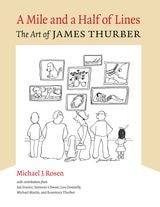
A Mile and a Half of Lines
The Art of James ThurberMichael J. Rosen, with contributions from Ian Frazier, Seymour Chwast, Liza Donnelly, Michael Maslin, and Rosemary Thurber
The Ohio State University Press, 2019
Including some 260 drawings, this collection is the first comprehensive focus on his work as an artist, a cartoonist, and an illustrator. With commentary from a host of preeminent cartoonists and writers, including Ian Frazier, Seymour Chwast, and Michael Maslin, A Mile and a Half of Lines celebrates the significance of Thurber’s spontaneous, unstudied, and novel drawing style that not only altered the nature of American cartooning but also expanded the very possibilities of an illustrated line. Coinciding with the first major retrospective of Thurber’s art presented by the Columbus Museum of Art in 2019, A Mile and a Half of Lines showcases both classic Thurber as well as visual material never before seen in print.

A Very Serious Thing
Women’s Humor and American CultureNancy A. Walker
University of Minnesota Press, 1988
A Very Serious Thing was first published in 1988. Minnesota Archive Editions uses digital technology to make long-unavailable books once again accessible, and are published unaltered from the original University of Minnesota Press editions.
"It is a very serious thing to be a funny woman." –Frances Miriam Berry Whitcher
A Very Serious Thing is the first book-length study of a part of American literature that has been consistently neglected by scholars and underrepresented in anthologies—American women's humorous writing. Nancy Walker proposes that the American humorous tradition to be redefined to include women's humor as well as men's, because, contrary to popular opinion, women do have a sense of humor.
Her book draws on history, sociology, anthropology, literature, and psychology to posit that the reasons for neglect of women's humorous expression are rooted in a male-dominated culture that has officially denied women the freedom and self-confidence essential to the humorist. Rather than a study of individual writers, the book is an exploration of relationships between cultural realities—including expectations of "true womanhood"—and women's humorous response to those realities.
Humorous expression, Walker maintains, is at odds with the culturally sanctioned ideal of the "lady," and much of women's humor seems to accept, while actually denying, this ideal. In fact, most of American women's humorous writing has been a feminist critique of American culture and its attitudes toward women, according to the author.

Academic Tribes
Hazard Adams
University of Illinois Press, 1988
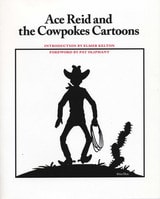
Ace Reid and the Cowpokes Cartoons
By Ace Reid
University of Texas Press, 1999
Winner, Mitchell A. Wilder Award for Publication Design, Texas Association of Museums
Folks across the West know a cowpoke named Jake. A good-hearted guy, he's always up to his eyebrows in debt or drought or prickly pears looking for them dad-blamed ole wild cows. In fact, he's so real a fella that it's hard to believe that Ace Reid made him up.
This book brings together 139 of Ace Reid's popular "Cowpokes" cartoons, reproduced in large format to show the artistry and attention to detail that characterized Reid's work. Grouped around themes such as work, weather, bankers, and friends, they reveal the distinctive "you might as well laugh as cry" sense of humor that ranch folks draw on to get through hard work and hard times.
In the foreword, Washington Post cartoonist Pat Oliphant offers an appreciation of Reid's "Cowpokes" cartoons, noting that "Ace's work has a magic of its own, and it owes nothing to anyone else." Reid's longtime friend Elmer Kelton recounts Ace's life and career in the introduction, describing how a shy boy who grew up on ranch work transformed himself into an artist-entrepreneur who never met a stranger and who made ranch work the subject of his real love, cartooning. This collector's volume belongs on the shelf of everyone who loves the "Cowpokes" cartoons, knows a fella like Jake, or enjoys the dry wit of the American cowboy.
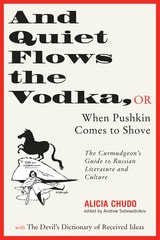
And Quiet Flows the Vodka
or When Pushkin Comes to Shove: The Curmudgeon's Guide to Russian Literature with the Devil's Dictionary of Received IdeasAlicia Chudo
Northwestern University Press, 2000
Written in the tradition of 1066 and All That, The Pooh Perplex, and The Classics Redefined, And Quiet Flows the Vodka will, with any luck, be the final word on the ghastly first two millennia of Russian literature, history, and culture.
Antisatire
In Defense of Women, against Francesco BuoninsegniArcangela Tarabotti
Iter Press, 2020
The Other Voice in Early Modern Women: The Toronto Series volume 70
Are You Really a Genius?
Timeless Tests for the Irritatingly IntelligentRobert A. Streeter and Robert G. Hoehn
Bodleian Library Publishing, 2015
“By rearranging the letters in the word ‘plea,’ make three new words.”
“Which is heavier, milk or cream?”
If you think you know the answers to these questions, you may be a genius! Before the Mensa admissions test or the awarding of MacArthur “Genius Grants,” self-described geniuses Robert A. Streeter and Robert G. Hoehn set out in the 1930s on a mission to find more men and women of above-average intelligence. Central to this undertaking were tests filled with fiendishly difficult brainteasers, tortuous trick questions, and complex calculations that could be administered to the unsuspecting.
Are You Really a Genius? collects a series of Streeter and Hoehn’s tests into a quirky quiz book. Throughout the tests are timeless favorites, as well as many charmingly old-fashioned scenarios reflecting simpler times past. For those struggling to reach the correct answers, a final three-point “brain twister” offers a chance for redemption. And for those not quite up to the challenge, a “moron’s morgue” may help improve one’s intellectual standing. Using the answer key found at the back of the book, each test can be carefully scored to determine the exact level of genius attained.
Think you’re in the company of the “rare Craneo-Bulgis species?” In the words of the authors, “sneak up on your friends and spring the questions on the following pages.”
Still wondering about the answers to the questions at the top?
1) 28 eggs
2) leap, peal, and pale
3) milk, because cream comes to the surface
As Ding Saw Herbert Hoover
Jay N. Darling
University of Iowa Press, 1996
Ding Darling was a Pulitzer Prize-winning editorial cartoonist whose work appeared daily on the front page of the Des Moines Register between 1906 and 1949 and also was syndicated in 135 newspapers across the country. A brief encounter with Herbert Hoover during World War I was the beginning of a friendship that lasted until Ding’s death in 1962. After Hoover’s election as president, Ding’s relationship changed somewhat from one of strictly a friend to one of an unofficial advisor. On at least three occasions, the Darlings were overnight guests at the White House. Although their friendship deepened after the years of the presidency, Ding did not agree with Hoover on everything. In As “Ding” Saw Herbert Hoover, Ding interprets the career of Hoover as food administrator, cabinet member, candidate, and president in 57 cartoons, personal recollections, and a running commentary of the times as told in the day-by-day headlines.
Away Happens
Phil Crossman
University Press of New England, 2005