Results by title
763 books match the query 'Immigration & Emigration' and 52 start with a
A Century of Transnationalism
Immigrants and Their Homeland ConnectionsEdited by Nancy L. Green and Roger Waldinger
University of Illinois Press, 2016
A Collective Pursuit
Teachers' Unions and Education ReformLesley Lavery
Temple University Press, 2020
Teachers’ unions are the organizations responsible for safeguarding the conditions of teachers’ employment. Union supporters claim strong synergies between teachers’ interests and students’ interests, but critics of unions insist that the stance of teachers in collective bargaining may disadvantage students as unions reduce the power of administrators to manage, remove, reward or retain excellent teachers.
In A Collective Pursuit, Lesley Laveryunpacks how teachers’ unions today are fighting for contracts that allow them to earn a decent living and build “schools all students deserve.” She explains the form and function of the nation’s largest teachers’ unions. Lavery then explores unionization campaigns in the Twin Cities charter schools. A Collective Pursuit also examines teacher strikes and contract negotiations, school finance and finance reform, and district and union attempts to address racial achievement gaps, to provide a context for understanding the economic, political, and demographic forces that inspire teachers to improve conditions for students.
A Collective Pursuit emphasizes that while teachers’ unions serve a traditional, economic role, they also provide a vast array of valuable services to students, educators, parents, and community members.
A Common Humanity
Ritual, Religion, and Immigrant Advocacy in Tucson, ArizonaLane Van Ham
University of Arizona Press, 2011
This is the first book to examine immigrant aid groups from the inside. Author Lane Van Ham spent more than three years observing the groups and many hours in discussions and interviews. He is particularly interested in how immigrant advocates both uphold the legitimacy of the United States and maintain a broader view of its social responsibilities. By advocating for immigrants regardless of their documentation status, he suggests, advocates navigate the conflicting pulls of their own nation-state citizenship and broader obligations to their neighbors in a globalizing world. And although the advocacy organizations are not overtly religious, Van Ham finds that they do employ religious symbolism as part of their public rhetoric, arguing that immigrants are entitled to humane treatment based on universal human values.
Beautifully written and immensely engaging, A Common Humanity adds a valuable human dimension to the immigration debate.
A Forgetful Nation
On Immigration and Cultural Identity in the United StatesAli Behdad
Duke University Press, 2005
Behdad shows how political, cultural, and legal texts have articulated American anxiety about immigration from the Federalist period to the present day. He reads texts both well-known—J. Hector St. John de Crèvecoeur’s Letters from an American Farmer, Alexis de Tocqueville’s Democracy in America, and Walt Whitman’s Leaves of Grass—and lesser-known—such as the writings of nineteenth-century nativists and of public health officials at Ellis Island. In the process, he highlights what is obscured by narratives and texts celebrating the United States as an open-armed haven for everyone: the country’s violent beginnings, including its conquest of Native Americans, brutal exploitation of enslaved Africans, and colonialist annexation of French and Mexican territories; a recurring and fierce strand of nativism; the need for a docile labor force; and the harsh discipline meted out to immigrant “aliens” today, particularly along the Mexican border.
A Greater Ireland
The Land League and Transatlantic Nationalism in Gilded Age AmericaEly M. Janis
University of Wisconsin Press, 2014
As this "Greater Ireland" flourished, new opportunities arose for women and working-class men to contribute within Irish-American society. Exploring the complex interplay of ethnicity, class, and gender, Janis demonstrates the broad range of ideological, social, and political opinion held by Irish Americans in the 1880s. Participation in the Land League deeply influenced a generation that replaced their old county and class allegiances with a common cause, shaping the future of Irish-American nationalism.

A Liberal Tide?
Immigration and Asylum Law and Policy in Latin AmericaEdited by David James Cantor, Luisa Feline Freier, and Jean-Pierre Gauci
University of London Press, 2015
A Midwestern Mosaic
Immigration and Political Socialization in Rural AmericaJ. Celeste Lay
Temple University Press, 2012
Drawn by low-skilled work and the safety and security of rural life, increasing numbers of families from Latin America and Southeast Asia have migrated to the American heartland. In the path-breaking book A Midwestern Mosaic, J. Celeste Lay examines the effects of political socialization on native white youth growing up in small towns.
Lay studies five Iowa towns to investigate how the political attitudes and inclinations of native adolescents change as a result of rapid ethnic diversification. Using surveys and interviews, she discovers that native adolescents adapt very well to foreign-born citizens, and that over time, gaps diminish between diverse populations and youth in all-white/Anglo towns in regard to tolerance, political knowledge, efficacy, and school participation.
A Midwestern Mosaic looks at the next generation to show how exposure to ethnic and cultural diversity during formative years can shape political behavior and will influence politics in the future.
A Nation of Immigrants Reconsidered
US Society in an Age of Restriction, 1924-1965Maddalena Marinari, Madeline Hsu, Maria Garcia
University of Illinois Press, 2019
Contributors: Eiichiro Azuma, David Cook-Martín, David FitzGerald, Monique Laney, Heather Lee, Kathleen López, Laura Madokoro, Ronald L. Mize, Arissa H. Oh, Ana Elizabeth Rosas, Lorrin Thomas, Ruth Ellen Wasem, and Elliott Young
A New Language, A New World
Italian Immigrants in the United States, 1890-1945Nancy C. Carnevale
University of Illinois Press, 2012

A Suitable Enemy
Racism, Migration and Islamophobia in EuropeLiz Fekete
Pluto Press, 2009
Liz Fekete is a leading authority on issues of racism, Islamophobia and national security legislation. A Suitable Enemy draws on sixteen years of research to present a comprehensive overview of EU immigration, asylum, race and security policies.
Fekete argues that at the same time as the EU introduces selective migration policies, it closes its borders against asylum seekers who were the first victims of the growth of the security state which now embraces Muslims. She explores the way in which anti-terrorist legislation has been used to evict undesirable migrants, how deportation policies commodify and de-humanise the most vulnerable and how these go hand in hand with evolving forms of racism, particularly Islamophobia.
At the heart of the book is an examination of xeno-racism -- a non-colour coded form of institutionalised racism -- where migrants who do not assimilate, or who are believed to be incapable of assimilation, are excluded.
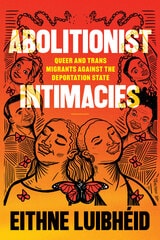
Abolitionist Intimacies
Queer and Trans Migrants against the Deportation StateEithne Luibheid
Duke University Press, 2025
Accidental Immigrants and the Search for Home
Women, Cultural Identity, and CommunityCarol E. Kelley
Temple University Press, 2013
The intimate stories of these "accidental" immigrants broaden conventional notions of home. From a Maori woman who moves to Norway to the daughter of an Iranian diplomat now living in France, Kelley weaves together these stories of the personal and emotional effects of immigration with interdisciplinary discussions drawn from anthropology and psychology. Ultimately, she reveals how the lifelong process of immigration affects each woman's sense of identity and belonging and contributes to better understanding today's globalized society.
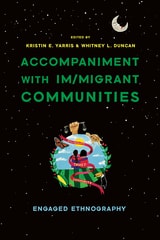
Accompaniment with Im/migrant Communities
Engaged EthnographyKristin E. Yarris and Whitney L. Duncan
University of Arizona Press, 2024
This collection brings together the experiences and voices of anthropologists whose engaged work with im/migrant communities pushes the boundaries of ethnography toward a feminist, care-based, decolonial mode of ethnographic engagement called “accompaniment.”
Accompaniment as anthropological research and praxis troubles the boundaries of researcher-participant, scholar-activist, and academic-community to explicitly address issues of power, inequality, and the broader social purpose of the work. More than two dozen contributors show how accompaniment is not merely a mode of knowledge production but an ethical commitment that calls researchers to action in solidarity with those whose lives we seek to understand. The volume stands as a collective conversation about possibilities for caring and decolonial forms of ethnographic engagement with im/migrant communities.
This volume is ideal for scholars, students, immigrant activists, instructors, and those interested in social justice work.
Contributors
Carolina Alonso Bejarano
Anna Aziza Grewe
Alaska Burdette
Whitney L. Duncan
Carlos Escalante Villagran
Christina M. Getrich
Tobin Hansen
Lauren Heidbrink
Dan Heiman
Josiah Heyman
Sarah Horton
Nolan Kline
Alana M. W. LeBrón
Lupe López
William D. Lopez
Aida López Huinil
Mirian A. Mijangos García
Nicole L. Novak
Mariela Nuñez-Janes
Ana Ortez-Rivera
Juan Edwin Pacay Mendoza
Salvador Brandon Pacay Mendoza
María Engracia Robles Robles
Delmis Umanzor
Erika Vargas Reyes
Kristin E. Yarris
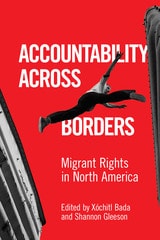
Accountability Across Borders
Migrant Rights in North AmericaEdited by Xóchitl Bada and Shannon Gleeson
University of Texas Press, 2019
Collecting the diverse perspectives of scholars, labor organizers, and human-rights advocates, Accountability across Borders is the first edited collection that connects studies of immigrant integration in host countries to accounts of transnational migrant advocacy efforts, including case studies from the United States, Canada, and Mexico.
Covering the role of federal, state, and local governments in both countries of origin and destinations, as well as nongovernmental organizations (NGOs), these essays range from reflections on labor solidarity among members of the United Food and Commercial Workers in Toronto to explorations of indigenous students from the Maya diaspora living in San Francisco. Case studies in Mexico also discuss the enforcement of the citizenship rights of Mexican American children and the struggle to affirm the human rights of Central American migrants in transit. As policies regarding immigration, citizenship, and enforcement are reaching a flashpoint in North America, this volume provides key insights into the new dynamics of migrant civil society as well as the scope and limitations of directives from governmental agencies.

Achieving Anew
How New Immigrants Do in American Schools, Jobs, and NeighborhoodsMichael J. White
Russell Sage Foundation, 2009

Across Canons
Language, Latin American Immigrant Literature, and the Making of Latinx NarrativesThania Muñoz D.
University of Arizona Press, 2026
Author Thania Muñoz D. looks at immigrant experiences impacted by a prism of social and political factors, including free trade agreements, drug trafficking, political violence, massive foreign debt, and economic dependency. The author examines why these writers refuse to identify as immigrants and reject stereotypical portrayals. Throughout, Muñoz D. makes the case for a new field within Latinx literature: Latin American immigrant writing in Spanish. She explains why this type of literary work is critical across Latin American, Latinx, and U.S. literature.
This book highlights the benefits of comparative, interdisciplinary interpretations that allow readers and scholars to grapple with the realities of a multilingual Latin American–origin literary present and future of the United States.
Across Oceans of Law
The Komagata Maru and Jurisdiction in the Time of EmpireRenisa Mawani
Duke University Press, 2018
Additive Schooling in Subtractive Times
Bilingual Education and Dominican Immigrant Youth in the HeightsLesley Bartlett
Vanderbilt University Press, 2011
After offering a history of the school's formation, the authors detail the ways in which federal No Child Left Behind policies, New York State accountability measures, and New York City's educational reforms under Mayor Michael Bloomberg complicated the school's efforts. The book then describes the dynamic bilingual pedagogical approach adopted within the school to help students develop academic Spanish and English. Focusing on the lives of twenty immigrant youth, Bartlett and Garcia also show that, although the school achieves high completion rates, the graduating students nevertheless face difficult postsecondary educational and work environments that too often consign them to the ranks of the working poor.
Adoption across Race and Nation
US Histories and LegaciesEdited by Silke Hackenesch
The Ohio State University Press, 2022
Advancing Immigrant Rights in Houston
Els de Graauw and Shannon Gleeson
Temple University Press, 2024
In Advancing Immigrant Rights in Houston, Els de Graauw and Shannon Gleeson recount how local and multi-level contexts shape the creation, contestation, and implementation of immigrant rights policies and practices in the city. They examine the development of a city immigrant affairs office, interactions between local law enforcement and federal immigration enforcement officials, local public-private partnerships around federal immigration benefits, and collaborations between labor, immigrant rights, faith, and business leaders to combat wage theft.
The case study of Houston provides a bellwether for how other U.S. cities will deal with their growing immigrant populations and underscores the importance of public-private collaborations to advance immigrant rights.

Aesthetic Citizenship
Immigration and Theater in Twenty-First-Century ParisEmine Fisek
Northwestern University Press, 2017
From neighborhood associations and humanitarian alliances to arts organizations both large and small, Fisek traces how theater has emerged as a practice with the perceived capacity to address questions regarding immigrant rights, integration, and experience. In Aesthetic Citizenship, she explores how the stage, one of France’s most evocative cultural spaces, has come to play a role in contemporary questions about immigration, citizenship and national identity. Yet Fişek’s insightful research also illuminates Paris’s broader historical, political, and cultural through-lines that continue to shape the relationship between theater and migration in France.
By focusing on how French public discourses on immigration are not only rendered meaningful but also inhabited and modified in the context of activist and arts practice, Aesthetic Citizenship seeks to answer the fundamental question: is theater a representational act or can it also be a transformative one?
Affective Circuits
African Migrations to Europe and the Pursuit of Social RegenerationEdited by Jennifer Cole and Christian Groes
University of Chicago Press, 2016
The contributors point to the intersecting streams of goods, people, ideas, and money as they circulate between African migrants and their kin who remain back home. They also show the complex ways that emotions become entangled in these exchanges. Examining how these circuits operate in domains of social life ranging from child fosterage to binational marriages, from coming-of-age to healing and religious rituals, the book also registers the tremendous impact of state officials, laws, and policies on migrant experience. Together these essays paint an especially vivid portrait of new forms of kinship at a time of both intense mobility and ever-tightening borders.
Africans in Europe
The Culture of Exile and Emigration from Equatorial Guinea to SpainMichael Ugarte
University of Illinois Press, 2013
Based on personal stories of people forced to leave and those who left of their own accord, Africans in Europe captures the nuanced realities and widespread impact of mobile populations. By focusing on the geographical, emotional, and intellectual dynamics of Equatorial Guinea's human movements, readers gain an inroad to "the consciousness of an age" and an understanding of the global realities that will define the cultural, economic, and political currents of the twenty-first century.
After Ellis Island
Newcomers and Natives in the 1910 CensusSusan Cotts Watkins
Russell Sage Foundation, 1994
After They Closed the Gates
Jewish Illegal Immigration to the United States, 1921-1965Libby Garland
University of Chicago Press, 2014
In After They Closed the Gates, Libby Garland tells the untold stories of the Jewish migrants and smugglers involved in that underworld, showing how such stories contributed to growing national anxieties about illegal immigration. Garland also helps us understand how Jews were linked to, and then unlinked from, the specter of illegal immigration. By tracing this complex history, Garland offers compelling insights into the contingent nature of citizenship, belonging, and Americanness.
Against Their Will
The History and Geography of Forced Migrations in the USSRPavel Polian
Central European University Press, 2003
Against the Deportation Terror
Organizing for Immigrant Rights in the Twentieth CenturyRachel Ida Buff
Temple University Press, 2017
Despite being characterized as a “nation of immigrants,” the United States has seen a long history of immigrant rights struggles. In her timely book Against the Deportation Terror, Rachel Ida Buff uncovers this multiracial history. She traces the story of the American Committee for the Protection of the Foreign Born (ACPFB) from its origins in the 1930s through repression during the early Cold War, to engagement with “new” Latinx and Caribbean immigrants in the 1970s and early 1980s.
Functioning as a hub connecting diverse foreign-born communities and racial justice advocates, the ACPFB responded to various, ongoing crises of what they called “the deportation terror.” Advocates worked against repression, discrimination, detention, and expulsion in migrant communities across the nation at the same time as they supported reform of federal immigration policy. Prevailing in some cases and suffering defeats in others, the story of the ACPFB is characterized by persistence in multiracial organizing even during periods of protracted repression.
By tracing the work of the ACPFB and its allies over half a century, Against the Deportation Terror provides important historical precedent for contemporary immigrant rights organizing. Its lessons continue to resonate today.
Against the Tide
Immigrants, Day Laborers, and Community in Jupiter, FloridaSandra Lazo de la Vega and Timothy J. Steigenga
University of Wisconsin Press, 2013
At the beginning of the twenty-first century, Jupiter was in the throes of immigration debates. A decade earlier, this small town had experienced an influx of migrants from Mexico and Guatemala. Immigrants seeking work gathered daily on one of the city’s main streets, creating an ad-hoc, open-air labor market that generated complaints and health and human safety concerns. What began as a local debate rapidly escalated as Jupiter’s situation was thrust into the media spotlight and attracted the attention of state and national anti-immigrant groups. But then something unexpected happened: immigrants, neighborhood residents, university faculty and students, and town representatives joined together to mediate community tensions and successfully moved the informal labor market to the new El Sol Neighborhood Resource Center.
Timothy J. Steigenga, who helped found the center, and Lazo de la Vega, who organized students in support of its mission, describe how El Sol engaged the residents of Jupiter in a two-way process of immigrant integration and helped build trust on both sides. By examining one city’s search for a positive public policy solution, Against the Tide offers valuable practical lessons for other communities confronting similar challenges.
Alien
Reflections on Being an ImmigrantSandro Galea
University of Chicago Press, 2026
A personal treatise from distinguished social scientist Sandro Galea on the indelible effects of being an immigrant—and what it means for the greater good.
“I am one of the lucky ones,” writes Sandro Galea. Galea left home in Malta at fourteen with his parents and sister as the island was rocked by political turmoil. The family made their way to Canada and Galea, in turn, eventually made his way to the United States. This is the story of Galea’s long, surreal journey of forging a life in a series of new and unfamiliar places.
With spare and deeply affecting prose, Alien is a poignant exploration of what it means to build a life across borders—and why it’s important for all of us. Galea’s intimate and personal story frames the experience of being an immigrant in terms of its indelible lessons on adaptation, identity, belonging, and shared generosity. Galea also captures at once the joys and the uncertainties that define the process of uprooting one life to begin another abroad. His is a reflection on empathy, on precarity, and on the effect of immigrating, in which one becomes keenly aware of how quickly life—and the world—can change.
Blending philosophical inquiry and personal story, Alien bridges the gap between storytelling and scholarship and, in doing so, gifts us an essential aperture on the world not everyone experiences—and the value of having those who do.
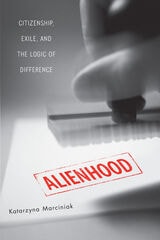
Alienhood
Citizenship, Exile, And The Logic Of DifferenceKatarzyna Marciniak
University of Minnesota Press, 2006
Using examples from exilic literature and cinema, including the works of Julia Alvarez, Eva Hoffman, Gregory Nava, and Roman Polanski, Alienhood theorizes multicultural experiences of liminal characters that belong in the interstices between nations. Investigating gendered, racialized, and ideological formations of “aliens,” Marciniak’s readings put into dialogue narratives from both the second world and the third world in relation to “first worldness.” This dialogue problematizes the meanings of “transnational” and brings the so-called second world into these debates. In doing so, Marciniak reorients the study of immigrant or exile subjects beyond the celebrated notion of transnationalism.
With its unique focus on “aliens” in relation to discourses of immigration, exile, and displacement, Alienhood shows how transnationality is, for many dislocated people, an unattainable privilege.
Katarzyna Marciniak is associate professor of English at Ohio University.

All They Will Call You
Tim Z. Hernandez
University of Arizona Press, 2017
All They Will Call You is the harrowing account of “the worst airplane disaster in California’s history,” which claimed the lives of thirty-two passengers, including twenty-eight Mexican citizens—farmworkers who were being deported by the U.S. government. Outraged that media reports omitted only the names of the Mexican passengers, American folk icon Woody Guthrie penned a poem that went on to become one of the most important protest songs of the twentieth century, “Plane Wreck at Los Gatos (Deportee).” It was an attempt to restore the dignity of the anonymous lives whose unidentified remains were buried in an unmarked mass grave in California’s Central Valley. For nearly seven decades, the song’s message would be carried on by the greatest artists of our time, including Pete Seeger, Dolly Parton, Bruce Springsteen, Bob Dylan, and Joan Baez, yet the question posed in Guthrie’s lyrics, “Who are these friends all scattered like dry leaves?” would remain unanswered—until now.
Combining years of painstaking investigative research and masterful storytelling, award-winning author Tim Z. Hernandez weaves a captivating narrative from testimony, historical records, and eyewitness accounts, reconstructing the incident and the lives behind the legendary song. This singularly original account pushes narrative boundaries, while challenging perceptions of what it means to be an immigrant in America, but more importantly, it renders intimate portraits of the individual souls who, despite social status, race, or nationality, shared a common fate one frigid morning in January 1948.
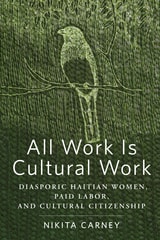
All Work Is Cultural Work
Diasporic Haitian Women, Paid Labor, and Cultural CitizenshipNikita Carney
Rutgers University Press, 2026
What does it mean to belong in a nation? All Work Is Cultural Work examines how Haitian women living in diaspora find and create status through their work outside the home. Nikita Carney draws on ethnographic data gathered over several years in Boston, Montreal, and Paris with women who left Haiti in search of other things: safety, financial security, and opportunity. Ranging from administrative assistants to dancers to preschool teachers, the women in this study share their rich experiences, teaching us how they found a place in their new host nations through paid labor. Focusing on small, daily interactions in the workplace, these women’s narratives highlight the ways in which often invisible daily cultural practices build and re-build both the nation and the home. Taking into account the overlapping and interlocking systems of oppression her participants face both nationally and globally, Carney uses an intersectional analysis to illuminate how the workplace serves as a central site in which Haitian women become raced, gendered, and classed within the nation. Ultimately, the lives and experiences of these women point to one conclusion: culture is indivisible from labor and labor from culture, with paid labor providing a vital method for national culture to be created and recreated each and every day.
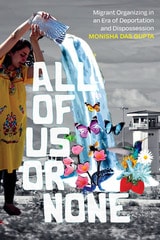
All of Us or None
Migrant Organizing in an Era of Deportation and DispossessionMonisha Das Gupta
Duke University Press, 2024

Almost Gone
Brian Sousa
Tagus Press, 2013
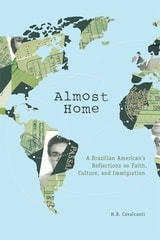
Almost Home
A Brazilian American's Reflections on Faith, Culture, and ImmigrationH. B. Cavalcanti
University of Wisconsin Press, 2012
Due to both his family background and the prevalence of U.S. media in Latin America, Cavalcanti already felt immersed in U.S. culture before arriving in Kentucky in 1981 to complete graduate studies. At that time, opportunities for advancement in the United States exceeded those in Brazil, and in an era of military dictatorships throughout much of Latin America, Cavalcanti sought in the United States a nation of laws. In this memoir, he reflects on the dynamics of acculturation, immigrant parenting, interactions with native-born U.S. citizens, and the costs involved in rejecting his country of birth for an adopted nation. He also touches on many of the factors that contribute to migration in both the “sending” and “receiving” countries and explores the contemporary phenomenon of accelerated immigration.
With its blend of personal anecdotes and scholarly information, Almost Home addresses both individual and policy-related issues to provide a moving portrait of the impact of migration on those who, like Cavalcanti, confront both the wonder and the disorientation inherent in the immigrant experience.
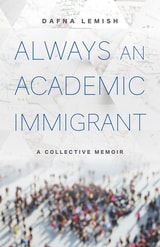
Always an Academic Immigrant
A Collective MemoirDafna Lemish
Rutgers University Press, 2025
Always an Academic Immigrant is a collective memoir that gives voice to eighty-one academics who immigrated from thirty-seven countries for a career in an institution of higher education, in either the United States or one of ten other countries. Through in-depth interviews and observations from her own experiences as an immigrant scholar, Dafna Lemish shares the highs and the lows that academic immigrants feel as they search for both a country and an institution they can call home. She discovers the formative events that led these scholars to pursue careers outside their native lands and details the challenges they faced adapting to unspoken expectations in their new countries and workplaces. Ultimately, this book reveals the strategies that immigrant professors use to bridge their native and adoptive cultures while highlighting the vital contributions they have made to academia as scholars, teachers, and leaders.
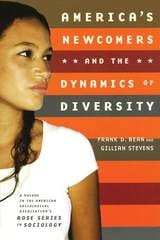
America's Newcomers and the Dynamics of Diversity
Frank D. Bean
Russell Sage Foundation, 2003
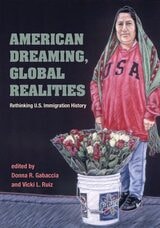
American Dreaming, Global Realities
Rethinking U.S. Immigration HistoryEdited by Donna R. Gabaccia and Vicki L. Ruiz
University of Illinois Press, 2006
An introduction to the best from the new directions in U.S. immigration history
Representing a selection of the finest new research on immigration, American Dreaming, Global Realities explores the ways in which immigrant lives and those of their children are shaped by transnational bonds, globalization, family ties, and personal choice, and the ways in which they engender a sense of belonging and a sense of themselves as “Americans.”
American Dreaming, Global Realities considers a plurality of very specific historical, economic, regional, familial, and cultural contexts. This history reveals resistance and accommodation, both persistent older traditions and Americanization, plus the creation of new cultural forms blending old and new. The twenty-two interdisciplinary essays included in this collection explore the intricate overlapping of race, class, and gender on ethnic identity and on American citizenship.
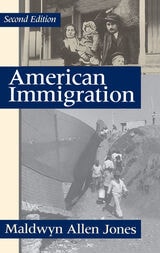
American Immigration
Maldwyn Allen Jones
University of Chicago Press, 1992
In this new edition, Jones brings his history of immigration to the United States up to 1990. His new chapter covers the major changes in immigration patterns caused by changes in legislation, such as the Immigration and Nationality Act of 1965.
"It is done with a grasp of regional, chronological, national and racial information, plus that 'feel' for the situation which can come only from the vast resources and a gift for interpretation."—A. T. DeGroot, Christian Century
"A scholarly contribution, based on a thorough mastery of the subject."—Carl Wittke, Journal of Southern History
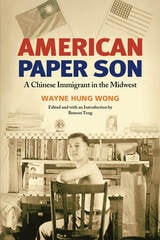
American Paper Son
A Chinese Immigrant in the MidwestWayne Hung Wong
University of Illinois Press, 2005
In the early and mid-twentieth century, Chinese migrants evaded draconian anti-immigrant laws by entering the US under false papers that identified them as the sons of people who had returned to China to marry. Wayne Hung Wong tells the story of his life after emigrating to Wichita, Kansas, as a thirteen-year-old paper son. After working in his father’s restaurant as a teen, Wong served in an all-Chinese Air Force unit stationed in China during World War II. His account traces the impact of race and segregation on his service experience and follows his postwar life from finding a wife in Taishan through his involvement in the government’s amnesty program for Chinese immigrants and career in real estate. Throughout, Wong describes the realities of life as part of a small Chinese American community in a midwestern town.
Vivid and rich with poignant insights, American Paper Son explores twentieth-century Asian American history through one person’s experiences.
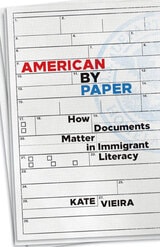
American by Paper
How Documents Matter in Immigrant LiteracyKate Vieira
University of Minnesota Press, 2016
American by Paper reveals how two groups of immigrants who share a primary language nevertheless have very different experiences of literacy in the United States. It describes the social realities facing documented and undocumented immigrants who use everyday acts of writing to negotiate papers—the visas, green cards, and passports that promise access to the American Dream. It is both an ethnography, filled with illuminating details about contemporary immigrant lives, and a critical intervention into two leading—and conflicting—scholarly ideas of literacy and its social role.
Although popular thinking and scholarship have viewed literacy as a method of culturally assimilating immigrants into the nation, Kate Vieira finds that upward mobility and social inclusion in the United States are tied to literacy in complex ways. She draws from extensive interviews with Portuguese-speaking migrants who live and work together in a former mill town in Massachusetts that she calls South Mills: one group from the Azores, who are usually documented, and another from Brazil, who are usually undocumented. She explains how these migrants experience literacy not as a vehicle for assimilation (as educational policy makers often assert) nor as a means of resisting oppression (as literacy scholars often hope) but instead as tied up in papers, particularly in the papers that confer legal status. Papers and literacy are inextricably bound together, both promoting and constraining opportunities, and they shape why and how migrants read and write.
Vieira builds on insights from literacy theories that have long been in opposition to each other in order to develop a new sociomaterial theory of literacy, one that takes into account its inseparable link to paper, forms, and documentation. This point of view leads to a deeper understanding of how literacy actually accrues meaning by circulating, and recirculating, through institutions and the lives of individuals.

Amerikanuak
Basques In The New WorldWilliam A. Douglass
University of Nevada Press, 2005

An Alliance Of Women
Immigration And The Politics Of RaceHeather Merrill
University of Minnesota Press, 2006
Taking as a starting point the Italian crisis over immigration in the early 1990s, Merrill examines grassroots interethnic spatial politics among female migrants and Turin feminists in Northern Italy. Using rich ethnographic material, she traces the emergence of Alma Mater—an anti-racist organization formed to address problems encountered by migrant women. Through this analysis, Merrill reveals the dynamics of an alliance consisting of women from many countries of origin and religious and class backgrounds.
Highlighting an interdisciplinary approach to migration and the instability of group identities in contemporary Italy, An Alliance of Women presents migrants grappling with spatialized boundaries amid growing nativist and anti-immigrant sentiment in Western Europe.
Heather Merrill is assistant professor of geography and anthropology at Dickinson College.
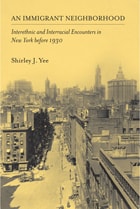
An Immigrant Neighborhood
Interethnic and Interracial Encounters in New York before 1930Shirley Yee
Temple University Press, 2011
Examining race and ethnic relations through an intersectional lens, Shirley Yee's An Immigrant Neighborhoodinvestigates the ways that race, class, and gender together shaped concepts of integration and assimilation as well as whiteness and citizenship in lower Manhattan during the late nineteenth and early twentieth-centuries.
In contrast to accounts of insulated neighborhoods and ethnic enclaves, Yee unearths the story of working class urban dwellers of various ethnic groups—Chinese, Jews, Italians, and Irish—routinely interacting in social and economic settings.
Yee's numerous, fascinating anecdotes—such as one about an Irishman who served as the only funeral director for Chinese for many years—recount the lived experiences of these neighborhoods, detailing friendships, business relationships, and sexual relationships that vividly counter the prevailing idea that different ethnic groups did not mix except in ways marked by violence and hostility.
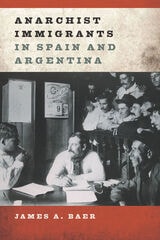
Anarchist Immigrants in Spain and Argentina
James A. Baer
University of Illinois Press, 2015
James A. Baer follows the lives, careers, and travels of Diego Abad de Santillán, Manuel Villar, and other migrating anarchists to highlight the ideological and interpersonal relationships that defined a vital era in anarchist history. Drawing on extensive interviews with Abad de Santillán, José Grunfeld, and Jacobo Maguid, along withunusual access to anarchist records and networks, Baer uncovers the ways anarchist migrants in pursuit of jobs and political goals formed a critical nucleus of militants, binding the two countries in an ideological relationship that profoundly affected the history of both. He also considers the impact of reverse migration and discusses political decisions that had a hitherto unknown influence on the course of the Spanish Civil War.
Personal in perspective and transnational in scope, Anarchist Immigrants in Spain and Argentina offers an enlightening history of a movement and an era.
Arc of the Journeyman
Afghan Migrants in EnglandNichola Khan
University of Minnesota Press, 2021
A monumental account of one migrant community’s everyday lives, struggles, and aspirations
Forty years of continuous war and conflict have made Afghans the largest refugee group in the world. In this first full-scale ethnography of Afghan migrants in England, Nichola Khan examines the imprint of violence, displacement, kinship obligations, and mobility on the lives and work of Pashtun journeyman taxi drivers in Britain. Khan’s analysis is centered in the county of Sussex, site of Brighton’s orientalist Royal Pavilion and the former home of colonial propagandist Rudyard Kipling. Her nearly two decades of relationships and fieldwork have given Khan a deep understanding of the everyday lives of Afghan migrants, who face unrelenting pressures to remit money to their struggling relatives in Pakistan and Afghanistan, adhere to traditional values, and resettle the wives and children they have left behind.
This kaleidoscopic narrative is enriched by the migrants’ own stories and dreams, which take on extra significance among sleep-deprived taxi drivers. Khan chronicles the way these men rely on Pashto poems and aphorisms to make sense of what is strange or difficult to bear. She also attests to the pleasures of local family and friends who are less demanding than kin back home—sharing connection and moments of joy in dance, excursions, picnics, and humorous banter. Khan views these men’s lives through the lenses of movement—the arrival of friends and family, return visits to Pakistan, driving customers, even the journey to remit money overseas—and immobility, describing the migrants who experience “stuckness” caused by unresponsive bureaucracies, chronic insecurity, or struggles with depression and other mental health conditions.
Arc of the Journeyman is a deeply humane portrayal that expands and complicates current perceptions of Afghan migrants, offering a finely analyzed description of their lives and communities as a moving, contingent, and fully contemporary force.

Argentina and the Jews
A History of Jewish ImmigrationHaim Avni
University of Alabama Press, 1991
Traces the shifting patterns of Jewish immigration and Argentine immigration policy.
Argentina is home to the largest Jewish community in the Hispanic world, the second largest in the Western hemisphere. During successive political and social regimes, Argentina alternately barred Jews from entering the country and recruited them to immigrate, persecuted Jews as heretics or worse and welcomed them as productive settlers, restricted Jews by law and invested them with the fullest rights of citizenship. This volume traces the shifting patterns of Jewish immigration and Argentine immigration policy, both as manifestations of cultural and historical processes and as forces shaping the emergence of a large and energetic Jewish community.
Within Argentina, many Jews followed traditional immigration strategies by consolidating communities and institutions in Buenos Aires and other cities. But many others settled on the land, in agricultural colonies sponsored by Baron Maurice de Hirsch’s Jewish Colonization Association, a group with far-reaching impact that is examined closely in this book. The Israeli kibbutz movement drew strength from the Argentine farming colonies, when beginning in 1949 groups of Argentine Jews immigrated to Israel to found kibbutzes. Eventually, in the face of political and economic upheavals with anti-Semitic undercurrents, almost 40,000 Jews left Argentina for Israel. A country of absorption became a country of exodus, and Zionism became a central focus of Argentine Jewry, interlocking families and fates separated by oceans and continents.
Argonauts of West Africa
Unauthorized Migration and Kinship Dynamics in a Changing EuropeApostolos Andrikopoulos
University of Chicago Press, 2023
In rapidly changing and highly precarious contexts, unauthorized African migrants turn to kinship in search of security, stability, and predictability. Through the exchange of identity documents between “siblings,” assistance in obtaining such documentation through kinship networks, and marriages that provide access to citizenship, new assemblages of kinship are continually made and remade to navigate the shifting demands of European states. These new kinship relations, however, often prove unreliable, taking on new, unexpected dynamics in the face of codependency; they become more difficult to control than those who enter into such relations can imagine. Through unusually close ethnographic work in West African migrant communities in Amsterdam, Apostolos Andrikopoulos reveals the unseen dynamics of kinship through shared papers, the tensions of race and gender that develop in mutually beneficial marriages, and the vast, informal networks of people, information, and documentation on which migrants rely. Throughout Argonauts of West Africa, Andrikopoulos demonstrates how inequality, exclusionary practices, and the changing policies of an often-violent state demand innovative ways of doing kinship to successfully navigate complex migration routes.
As French as Everyone Else?
A Survey of French Citizens of Maghrebin, African, and Turkish OriginAuthored by Sylvain Brouard and Vincent Tiberj
Temple University Press, 2011
France is often depicted as the model of assimilationist or republican integration in the international literature on immigration. However, rarely have surveys drilled down to provide individual responses from a double representative sample. In As French as Everyone Else?, Sylvain Brouard and Vincent Tiberj provide a comprehensive assessment of the state of integration in France and challenge the usual crisis of integration by systematically comparing the "new French" immigrants, as well as their children and grandchildren born in France, with a sample of the French general population.
The authors' survey considers a wide range of topics, including religious affiliation and religiosity, political attitudes and political efficacy, value systems (including gender roles, work ethics, and anti-Semitism), patterns of integration, multiple identities and national belongings, and affirmative action. As the authors show, despite existing differences, immigrants of Maghrebin, African, and Turkish origin share a wide scope of commonality with other French citizens.
Asian Americans in Dixie
Race and Migration in the SouthEdited by Jigna Desai and Khyati Y. Joshi
University of Illinois Press, 2013